Harness Blog
Featured Blogs
AI is writing more of the code. Software delivery, the work between writing code and running it in production, is where most of the day still goes. Building, testing, scanning, deploying, remediating, and operating still require the same, if not more, effort as before AI.
Today, we're introducing Autonomous Worker Agents for software delivery: the platform for enterprises to build and safely run AI agents that handle the work between writing code and shipping it to production.
Autonomous Worker Agents execute as pipeline steps and produce auditable outputs. Their memory is the organization: services, pipelines, deployments, incidents, policies, all connected through the Harness Knowledge Graph, and their capability is powered by the Harness MCP. They operate in production and support the deployment, security, remediation, and validation of your code.
They join Harness Expert Agents, which have been available to customers for some time, to form a complete AI layer across the platform.
Each agent runs as a step inside a Harness pipeline, on customer-controlled infrastructure, with full governance: scoped credentials, OPA policy enforcement, approval gates, and complete audit trails.
Safe to Run in Production
Autonomous Worker Agents are invoked as pipeline steps or independently. They inherit the governance Harness pipelines already provide. Instead of trying to teach an AI agent a massive list of corporate rules, the agent operates entirely within the constraints of your existing software delivery pipelines.
- OPA Policies that gate production deployments gate the agents.
- RBAC that controls who can push to production controls who can trigger an agent.
- Approval Gates apply before an agent's fix ships, just as they do before any release.
Safety is architected in as well. Workloads execute on Harness Delegates, lightweight runtimes installed inside the customer's own Kubernetes cluster or VPC. An agent that "shouldn't be able to merge to main" cannot merge to main, even if its prompt asks it to. The architecture enforces it.
We built RiskSentinel, a Harness Autonomous Worker Agent, to demonstrate that governed AI can move beyond identifying security issues to safely remediate them while maintaining enterprise controls, auditability, and compliance. When building with Harness, what stood out most was how intuitive the experience was — it enabled our team to move from an initial idea to a production-ready agent in just four days, allowing us to focus on solving a real enterprise challenge rather than the underlying platform. That combination of developer experience and enterprise-ready capabilities is what will enable organizations to confidently scale AI across software delivery.
- Ratna Devarapalli, Director IT, United Airlines
Six additional controls make Autonomous Worker Agents production-safe.
1. Sandboxing
Agents are run containerized, with non-root execution (UID 65534, "nobody"). Their filesystem is read-only except for the workspace. Network access is configurable per agent: unrestricted, restricted to allowed MCP servers, or fully disabled.
An agent that produces a malicious bash command has nowhere to send the data.
2. Scoped Credentials
When a pipeline triggers, Harness mints an ephemeral scoped token. Its scope is the intersection of the agent's permissions and the triggering user's RBAC.
Token deletes on completion. TTL as a failsafe. MongoDB TTL index as final backstop.
3. Policy Enforcement
OPA policies, the same framework Harness customers use to govern deployments, apply to agents. Policies govern the agent at runtime and during configuration.
4. Audit Trails
Every execution is captured in the Harness Audit Trail. This includes a full provenance chain: who or what triggered the agent, template version, every action taken, and final outcome.
Prompts and reasoning chains are sanitized before persistence: secrets stripped, and PII is stripped.
5. Cost Tracking
Token consumption and costs are surfaced per execution, per agent, and per pipeline. Running totals are shown live in the step header.
6. Chaining
Agents are architected to run within pipelines and can be naturally composed into multi-step workflows.
- Sequential: Agent B consumes Agent A's output.
- Parallel: agents run simultaneously.
- Conditional: an agent runs only if a previous step meets a condition.
- Matrix: same agent across repos, environments, or services.
Output handoff happens via pipeline expressions and shared workspace files.
Three ways to create an agent
Using YAML
A Worker Agent is defined in a single file. Here's a complete agent that reviews every pull request for security issues:
agent:
   group:
     steps:
       - name: Run Code Coverage Agent
         id: runCodeCoverageAgent
         if: <+Always>
         run:
           container:
             image: pkg.harness.io/vrvdt5ius7uwygso8s0bia/harness-agents/harness-ai-agent:latest
           env:yam
             ANTHROPIC_MODEL: ${{inputs.model_name}}
             PLUGIN_HARNESS_CONNECTOR: ${{inputs.llm_connector.id}}
             PLUGIN_MAX_TURNS: "150"
             PLUGIN_MCP_FORMAT: harness
             PLUGIN_MCP_SERVERS: <+connectorInputs.resolveList(<+inputs.mcp_connectors>)>
             PLUGIN_TASK: |
               Autonomous Harness Code Coverage Agent; no prompts. Resolve branch/repo/clone_url/account/org/project/execution strictly: input -> env -> MCP, never guess; branch must exist via SCM MCP or fail.
               Use /harness first, else $HARNESS_WORKSPACE; if repo missing, clone (SCM MCP preferred, git fallback) and checkout resolved branch.
               Detect language/test/coverage stack, run baseline coverage (overall + per-file), and target >=90% overall and >=80% per-file.
               Add meaningful tests for critical uncovered paths (happy/edge/error/boundary); allow only minimal production testability tweaks.
               Re-run full tests + coverage + lint + build; all must pass before continuing.
               Review full diff (SCM MCP preferred, git diff fallback); allow only tests + minimal testability tweaks (+ COVERAGE.md only if it already exists; never create it).
               Build report with overall before->after, per-file before/after for touched files, and key improvements.
               Stage files one-by-one only; never use git add -A or git add .; verify staged diff is clean and in-scope.
               Create exactly one commit: "Code coverage: automated test additions by Harness AI"; push plain to origin <branch> (no pull/rebase/merge/force).
               If push fails, print rejection, git reset --hard HEAD~1, exit non-zero; never commit unrelated changes, never weaken existing tests, never log secrets.
YAML frontmatter on top. Natural language below ---. The same convention Jekyll, Hugo, and AI agent definitions across the industry use.
Save the file, commit it to the repo, and the agent is live, governed, and in the catalog. Every PR triggers it. Every run is audited. Every action is scoped by RBAC. From a blank file to a live governed agent in minutes.
The Harness pipeline engine handles container runtime, scoped credentials, MCP server integration, audit logging, and cost tracking.
Using the UI
The Harness Agent Builder is a simple form for configuring your Agents. Define your prompts in plain English, referencing Harness constructs through common expressions. This experience makes it easy to see what you need to provide and set up your agent in minutes.
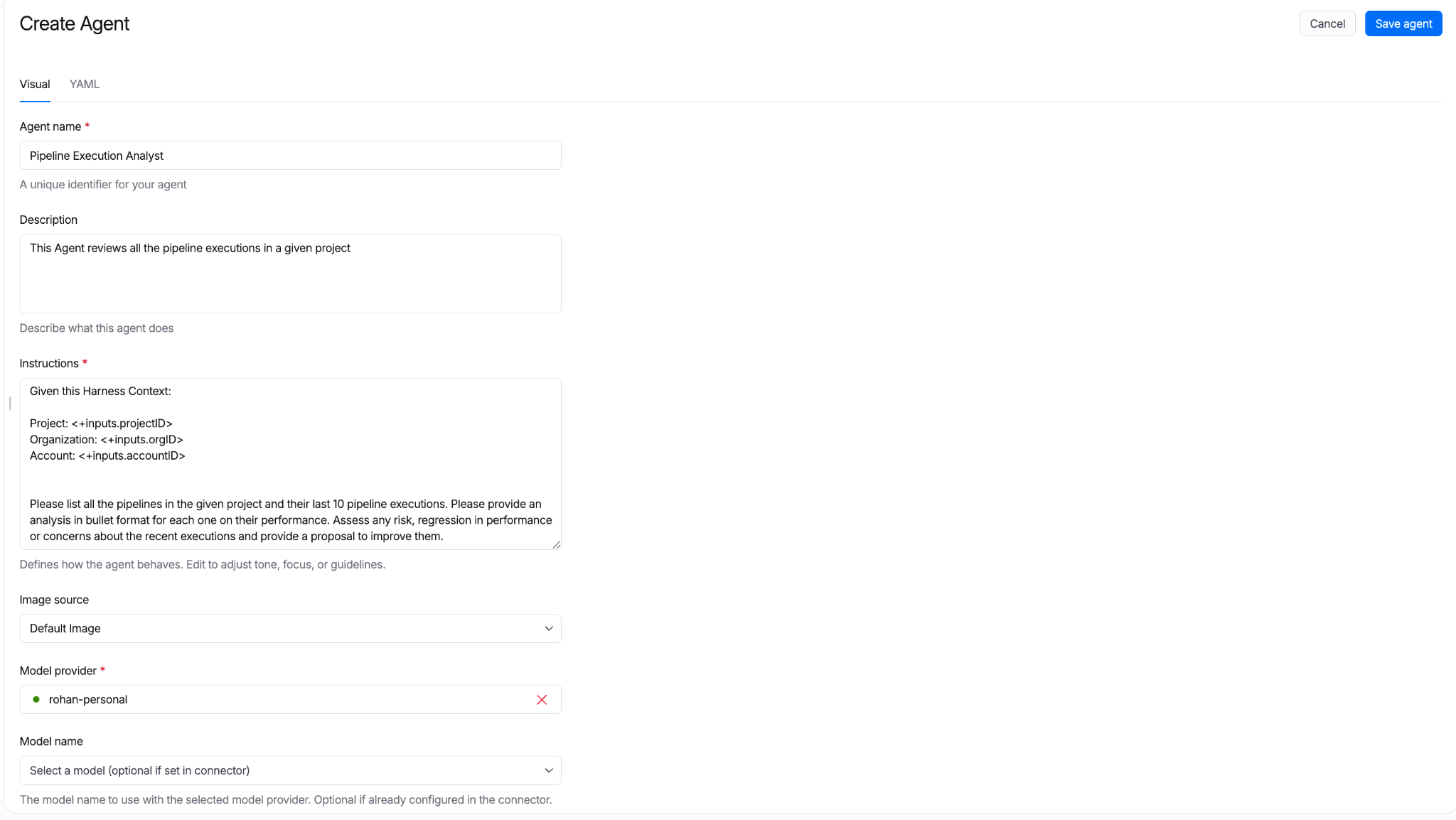
All agent definitions are stored in Harness. Their reference in pipelines can be managed in Git. Approval gates apply. Pipeline Branch-based versions let teams test new agent behavior in feature branches before merging to main.
"We built an agent that handles log analysis directly inside Harness. No tool switching, no context loss. The ability to stay on one platform and have the agent surface what's happening and review it for us was the biggest immediate win. We're planning to use it in production."
- Mandy Pearce, Senior Engineer, Cloud Automation, Verint
Create with MCP
Using your favorite coding agent, you can connect to Harness over the MCP. The MCP bridges the AI Coding agents’ inner-loop context and the outer-loop context and the constructs in Harness.
Agents as Pipeline Steps
Most software delivery workflows have more than one step. Autonomous Worker Agents compose with shell scripts, plugins, approval gates, and other agents to make full pipelines.
Referencing an Agent in a Pipeline
pipeline:
 stages:
   - steps:
       - name: Feature Agent
         template:
           uses: ca_feature_triage_agent@1.0.2
       - name: Plan Agent
         template:
           uses: ca_work_planning_agent@1.0.2
       - name: Build Feature Agent
         template:
           uses: ca_builder_agent@1.0.2
uses: references a Worker Agent template by name and version. The agent runs as one step alongside everything else a Harness pipeline can run.
Sequential: Output Handoff
Agent B consumes Agent A's output. The pipeline expression ${{ steps.<agent_id>.output }} carries the result forward.
pipeline:
 stages:
   - steps:
       - name: spec design
         parallel:
           steps:
             - name: Feature Agent
               template:
               uses: ca_feature_triage_agent@1.0.2
             - name: PR Body
               template:
                 uses: pr_body_writer
                 with:
                   artifactPath: ${{featureagent.output.artifact}}
                   issueKey: cds-1234
Parallel
Multiple agents run simultaneously:
 parallel:
           steps:
             - name: Feature Agent
               template:
                 uses: ca_feature_triage_agent@1.0.2
             - name: PR Body
               template:
                 uses: pr_body_writer
                 with:
                   artifactPath: ${{featureagent.output.artifact}}
                   issueKey: cds-1234
Step Groups
A Step Group bundles agents and deterministic steps into a single reusable unit:
         group:
           steps:
             - name: feature anaylzer
               template:
                 uses: feature_ingester_agent@1.0.2
             - name: work planner
               template:
                 uses: ca_work_planning_agent@1.0.4
Save the group as a template. Reference it from any pipeline. The PR Autofix workflow ships as a Step Group template.
Conditional and Matrix
An agent runs only when a condition is met:
  - steps:
         group:
           steps:
             - name: feature ingest
               template:
                 uses: feature_ingester_agent
             - name: work planner
               template:
                 uses: ca_work_planning_agent
     name: Spec Driven Development
     if: <+OnPipelineSuccess>
The same agent runs across multiple targets:
             - name: work planner
               template:
                 uses: ca_work_planning_agent
               strategy:
                 fail-fast: true
                 for:
                   iterations: 3
Approval gates, failure strategies, retry policies, and rollback work the same way they do for any other pipeline step.
Introducing the Harness Agent Marketplace
The Harness Agent Marketplace is where teams discover, install, fork, customize, and publish Autonomous Worker Agents.
Three publisher tiers anchor it:
- Harness Managed: Built and maintained by Harness. SLA-backed. Versioned. Pinnable (e.g., harness.autofix@1.2).
- Harness Certified: Partner-built. Reviewed and certified by Harness engineering and security. Examples: dependency vendors with their own scanning agents, cloud providers with cloud-specific deployment agents.
- Community: Published by the broader Harness community. Validated for schema, no secrets in prompt. Enterprise accounts can restrict via OPA policy. Allow only Managed and Certified in production, for instance.
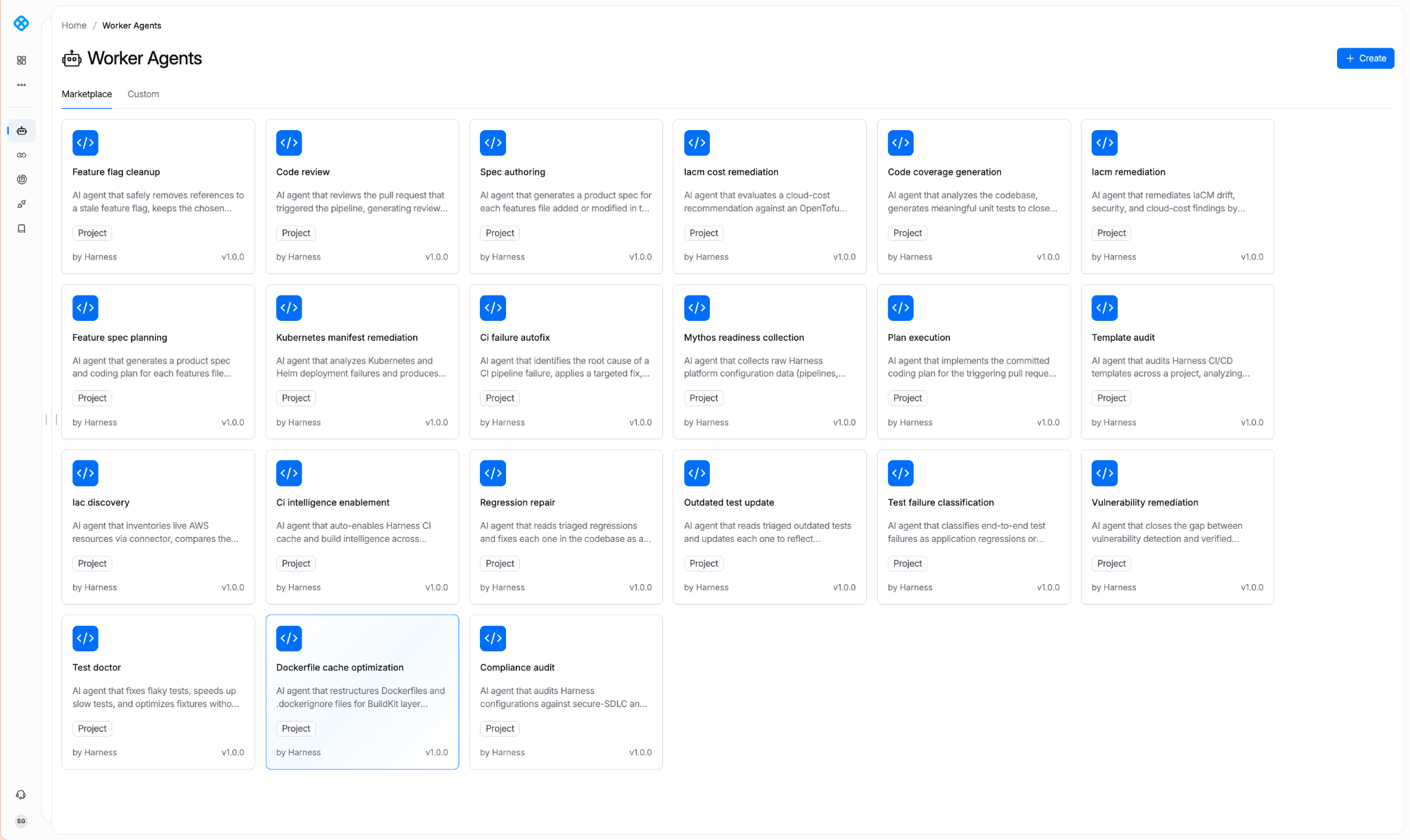
Harness Managed Agents
With today’s launch, Harness has pre-built agents for the most requested use cases. Here are some examples of what’s currently available:
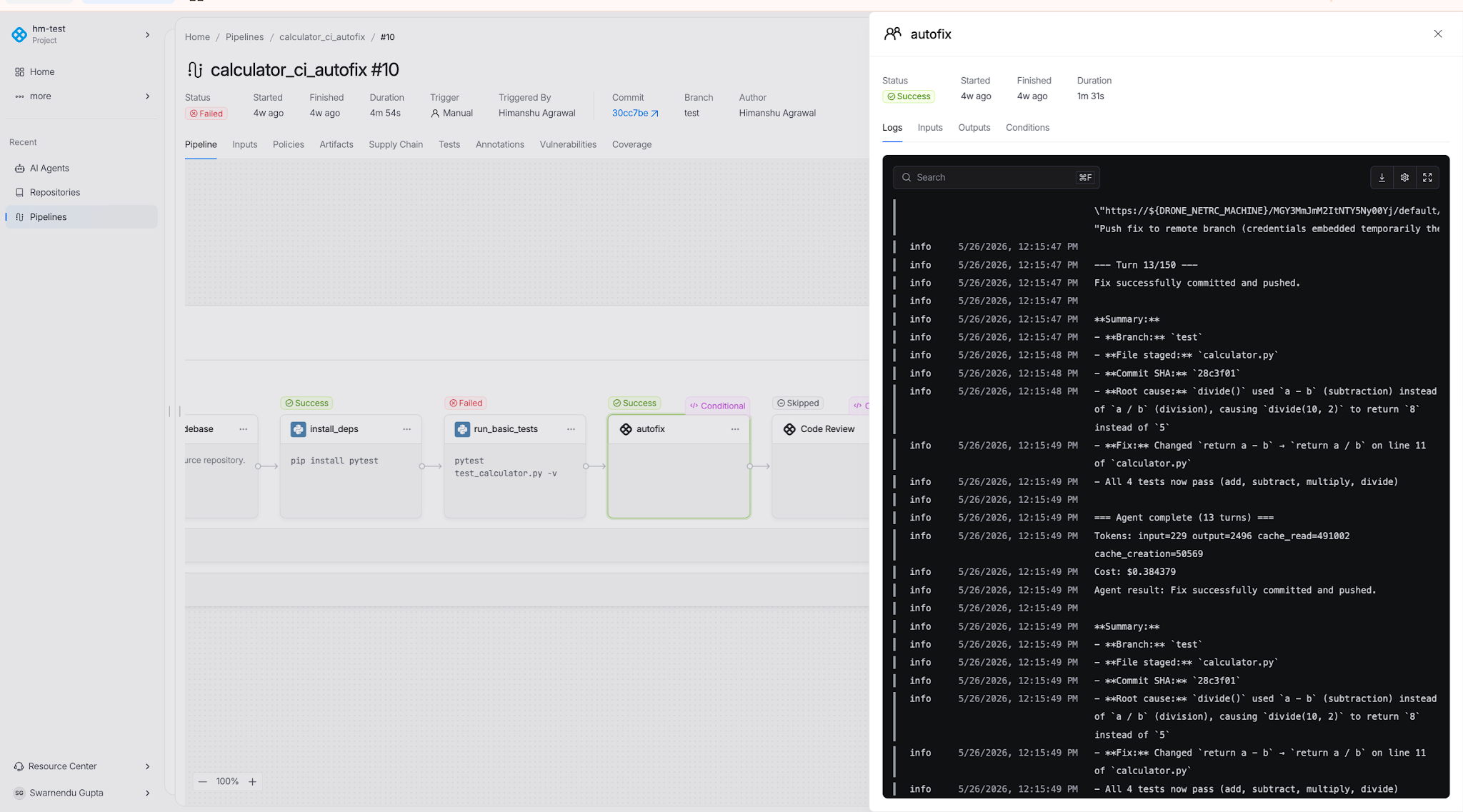
CI Autofix
Reads build logs from a failed PR build, identifies the root cause, commits a fix to the PR branch, re-triggers the build, and repeats until the build passes or the configured max-turns limit is reached.
Manifest Remediator
Analyzes failed Kubernetes deployments. Identifies whether the issue is the manifest, the cluster, or the workload. Fixes manifest issues. Used by teams managing dozens of services across multiple clusters.
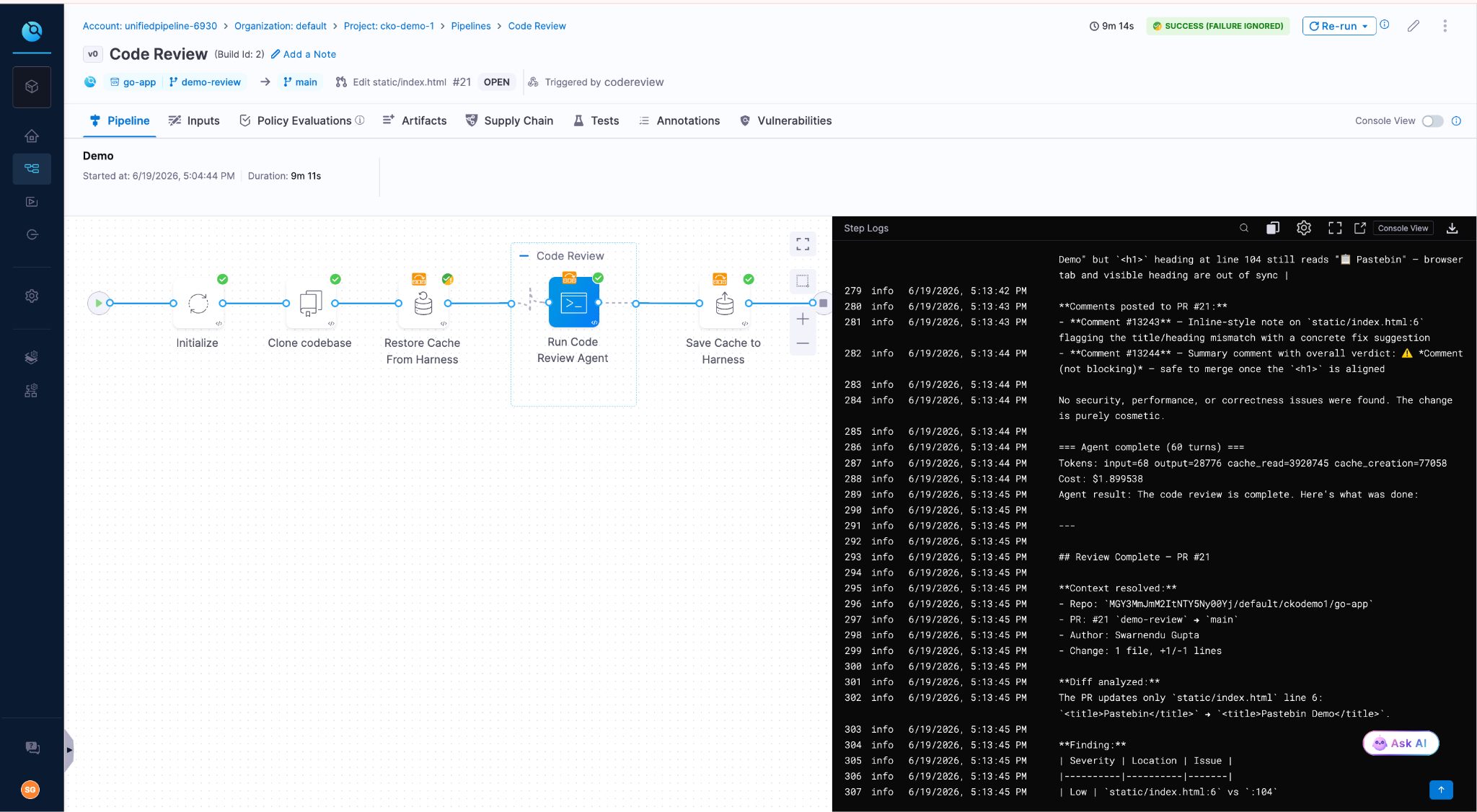
Code Review
Reviews PR diffs across security, quality, and test coverage. Outputs structured findings with severity ratings and concrete remediation. Grounded in the Harness Knowledge Graph, the agent knows which services are production-critical, which have had recent incidents, and which historical anti-patterns have caused outages.
Feature Flag Cleanup
Reads code, config, and flag-system state to identify feature flags that are fully rolled out or fully off. Once it validates removal is safe, the agent generates a cleanup PR. With this agent, the status of your experiments automatically informs you when flags are cleaned up, reducing flag debt and the drudgery of cleaning up old flags.
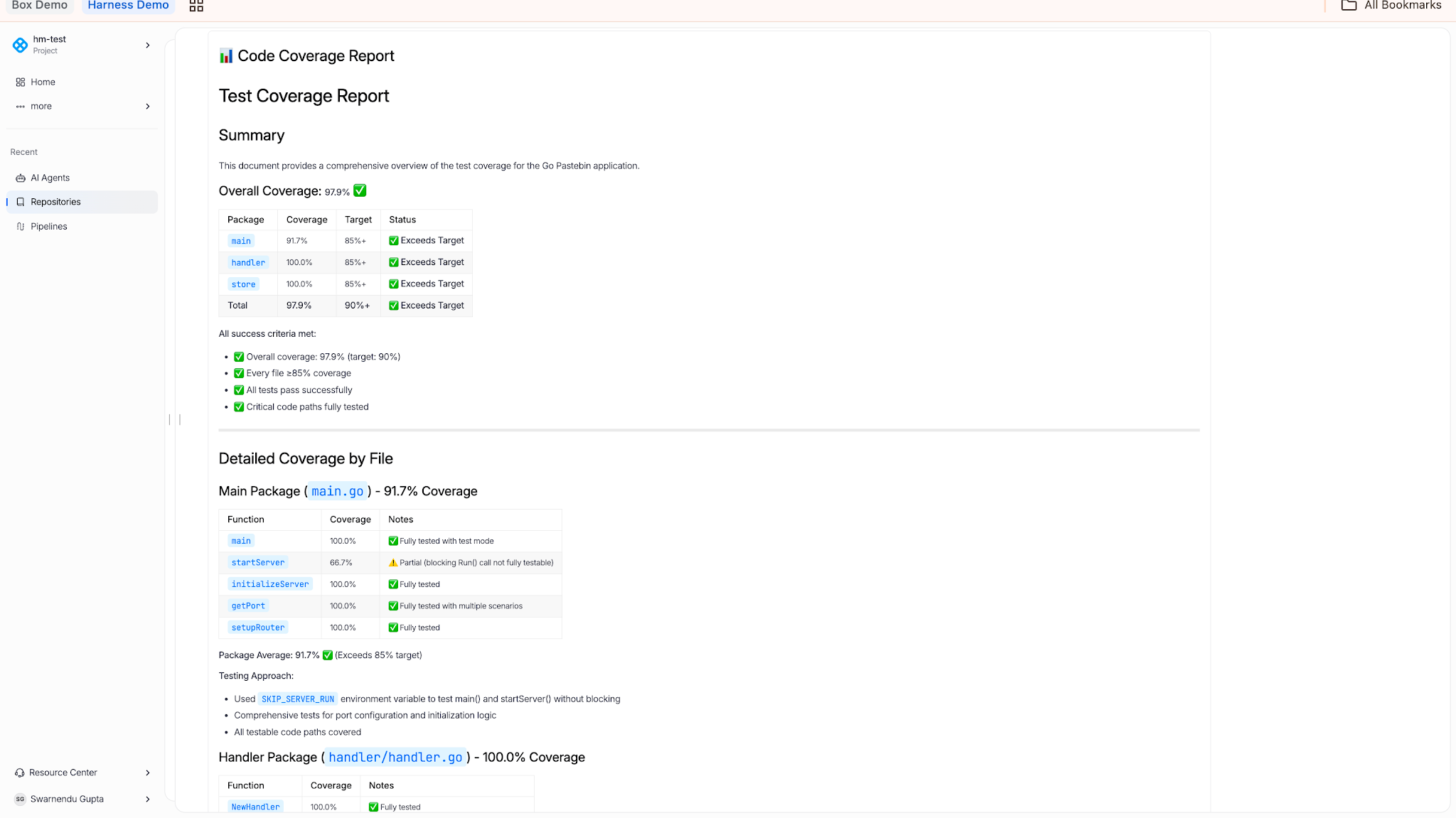
Code Coverage
Reads coverage reports, identifies untested lines, branches, and functions, and generates tests to close gaps. Used when a team has inherited a codebase with weak coverage and needs to lift it before a release.
IaCM Remediation
Fixes configuration drift, security findings, and cloud cost issues by editing infrastructure configurations.
Bring Your Own Model
Autonomous Worker Agents are model-agnostic. Connect LLM providers through Harness connectors:
- OpenAI: Direct to Provider
- Anthropic: AWS Bedrock, Direct to Provider
The model can be specified at three levels: in the agent template, at the pipeline step level (overriding the template), or at the account level via environment variable defaults. Switch models per agent, per environment, or per pipeline without changing agent logic.
Three reasons this matters:
- Cost. Different models have different price points. Routing high-volume work through cheaper models is a common pattern.
- Compliance. Some teams require AWS-routed Bedrock for billing consolidation, VPC routing, or Bedrock-specific compliance attestations.
- Future-proofing. Model leaders change. The enterprise decides which model today, which model tomorrow.
Getting Started
Autonomous Worker Agents are available today for all Harness customers. Learn more about Harness Autonomous Worker Agents or request a demo to see them in production.
Visit the in-app Harness Marketplace in app to try out any of the Worker Agents. Add it to your pipeline and watch it run.
Harness has been recognized as a Leader in the 2026 Gartner® Magic Quadrant™ for DevSecOps Platforms for the third consecutive year. Harness was also positioned furthest on the Completeness of Vision axis in the report.
Our Key takeaways:
- Harness is named a Leader for the third consecutive year
- Harness is positioned furthest on the Completeness of Vision axis
- Harness continues investing in governed, AI-powered DevSecOps
Harness is the AI platform for engineering, security, and operations teams to build, secure, deploy, govern, and optimize software delivery across the SDLC.
We believe our recognition in the Gartner Magic Quadrant for DevSecOps Platforms reflects the continued evolution of the Harness platform and our commitment to helping teams deliver software faster, safer, and with greater governance across the software delivery lifecycle.
We’re thrilled to share this recognition, which we believe reflects the strength of our product strategy, the breadth of our platform, and our continued investment in helping enterprises modernize software delivery with security, reliability, cost management, and AI built into the development lifecycle.
Today, organizations across industries like United Airlines, Ancestry, and Citi rely on Harness to reduce delivery complexity, improve developer productivity, strengthen governance, and accelerate innovation across increasingly complex software environments.
Why This Matters Now
Software delivery has entered a new era. AI coding assistants are helping teams create software faster than ever, but faster code generation also means more changes, more tests, more vulnerabilities, more deployments, and more incidents for organizations to manage. The next era of DevSecOps will not be defined by who can generate code faster. It will be defined by who can safely convert that speed into reliable business outcomes.
Our view is that the future of DevSecOps is autonomous AI agents, governed and directed by expert engineers. As humans and AI agents both contribute to software change, enterprises will need one connected platform to understand, validate, secure, deploy, observe, optimize, roll back, and prove every change across the software delivery lifecycle.
Our Journey
As a pioneer in modern software delivery, Harness offers over 15 platform products and has built one of the industry’s most comprehensive platforms to support the full spectrum of application development, deployment, security, reliability, feature management, cost management, and operations.
Harness has evolved through a combination of product innovation, internal entrepreneurship, open source investment, and strategic acquisitions. We believe our recognition as furthest on the Completeness of Vision axis in the 2026 Gartner® Magic Quadrant™ for DevSecOps Platforms is proof that Harness is solving problems for our customers in a measurable way.
Over the past year, Harness has continued to expand platform capabilities and AI agents across:
- Security and risk management
- AI-native testing capabilities including flaky test detection and AI impact testing
- Feature Management and Experimentation
- Cloud and AI Cost Management
- AI DLC insights
- Resilience Testing, and more
This matters because software delivery is no longer just about building and deploying code. Teams must now manage security risk, release complexity, infrastructure cost, compliance requirements, production reliability, and the growing impact of AI-generated software. The Harness platform allows teams to adopt what they need, when they need it, in one place.
With operations across North America, Europe, APAC, Latin America, and India, Harness serves organizations of all sizes across industries. Customers choose Harness not only for the breadth of the platform but also for the flexibility to adopt individual modules or the full platform based on their needs, maturity, and business priorities.
What’s Next for Harness
This recognition in our opinion is a milestone, and we’re proud, but we’re even more excited by the road ahead.
We build security in the software delivery lifecycle natively, not as a separate stage or disconnected toolchain. As AI increases the volume of code, changes, and security findings, enterprises will need platforms that connect detection, prioritization, policy, remediation, deployment, and runtime defense into a single, governed workflow.
Harness is focused on helping enterprises meet that moment. We will continue investing in AI software delivery to help teams move faster without losing control. Our goal is to help every organization deliver software that is faster to build, safer to release, easier to govern, and more resilient in production.
Thank you to our customers, partners, employees, and community for your continued trust. We’re excited about the journey ahead and can’t wait to show you what’s next.
Learn More
Get a complimentary copy of the 2026 Gartner® Magic Quadrant™ for DevSecOps Platforms.
Or, to talk to someone about Harness, please contact us.
Gartner Disclaimer
Gartner, Magic Quadrant for DevSecOps Platforms, 2026, Keith Mann, Thomas Murphy, Bill Holz, 15 June 2026
Gartner does not endorse any vendor, product, or service depicted in its research publications and does not advise technology users to select only those vendors with the highest ratings or other designation. Gartner research publications consist of the opinions of Gartner’s research organization and should not be construed as statements of fact. Gartner disclaims all warranties, expressed or implied, with respect to this research, including any warranties of merchantability or fitness for a particular purpose.
GARTNER is a registered trademark and service mark of Gartner, and Magic Quadrant is a registered trademark of Gartner, Inc. and/or its affiliates in the U.S. and internationally, and is used herein with permission. All rights reserved.
TLDR: Today, Harness is introducing the Harness Cursor Plugin, bringing the power of the Harness AI-native software delivery platform directly into Cursor. This integration, along with the Harness Secure AI Coding hook for Cursor, allows developers and AI agents to move from code changes to vulnerability detection, CI/CD execution, security validation, approvals, deployments, and operational insight without leaving the editor.
AI has completely changed how we write code. You can spin up functions, refactor entire files, and generate tests in seconds. The inner loop, writing and iterating on code, has never been faster. But the moment you try to ship that code, everything slows down. This is what we call the AI Velocity Paradox.
You are suddenly back to juggling pipelines, waiting on approvals, checking security scans, debugging failed runs, and bouncing between tools just to get a change into production.
That gap, between fast code and slow delivery, is what we kept running into. So we built something to fix it.
Today, we are introducing the Harness Plugin for Cursor, a way to go from PR to production without leaving your editor.
AI Made Coding Faster, But Delivery Did Not Catch Up
If you are using agentic coding tools, such as Cursor, you have probably felt this.
You can:
- Generate code instantly
- Understand unfamiliar repos faster
- Fix bugs and open PRs in minutes
But shipping still depends on everything outside your editor:
- CI/CD pipelines
- Security checks
- Approval flows
- Policy enforcement
- Deployment tooling
- Monitoring and debugging
And none of that got simpler just because AI showed up. In fact, AI makes the problem more obvious.
Now you can create changes faster than your delivery process can safely handle. And if those controls are not tight, you are introducing a whole new category of risk. Fast-moving code with fragmented governance.
AI did not break software delivery. It exposed how disconnected it already was.
What If You Could Just Ask
Instead of jumping between tools, what if you could just tell your editor what you want to happen?
Something like:
“Deploy PR #4821 to staging once the security scan passes, and Slack me if anything fails.”
That is the idea behind the Harness Cursor Plugin.
It connects Cursor directly to Harness, so you can trigger and manage your entire delivery workflow using natural language, right inside Cursor.
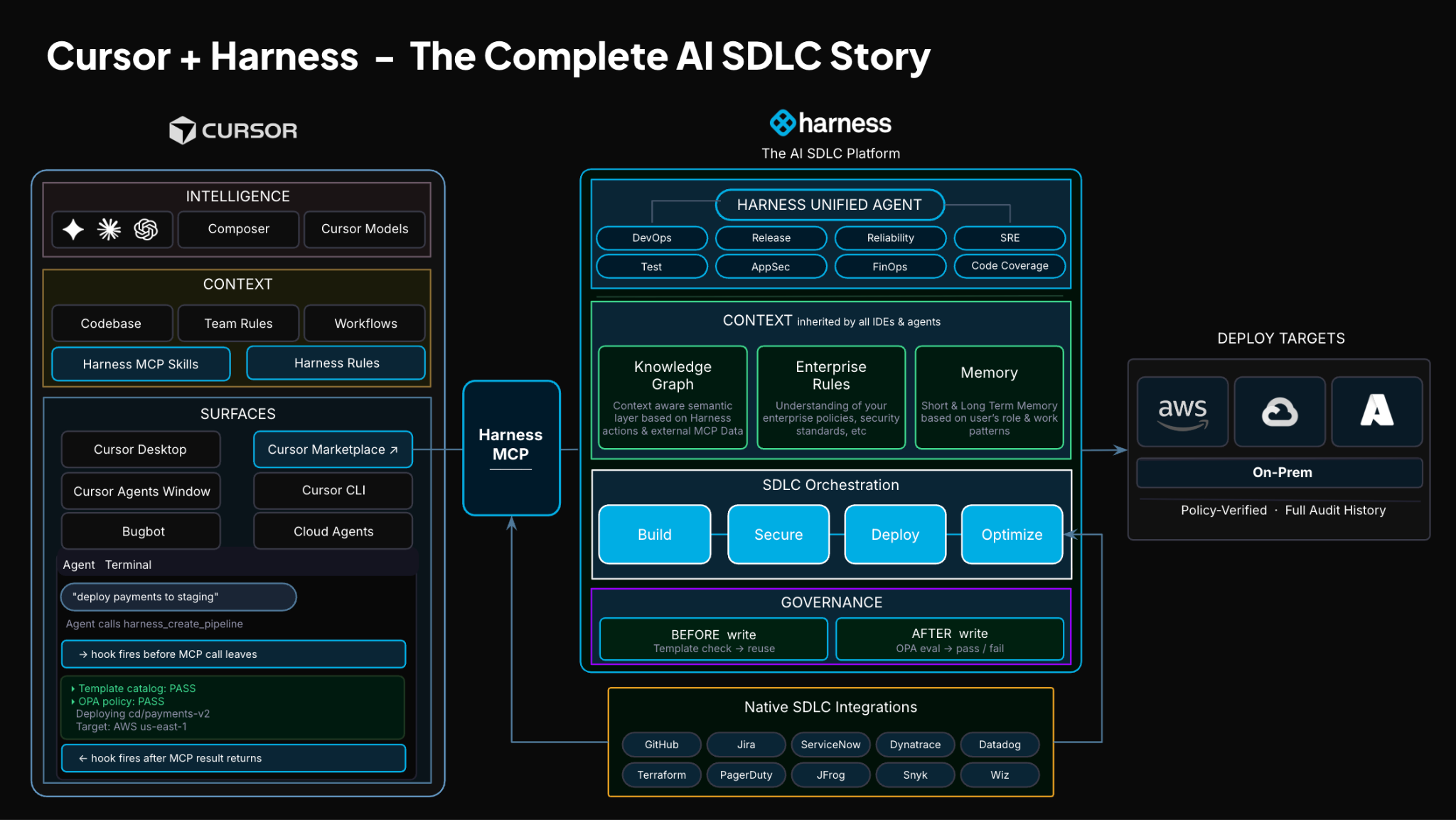
No tab switching. No manual orchestration. No guessing what is happening in the pipeline.
Some Sample Use Cases
Once connected, you can use Cursor to interact with your delivery system just as you do with your code.
For example, you can:

This builds on what we introduced last month, Secure AI Coding, which integrates directly with Cursor and scans code at the moment of generation rather than waiting for a PR review. Developers see inline vulnerability warnings with the option to send flagged code back to the agent for remediation, without leaving their workflow. Under the hood, it leverages Harness's Code Property Graph (CPG) to trace data flows across the entire codebase, surfacing complex vulnerabilities that simpler linting tools would miss.
The key thing is that you are no longer just interacting with code. You are interacting with the entire delivery system from the same place.
The Important Part: This Is Not Skipping Control
One of the biggest concerns with AI in delivery is obvious:
“Are we about to let agents push code to production without guardrails?”
No.
With Harness, everything runs through the controls that you can rely on:
- Granular RBAC permissions
- OPA policies
- Approval gates
- Audit logs
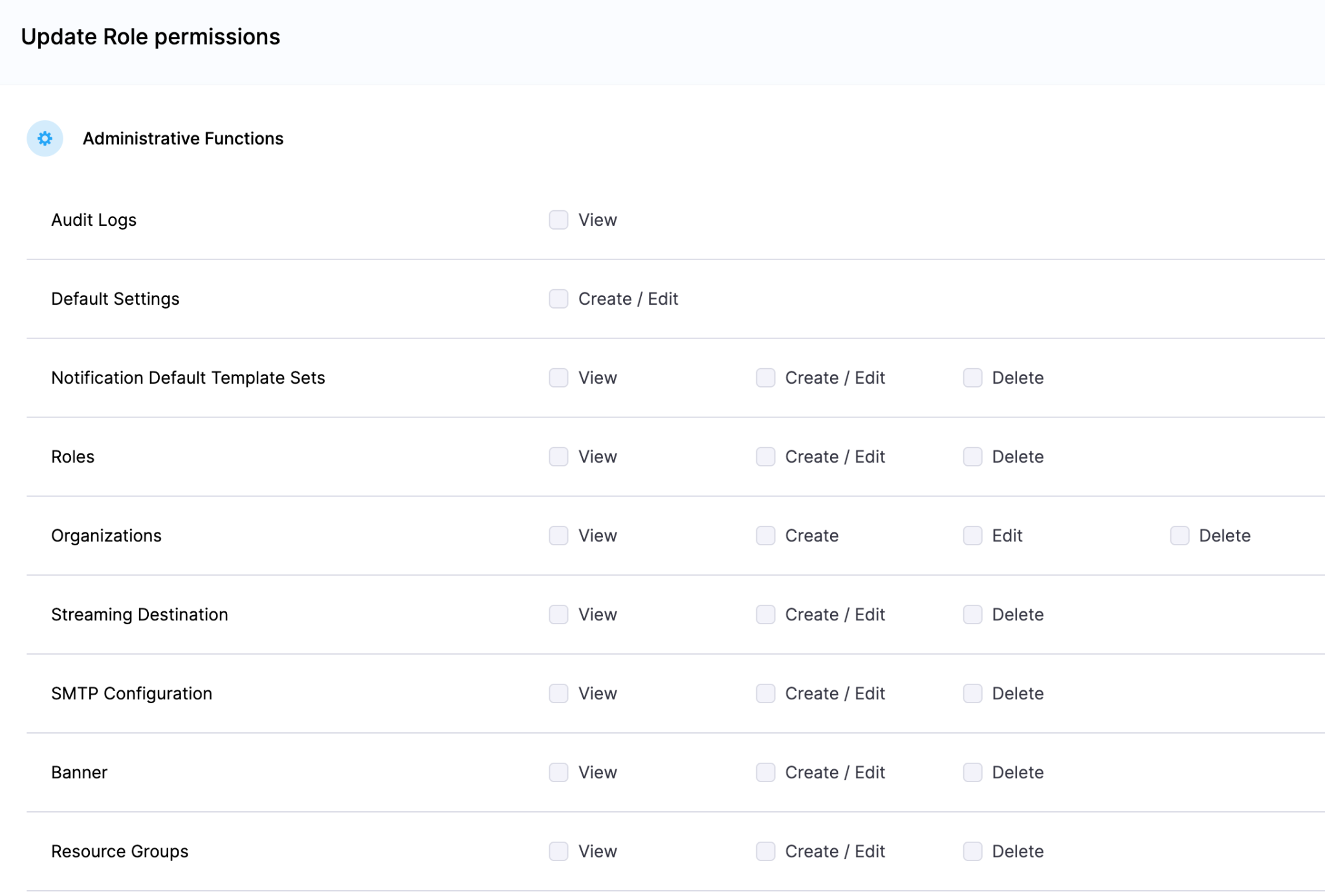
Instead of being manual checkpoints spread across tools, they are enforced automatically as part of the workflow while you stay in flow.
So AI can help move things faster, but it cannot bypass the governance that matters.
Why We Built It This Way
Most integrations today expose APIs or bolt AI onto existing systems. That is not what we wanted to do.
We designed the Harness Cursor Plugin specifically for how AI agents actually work:
- It is built around actions and workflows, not raw endpoints
- It spans the full delivery lifecycle, not just one step
- It gives agents enough context to reason about what to do next
Because shipping software is not a single action. It is a chain of decisions across CI, CD, security, approvals, and operations. If AI is going to help here, it needs access to that full picture. That’s where the Harness Software Delivery Knowledge Graph comes into play. It provides the necessary context for AI to take actions for you.
The knowledge graph models the relationships between services, pipelines, environments, policies, and operational signals in real time. Instead of treating each step in delivery as an isolated task, it creates a connected system of record that AI can reason over. This allows agents to understand not just what to do, but when and why to do it, based on dependencies, risk signals, and historical behavior.

In practice, this means smarter automation: deployments that adapt to context, approvals that are triggered based on policy and impact, and faster root cause analysis because the system already understands how everything is connected.
This Changes How Ideas Move To Prod
This is not just about convenience. It is a shift in how software actually moves from idea to production.
Instead of:
- Writing code in one place
- Managing delivery somewhere else
- And stitching it all together manually
You get a single, connected workflow:
- Code to pipeline to validation to deployment to operations
All accessible from your editor. Cursor accelerates the building. Harness governs the shipping. And the handoff between the two disappears.
Watch the demo:
Getting Started
If you want to try it:
- Install the Harness Cursor Plugin from the Cursor Marketplace
- Authenticate with Harness using OAuth. No API keys or setup headaches
- Start using natural language to run pipelines, debug issues, and manage deployments
For example:
“Run the CI pipeline for this branch, check if the security scan passed, and promote to staging if it did.”
That is it.
AI is not just changing how we write code. It is changing expectations for how fast we should be able to ship it. But speed without control does not work in real environments. What we are building toward is something simpler:
A world where every step, from PR to production, is:
- Fast
- Governed
- Observable
- Auditable
Without forcing developers to leave their flow. This plugin is one step in that direction.
Latest Blogs

Harness Announces Capabilities that Enable Security at Machine Speed
Vulnerabilities used to move at human speed. A researcher found one, disclosed it, and defenders had days - sometimes weeks - to respond before it was weaponized in the wild.
That window is gone. According to the Edgescan 2026 Vulnerability Statistics Report, it still takes an average of 55 days to fix a vulnerability - but the Zero Day Clock shows attackers going from disclosure to first exploit in as little as 6 hours. And per the 2025 DORA Report, once a fix is written, it can still take more than a week to get from commit to production. Security teams are trying to close a gap measured in hours with a process measured in weeks.
Frontier models like Claude Mythos are pulling on both ends of that gap at once. On one side, they're giving attackers a faster way to find and chain vulnerabilities. On the other, they're giving defenders a faster way to find vulnerabilities too. Point an LLM scanner at a codebase and it will surface far more findings than traditional tools ever did. Project Glasswing partners saw roughly 10x more vulnerabilities surfaced during testing. That's a good thing only for visibility. But it creates an operationalization challenge. Without any normalization, deduplication, reachability or integration with developer workflow, it just creates more backlog for a remediation process that was already too slow. Comcast, a Project Glasswing participant, put a number on that gap in its own testing: 44% of critical- and high-severity findings turned out to be false positives.
Security has to move at machine speed now, end to end: scan without drowning in noise or cost, triage what's actually worth fixing, remediate it, get the fix into production before the window closes, and still protect the perimeter while the fix is fully deployed. That's what this launch is about.
Scan without the guesswork: AI SAST and LLM Scan Orchestration
Everything downstream starts with the scan, so that's where machine speed has to start too.
LLM-based scanners are genuinely good at finding things traditional static analysis misses, which is exactly why they've generated so much attention. But they're still probabilistic: point the same model at the same code twice and you can get different findings, different false positives, latency that can hold up pipelines, and a token bill that scales with every file you scan. That's a real cost, and it makes it unrealistic to scan continuously in CI/CD.
That’s why Harness is embracing the hybrid approach - use LLMs for one-off hunting scans, and a deterministic SAST augmented by AI in the pipeline.
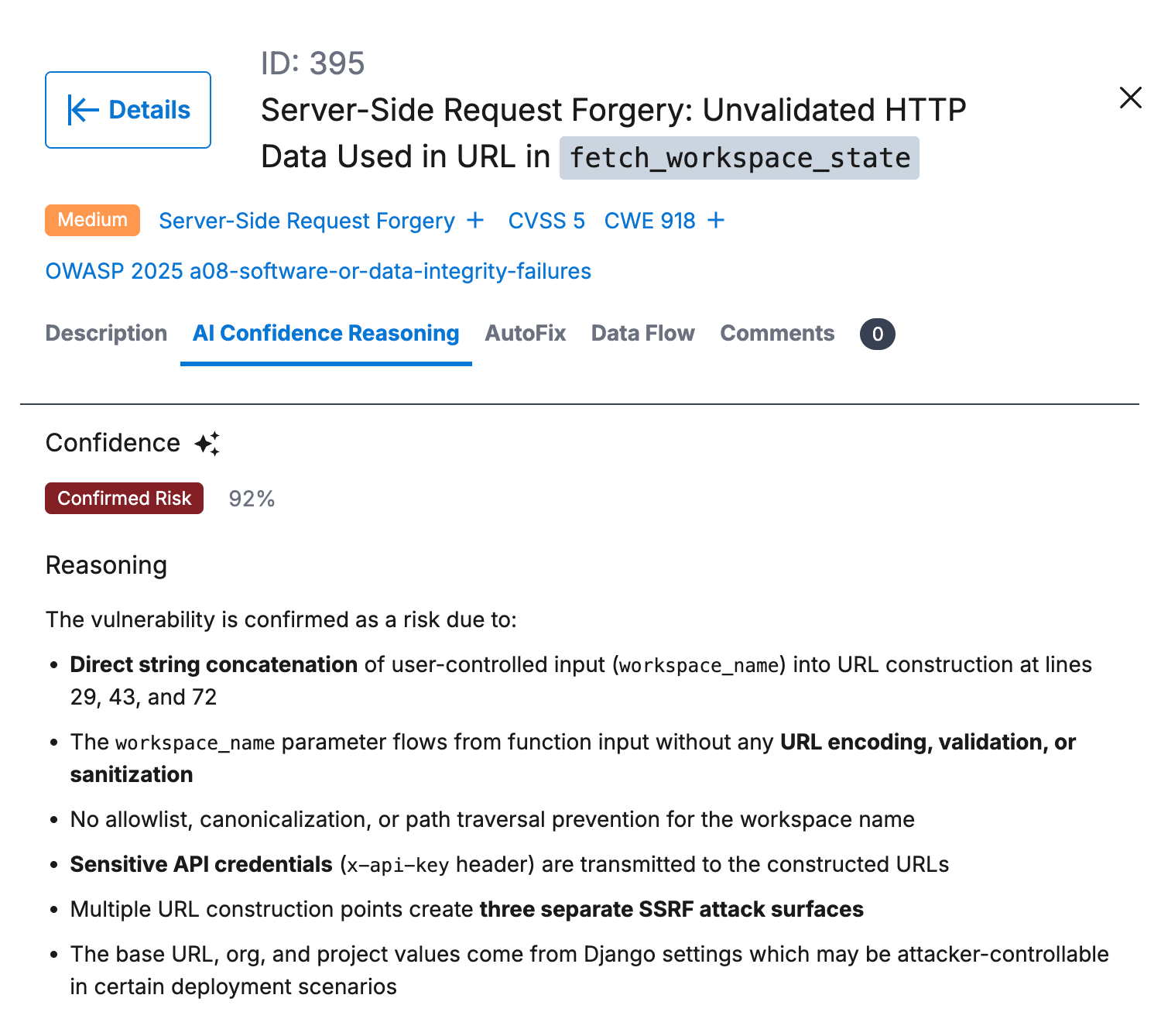
AI SAST
Harness pairs a high-recall dataflow engine with an AI confidence layer that classifies each finding as confirmed risk, potential risk, or contextually safe. It's deterministic where LLM scanning is probabilistic: same code, same result, every time, with a traceable path from input to sink. In our own benchmarking against the OWASP Java corpus, that confidence layer cut false positives by 79% (from 454 down to 95) and lifted precision from 74% to 93%, while preserving 91% recall - almost no loss of signal for a large gain in precision. It also extends into broken access control (IDOR), a class dataflow analysis alone can't see because there's no malformed input to pattern-match, only a missing authorization check: 71% recall at 99% precision across a 390-case corpus spanning Go, Java, and Python.
LLM Scan Orchestration
For teams that want to run LLM-based scanners, Harness now orchestrates them natively inside the CI/CD pipeline, reducing token spend, increasing scan speed, and feeding results into the same triage and remediation workflow as everything else - instead of a separate spreadsheet living outside your pipeline.
Which should you choose? AI SAST reduced the triage queue by 21% in our benchmark (1,746 flagged cases down to 1,381 actionable ones) without giving up coverage, and without paying a per-scan LLM bill to get there. LLM scanners still have a place, and Harness will keep making them faster and cheaper to run. But when the choice is between a probabilistic result and a deterministic one at comparable or better accuracy, the deterministic one should usually win by default.
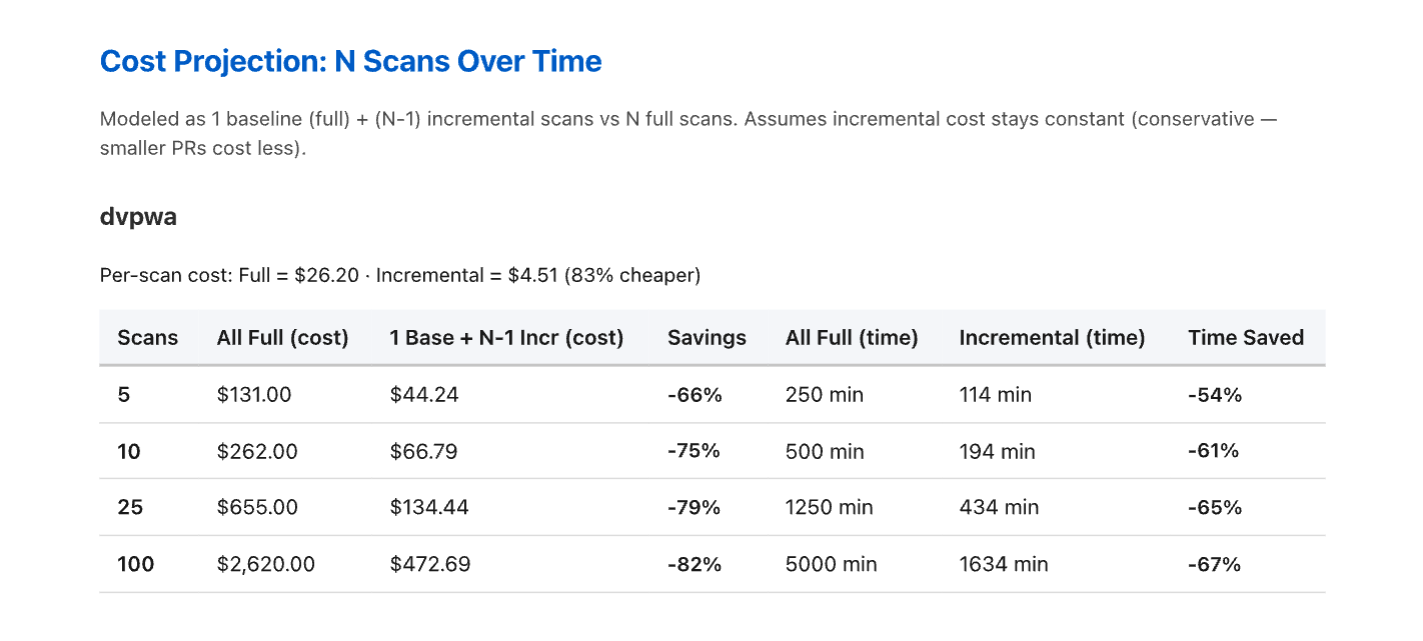
From finding to fix: Triage Agent and Remediation Agent
A scanner - any scanner - is only useful if what it finds actually gets fixed. And the steady output of SAST and SCA scanning has a particular shape: a high volume of findings that need to be sorted by real risk before anyone starts fixing, because most security teams already have more open findings than they can act on in a sprint, let alone a day. And most of that backlog isn't as urgent as it looks: in the same Project Glasswing testing, only 36% of critical-severity and 33% of high-severity findings were confirmed exploitable. Sorting through that backlog by hand, then writing and validating each fix one by one, is exactly the kind of toil that doesn't scale with the volume scanning produces, so Harness is introducing an agentic workflow that does.
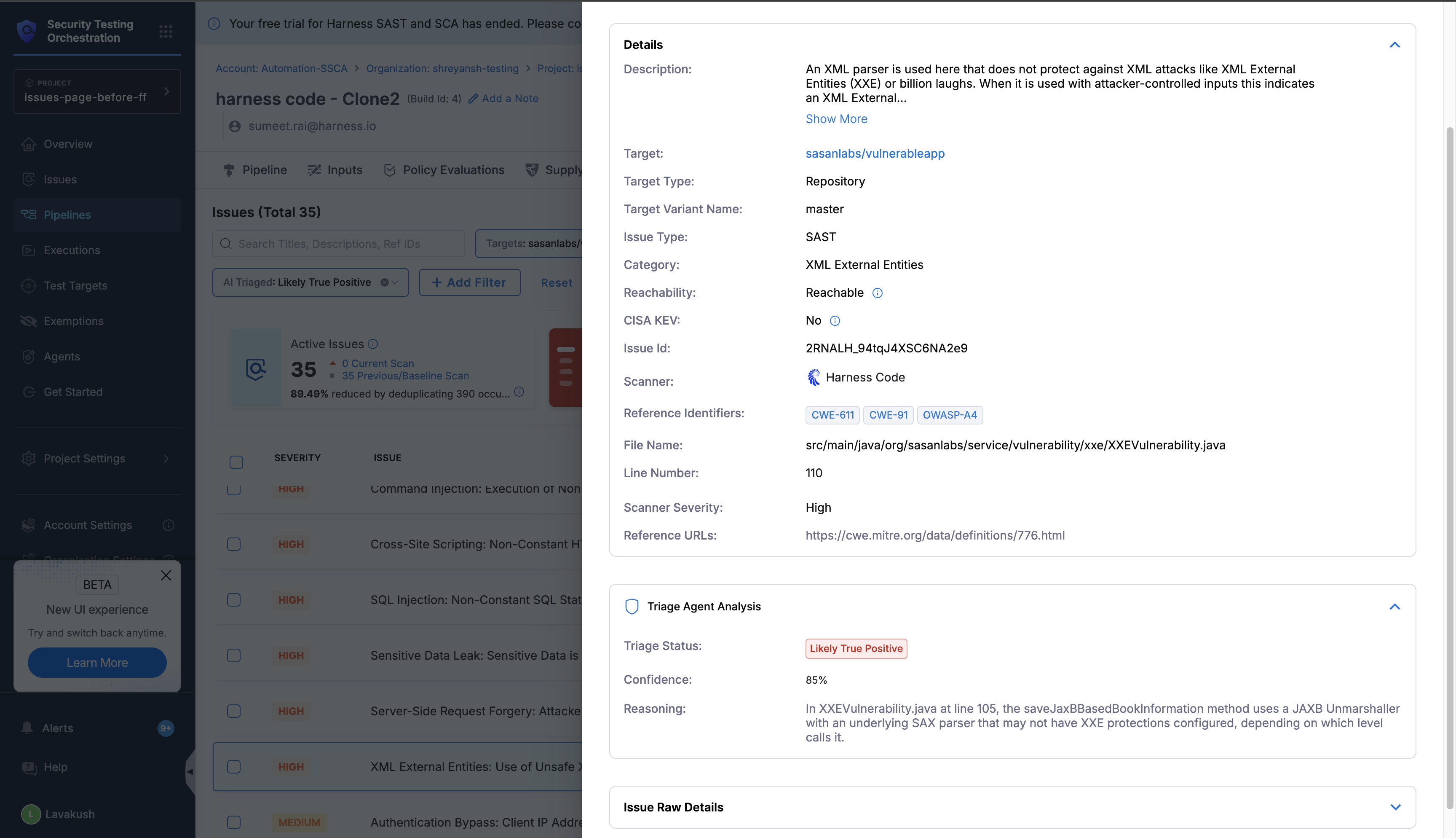
Triage Agent
Harness’s Triage Agent prioritizes what's actually exploitable, combining CVSS, EPSS, and reachability analysis to cut a sprawling SAST/SCA finding list down to a clean, actionable backlog - so your team works on real risk, not everything with a CVE number.
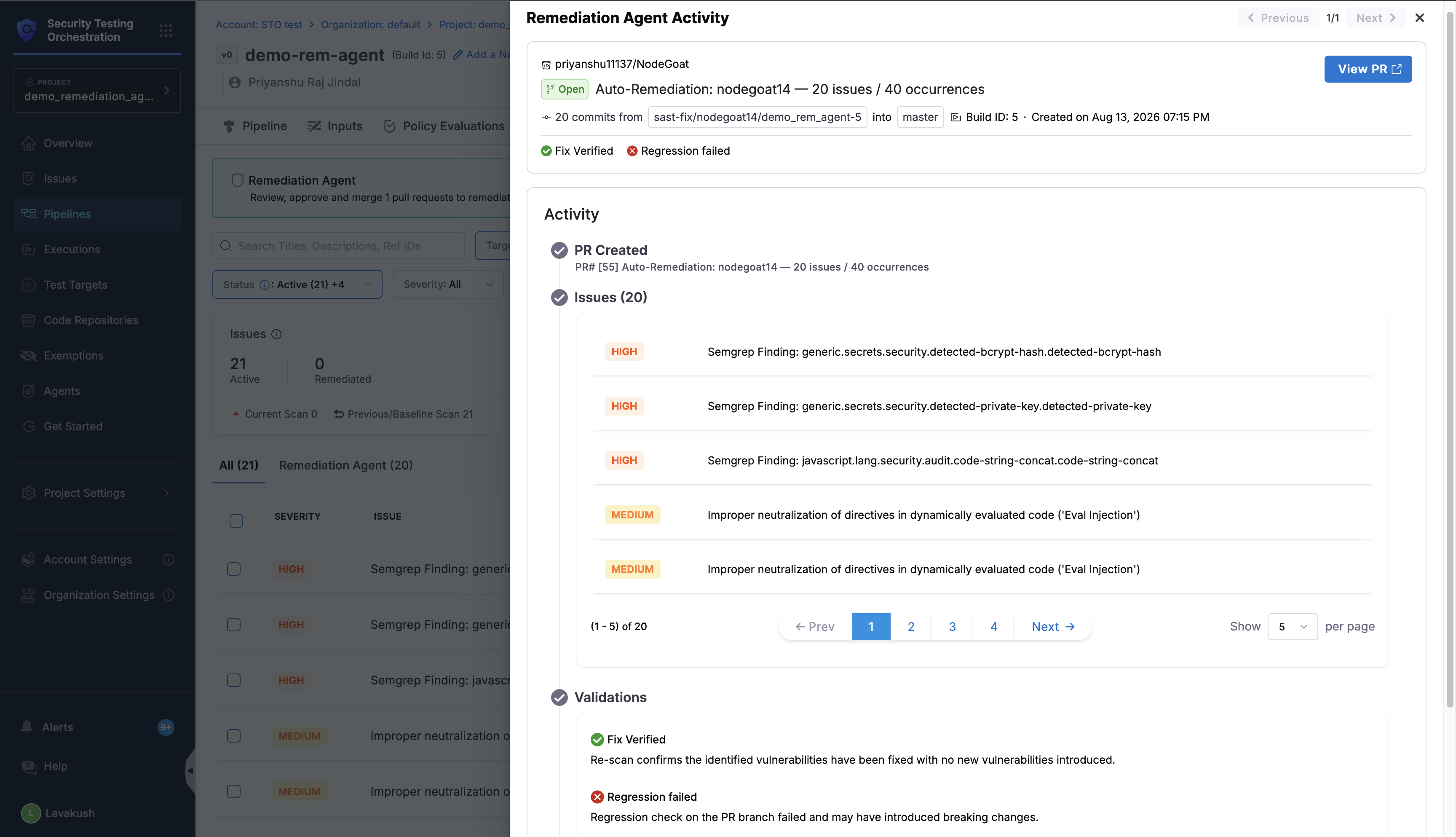
Remediation Agent
Once a finding is prioritized, the Remediation Agent applies the fix and validates it in your pipeline to prevent breaking builds, then opens a human-reviewed pull request. Developers stay in charge of what merges; the agent just does the work of getting them a validated fix instead of a bare finding.
Function-level reachability
Reachability analysis doesn't stop at "is this vulnerable package called." Harness now traces the call path down to the specific vulnerable function, so a dependency only gets flagged if that exact function is reachable in your code. Both agents work off that sharper signal: fewer false positives for Triage Agent, and a precise code path to close for Remediation Agent.
Because these agents run on top of Harness's existing pipeline governance (policy gates, approvals, chain of custody), a fix doesn't just get written faster, it gets safely into production faster too. That's the piece that's easy to overlook: a fix sitting in a pull request isn't protection. A fix that's deployed with an audit trail through the same governed pipeline you already trust - that's protection.
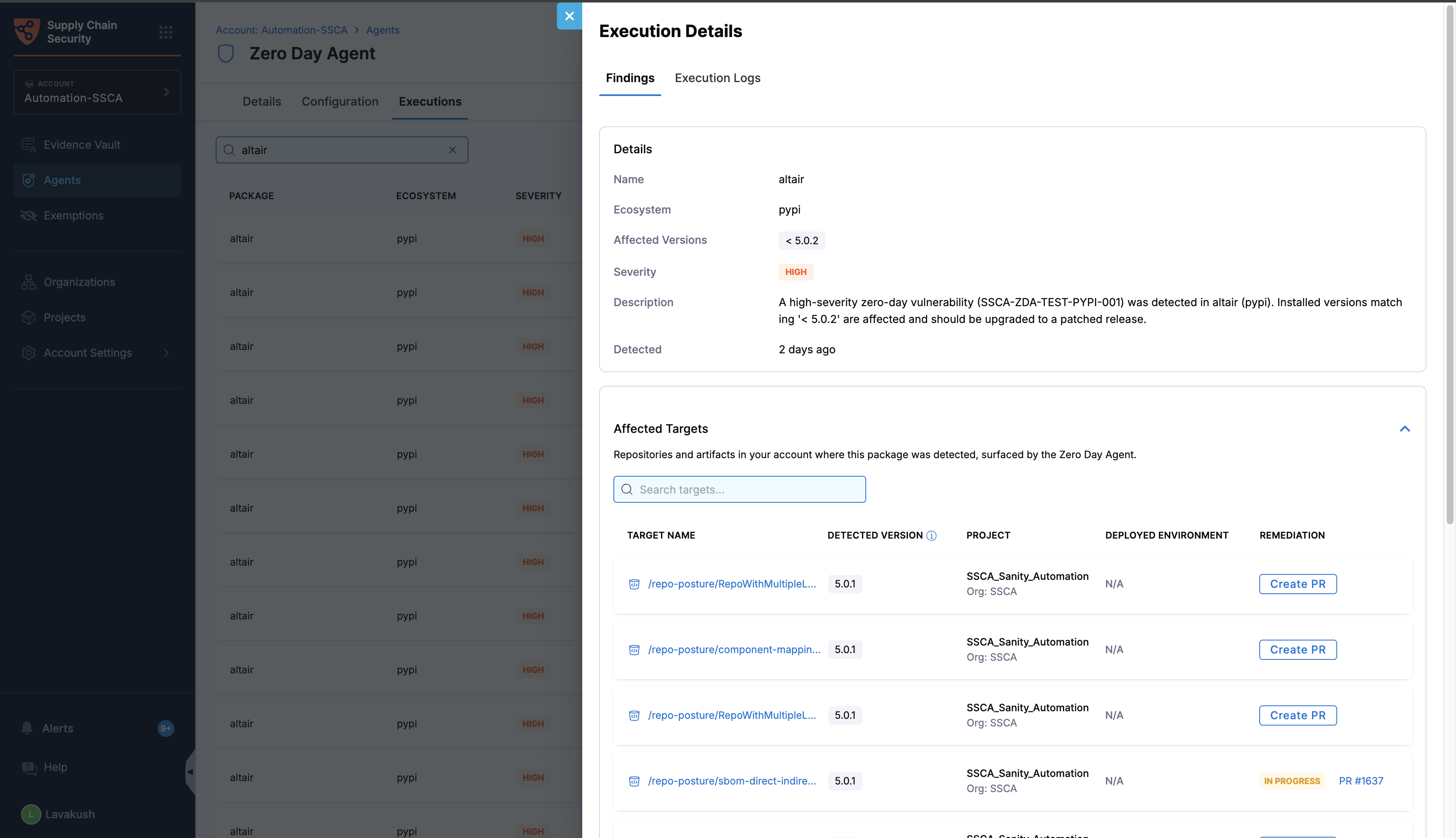
Zero-days don't wait in line: Zero-Day Agent
Everything above assumes there's time to scan, triage, and prioritize before anyone acts. A zero-day doesn't give you that time. The clock starts the moment it's disclosed, and most of that time doesn't get spent writing a fix - it gets spent figuring out if you're even affected and waiting for a fixed artifact to work its way back through build, test, and deploy.
A newly disclosed zero-day doesn't need to wait in a triage queue behind the rest of the backlog; it needs an immediate, end-to-end response. Zero-Day Agent runs that response itself: it continuously monitors for newly disclosed zero-day vulnerabilities, automatically identifies every affected artifact and pipeline across your environment, and takes it the rest of the way - applying and validating a fix, then opening a human-reviewed pull request. No separate triage step, no handoff to another agent. Blast radius mapping that used to take days happens in seconds, and a fix is ready for review shortly after.
Shielding production while the fix is in flight
Even with agents compressing the fix cycle to hours, hours are still a window. Harness closes that window from the other direction with virtual patching: when API testing discovers a vulnerability, it can create a virtual patch and deploy it on our WAAP - no tickets or code changes required. Production is shielded within minutes of discovery, while the permanent fix is worked in code. When the fix ships, the virtual patch comes down.
That's the same principle running through this whole launch: don't wait for the slowest step in the chain to gate every other step. Contain the risk immediately, fix it in parallel, and let each part of the system move as fast as it's capable of moving.
Security at machine speed
None of this works as a single point tool. The value comes from AI SAST, LLM scan orchestration, Triage Agent, Remediation Agent, Zero-Day Agent, and virtual patching all sitting on the same platform - the same one that's already deploying your code, governing your pipelines, and holding chain of custody on every artifact. Finding a vulnerability faster only matters if fixing it and deploying it are just as fast.
The organizations that build this operating rhythm now, those that scan without noise, triage in minutes, ship a validated fix in hours, shield production the whole time, will be the ones still moving confidently when attackers have the same frontier models defenders do. The ones that don't will keep measuring their response time in weeks while the threat measures its head start in hours.
Want to learn more?
Read about Harness's perspective on how Mythos is not just a security problem, but also an engineering problem. To learn more about the security capabilities in this launch, request a demo or reach out to your Harness account rep.
.png)
Bringing Third-Party Apps into Harness AI Chat: Our MCP Gateway for Distributed Enterprise Systems
TLDR: When you work in Harness AI Chat, your work doesn't stop at Harness. Your pipelines live here, but the change you actually need to make might be a YAML file in GitHub, a Jira ticket, or a Confluence doc. So we built an MCP Gateway inside Harness that lets AI Chat reach those third-party apps for you: safely, under Harness's own access controls and secrets, and without dropped sessions across our distributed fleet. This is the story of what we built and why.
The problem we set out to solve
Harness is a software delivery platform: pipelines, builds, deployments, and security scans. Harness AI Chat is the conversational agent inside it that can act on your behalf. Our customers live in Harness, pipelines, services, environments, secrets, and connectors. But a lot of the real work, the actual change you need to ship, lives outside Harness: the source of truth for a pipeline change is often a GitHub repo, and the surrounding context lives in Jira, Confluence, and a long tail of other SaaS tools. We wanted Harness AI Chat to act on all of that in one conversation: “sync this YAML, fix this stage, open a PR, update the ticket”, without the user ever leaving the chat.
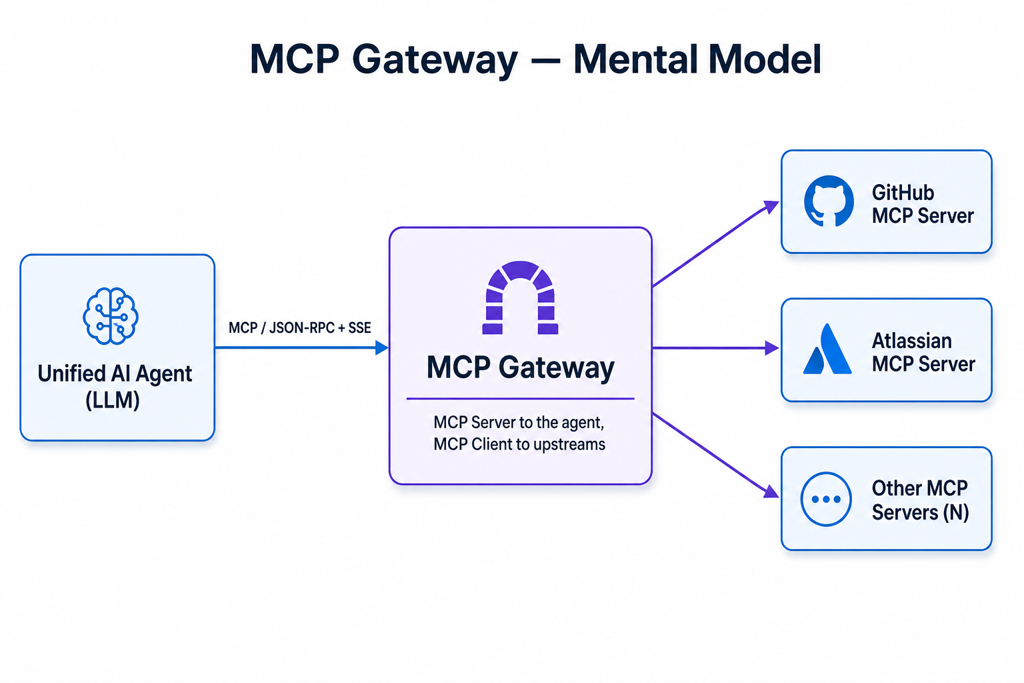
Doing that safely at Harness scale is hard: thousands of accounts, strict isolation between them, per-user access control, third-party credentials, and connections that can't drop in the middle of a task. Rather than bolt on a workaround, we built a proper piece of infrastructure for it, an MCP Gateway for our own distributed enterprise systems. To the AI agent, all of GitHub, Jira, and Confluence look like a single tool it can call. The Gateway is what makes that possible.
What we built: one governed doorway from Harness AI Chat to your other tools
The MCP Gateway sits between Harness AI Chat and the third-party apps you've connected. To the AI agent, it looks like a single tool provider; behind it, the gateway connects to every third-party MCP app you've set up as a Harness Connector. We deliberately did not reinvent security; the gateway reuses what Harness already has: Harness RBAC determines who can see what, the Harness Secret Manager stores credentials, and Harness Connectors define what's reachable.
- Connect an app once, then just use it in chat. An admin adds a third-party MCP app as a Harness Connector, no engineering work, no redeploy, and it becomes available in AI Chat.
- You only see what you're allowed to. Because it runs on Harness RBAC, a user only ever gets the apps they already have access to.
- Credentials stay protected. Secrets stay in the Harness Secret Manager; the gateway references them at runtime and never exposes them to the agent.
Why distributed systems made this hard, and how we kept it reliable
Harness doesn't run on a single box. Our infrastructure spans multiple servers, and connections can silently break when a server restarts. We built recovery that's invisible to you. A broken connection reconnects automatically instead of failing your task.
When an upstream session expires, the gateway quietly re-establishes it and retries, so AI Chat keeps working. And because a conversation's session state lives in a shared store rather than in any one pod's memory, if a gateway pod restarts, another pod simply picks the conversation up. The user never sees the seams.
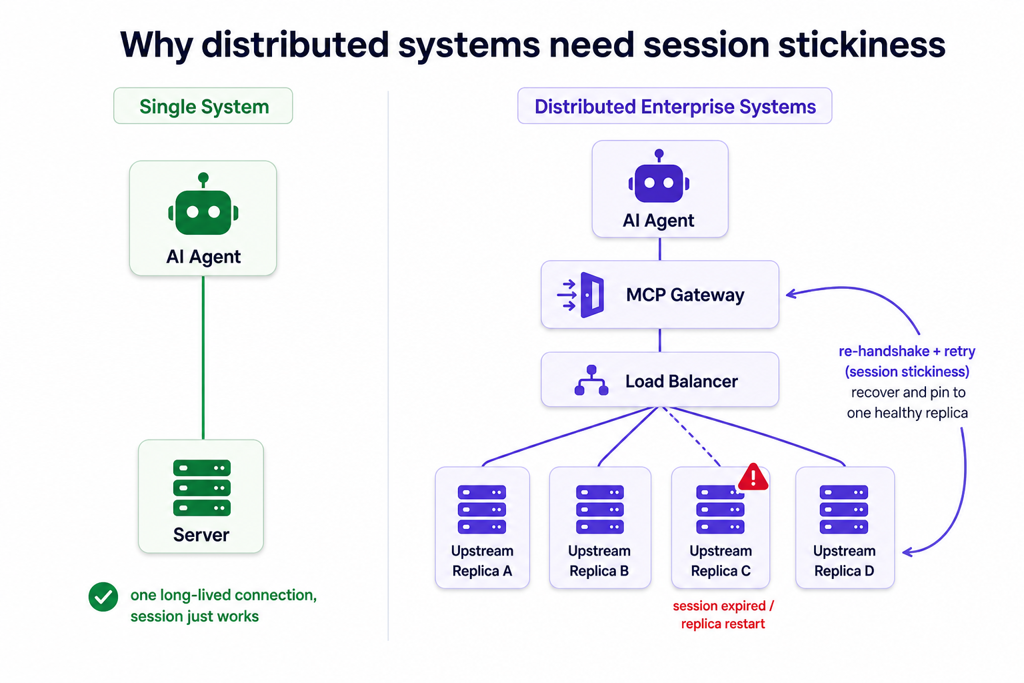
How do we keep it governed
Every call is governed by Harness; the agent can neither see nor invoke anything it shouldn't, regardless of what a client sends.
- Visibility: users only get the apps their Harness access allows.
- Per-tool permissions: admins mark each capability as Allowed, Needs approval, or Blocked.
- Per-request scoping: a conversation can be narrowed to just the tools it needs (fail-closed by default).
- Runtime guardrails: tool inputs and outputs are inspected for prompt-injection and misuse, reusing the same protection layer that already guards the rest of Harness AI.
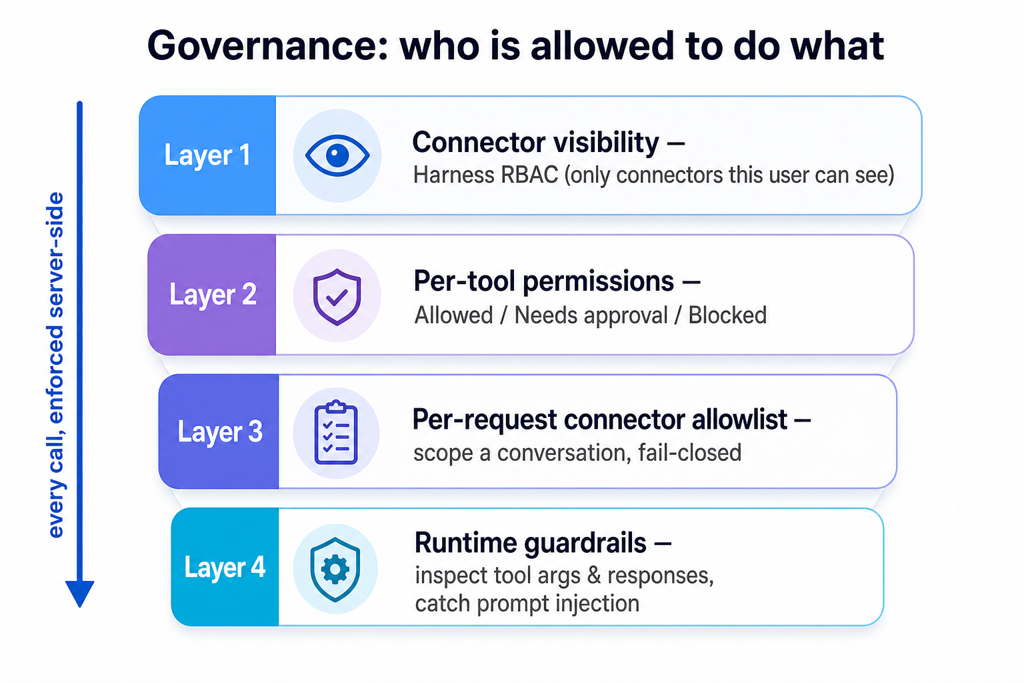
What it means for you in Harness AI Chat
The takeaway
We didn't set out to build a standalone product. We built the piece Harness needed so AI Chat can safely reach the rest of your toolchain, using the connectors, secrets, and access controls you already run on. As a result, your third-party apps work seamlessly within Harness AI Chat.

Join the Conversation: The Harness Community Is Now Live
Every Harness user knows the moment. It's late. A CD pipeline is failing in a way you've never seen. A Feature Flag rollout isn't behaving the way it did in staging. A Chaos experiment surfaced something ugly right before a release, and you have thirty minutes to decide whether to ship. The docs get you 80% of the way there. The rest is a mix of tribal knowledge, hard-won intuition, and hoping someone somewhere has already solved this exact thing in their Harness setup.
Running a modern delivery platform is full of these moments. So is the work of adopting AI agents responsibly across your SDLC. The problems are getting harder, the Harness platform keeps expanding to meet them, and the people doing the work often figure it out alone.
We think that's worth changing. Today, we're launching the Harness Community, an open space where the people building, shipping, and operating software with Harness come together to work through the hard problems, share what they've learned, and shape where the platform goes next.
You can join us at community.harness.io.
Why we built this
Harness has always been more than a product. It's a growing group of practitioners who care deeply about how software gets delivered, and who have opinions about the tools they use to do it. That group has been having brilliant conversations for years — in support tickets, at {unscripted}, in customer Slack channels, over coffee at meetups. Great conversations, but scattered.
The Harness Community brings those conversations into one place, in the open, where any Harness user can learn from them.
It covers the full surface area of the Harness platform: CI, CD & GitOps, Feature Flags, Infrastructure as Code Management, Chaos Engineering, Internal Developer Portal, Cloud Cost Management, our AI DevOps Agents, and everything in between. Whether you're just spinning up your first pipeline or you've been running Harness at scale across hundreds of services for years, there is a seat for you here.
A discussion forum, not a ticket queue
We were intentional about what this space is, and what it isn't.
It isn't a replacement for Harness Support, and it isn't another Q&A board where questions get closed as duplicates and answers go stale. It's a discussion forum, built for the kind of conversation you'd have with a trusted colleague who happens to have solved the exact problem you're facing by using Harness.
That means threads have room to breathe. The interesting part is often the follow-up: "here's how we structured our stage templates," "this is the trigger pattern that finally worked for our monorepo," "we tried the same IaCM workflow and here's why we ended up doing it differently" — the context that turns an answer into an understanding. We care more about whether you leave with clarity than whether a thread gets marked resolved.
Who you'll meet here
You'll meet two kinds of people here, and one kind of helper that isn't a person at all.
First, the Harness team. Product engineers, solution architects, developer advocates, and support specialists who work on the platform every day. When you have a question about how a capability is meant to work, or how to push it further than the docs describe, they're here.
Second, the group we're most excited about: Harness customers, just like you. Highly technical practitioners running Harness in production, solving real problems at real scale, and generous enough to share what they've learned. Some of the best answers in any technical community come from someone who was in your exact situation six months ago and figured it out. This is where you'll find them.
Alongside them, you'll also see AI agents trained on the Harness developer documentation. They can surface the right docs, offer a starting point when no human has replied yet, and help unblock you at odd hours. They exist to support the humans in this community, not to speak for them. Human first, always.
Human first, AI as backup
Harness is an AI-native platform, and we use AI everywhere it genuinely helps our customers ship faster and more safely. But when it comes to community, we start from a clear principle: humans first, AI as backup.
The primary voices in every thread are real Harness practitioners sharing lived experience. AI shows up in supporting roles — surfacing related past discussions, keeping the space organized, and offering a starting point when no human has replied yet so you're not left waiting. When a response is AI-generated, we say so. You will always know who, or what, you are talking to.
The goal is a community that feels like a room full of thoughtful Harness engineers, with quiet automation handling the parts that machines do better than we do.
A home for the Harness open source family
A lot of what Harness is built on, and a lot of what we ship back to the ecosystem, is open source. That heritage matters to us, and the Harness Community reflects it.
You'll find dedicated space for the open source projects in the Harness family:
- Drone — the container-native CI engine that many of you first met Harness through
- OpenTofu — the open source infrastructure-as-code project Harness helped launch and continues to steward
- Harness Open Source — the self-hostable platform for source code management, pipelines, and artifact registries
- harness-cli — the command-line interface for managing Harness resources as code
- LitmusChaos — the CNCF chaos engineering project incubated at Harness
We'll keep adding more as our community continues to contribute to and steward projects across the ecosystem.
Whether you're self-hosting a Harness Open Source instance, filing your first pull request against Drone, running LitmusChaos experiments before a big release, or debugging an OpenTofu state late at night, this is a place to talk about that work. Contributors, maintainers, and users all sit at the same table.
Open source has always been a conversation. Someone writes code, someone else reads it, improves it, questions it, extends it. That conversation is what turns a project into a community, and a community into something that outlasts any single company or contributor. We want the Harness Community to honor that tradition: transparent, generous, welcoming to newcomers, and rigorous with each other when it matters.
How to get started
Joining takes less than a minute. Head to community.harness.io and sign in. Introduce yourself, tell us which Harness capabilities you're using, and what you'd love to learn or share.
From there, you can ask a question, start a discussion, share a pipeline pattern that worked for your team, post a Chaos experiment you wrote, or simply read and learn. All of those are valid ways to be part of this.
Come build with us
Communities are shaped by the people who show up early and set the tone. If you care about running Harness well, about contributing to the open source projects we all depend on, and about doing AI in the SDLC responsibly, we'd love to have you.
Join us at community.harness.io. Bring a question, a story, or an opinion. We're saving you a seat.

Software Delivery Platform Explained: Key Features and How to Evaluate One
- A software delivery platform governs the full after-code lifecycle (CI, CD, security, insights) as one system, replacing a stack of point tools.
- A CI/CD tool automates one slice of the pipeline. A platform governs the entire after-code lifecycle with shared policy, visibility, and rollback.
- Must-have features: pipeline automation, progressive delivery, built-in security, audit trails, and AI-native rollback and test intelligence.
- Evaluate platforms on scope coverage, integrations, AI capabilities, governance, and scalability, not on a feature checklist alone.
What is a software delivery platform?
A software delivery platform is an integrated system that manages every stage of moving software from a code commit to production: continuous integration, continuous delivery, security, and the feedback loops in between. It treats delivery as one governed lifecycle instead of a chain of disconnected steps.
- It covers the full software delivery pipeline, not a single stage like build or deploy.
- It replaces a stack of stitched-together software delivery tools with one system that shares policy, access control, and visibility.
- It's often called an application delivery platform or a continuous delivery platform, though those terms usually emphasize the deploy side.
A vendor tells your team it needs a software delivery platform. You already run a CI/CD pipeline that builds and ships code every day, so the pitch sounds like a fresh label on the tooling you have. Most of the time, it is not. A platform owns the parts your CI/CD tool never touched: security gates, cross-service release coordination, governed rollback, and proof that a release worked. The line between the two is where most of the value sits, and where most of the buying mistakes happen.
Software delivery platform vs. CI/CD tool: what is the difference?
A CI/CD tool automates one slice of the work: it builds your code, runs tests, and pushes an artifact toward an environment. Most teams start there. The trouble is that build-and-deploy is the middle of the story, not all of it. Security scanning, approvals, multi-service release coordination, rollback, and the data that tells you whether the release worked all live outside that slice, so they get bolted on as separate scripts and separate software delivery tools.
A software delivery platform manages the whole after-code lifecycle as one governed system. Same policy engine, same access control, same audit trail, same view of what is in flight across every pipeline.
The distinction matters most as you grow. One CI/CD tool is fine for one team. Fifty teams running fifty variations is how toil and risk compound, and why so many move to a unified DevOps automation platform.
What features should you look for in a software delivery platform?
Treat this as an evaluation checklist. A real platform covers the entire software delivery pipeline, so it should carry all of these, not a subset. The capabilities below separate a current platform from a relabeled CI/CD tool.
Check the first five capabilities but none of the AI-native ones (test intelligence, automated rollback, AI-assisted diagnosis), and you're evaluating yesterday's platform. The AI Velocity Paradox is real: faster code creation without faster, smarter delivery infrastructure just delivers risk faster.
How should you evaluate a software delivery platform?
Features tell you what a platform can do. Evaluation tells you whether it fits your team. Score every candidate on the same six dimensions:
- Scope coverage. How much of your pipeline does it replace? Count the software delivery tools you would retire.
- Integration. Does it meet your stack (Git provider, registries, clouds, observability), or force a rip-and-replace?
- AI capabilities. Pipeline generation, verification, and rollback grounded in your delivery data, not generic suggestions.
- Governance. Policy-as-code, RBAC, and audit trails built into the flow, not layered on after.
- Scalability. Does it stay sane at fifty teams and thousands of pipelines, or does it sprawl?
- Pricing model. Per-seat, per-deploy, or consumption, and how that tracks as you grow.
Then put real questions to the vendor: How does rollback work, and what signals trigger it? What is your multi-cloud and on-prem support? How are pipelines versioned and reused across teams? How is access controlled, and what shows up in the audit log? What does onboarding look like, and who supports the migration?
Two platforms can check the same boxes and deliver different results once implementation support, documentation, and community enter the picture. The platform your team can actually adopt beats the one with the longest spec sheet.
How do you evaluate a software delivery platform against Jenkins, GitHub Actions, and GitLab?
Few teams evaluate a platform in a vacuum. You almost certainly already run Jenkins, GitHub Actions, or GitLab, so the real question is what a platform adds on top of what you have, not whether it can replace it outright. Two of the three are CI/CD tools you would extend; one is the closest thing to a platform-category peer. Score each on how much of the after-code lifecycle it still leaves you to build and maintain by hand.
The questions to put to a vendor follow from that table: How much of what we run in Jenkins or GitHub Actions does this absorb? Where does it sit alongside our source control instead of replacing it? Run the same scoring on all three incumbents, tally what each still leaves to manual scripts and add-on tools, then measure how much of that gap a given platform actually closes. The bigger the share it takes over, the less custom plumbing your team is left maintaining.
How Harness approaches the software delivery platform
The challenge
Most teams already automated the middle of delivery with a CI/CD tool. The parts a platform owns (security, cross-service release coordination, verified rollback, and self-service for developers) stayed manual, stitched together by hand. That gap is expensive: for heavy AI-coding-tool users, 22% of deployments end in a rollback, hotfix, or incident (Harness, 2026 State of DevOps Modernization), and DORA research (State of DevOps 2024) shows throughput flat while stability slips.
The approach
Harness is the AI-native software delivery platform for everything that happens after code is written. Continuous Delivery and GitOps generates pipelines from natural language, layers a control plane over your existing Argo CD estate, and auto-rolls back bad deployments. Continuous Integration speeds builds with test intelligence. The Internal Developer Portal gives platform teams a golden-paths layer for developer self-service. Application Security Testing, Cloud and AI Cost Management, and AI DLC Insights run on the same governed control plane. Underneath, Harness AI grounds intelligence in the Software Delivery Knowledge Graph, while policy-as-code and RBAC keep self-service governed. Developer-friendly guardrails, not bolted-on automation.
The outcome
Teams retire the tangle of point tools for one system. A release turns into something you can verify and reverse, not a gamble. Hundreds of engineering teams trust Harness to consolidate delivery and remove manual interventions, with platform teams defining golden paths and developers self-serving safely.
How engineering teams consolidate on one software delivery platform
The clearest signal is what teams report after they replace point tools with one platform.
How did Raisin retire Jenkins and save $525,000 a year?
Raisin's six-person DevOps team had been spending 80% of its time keeping a fragile Jenkins setup running. After moving to Harness, that team spends 20% of its time administering software delivery, a 60% reduction in effort worth roughly $525,000 a year. Deployments climbed from 10 to 53 a month, and onboarding a new application dropped from two days to 30 minutes.
“We have drawn clear lines of ownership using Harness. My team owns workflows and templates, and each application team manages their own services, pipelines and triggers.”
José Meyer, Lead CI/CD Engineer, Raisin
Source: Raisin runs from Jenkins nightmare — saves $525k per year
How did Experian get to 100 releases a month?
Experian shifted from "big bang" releases twice a month to 100 risk-controlled deployments per month using feature flags and progressive delivery, a 50x release-velocity increase. Engineers experiment with real consumer data safely, and cross-functional teams across multiple time zones now release continuously instead of coordinating around end-of-day windows.
“Harness provides so much more than just a tool set change. It sounds simple, feature toggles, but it's transformative in nature. It's transformative in terms of the teams, in terms of the culture that we adopt.”
Mirza Baig, Senior VP of Engineering, Experian
Source: How Experian increased release velocity by 50x
Buy for the whole pipeline, not one stage
A CI/CD tool solves the middle of delivery. A software delivery platform solves the whole of it, which is why the market keeps consolidating. Start from your own pipeline: map every stage from commit to production, mark the manual handoffs, and count the software delivery tools one platform would retire. The platform that erases the most of those handoffs while keeping delivery governed is the one worth buying. Everything else just runs the same brittle scripts faster.
See how Harness brings the full after-code lifecycle onto one AI-native platform.
FAQs about software delivery platforms
What is the difference between a software delivery platform and a CI/CD tool?
A CI/CD tool automates build, test, and deploy for one pipeline. A software delivery platform governs the entire after-code lifecycle across every pipeline, with shared policy-as-code, RBAC, visibility, and automated rollback. The tool is a stage in the workflow; the platform is the system that runs the workflow end to end.
What is an application delivery platform?
It is another name for a software delivery platform, with more weight on the deploy-and-run side: getting an application into production and keeping it healthy. In practice the terms are used interchangeably, though application delivery platforms sometimes emphasize runtime concerns over earlier pipeline stages.
What is a continuous delivery platform?
A continuous delivery platform focuses on the CD half of the pipeline: promoting artifacts across environments, progressive rollout with canary or blue-green strategies, and automated rollback. A full software delivery platform wraps that with CI, security testing, and delivery insights on one governed control plane.
How do I build a software delivery pipeline?
Connect source control, build and test, an artifact registry, security scans, and a deployment strategy into one flow, then add approvals and rollback. A platform generates and versions that software delivery pipeline for you instead of leaving it to bespoke scripts, and applies policy-as-code at each stage.
What software delivery tools do enterprise teams use?
Many still stitch together separate CI servers, deployment scripts, scanners, and registries. The market is consolidating: enterprises are replacing those software delivery tools with one platform to cut toil, standardize governance, and give platform teams a single place to define and enforce golden paths.
What are the limits of a software delivery platform today?
Two worth knowing. ML-based verification needs baseline data, so new services run in a learning period before anomaly detection is reliable. And automated rollback for stateful services or database migrations needs careful configuration before it can be trusted, even on a strong platform.
How much does a software delivery platform cost?
Pricing usually follows one of three models: per developer seat, per deployment, or consumption based on usage. The number that matters isn't the sticker price but how the bill behaves as your team and pipeline count climb, and what the platform lets you retire. One platform that replaces several point tools can lower your total spend versus the stack it consolidates, so weigh it against the licenses, maintenance, and engineering toil you would drop, not in isolation.

DevOps Automation Platform Explained: How It Works and Why You Need One
- A DevOps automation platform connects build, test, deploy, security, and rollback in one workflow instead of a stack of disconnected scripts.
- An automation tool automates one step; a platform is workflow-aware and connects every step with shared context, permissions, and audit trail.
- DORA 2025: 90% of technology professionals now use AI at work, and that speed lifts delivery throughput but raises instability unless your automation can absorb the extra change safely.
- An AI-native platform recommends which tests to run, diagnoses failures, and remediates issues rather than just executing the steps you scripted.
What is a DevOps automation platform?
A DevOps automation platform is an integrated system that automates the repetitive, error-prone work across the software delivery lifecycle, covering builds, tests, deployments, security checks, and rollbacks in one place. Instead of wiring scripts and point tools together by hand, you get one workflow-aware platform that moves code from commit to production with less manual handoff.
- What it replaces: a patchwork of point tools, each automating one step and none aware of the others.
- What it automates: CI pipelines, deployment automation, infrastructure provisioning, security scanning, and incident response.
- What "AI-native" adds: test selection, failure diagnosis, anomaly detection, and auto-remediation.
- Who it's for: platform, DevOps, and engineering teams losing time to toolchain handoffs.
Walk into most engineering orgs and you will find too much automation, not too little, scattered across a CI runner here, deploy scripts there, and a monitoring tool nobody fully owns. What eats the week is wiring those scripts together and chasing what broke in the gaps between them. A DevOps automation platform folds that sprawl into one workflow, so engineers ship software instead of babysitting the glue.
What is the difference between an automation tool and a DevOps automation platform?
The difference decides whether automation actually pays off.
An automation tool does one job. Ansible configures servers, a CI runner executes builds, and a Terraform file provisions infrastructure. Each is good at its slice but blind to what runs before or after it. So you wire the slices together yourself, and every handoff drops context or triggers a manual step at 2 a.m.
A DevOps automation platform is workflow-aware. A build feeds a test stage, which feeds a deployment, which feeds a rollback policy, all sharing one context, one set of permissions, and one audit trail. With 60% of teams running more than five tools (GitLab 2025), the integration tax across those stacks is the real cost, not the tools themselves. Point automation speeds up a step. Platform automation speeds up the system.
What does a DevOps automation platform automate?
Automation takes repeatable work off your engineers across four areas. The table below maps what a platform replaces and why it matters.
On security: with 84% of codebases carrying at least one open-source vulnerability (Synopsys OSSRA 2024), in-pipeline scanning via Application Security Testing stopped being optional a while ago. The question is whether the scan happens inside your pipeline with an audit trail, or outside it where developers route around it.
What is an AI-native DevOps automation platform?
Rule-based automation runs the steps you scripted, the same way every time. An AI-native platform adds a layer that reads the situation and decides.
The difference shows up the moment something goes sideways. A scripted pipeline runs all 4,000 tests on a one-line change, then pages a human when it breaks. An AI-native one runs only the 40 tests that touch the change, and when something breaks it reads the logs, names the likely cause, and can roll back on its own. Test selection, failure diagnosis, anomaly detection, auto-remediation: all of it comes from one shift. The automation weighs what is in front of it instead of blindly running the steps.
Among teams leaning hardest on AI coding tools, 22% of deployments end in a rollback, hotfix, or incident (Harness, 2026 State of Engineering Excellence). When change volume climbs, scripted automation cannot tell a safe change from a risky one. That judgment is what an AI-native platform, grounded in the Software Delivery Knowledge Graph, adds.
How should you evaluate a DevOps automation platform?
Not every platform automates the same breadth, and the gaps are where bottlenecks hide. Run any candidate through this checklist:
- Automation coverage. Does it span the full software delivery lifecycle (CI, CD, security, infrastructure, cost, incident response), or just a slice?
- AI capabilities. Does the AI act on the pipeline (selecting tests, diagnosing failures, remediating), or only report on it from the sidelines?
- Pipeline authoring. Can teams build and reuse pipelines via a portal like the Internal Developer Portal without a dedicated scripting priesthood?
- Multi-cloud support. Does it run across the clouds and clusters you actually use?
- Governance and audit. Are RBAC, policy-as-code, and audit trails baked in, not bolted on?
One warning: a platform that automates only part of the workflow creates fresh bottlenecks at the handoffs it does not cover. Partial automation moves the wait; it does not remove it.
How Harness approaches automated DevOps at scale
The challenge
Most teams automate in fragments: a CI runner here, deploy scripts there, security tacked on at the end. The fragments do not share context, so every release still leans on manual judgment. That judgment is exactly what buckles when AI-assisted coding pushes change volume past what humans can review by hand.
The approach
Harness automates everything after code is written, on one platform. Continuous Integration speeds builds with test intelligence. Continuous Delivery and GitOps ships with progressive rollouts, automated rollback, and continuous verification. Infrastructure as Code Management provisions infrastructure through governed pipelines. Application Security Testing embeds scanning into the workflow. AI SRE reads logs and names the likely cause of failures. Cloud and AI Cost Management closes the loop on spend. The Software Delivery Knowledge Graph grounds every AI decision in your delivery data, while policy as code and RBAC keep the whole system governed. Developer-friendly guardrails.
The outcome
With the whole lifecycle automated, shipping stops being the risky part. Each change carries its own checks and a clean path back if it misbehaves, so the team spends fewer nights chasing incidents and more time on the decisions that genuinely need a person. Hundreds of engineering teams trust Harness to consolidate delivery and remove manual interventions.
What teams running automated DevOps report
Two teams, two stacks, one pattern: retiring glue code and manual steps returns engineering time to the work that actually needs it.
How did Citi move from build to production in under seven minutes?
Moving release onto Harness let Citi go from build to running in production in under seven minutes, with role-based controls over more than 20,000 people, most deploying several times a day, the bank reported.
“Harness CD let us release each change within minutes of a pull request being merged.”
Stefanos Piperoglou, Technical Program Manager, Citi
Source: Citi enhances software delivery with Harness CD
How did Meltwater scale to 1,200 pipeline executions a day?
After moving CI off Jenkins onto Harness, Meltwater now runs more than 1,200 pipeline executions a day, with CI adoption growing 3x to cover 50% of the engineering organisation, the company reported.
“Harness CI is extremely open and flexible. There's nothing holding you back from building and deploying the way you want. Jenkins was extremely rigid and wouldn't have allowed us to grow the way we have.”
Jim Sheldon, Principal Software Engineer, Meltwater
Source: Meltwater scales CI to 1,200 pipelines daily
The gain traces to one move: retiring glue code and manual steps, not stacking on more tools.
One system beats a pile of tools
A pile of point tools only takes you so far. A DevOps automation platform takes repeatable work off your engineers, connects every stage of software delivery, from build to production, and turns that pile into one system you can actually improve against DORA's delivery metrics. Start with breadth of coverage, demand AI that acts on the pipeline, and treat governance as a guardrail, not a gate. Get it right and the handoffs that used to eat your week quietly disappear.
See how Harness brings the full software delivery lifecycle onto one AI-native platform.
FAQs about DevOps automation platforms
What is a DevOps automation platform?
An integrated system that automates the delivery lifecycle (builds, tests, deployments, security scans, rollbacks) in one workflow-aware platform instead of disconnected scripts. It connects every stage with shared context, permissions, and an audit trail, so the whole system speeds up rather than just one slice of it.
What is the difference between an automation tool and a DevOps automation platform?
A tool handles one step, like running a build, and stays blind to whatever runs before or after it. A platform connects those steps into one workflow with shared context, permissions, and an audit trail. What you stop maintaining is the wiring between the steps, which is where most of the toil hides.
What is deployment automation and how does it work?
Deployment automation moves code to production without manual steps. It separates deploy from release: code ships dormant, rolls out progressively with canary or blue-green strategies, and rolls back automatically if continuous verification flags a problem. The deploy becomes a controlled event rather than a late-night gamble.
What is an AI DevOps platform?
A DevOps AI platform adds a reasoning layer to automation. Instead of only running scripts, it selects which tests to run, diagnoses failures from your delivery data, spots anomalies after a deploy, and can auto-remediate, all grounded in the Software Delivery Knowledge Graph rather than generic suggestions.
How do I get started with automated DevOps?
Map your lifecycle and find the manual handoffs. Automate the highest-toil stretch first, usually builds or deployments, then expand coverage so you do not just move the bottleneck somewhere else. Reuse the same pipelines and policy guardrails as you add each stage.
What are the limits of DevOps automation today?
AI-based verification needs baseline data, so net-new services run in a learning period before anomaly detection is reliable. Automated rollback for stateful services or database migrations requires careful configuration before it can be trusted. And a platform only pays for itself once it covers enough of the lifecycle to retire the scripts it replaces.

Platform Engineering vs DevOps: How a Software Engineering Platform Unites Both
- DevOps is a culture and set of practices that ship software. Platform engineering builds the self-service tooling that scales those practices.
- 45% of developers name context switching between tools as a top source of friction (Harness State of Engineering Excellence 2026) — exactly the toil an internal platform removes.
- Adopt platform engineering when DevOps practices work but stop scaling: duplicated pipelines, slow onboarding, and platform teams running help desks.
- AI shifts the delivery bottleneck downstream, making governed self-service and policy-as-code essential, not optional, at every gate.
What is the difference between DevOps and platform engineering?
DevOps is a culture and practice that gets development and operations teams to collaborate, automate, and ship software faster and more reliably. Platform engineering is the discipline that builds the internal tooling and self-service infrastructure that makes those DevOps practices repeatable at scale. Put simply: DevOps is the goal; platform engineering is one of the most effective ways to reach it across many teams.
- DevOps answers "how do we work together to ship safely and often."
- Platform engineering answers "how do we make that easy for every developer, without a ticket."
- The software engineering platform is the product a platform team builds so developers get a supported path to production instead of raw infrastructure.
Your developers are shipping code faster than ever. The pipeline that has to test, secure, and release it has not kept up. So the same question keeps landing on engineering leaders' desks: double down on DevOps, or stand up a platform engineering team?
The framing is wrong. DevOps and platform engineering solve different parts of the same problem, and the strongest teams treat them as one system, increasingly a single software engineering platform that runs both. Below, where each earns its keep, when to invest in platform engineering, and how AI changes the calculation.
What is DevOps? A quick refresher
DevOps is a culture and set of practices that get development and operations working off the same goals: automate the path to production, share ownership of what ships, and improve in tight loops instead of big releases. In practice that means CI/CD pipelines, infrastructure as code, monitoring, and a "you build it, you run it" mindset, all measured by flow. DORA's four key metrics answer the question: can a change get from commit to production quickly, safely, and often?
What DevOps does not prescribe is who builds the shared tooling, or how a 500-developer org keeps every team on the paved road. That gap is where platform engineering comes in.
What is platform engineering?
Platform engineering is the discipline of designing and running the internal tools, workflows, and self-service infrastructure developers rely on to ship software. The output is usually an internal developer platform (IDP): a self-service layer between developers and the infrastructure underneath.
The defining move is the product mindset. A platform team treats its platform as a product, with real users, a roadmap, and adoption metrics. Nobody is forced to use it. It has to be good enough that developers want to.
A platform usually bundles a few core pieces:
- Golden paths: the supported way to spin up and ship a service, so nobody reinvents the setup.
- A software catalog: one searchable place for services, owners, dependencies, and APIs.
- Self-service workflows: provision an environment or onboard a repo without filing a ticket.
- Scorecards: automated checks that hold each service to your security, reliability, and compliance bar.
The goal is not only speed. It is cutting the cognitive load on developers so they spend their time on product work, not on infrastructure plumbing they should not have to think about.
How do DevOps and platform engineering compare, side by side?
One is about how teams work. The other is about what you build so that work scales.
Platform engineering does not compete with DevOps. It is what you reach for when those practices work but do not scale, when every team keeps solving the same provisioning problems alone.
When should you invest in platform engineering?
Not at the start. With a handful of developers, a shared pipeline and good habits beat a dedicated platform team. Platform engineering earns its cost when the friction of not having a platform outweighs the cost of building one.
What signals indicate your team is ready?
A few concrete tells, not impressions:
- Developers lose an hour or more a day to deployment, environment, or infrastructure work. Time that should go to product, not plumbing.
- DevOps has quietly become a help desk, fielding the same provisioning tickets repeatedly.
- New-service setup takes days. Onboarding a new developer drags toward the two-month industry average.
- Every team runs its own snowflake pipeline.
How does the business case stack up?
It comes down to math. A platform team is a fixed investment that buys back time across every other team. For enterprise and regulated teams the upside compounds, because a standardized platform is where you enforce security and compliance by default, not by audit.
What can go wrong with a platform investment?
Three failure modes worth pressure-testing. First, building a platform nobody adopts because it was designed in isolation from the developers it serves. Second, treating the platform as a finished project rather than a product, so it stops evolving and developers route around it. Third, layering self-service on top of weak governance, which speeds up the wrong things and creates compliance risk faster than DevOps alone would have.
How does AI change the DevOps and platform engineering equation?
AI does not settle the DevOps-versus-platform-engineering question. It makes it urgent. When AI assistants help developers write code several times faster, the bottleneck moves downstream, to everything that tests, secures, and releases that code. More code only helps if delivery can absorb it.
Harness calls this the AI Velocity Paradox: faster code creation without faster delivery infrastructure shifts the same risk further down the line. The fix is not slower coding. It is stronger delivery.
The pressure lands on both sides. DevOps with AI reshapes the pipeline: AI-assisted code review, smarter test selection, and automated remediation that rolls back bad changes. For platform teams, it raises the bar on self-service. GitOps-based delivery keeps your desired state in version control, so every change is reviewed, auditable, and reversible. That is what lets AI-driven automation move fast without moving recklessly.
How Harness approaches DevOps and platform engineering
The "versus" framing breaks down because mature teams need both at once, on the same software engineering platform. Harness is built for that: the AI-native Software Delivery Platform that automates and governs the after-code lifecycle, serving DevOps automation and platform-engineering self-service from one place.
The challenge
DevOps teams want fast, automated CI/CD. Platform teams want self-service with standards baked in. Bolt those together from separate point tools and governance becomes an afterthought spread across both. The handoffs leak audit trails, dilute policy enforcement, and shift toil from developers to platform teams.
The approach
DevOps teams get Continuous Integration, Continuous Delivery and GitOps, and Infrastructure as Code Management with progressive rollouts and automated rollback. Platform teams get the Internal Developer Portal with self-service workflows, a software catalog, scorecards, and golden paths to production. Underneath both, Harness AI grounds intelligence in the Software Delivery Knowledge Graph, while Policy as Code and RBAC keep self-service governed.
The outcome
Teams reduce toil and ticket queues, onboard developers and services in a fraction of the time, and ship faster without giving up control. The versus debate dissolves, because both DevOps automation and governed self-service run on one foundation. Hundreds of engineering teams trust Harness to consolidate point tools and remove manual interventions.
How engineering teams pair DevOps and platform engineering at scale
Two patterns, two stacks, one outcome: the work that used to repeat across teams stops repeating.
United Airlines
United Airlines moved CI and CD onto Harness, giving developers self-service deployments with governance enforced through templates rather than tickets. The company reported a 75% acceleration in deployment time and migrated 80% of workloads to the cloud (United Airlines case study).
“By choosing Harness for CI and CD, we were able to give the governance policies to the developers and create the guardrails we needed. Harness gives us a platform rather than just a DevOps tool.”
Ratna Devarapalli, Director of IT, Architecture, Platform Engineering & DevOps, United Airlines
PlayQ
PlayQ's lean platform team moved infrastructure to fully self-service workflows, pushing Kubernetes upgrades 4x faster than their previous setup.
With Harness, all Terraform plans and applies run concurrently. Pushing upgrades to Kubernetes clusters is 4x faster than it used to take with Terraform Cloud.
John Maynard, Director of Platform Engineering, PlayQ
Stop choosing, start combining
The honest answer to "DevOps or platform engineering" is that it was never an either-or. DevOps gives you the culture and practices. Platform engineering turns them into a software engineering platform every team can use on demand. One is the goal; the other is how you reach it at scale.
Pick the foundation that lets DevOps automation and governed self-service run together, and let developers spend their time on the product instead of the plumbing. See how Harness brings both together as one AI-native platform.
FAQs about DevOps vs platform engineering
Is platform engineering the same as DevOps?
No. DevOps is a culture and set of practices for shipping software faster and more reliably. Platform engineering builds the self-service tooling that puts those practices in every developer's hands. It scales DevOps; it is not a different goal.
What does a software engineering platform include?
A self-service developer portal, a software catalog, golden paths to production, automated CI/CD and GitOps delivery, environment provisioning, and scorecards for quality, security, and compliance. Paved roads with guardrails, not a pile of disconnected software engineering tools.
Do I need a platform engineering team if I already have DevOps?
Not always. If a few teams ship well, keep investing in DevOps practices. Add a platform team when the same toil repeats across many teams: duplicated pipelines, slow onboarding, engineers buried in tickets. That is when a platform pays for itself, especially in larger DevOps enterprise environments.
What is a GitOps platform and how does it fit in?
A GitOps platform keeps infrastructure and deployment state in version control as the single source of truth, so every change is reviewed, auditable, and reversible. It connects platform workflows to versioned infrastructure and gives AI-driven automation a safe path to act on.
How does DevOps with AI change platform engineering priorities?
AI speeds up how fast code gets written, pushing more change into testing, security, and release. That makes governed self-service and guardrails more important, not less. Platform teams now prioritize AI-assisted pipelines, automated remediation, and policy-as-code at every gate.
What are the most common platform engineering failure modes?
Three patterns recur. Building a platform without involving the developers who will use it, so adoption stalls. Treating the platform as a finished project instead of a product, so it stops evolving. Layering self-service on top of weak governance, which speeds up risk before it speeds up shipping.
.png)
How to build an A/B testing framework for modern CI/CD pipelines
- An A/B testing framework works best when it lives inside your CI/CD pipeline, not outside of it.
- Feature flags, progressive delivery, and guardrail metrics help teams test safely without slowing releases down.
- Automation makes it easier to detect regressions early, roll back fast, and keep experiment debt under control.
Most engineering teams still tie A/B tests to major releases, waiting weeks or even months to validate impact while users suffer through broken features. Feature flag interdependencies create hidden technical debt at scale, making big-bang experiments even riskier. Instead: decouple deployment from release entirely.
The most effective A/B testing framework lives inside your CI/CD pipeline, not bolted on afterward. Deploy code with features disabled, then use progressive delivery and real-time metrics to prove impact before full rollout. This approach treats experimentation as a first-class deployment capability, with automated verification wired directly into your release process.
Ready to ship 50x faster with built-in experimentation? Harness Feature Management & Experimentation unifies feature flags, release monitoring, and A/B testing in a single platform.
What is an A/B testing framework?
An A/B testing framework is a tool that lets teams compare a control experience to a variation, divide traffic between the two, measure the results, and then act on those results.
That framework is more than just a dashboard when it comes to software delivery. It has:
- Traffic distribution
- Flags for features or controls for runtime
- Rules for targeting and defining experiments
- Tracking exposure
- Business and reliability metrics
- Logic for promotion and rollback
- Rules about who can start, change, or end an experiment
The main point is simple: deployment shouldn't have to mean release. You should be able to send code safely, keep a feature hidden, and then slowly show it to real users when you're ready to learn from them.
Why traditional A/B testing breaks down in modern delivery
Traditional A/B testing often assumes a slower release cycle. Teams launch a change, wait for a handoff, then run an experiment after the fact. That model creates friction for engineering teams that deploy often.
It also creates avoidable problems:
- Experiments get delayed until after the release windows
- Teams rely on manual traffic changes
- Business metrics and system health live in different tools
- Rollback decisions take too long
- Stale flags and one-off test logic pile up over time
Modern delivery needs something tighter. If teams are shipping daily or several times a day, the A/B testing framework has to move at the same pace. That means the workflow for building, testing, releasing, measuring, and rolling back should live in one delivery process instead of being spread across disconnected tools.
Architecture of an A/B testing framework inside CI/CD
The biggest mistake teams make is treating A/B testing like a separate system that sits beside the pipeline. That usually turns experimentation into another manual checkpoint. Velocity drops. Ownership gets fuzzy. Learning slows down.
A stronger setup keeps experimentation inside CI/CD from the start.
Separate the control plane from the data plane
Your control plane is where you define the experiment: feature flags, audience rules, rollout percentages, mutual exclusion rules, and success criteria. Your data plane is where the experiment runs: flag evaluations, telemetry, exposure events, and outcome tracking.
Keep those concerns separate. That gives teams a cleaner operating model:
- Changes to targeting rules do not require a redeploy
- Applications keep serving users even if the control plane is unavailable for a short period
- Experiment logic stays consistent across environments
- Release decisions are driven by data instead of manual guesswork
Wire experiments directly into pipeline stages
A practical A/B testing framework follows the same rhythm every time:
- Create the feature flag and experiment definition.
- Deploy the code with the feature turned off.
- Run smoke, regression, and integration checks.
- Expose the feature to a small audience.
- Measure business impact and guardrail metrics.
- Promote, pause, or roll back based on what the data says.
This flow mirrors how modern pipelines move from commit to validation to progressive rollout. As exposure increases, teams rely on real-time metrics to decide whether to continue ramping, hold steady, or roll back.
This is where CI/CD orchestration matters. Teams using pipeline as code can keep those steps visible, repeatable, and reviewable. And when teams need more flexibility across different targets and environments, capabilities such as Powerful Pipelines and Deploy Anywhere help keep the process consistent.
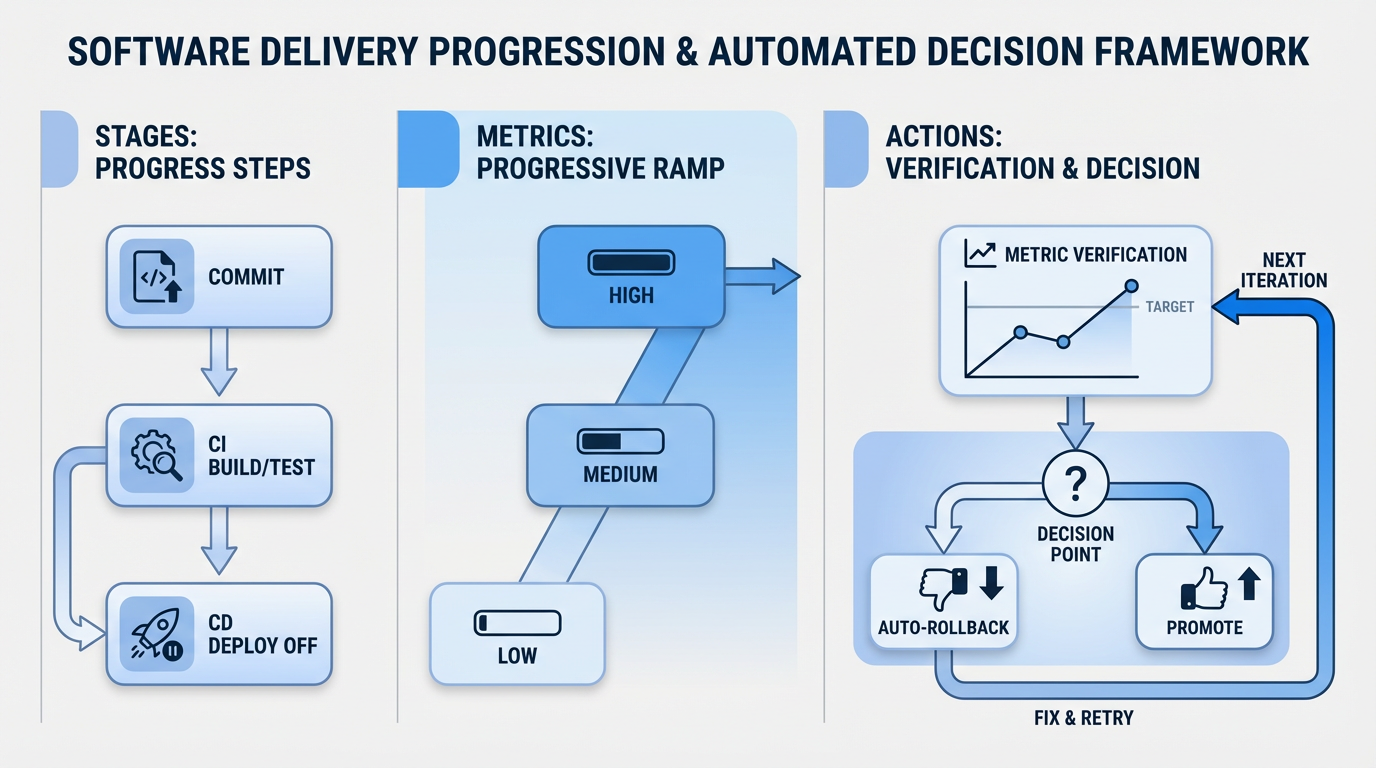
Store experiment rules as code
If experiment settings are stored in spreadsheets or in tribal knowledge, they will drift.
Store flag definitions, targeting rules, metric choices, and rollout policies in version control alongside the application and delivery config.
That gives you:
- A reviewable history of every change
- Cleaner audit trails
- Repeatable rollout patterns
- Fewer ad hoc experiments
- Less cleanup pain later
This is also the right place to enforce policy. Policy as code in CI/CD helps teams standardize approval logic, experiment guardrails, and release controls without forcing every decision through manual review. For broader controls across delivery workflows, DevOps Pipeline Governance fits naturally here.
How an A/B testing framework works in 6 steps
A clean framework does not have to be complicated. It just has to be disciplined.
1. Start with a real hypothesis
Do not test just because you can. Define what you believe will happen and why. For example, reducing the number of fields on signup will increase completed registrations without increasing fraudulent signups.
That kind of hypothesis gives the experiment direction. It also tells you what to measure.
2. Choose one primary metric and a small set of guardrails
Every experiment needs a main outcome metric. It also needs a few metrics that tell you whether the change is causing harm somewhere else.
A solid setup usually includes:
- One primary business metric
- Two to four guardrail metrics
- Optional diagnostic metrics for deeper analysis
3. Build the control and variation
Keep the comparison clean. If you change too many variables at once, the result gets muddy fast. This is one reason feature flags work well in delivery pipelines. They let teams isolate a change, ship it safely, and expose only the behavior they want to test.
4. Split traffic deliberately
Traffic allocation should be planned, not improvised. Early ramps should stay small until the change proves it is stable. From there, teams can widen exposure in steps. If your environment supports more advanced routing, traffic routing for A/B testing, canary, and blue-green deployments can make that progression much easier to manage.
5. Run the experiment long enough to learn something real
Ending a test too early is one of the fastest ways to make a bad decision look smart.
Set expectations up front for:
- Minimum sample size
- Minimum test duration
- Stop conditions for regressions
- Stop conditions for a clear winner
6. Decide what happens next
A useful A/B testing framework does not stop at analysis. It tells the pipeline what to do next. That action might be:
- Promote the change to a larger audience
- Keep the test running
- Pause and investigate
- Roll back automatically
- Retire the variation and document the result
Best practices for A/B testing in DevOps workflows
The best experimentation programs are not just fast. They are predictable.
Here are the practices that matter most:
- Write the hypothesis before the rollout starts. If the team cannot explain what success looks like, the test is not ready.
- Use feature flags as release controls. Deploy first, then decide who sees the change and when.
- Ramp exposure gradually. Start small, then increase only after the data looks healthy.
- Define business metrics and system metrics together. Conversion means very little if latency, errors, or support tickets spike.
- Make rollback automatic where possible. Teams should not need to watch dashboards by hand to know when something is going wrong.
- Document the result even when the test fails. A losing experiment can still save the team from shipping the wrong thing.
- Clean up flags on purpose. Every experiment should have an owner, a review date, and an end state.
This is also where CI performance matters. Faster feedback loops make experiments easier to run and easier to trust. Teams can shorten validation time with tools such as Test Intelligence, Incremental Builds, and Analytics & Insights.
For teams thinking through rollout patterns more broadly, it helps to understand where blue-green, canary, and other deployment strategies fit into the overall delivery model.
Metrics that matter in an A/B testing framework
Not every metric belongs in the decision path. A useful A/B testing framework usually groups metrics into three buckets.
Primary metrics
These answer the main business question.
Examples include:
- Conversion rate
- Signup completion
- Revenue per visitor
- Feature adoption
- Retention
Guardrail metrics
These tell you whether the experiment is causing damage while chasing the primary goal.
Examples include:
- Error rate
- Latency or response time
- Crash rate
- Checkout failures
- Support volume
- Abandonment rate
Diagnostic metrics
These help the team understand why a change won or lost.
Examples include:
- Click-through rate
- Time on task
- Drop-off by step
- Session depth
- API-level health signals
Teams also need a clean way to view these signals together. That is where CD Visualize DevOps Data can help delivery teams line up rollout activity with operational outcomes.
AI-powered automation for safer experimentation
Automation matters because humans are slow at repetitive judgment calls, especially during live rollouts.
In a modern A/B testing framework, automation should help with a few specific jobs:
- Correlate exposure data with health and performance signals
- Flag regressions during percentage ramps
- Enforce promotion criteria consistently
- Trigger rollback when guardrails fail
- Reduce the need for teams to babysit dashboards
This is especially useful during progressive delivery, where the question is not just “Did the feature work?” But also, “Should we widen exposure right now?”
For that part of the workflow, AI-Assisted Deployment Verification is a natural fit. It helps teams move from manual inspection to a more consistent release decision model.
Common A/B testing mistakes in CI/CD
Even the best teams can get caught in some common traps. Most of these mistakes aren't made with bad intentions. They happen when you move too quickly, read early signals too confidently, or think of experimentation as a one-time launch task instead of an ongoing process.
Starting without a clear hypothesis
The analysis will be vague if the team isn't sure what they want to happen. A good hypothesis should say what the change is, who it is for, and what effect it will have. Without that, teams often gather a lot of information but still can't figure out if the test worked.
Only measuring business lift
A variant can make conversions better while quietly hurting performance, reliability, or workflows that come after it. That's why experiments need both outcome metrics and guardrail metrics. If latency, error rates, or support volume go the wrong way, the apparent win may not be worth sending.
Stopping tests too soon
When the numbers start to go in the right direction, it's easy to pick a winner. It's much harder to say that the sample is still too small. Before launching the test, teams should agree on the minimum sample size, runtime, and stop conditions so that the test doesn't end on a whim.
Carelessly running experiments that overlap
When users end up in tests that don't match, the data gets messed up quickly. Rules about mutual exclusion are important. User bucketing that is consistent is also important. When experiments overlap and there aren't clear lines between them, teams can't figure out which change caused the result.
Forget about cleaning up
Flags that are never taken down cause confusion, branch logic, and technical debt. There should always be an exit plan for an experiment. That should include an owner, a date for making the decision, and a clear next step: promote the winner, remove the losing path, and get rid of flag logic that isn't needed anymore.
Ship faster with confidence
Adding an A/B testing framework to your CI/CD pipeline isn't just about adding another tool. It's about making decisions about releases with better signals and less guesswork. When teams separate deployment from release, they have more space to safely test changes. They can learn faster without making every release a risk by using feature flags, progressive delivery, metrics, and rollback logic together. That's what a modern framework is really worth. It helps teams ship, measure, and respond all at once.
Harness supports that model throughout the delivery lifecycle with tools for testing efficiency, managing rollouts, verifying, and governance. To go from basic flagging to a more complete experimentation workflow, you should start by making your rollout process easy to measure, repeat, and control.
A/B testing framework FAQs
Teams usually run into the same questions once they start moving experimentation into the delivery pipeline. These answers cover the practical issues that come up most often, from rollout strategy to measurement and cleanup.
What is an A/B testing framework in software delivery?
It is the set of processes, controls, and measurement tools that let teams compare two versions of a feature, split traffic safely, analyze the result, and act on it inside the delivery workflow.
How is A/B testing different from canary deployment?
Both are progressive delivery strategies, which are complementary. Canary deployment gradually shifts traffic to a new version to reduce deployment risk. A/B testing compares different experiences to learn which one performs better. Ideally, use Canary to safely deploy new versions of your software that include new experiences, and A/B test to see if those experiences are superior.
How long should an A/B test run in CI/CD?
Long enough to reach the sample size and runtime you defined before launch. The right duration depends on traffic volume, metric volatility, and how quickly the team can detect regressions.
Which metrics should teams track in an A/B testing framework?
Track one primary business metric, a small set of guardrail metrics for reliability and user impact, and diagnostic metrics that help explain the result.
How do feature flags support A/B testing?
Feature flags let teams deploy code without exposing it immediately. That makes it easier to target audiences, control rollout percentages, pause experiments, and roll back without redeploying.
How do you prevent experiment debt from building up?
Assign clear owners, set expiration dates, review flags regularly, and clean up experiments once the team has made a decision.

FinOps Savings Optimization: Stop Overspending, Start Saving
Cloud spend is up 40% year-over-year. Your CFO wants answers.
So your team does the thing everyone does — pulls up the console, starts hunting. Orphaned resources. That RDS instance nobody's touched since Q2. A dev environment three engineers have forgotten exists, quietly billing $800 a month.
You find some waste. You kill it. You send a report. Everyone breathes again.
Until next quarter.
Here's the problem with that reflex — you're asking the wrong question.
"Where are we wasting money?" sounds responsible. But "where are we leaving savings on the table?" is the one that actually changes your trajectory. You're not overspending. You're under-saving. That distinction changes what you measure, what you automate, and ultimately what your cloud bill looks like twelve months from now.
The Reactive Trap: Why Traditional FinOps Misses the Mark
Most FinOps programs run in a reactive mode. A budget alert fires, an exec asks an uncomfortable question, or a surprise bill lands. Teams scramble, find the obvious stuff, ship a report, return to delivery work. Until next time.
This is cost management as damage control. It finds something — these exercises usually do. But they systematically miss everything that didn't make enough noise to trigger a review.
Reserved Instances are a clear example. A reactive team reviews commitment coverage quarterly, maybe monthly if they're disciplined. A proactive team treats it as a continuous process — analyzing utilization patterns, forecasting demand shifts, adjusting before inefficiency compounds. The gap isn't a few percentage points. Over a year, that difference on compute alone can be 15% savings versus 35%.
Cloud Cost Savings Strategy: Building a Proactive Framework
Proactive cloud cost optimization runs on three things: continuous visibility, automated governance, and team-level accountability.
Continuous visibility means treating cost data like application performance data. You wouldn't wait for a service to degrade before checking latency. Every resource should map to a team, service, and environment. When something spikes, you should know within hours, not when the monthly bill arrives.
Dashboards aren't visibility — operational discipline is. Before a developer provisions a new database, they should see the projected monthly cost. When a team's weekly spend jumps 20%, someone should be asking why before the week ends.
Automated governance goes further than guardrails. Budget limits stop runaway costs, but savings automation optimizes what's already running. Idle resource detection, snapshot lifecycle management, rightsizing that executes after approval — these are what separate optimizing once from optimizing continuously.
Here's the mental shift: governance isn't a constraint on engineering. When cost controls are baked in, teams move faster because they're not second-guessing decisions. When finance knows optimization runs systematically, they stop sending nervous emails.
FinOps Best Practices: Accountability Beyond Finance
The biggest obstacle isn't technology. It's org structure.
Most companies centralize cloud cost management in a FinOps team or finance. That team generates reports and recommendations. Engineering teams receive them, nod, and file them under "next sprint." Sometimes that sprint never comes.
That structure almost guarantees under-saving. The people who can change architecture and resource allocation aren't tracking savings opportunities. The people tracking opportunities don't have enough context to know what's worth doing now versus later.
What works: embed cost accountability at the team level. Platform teams own the infrastructure baseline — commitments, shared services, networking architecture. Service teams own their marginal costs — compute, storage, data transfer. Both groups have budgets, both have optimization targets, both report on them in the same cadence they use for reliability and delivery. Not as cost-cutting pressure. As engineering ownership.
This also surfaces trade-offs a centralized team can't see. A 10% cost increase might be pure waste for one team and completely justified for another. Only the team building the service knows which is which.
Maximize Cloud Savings Through Preventive Optimization
Reactive FinOps asks: what can we clean up? Proactive FinOps asks: what are we about to waste?
Developers over-provision for testing and forget to scale down. A reactive team writes a runbook, sends a Slack reminder, adds it to the wiki. A proactive team changes the deployment template — test environments scale down automatically after hours, resources created without tags hit an approval workflow. The waste never happens because the system prevents it.
Storage lifecycle policies archive cold data before it accumulates. Commitment analysis runs daily, catching utilization shifts before they hurt savings rates. Anomaly detection flags unexpected resource creation within the hour.
The cloud cost governance model shifts from periodic audits to continuous validation. A pull request that increases projected spend past a threshold needs cost justification before merge. A service blowing its cost budget gets the same escalation as a service blowing its error budget. Cost feedback runs as tight as your CI/CD pipeline.
Harness CCM: Engineering Proactive Cloud Cost Optimization
Harness Cloud Cost Management is built around this proactive model. Not just tracking what you spent — identifying what you should be saving and providing automation to capture those savings continuously.
Visibility maps to how engineering teams actually work. Every resource ties to a service, team, and environment through automatic tagging and Kubernetes label support, with a unified view across AWS, Azure, and GCP. Costs break down by workload, not just account or region.
Budget tracking adjusts dynamically. Teams set budgets tied to their delivery roadmap and the platform forecasts against actual deployment patterns. Anomaly detection surfaces cost increases before they compound, with enough context to separate signal from noise.
Governance enforces optimization without blocking delivery. Idle resource detection finds underutilized instances, and policy controls define what happens next — notify, require approval, or automate rightsizing. Commitment optimization analyzes Reserved Instance and Savings Plan coverage on an ongoing basis, not just when someone remembers to run a report.
Recommendations quantify trade-offs rather than just flagging problems. Teams see the projected savings from rightsizing a specific instance, the risk of reducing commitment coverage, the benefit of moving a workload to spot instances. Informed decisions instead of guesses.
Cost data integrates into deployment pipelines and operational dashboards alongside reliability and delivery metrics — part of how engineering works, not a separate initiative.
Moving from Reactive to Proactive FinOps
This isn't a project with an end date. It's a change in how teams think about cloud spend.
Teams with strong cost visibility make better architecture decisions during planning, not during post-mortems. They pick storage tiers, compute types, and networking patterns based on actual trade-offs instead of defaults. Finance gets predictability — when optimization runs continuously, cost trajectories stabilize and budget conversations stop being about explaining overruns. Platform teams get time back from repetitive cost hygiene and focus on architecture and reliability.
The under-saving vs overspending paradigm isn't semantic. It's a different operating model. Every dollar left on the table through missed savings is a dollar not funding new capabilities, better reliability, or faster delivery.
Start by measuring what you're not saving. Check your Reserved Instance coverage. Calculate the gap between actual commitment utilization and where it should be. Find resources running overnight that could be scheduled off. Quantify what's available through rightsizing and what it would actually take to capture it.
The number will probably be uncomfortable. It should be. That's what reactive FinOps actually costs — not what you're wasting, but the savings you never went looking for.
Learn more about Cloud Cost Management, check out Harness implementation docs, and see the CCM roadmap.
ChainDrop npm Worm Shows Why Valid Provenance Is Not Enough
Dek: A self-propagating npm worm poisoned hundreds of packages and spread through legitimate publishing workflows. The incident exposes a critical distinction for software supply chain security: build provenance can be valid even when the source entering the build is malicious.
Based on public reporting available as of August 5, 2026, at 10:19 a.m. Central Time. Package and version counts may change as researchers continue investigating.
What happened
On August 4, a self-propagating npm worm spread from packages in the widely used keyv and cacheable ecosystem into packages controlled by multiple unrelated organizations.
SafeDep confirmed 2,234 poisoned versions across 444 package names and reported that the worm reached 12 organizations in less than four hours. Four foundational affected packages—keyv, flat-cache, file-entry-cache, and cacheable-request—collectively receive approximately 1.88 billion downloads per month.
Each malicious release added an npm preinstall hook that executed before installation completed. The payload searched developer machines and CI/CD environments for GitHub, npm, cloud, HashiCorp Vault, Kubernetes, database, and other credentials. It could also inspect GitHub Actions runner memory and use stolen npm publishing access to modify and republish additional packages.
Researchers also identified persistence mechanisms involving VS Code and Claude Code project configuration. Opening an affected repository in those tools could trigger malicious code independently of a normal package installation.
One of the most important response details is counterintuitive: the malware installed a monitor that could execute an attacker-controlled command when a stolen GitHub token stopped working. Teams therefore need to locate and remove that persistence mechanism before revoking or rotating credentials.
Why this matters
ChainDrop did not rely only on unsigned artifacts or an obviously unauthorized release process.
Some malicious packages were published through legitimate GitHub Actions and npm OpenID Connect trusted-publishing workflows. Those releases retained valid SLSA provenance because the authorized build system had, in fact, produced them.
The provenance was not technically false. It accurately identified the workflow that built and published the artifact. The failure occurred earlier: malicious source or workflow inputs had already entered the trusted process. As Socket summarized, provenance attested to build integrity, not source integrity.
That distinction matters for engineering and security leaders. Signing and attestation are important controls, but they cannot independently answer several essential questions:
- Was the source change reviewed and approved?
- Did the release correspond to an expected commit, pull request, and tag?
- Were workflow files or project configuration modified unexpectedly?
- Should this dependency be allowed to execute an install script?
- Did the build behave consistently with the package’s intended purpose?
- What identities and secrets could the build runner access?
A delivery system can be cryptographically verifiable and still faithfully build malware.
The business consequences extend beyond one poisoned dependency. Credentials taken from a developer workstation or runner can create access to source repositories, registries, cloud environments, clusters, secret stores, and downstream release workflows. What starts as a dependency incident can quickly become an identity compromise, a release-integrity problem, and an organization-wide response effort.
How teams can reduce the risk of similar incidents
Teams should treat provenance as one layer in a broader evidence chain rather than as a standalone trust decision. Provenance confirms how an artifact was produced, not whether the underlying source code is trustworthy.
Govern source and workflow changes. Protect branches, require independent review for release-related code, and apply additional scrutiny to package manifests, lifecycle scripts, CI workflows, editor tasks, and AI-agent configuration. A valid signature should not override an unexpected or unreviewed change.
Correlate releases with source events. Before permitting publication or promotion, verify that an artifact maps to an approved commit, pull request, tag, workflow version, and expected build identity. Unexpected patch releases or artifacts without corresponding source activity should be investigated.
Restrict install-time execution. Disable npm lifecycle scripts in CI where they are unnecessary. Where scripts are required, isolate their execution, monitor network and process activity, and explicitly allow only known behavior.
Use ephemeral, least-privilege identities. Prefer short-lived credentials with narrowly scoped permissions. A build that only needs to read dependencies should not have standing access to publish packages, modify repositories, enumerate cloud secrets, or reach production infrastructure.
Isolate runners. Use disposable build environments, minimize credentials present in memory, restrict outbound connectivity, and rebuild runners after suspected exposure. Long-lived, broadly privileged runners increase both the value of stolen credentials and the worm’s opportunity to persist.
Gate artifact publication and promotion. Evaluate more than signature status. Policies should consider source review, dependency risk, suspicious new scripts, unusual package behavior, scanner findings, and the relationship between the source repository and published artifact.
For this incident specifically, organizations should first hunt for the reported token-monitoring persistence, editor hooks, package IOCs, and unexpected releases. Credential revocation and rotation should then occur from a known-clean environment, followed by rebuilding affected systems and downstream artifacts.
How Harness could help
Harness positions software supply chain security as a combination of dependency governance, security testing, policy enforcement, artifact controls, and delivery evidence not merely the presence of an attestation.
Harness Supply Chain Security supports assessing software supply chain posture, governing open source dependencies using software bills of materials, and managing artifact promotion with SLSA attestations. Harness messaging also emphasizes workflows for rapidly responding to vulnerable or compromised components.
The broader Harness platform can enforce organizational policies through Open Policy Agent, apply security gates within delivery pipelines, use fine-grained access controls, and maintain audit trails. Harness Artifact Registry is designed to centralize artifacts and dependencies while enforcing quality and security standards.
Applied to an incident like ChainDrop, those capabilities could help teams:
- govern which open source dependencies and package versions are permitted
- enforce a minimum package-age policy to delay adoption of newly published dependency versions
- require security and policy checks before publishing or promoting artifacts
- correlate attestations with approved delivery processes
- limit problematic packages through automated policy enforcement
- identify where affected components are used
- preserve audit evidence for investigation and remediation
These controls would not make provenance infallible or guarantee prevention. They could, however, strengthen the surrounding guardrails, reduce exposure, improve visibility, and accelerate remediation when trust signals conflict.
The bigger trend
ChainDrop reflects three converging trends.
First, software supply chain attacks increasingly target identities rather than only source code. npm tokens, GitHub credentials, cloud identities, and CI/CD permissions let attackers move through the same trusted paths maintainers use.
Second, developer environments now include more executable surfaces. Package lifecycle hooks, IDE tasks, automation files, and AI coding-agent configuration can all become persistence or propagation mechanisms.
Third, security decisions increasingly require combined evidence. Provenance, code review, dependency intelligence, workflow history, policy results, and runtime behavior each answer different questions. None is sufficient by itself.
Harness take
ChainDrop shows that “signed” and “safe” are not synonyms. Modern software delivery needs to establish continuity of trust from the proposed source change through the workflow, artifact, promotion decision, and runtime—not simply verify the identity of the pipeline that produced the final package.
Closing
ChainDrop does not make provenance unimportant. It clarifies its proper role.
Attestations remain valuable evidence about how software was produced, but trustworthy delivery requires controls before and after the build: reviewed source, governed workflows, constrained identities, policy-gated artifacts, isolated execution, and evidence from runtime behavior.
Harness helps organizations connect these controls across the software delivery lifecycle so that a valid signature becomes one input to a risk decision—not the entire decision.
Key takeaways
- SafeDep confirmed 444 affected npm package names and 2,234 poisoned versions as of its August 4 analysis.
- The worm executed during package installation and targeted developer, CI/CD, cloud, registry, Vault, and Kubernetes credentials.
- Legitimate OIDC publishing workflows produced artifacts with valid SLSA provenance after malicious inputs entered the pipeline.
- Teams should remove the reported token-revocation persistence before rotating credentials.
- Provenance should be combined with source governance, policy gates, dependency controls, least-privilege identities, and runtime evidence.
FAQ
What is the ChainDrop npm worm?
ChainDrop is the name used for a self-propagating npm supply chain campaign that inserts credential-stealing malware into packages and uses compromised publishing access to infect additional packages.
How can malware have valid SLSA provenance?
Provenance verifies information about the build process and identity that produced an artifact. When an authorized workflow builds already-compromised source, the resulting attestation can be valid even though the artifact is malicious.
What should teams do if they installed an affected package?
Treat the relevant developer machine or build runner as potentially compromised. Hunt for the published persistence mechanisms and indicators first, then revoke and rotate exposed credentials from a clean environment and rebuild affected systems and artifacts.

Automate Incident Intake and Start Response in Seconds
Manual intake eats the first 10 to 30 minutes of an incident. Harness AI SRE runs it as automation and gives those minutes back to your responders.
The first minutes go to setup
When an alert fires, most teams spend 10 to 30 minutes on coordination before anyone looks at the problem. The pattern repeats on every incident:
- An alert arrives from PagerDuty, Datadog, or another monitor
- Someone opens a Jira or ServiceNow ticket
- Someone spins up a Slack channel and pulls in responders
- Someone starts a Zoom bridge and pastes the link
- Someone hunts down the runbook or the last incident's notes
None of that work changes between incidents, and the delay compounds on every high-severity page.
Runbooks turn intake into a triggered workflow
In AI SRE, a runbook is an automated workflow that runs when a trigger fires. You build it in a visual workflow editor instead of writing glue code, with more than 50 pre-built integrations for its action steps. When the trigger condition is met, the runbook executes its steps in order and records each one.
A single intake runbook can:
- Create a ticket in Jira or ServiceNow
- Open a Slack channel and invite the right responders
- Start a Zoom bridge and post the join link to the channel
- Set severity, category, and impacted-service fields on the incident
- Write every action to the incident timeline as it happens
Setup that used to take 15 minutes runs in seconds, and the timeline leaves an ordered record for the post-incident review.
What sets the trigger off
A runbook fires on any of three signals:
- An inbound webhook from a monitoring or alerting tool. On the intake side, AI SRE ships ingestion templates for more than 20 alert sources, including Datadog, PagerDuty, BigPanda, Grafana, New Relic, Sentry, and Opsgenie, plus a generic template for any tool that posts JSON.
- Manual creation of an incident or alert, or an on-demand run of the runbook.
- A change to an existing incident, such as severity, status, or impacted services.
You scope which alerts launch a runbook with conditions. A trigger can filter on fields, tags, or thresholds through a rule builder or a CEL expression, so a Sev3 CPU blip and a Sev1 outage take different paths. Inside the runbook, a conditional step branches further: when severity is critical, page the secondary on-call team; otherwise the standard logging path runs.
The difference: response sits on your change data
Most incident tools begin with no context. They register that an alert fired and little else.
Platform teams already produce the answer. You build artifacts, deploy them through pipelines, and merge pull requests, and that record is the first place to look when something breaks. AI SRE reads it directly through the Deploy Change Investigator, which connects three streams:
- Build events carrying artifact version, commit SHA, and repository
- Deploy events carrying the services, environment, and versions that shipped
- The pull requests merged into the deployed branch
Once those are linked, the platform can name the deploy that was live when the incident started and diff the pull requests between the last healthy release and the current one. An AI agent reasons over that change history alongside recent feature-flag changes and related alerts. It then surfaces the deploys, PRs, and flags most likely behind the incident, each with a confidence level. It answers the first question in any incident, what changed, from data you already generate.
Runbook actions can act on that answer, too. A step can trigger a Harness pipeline directly (for example, to roll back the suspect deployment), so the same workflow that opened the incident can start the fix.
How to set one up
- Build the runbook. Lay out the intake steps in the visual editor and pick the integration each step uses.
- Add triggers. Point the runbook at the webhook sources and incident events that should launch it, then add conditions so only the right alerts qualify.
- Add actions. Define what runs on trigger: create the ticket, open the channel, start the bridge, set the fields, page the on-call. Every action lands on the timeline.
Start with intake, then keep going
Automating intake removes the fixed coordination cost from the start of every incident and gets responders to investigation in seconds. Because AI SRE sits on the build, deploy, and change data your pipelines already produce, it does more than open the channel faster. It hands the team a first read on what changed.
Human-in-the-loop stays the default. Automation clears the setup and surfaces the likely cause; people decide and drive the resolution.
See how Harness AI SRE automates incident intake or build your first runbook today.
FAQs
What is a runbook in incident response?
A runbook is an automated workflow that runs when a trigger fires. Instead of writing custom glue code, you build it in a visual workflow editor on top of pre-built integrations, and it executes a defined set of steps in order: creating tickets, opening Slack channels, starting bridges, and more, every time it's triggered.
What triggers an incident runbook to run?
A runbook fires on one of three signals: an inbound webhook from a monitoring tool like Datadog or PagerDuty, manual creation of an incident or an on-demand run, or a change to an existing incident such as a severity or status update. Conditions let you scope which alerts actually launch the runbook, so low-severity blips and major outages can follow different paths.
How does AI SRE reduce incident response time?
AI SRE automates the coordination work that normally eats the first 10 to 30 minutes of an incident (ticket creation, Slack channel setup, bridge links, and field tagging) and runs it in seconds instead. It also connects build, deploy, and pull request data through the Deploy Change Investigator, so responders get a first read on likely causes instead of starting from zero.
What is the Deploy Change Investigator?
It's the part of AI SRE that links three data streams: build events, deploy events, and merged pull requests, so the platform can identify which deploy was live when an incident started and diff the changes since the last healthy release. An AI agent reasons over that history, along with feature-flag changes and related alerts, to surface likely causes with a confidence level.
Which monitoring tools integrate with AI SRE?
AI SRE ships ingestion templates for more than 20 monitoring and alerting sources, including Datadog, PagerDuty, BigPanda, Grafana, New Relic, Sentry, and Opsgenie, plus a generic template for any tool that posts JSON.
Can a runbook trigger a rollback automatically?
A runbook step can trigger a Harness pipeline directly. For example, to roll back a suspect deployment so the same workflow that opens the incident can also kick off the fix. That said, human-in-the-loop remains the default: automation gets responders to the starting line and surfaces likely causes, but people make the call and drive resolution.
Does automating incident intake replace human responders?
No. Automation handles the repeatable coordination work (tickets, channels, bridges, timelines), so responders can start investigating immediately. Decisions and resolution still sit with people; AI SRE's job is to remove setup time, not judgment.

Terraform Scalability: When IaC Outgrows Your Setup
Quick question: can you envision how Terraform scalability issues you when your third team tries to apply changes at the same time, locks the state file, and someone's Friday evening turns into a debugging session? Maybe that hits a little too close to home. The first 500 resources feel manageable. The next 2,000 teach you what "workspace limitations" actually mean in production.
When infrastructure code grows past a certain threshold, the tools and workflows that worked for small teams stop working. State files balloon into multi-megabyte JSON blobs. Plan times stretch from seconds to minutes. What used to be a quick `terraform apply` becomes a risky operation requiring coordination across time zones. The infrastructure as code bottleneck isn't hypothetical. It's the moment your team starts avoiding changes because the process has become unpredictable.
Why Terraform Scalability Issues Emerge
Most scalability problems stem from decisions made when the codebase was small. A single monolithic state file works fine for 10 resources. For a thousand, it creates a serialization chokepoint. Every change requires locking the entire state, even if you're only modifying a security group in one region.
Remote state backends help, but they introduce their own failure modes. S3-backed state with DynamoDB locking works until someone's network hiccups mid-apply and leaves a stale lock. Cleaning up requires manual intervention and tribal knowledge about which lock IDs matter. At scale, these incidents compound. What was once an edge case becomes Tuesday.
Module sprawl accelerates the problem. Teams copy-paste working configurations, tweaking variables for each environment. Over time, you end up with dozens of nearly identical modules that diverged in subtle ways. When a breaking change hits a core provider, you're patching every fork individually. Version drift becomes a compliance risk.
State Management at Scale Breaks Assumptions
Terraform state management at scale exposes the implicit contract between your code and reality. State files aren't just metadata. They're the single source of truth about which resources exist, their current configuration, and the dependency graph connecting them. When that file grows past a certain size, read performance degrades. Plan operations slow down because Terraform has to parse and validate every resource, even if you're only touching one.
Splitting state helps, but it shifts complexity. You trade a monolith for a distributed system of loosely coupled state files. Now you need a mental model of which workspace controls which resources. Documentation becomes critical because the implicit coupling between workspaces isn't enforced by the tooling. A misconfigured variable in one workspace can cascade into another through shared data sources or implicit dependencies.
Remote backends introduce latency. If your state is in S3 and your CI runners are in another region, every read adds round-trip time. Multiply that by hundreds of resources and the cumulative effect is noticeable. Teams start optimizing for fewer plan runs, which ironically makes each run riskier because more changes accumulate between tests.
Collaboration Friction Increases with Team Size
When five engineers share a single workspace, coordination is informal. Someone shouts in Slack before running an apply. By the time you have fifteen people across three continents, informal processes collapse. The infrastructure code management problem becomes an access control and workflow problem simultaneously.
Without proper guardrails, junior engineers can accidentally destroy production resources. The blast radius of a bad apply is proportional to the size of the state file. In a monolithic setup, one mistake can ripple across hundreds of resources. Policy enforcement becomes necessary, but Terraform's native tooling offers limited help. You need something outside the core workflow to validate plans before they execute.
Terraform workspace limitations compound this. Workspaces were designed for environment separation, not collaborative workflows. They don't enforce approval gates, policy checks, or audit trails. If you need those capabilities, you're building them yourself or adopting a platform that provides them natively.
When Standard Tooling Stops Scaling
The breaking point varies by team, but the symptoms are consistent. Plan times stretch past acceptable thresholds. State lock contention increases. Engineers start working around the tooling instead of with it. Someone proposes splitting the monorepo into per-team repositories, which solves the immediate pain but fragments governance.
This is the moment teams evaluate Terraform alternatives or consider an OpenTofu migration. OpenTofu offers a community-governed fork with a stable open-source foundation, which matters if licensing uncertainty is a concern. But switching engines doesn't solve workflow problems. A poorly structured codebase remains poorly structured regardless of which binary executes it.
The real question isn't which IaC engine to use. It's whether you're managing infrastructure code or merely running it. If your workflow is `git clone,` `terraform init,` `terraform plan,` and `terraform apply` in a loop, you're missing the orchestration layer that enables teams to scale safely.
How an IaC Management Platform Addresses Scale
An IaC management platform like Harness IaCM treats infrastructure code as a first-class workflow problem, not just a tooling problem. It provides the orchestration, governance, and collaboration features that become non-negotiable past a certain scale.
Harness IaCM supports OpenTofu, Terraform, and Terragrunt, which means you're not locked into a single engine. The choice of execution runtime becomes an implementation detail. What matters is the management layer: default pipelines for plan and apply operations, workspace templates that enforce consistency, and variable sets that reduce configuration drift.
State management moves from a manual coordination problem to a platform-managed concern. Harness handles backend configuration, workspace isolation, and access control through policy. Drift detection runs continuously, flagging resources that diverged from code without requiring manual audits. When someone needs to troubleshoot, they're working from a unified interface with full audit history, not SSH'ing into CI runners and reading logs.
The Module and Provider Registry centralizes reusable components. Instead of maintaining dozens of forked modules, teams publish versioned modules to a shared registry. Consumers reference specific versions, which prevents breaking changes from propagating unexpectedly. Dependency management becomes explicit and trackable.
Policy enforcement integrates directly into the workflow. You can block applies that violate security policies, fail compliance checks, or exceed cost thresholds. These gates trigger before any changes reach production, which shifts risk left in the development cycle. Engineers get immediate feedback instead of discovering issues during post-deployment audits.
The Harness IaCM product page details the full feature set, and the IaCM documentation walks through real implementation patterns. If you're curious about where the platform is headed, the roadmap shows upcoming capabilities around enhanced governance and multi-cloud orchestration.
Moving Beyond the Bottleneck
The infrastructure as code bottleneck isn't about Terraform's limitations, but the gap between what basic tooling provides and what production-scale operations require. Small teams can manage with scripts and conventions. At scale, you need structured workflows, enforced policies, and visibility into who changed what and why.
Guardrails don't slow teams down. They enable speed by reducing the cognitive load of coordinating changes across distributed systems. When engineers trust that the platform will catch obvious mistakes before they reach production, they ship with confidence. The alternative is a culture of fear where every apply feels like defusing a bomb.
If your team is feeling the pain of Terraform scalability issues, the solution isn't to abandon infrastructure as code. It's to adopt tooling that matches the complexity of what you're building.
Start by auditing your current workflow: Where do engineers waste time? What manual steps could be automated? Which failure modes recur most often? The answers will point toward the specific capabilities that matter most for your context.
Modern IaC governance and compliance aren't optional at scale. They're the difference between infrastructure that evolves safely and infrastructure that becomes unmaintainable. The teams that figure this out early gain a compounding advantage. Those who wait pay an escalating tax on every change.
.png)
When Your SQL Table Outgrows Itself: Lessons from Refactoring at Scale
At Harness, we build an AI-powered software delivery platform, and test result data is core to how we help engineering teams ship faster. The table that stores it started small: one row per record, all the context right there on the row. Simple, readable, and it worked. Until it didn't.
This is the story of how we refactored it, what we learned, and what I'd tell you to watch for in your own systems.
What We're Working With
Within Harness Continuous Integration, we built a backend service, the Test Intelligence service (TI Service), that powers three critical features:
- Test Intelligence: Automatically selects only the tests that need to run based on code changes.
- Test Management: Tracks test trends, flakiness patterns, and health metrics.
- Flaky Test Detection: Identifies unreliable tests that pass and fail inconsistently.
These features help engineering teams ship faster by reducing test execution time and improving test reliability - but they only work if we can process and analyze test results at a massive scale.
Every time a CI pipeline runs, it produces test results in standard formats like JUnit XML: which tests ran, which passed or failed, how long each took, and any output they produced. Each report belongs to a build, each build belongs to a pipeline, each pipeline belongs to a project, and so on up to the account level. A busy organization can produce thousands of builds per day, with reports ranging from a handful of records to tens of thousands.
Why the Original Design Made Sense
When you're building a new product with evolving requirements, simplicity wins. The first version of our report table used a flat, denormalized approach: one row per test result, with all the context stored as text strings directly on each row. Every level of the hierarchy lived right there on the row. If you've worked with document databases, this pattern looks familiar. It's essentially how you'd model a collection in a NoSQL store: every record is self-contained, carrying all the context it needs.
In the early days, before you know exactly what queries you'll need to support, this approach has real advantages. Inserts are dead simple: one row, all the data, done. Reads don't need joins. The schema is easy to reason about because it is the data. When you have thousands of rows, queries are fast, and the duplication barely matters. This is a perfectly valid design until the data grows. And ours did.
The Cracks
As the data scaled to millions of rows, the flat design started working against us. For a pipeline running 10,000 tests, every row carried the same hierarchical scope strings; that's 10,000 copies of identical context. Here's what started breaking:
- Every summary was a full scan. Want a count of passed vs. failed for a build? Scan every row, aggregate on the fly. No pre-computed totals anywhere.
- String comparisons on everything. Queries filtered on text columns across millions of rows. No integer keys, no index-friendly joins. Structural identifiers like account, project, and pipeline names were stored as repeated strings on every row instead of integer references. String comparisons take more CPU cycles and are less cache-friendly than integer comparisons - at millions of rows, queries were roughly 10x slower than they needed to be.
- API latency grew with the payload. The write handler inserted one row per test result inline in the HTTP request. A report with 50,000 results meant 50,000 INSERT statements before the API could respond.
- Massive duplication. About 93% of the storage on each row was repeated scope strings - the same values, over and over.
- Hot and cold data mixed together. Test output (stdout, stderr - sometimes very large) lived alongside lightweight metadata. Queries that only needed a count still had to wade past blob-sized columns.
These are smells. Individually, they're manageable. Together, at scale, they compound into something that's hard to patch.
But here's the thing: we only saw these clearly because we stress-tested. Before we call something "production-ready" at Harness, we load-test every API and processing path, pushing each to its limits. Not just typical load, but burst traffic - what happens when a thousand pipelines finish at once? What happens when a single report has 100,000 test results instead of 100? This approach comes from experience. We've seen systems fall over under real-world load that never appeared in testing. So we don't guess. We measure. We break things in test environments so they don't break in production. Load testing tells you exactly where your ceilings are and which to raise first.
The Principles We Followed
Before jumping into a rewrite, we defined the principles that would guide every decision. These apply to any system that ingests high-volume data behind an API.
- Keep API calls bounded. Never do O(N) work in the request path. Our old handler's latency and memory usage scaled with the number of records - processing each test meant keeping all that data in memory during the request. When multiple large reports came in concurrently, the service would crash with out-of-memory errors. Even when it didn't crash, slow-running requests would block others, causing API calls to hang and eventually timeout after minutes. The fix: make the API do a fixed number of operations and return immediately, whether the report has 100 records or 100,000. Store the input, return fast, process later.
- Offload variable work to workers. Everything proportional to data size runs in a background worker pool, decoupled from the API via a queue. Producer and consumer scale independently.
- Bound memory explicitly. Every component gets a hard cap. Process in fixed-size chunks and release between chunks. If memory usage is proportional to input size, you will eventually run out.
- Stream, don't buffer. Decode one record at a time. Our old path deserialized the full payload, then re-serialized it for storage- holding the data in memory twice. The new path streams directly from the HTTP body to compressed storage with roughly 32 KB of fixed overhead.
- Pre-aggregate at write time. A counter increment during a write is negligible. A full scan during a read is not. We maintain running totals directly on each execution row - summary queries become a single indexed lookup.
- Use integer foreign keys over string matching. Normalize once, join cheaply forever. A 4-byte integer comparison is orders of magnitude faster than comparing variable-length strings, and storage per row dropped from roughly 400 bytes to about 28.
- Design for horizontal scaling. Vertical scaling has hard limits. We designed for horizontal: stateless workers, distributed coordination via locks with TTL, and work that can be split across instances. When load increases, add instances, not resources.
What Changed - The Big Picture
The architectural shift boils down to one idea: separate the "accept" from the "process."
The Data Model Shift
The flat table with repeated strings became a set of normalized tables joined by integer foreign keys.
Key Moves on Writes
- Normalized schema: Small tables joined by integer foreign keys, replacing one wide table with repeated strings.
- Delta processing: Each upload is processed as a delta and merged incrementally—no double-counting, concurrent-safe.
- Auto-scaling worker pool: Workers scale up with load and down after idle. Distributed locks prevent duplicate processing.
Key Moves on Reads
- Pre-aggregated summaries: Counters maintained at write time mean summary queries hit a single row, no scanning.
- Hybrid tiered reads: Small reports are read from compressed blobs and streamed through memory one record at a time. Large reports are stored as columnar files and queried by an analytical engine that only reads the columns needed—a count query never touches output columns.
- Memory-bounded pagination: Instead of loading a full report to paginate, we use a two-pass approach: a lightweight first pass collects just enough metadata to filter and sort, then a second pass reads full data only for the requested page. Memory stays bounded regardless of report size.
Performance Improvements
What to Watch For in Your Own Systems
If you're running a service that ingests detail data and serves aggregated views, here's a quick checklist:
- Are your summary queries scanning all detail rows? If getting a count requires touching every record, you need pre-aggregation.
- Is your API latency proportional to input size? If bigger payloads mean slower responses, you're doing too much work inline.
- Are you repeating the same strings on every row? That's a normalization opportunity—and the savings compound fast.
- Are you buffering entire payloads into memory? Stream when you can. Your memory profile should be constant, not proportional.
- Do your workers scale with demand? If it takes minutes to ramp up, you're leaving throughput on the table during burst load.
These patterns aren't unique to the report data. They show up anywhere you have high-cardinality detail tables behind an API - logs, events, metrics, audit trails.
And one more thing: this isn't the last refactor. At 10x or 100x the current scale, new bottlenecks will surface in different places, and the solutions will look different. That's fine. The goal is to define the requirements you need to support right now, find the right way there—even if that means a refactor—and leave room to evolve. No design is forever. Solve today's problem well, and grow from there.
--- A more technical deep dive ---
How It Actually Happened
Working with AI
We used AI extensively throughout this refactor, not just for writing code, but as a design partner. The process involved many back-and-forth iterations: propose a solution, challenge it with edge cases, refine, and repeat. The key difference from working solo was that we pushed every proposed design to handle 100% of cases, not just the 80% we might have settled for without that collaboration.
We went through 3-4 different refactoring designs before landing on the final approach. Each iteration surfaced assumptions that didn't hold or trade-offs we hadn't considered. The AI helped us explore those alternatives more thoroughly than we would have on our own. That said, AI didn't eliminate the hard parts. Testing remained a challenge, so we planned comprehensive unit and integration tests up front before starting implementation.
Design Philosophy
Our main goal was to preserve API contracts - same inputs, same outputs - while completely changing how the internals worked. We also made a conscious decision that API response time should be bounded and predictable. This led to two key strategies:
- If the work can be done asynchronously, push it to a worker. The API stores the input and returns immediately. Background workers handle the variable processing.
- If the work needs to be done synchronously, reconsider the data format. Sometimes we keep data in formats that are easy to query ad hoc but expensive to compute on every request. If you're aggregating the same raw data on every API call, you're doing it wrong. Pre-process it asynchronously and store a ready-to-serve report instead.
We also chose to process reports incrementally. Reports arrive over time - sometimes in chunks from parallel test runners, sometimes from retries. Instead of waiting for everything to arrive before processing, we merge incrementally.
Key Technical Choices
- Hybrid storage: Small reports as compressed blobs directly in the database and large reports as columnar files in object storage.
- In-process analytical engine: We chose an embedded analytical engine (DuckDB) instead of an external database because it eliminated a network hop and let us read columnar files directly from signed object storage URLs.
- Incremental aggregation and merge: Process each upload as a delta. When a new step report arrives or updates, we compute just that step's contribution and merge it into the running totals. This keeps memory bounded.
- Uniform summary storage: We store summaries for builds and steps in the same table, using a special marker value to distinguish them, keeping the query layer simple.
What We Learned from Scale Testing
We ran the system through heavy load testing - pushing services to their limits - and several issues surfaced that we wouldn't have caught otherwise.
Database insert performance degraded with table size.
Tables that receive heavy writes slow down as they grow, especially if they have indexes and foreign keys. Every insert validates constraints, updates indexes, and writes to the database's write-ahead log (a sequential record of all changes for crash recovery). At high concurrency, workers contend for locks on the index and the write-ahead log, resulting in reduced throughput. Our solution was a staging pattern: workers insert into a separate staging table with no indexes or foreign key constraints. They fire and forget. A single background worker periodically batch-processes rows from the staging table into the main table.
ID lookups for new objects became a bottleneck. The insert-and-query pattern in the same transaction was extremely heavy on the database. We switched to a query-first pattern: first, select all existing IDs in a batch. Then insert only the objects that are missing. Finally, query again to get IDs only for the newly inserted rows.
Worker auto-scaling was too slow. During a traffic burst, it took almost 6 minutes to ramp from minimum to maximum workers. We changed the algorithm to calculate how many workers were actually needed (based on queue depth and current capacity) and spin them all up at once. Scaling became immediate.
Migration Strategy
Using feature flags, we controlled the rollout per customer, directing data to both the old and new systems during the transition. The strategy was simple: redirect writes first, then reads. This prevented data loss. Once we had confidence in the new system's correctness, we shifted read traffic over.
Closing Thought
Refactors aren't set in stone. You can refactor the refactor if needed, which we did during this exercise. Don't be afraid of it, but do it when it's actually needed - when the system tells you it's time, not because the architecture feels imperfect. In some cases, it's needed. This was one of them. Learn more about Harness CI.

Infrastructure Breaks After Deployment: Why Day 2 Operations Demand a Control Plane
Most teams think infrastructure problems start during provisioning. They're wrong. Infrastructure breaks after deployment—in what the industry calls "day 2 operations."
You provision an EC2 instance. It works. Then someone makes a console change at 2 a.m. during an incident. Or configuration drifts between what Terraform declares and what's actually running. Or Ansible doesn't see the infrastructure dependencies it's trying to configure. And suddenly, your infrastructure is in an undocumented state that nobody fully understands.
The core problem is simple: most organizations run multiple tools—Terraform, Ansible, CI/CD platforms—each managing infrastructure in isolation. There's no single system thinking about correctness end-to-end. State is defined once but never reconciled. Control is assumed at every layer but enforced nowhere.
This is where infrastructure control planes become essential.
The Day 2 Operations Problem: When Infrastructure Diverges from Reality
Here's what happens in most organizations. Day one looks great: infrastructure gets provisioned, policies are in place, everything deploys successfully. Day two is where it falls apart.
First, console changes creep in. A firefighter needs to test something quickly or fix an incident at 3 a.m., so they click a change directly into AWS or GCP instead of going through the pipeline. That's the spark. But it's not the real problem.
The real problem is that nothing in your tool chain was watching for it in the first place. Your Terraform management tool has no idea what happened. Your CI/CD platform sees no change. Your Ansible configuration assumes a specific state that's no longer true. The systems operate in silos.
Then comes the second wave: incidents occur, you make changes to fix them, but you don't remediate those changes back into your Infrastructure as Code. So the same incident pops back up weeks later. Your infrastructure state file doesn't reflect reality. Cost balloons unexpectedly. Compliance checks fail because nobody knows what's actually deployed.
This is infrastructure drift, and it's the symptom of a broken control model.
The Broken Model: Control Assumed, Never Enforced
Think about the infrastructure lifecycle in most organizations:
Coding — You write Infrastructure as Code using Terraform, OpenTofu, or CloudFormation.
Provisioning — Terraform applies your code, but it's isolated. It has no awareness of what happens next.
Configuration — Ansible configures the infrastructure, but it has no awareness of infrastructure dependencies or what Terraform did.
Deployment — CI/CD deploys your application, often blind to the infrastructure configuration happening in parallel.
Governance — Policy tools like Open Policy Agent or Sentinel scan each step independently, but nothing ties policies across the entire workflow.
The pattern is consistent: state is defined but never enforced across the system end-to-end.
Most teams assume control exists at each layer. Security assumes policies are enforced. DevOps assumes CI/CD has visibility into infrastructure. Platform teams assume nothing will diverge from the declared state. But assumption is not enforcement. When things break—and they will—there's no unified system to catch it.
The Solution: A Control Plane That Continuously Reconciles State
A control plane sits across provisioning, configuration, and deployment. It does two critical things: it continuously reconciles desired state against actual state, and it enforces policy before anything is allowed to move to the next stage.
Concretely, this means:
Continuous Reconciliation — Drift is caught in hours or minutes, not at the next quarterly review. If someone changes an EC2 instance size in the console, your system detects it immediately and alerts you or automatically remediates it.
Policy Enforcement at Design Time — Policies aren't a side process security runs sporadically. They're baked into every stage. If someone tries to provision an oversized instance that violates cost policy, the system blocks it before Terraform plan even runs—like a linter catching a syntax error.
Unified Ownership and Context — When an infrastructure change moves through provisioning, configuration, and deployment, ownership and context are preserved. If you define RBAC at the provisioning stage, that same RBAC applies at the configuration and deployment stages. There's no handoff where context is lost.
Only Compliant Infrastructure Reaches Production — This is the line that resonates with security and compliance leaders. Non-compliant infrastructure literally cannot reach production. It's binary, enforceable, and auditable.
From Silos to Unified Automation: The Practical Impact
Here's what this looks like in practice. You're using Terraform to provision infrastructure, Ansible to configure it, and Jenkins or GitHub Actions to deploy applications. Normally, these tools never talk to each other. You manually coordinate changes across them.
With a unified infrastructure control plane, everything happens in one place. You provision with Terraform, configure with Ansible, and deploy with CI/CD—all in a single orchestrated pipeline. Policies run at every stage. Cost estimation happens before approval. Security scanning is mandatory. Drift is detected automatically.
The result: one platform team can realistically stand behind hundreds of policies and review every change in real time, instead of a handful of reviewers trying to catch everything that slips through.
Where AI Agents Accelerate the Model
This is where Harness AI becomes powerful. Harness brings together context across your code, infrastructure, configurations, deployments, policies, and the broader software delivery lifecycle giving AI a complete understanding of how your systems operate.
Harness AI already includes specialized platform agents and AI-powered capabilities like DevOps Agent and AppSec Agent that help teams reduce manual effort, make better decisions, and automate complex software delivery workflows. With more AI agents and capabilities coming, Harness is continuing to expand what teams can safely delegate to AI.
What makes Harness AI different for infrastructure is its deep, unified context. It does not operate from isolated prompts, schemas, or point-in-time tool queries. It understands the relationships between code, infrastructure, deployments, policies, dependencies, and organizational standards.
That context enables Harness AI to deliver results that are more reliable, explainable, and governed, helping engineering teams move faster and remediate infrastructure without sacrificing control.
The Path Forward: Treat Infrastructure Like Product
The north star most platform and engineering leaders are chasing is simple to state, hard to do: treat infrastructure as code like a product.
This means infrastructure goes through the same golden path pipeline as application code. Policy checks. Cost estimation. Approvals. Audit trails. Full visibility. Not a side process, but the same process.
When infrastructure follows this model, day 2 operations stop being a crisis. Drift is caught and remediated automatically. Costs are controlled before they spike. Compliance is enforced, not aspirational. And teams can move faster because the governance is built in, not bolted on.
The infrastructure that breaks after deployment isn't a technical problem—it's a control problem. Fix the control model, and everything else follows.
Ready to fix your infrastructure control model? The teams that treat infrastructure as a governed product, not a manual process, are the ones that scale safely. Learn how to unify Terraform, Ansible, and CI/CD governance in one control plane.
FORM SUBMISSION THANK YOU MESSAGE
Thank You Message Copy:
"Thanks for downloading! You've taken the first step toward infrastructure that's governed, not fragile. Check your email for the complete guide plus templates for building your own unified infrastructure pipeline. Bonus: See how AI agents can automate drift remediation and cost control while your team focuses on innovation. Questions? Our infrastructure experts are ready to help—reach out anytime."
Alternative (Shorter):
"Got it! Your guide is on the way. While you're reading, explore how a unified control plane catches infrastructure drift in minutes, not months. Watch our live demo showing policy enforcement, cost estimation, and automated remediation in action. Or schedule a walkthrough with our team to see how this works for your infrastructure."
Zero Day to Fix: Why Security Response Speed—Not Discovery—Is Your Real Bottleneck
Here's the uncomfortable truth about the Mythos era: knowing about a vulnerability and being able to neutralize it are two entirely different problems.
AI models like Mythos are finding vulnerabilities 10x faster than humans ever could. Project Glasswing participants discovered over 10,000 high and critical vulnerabilities in their applications. Firefox alone had 271 previously unknown zero-days exposed by Mythos. That's the good news.
The bad news? Most organizations aren't unprepared from a security standpoint. They're unprepared from an engineering standpoint. The bottleneck that matters isn't discovery—it's everything that comes after. When you're drowning in vulnerabilities you can't prioritize, remediate, and deploy fixes for, finding more vulnerabilities doesn't reduce risk. It just makes you more aware of how exposed you are.
This is where the real challenge lies: closing the gap between detection and deployment has become the defining challenge of the AI era.
The Discovery Isn't the Problem – Response Is
For years, the security industry has focused on finding vulnerabilities faster. Better SAST tools. More sophisticated scanning. AI-powered analysis. And it worked—SAST tools have been mainstream for two decades. Most organizations have multiple scanners running.
But here's what actually happens when you turn on a SAST tool: you instantly have thousands of vulnerabilities in your backlog. Then what?
You start with CVSS ratings, filtering for critical. You triage, asking which are real, which matter, who owns the code. You assign tickets to developers. They may or may not look at them. They may or may not know how to fix them. You may have to provide security training. Meanwhile, the vulnerability sits in a queue.
Once a developer actually fixes it in code, your security team thinks it's solved. But it's not. If this is a critical application with high DevOps maturity, the fix might deploy in hours. But for most organizations with average DevOps maturity or non-critical applications? That fix takes days or weeks to reach production.
So the real timeline isn't measured in hours. It's measured in days, weeks, sometimes months from discovery to production deployment.
Now introduce Mythos or another frontier LLM scanner. You're finding 10x the vulnerabilities. But you haven't hired 10x more security staff. Your developers haven't multiplied. Your CI/CD pipeline hasn't suddenly gotten faster. Everything after discovery remains the same. You've just made the backlog catastrophically larger.
This is the core problem of the Mythos era: AI accelerated discovery, but it didn't accelerate your ability to respond to that discovery.
The Real Framework: Security at Machine Speed
If machines are finding vulnerabilities at machine speed, your security program must respond at machine speed. This requires rethinking your entire vulnerability response lifecycle across five stages:
1. Understand Exposure — The moment a zero-day drops, you need to know immediately if you're affected and where. This means comprehensive software composition analysis (SBOM) and code analysis across all your applications. When Log4J hit, organizations without visibility took weeks to understand their exposure. With proper instrumentation, it should take hours or minutes.
2. Prioritize Vulnerabilities — Not all vulnerabilities are equal, but CVE scoring doesn't reflect your actual risk. You need exploitability analysis (EPSS), reachability analysis (is the vulnerable code path actually called?), and AI reasoning to cut through noise. Organizations report 90% noise reduction using these techniques.
3. Make Remediation Easier — AI-generated fixes are table stakes now. But the real acceleration comes from auto-generated pull requests with validated fixes. Developers don't need to understand the vulnerability or how to fix it—they just review the PR and click accept.
4. Protect Production Immediately — Don't wait for code fixes to deploy. Use virtual patching in your WAF to block exploitation while you fix the underlying issue. This applies every day, every year, not just during zero-day crises.
5. Verify and Prove Remediation — Automated audit trails prove you've taken action. This is critical for compliance, incident response, and forensics.
A global financial services institution implemented this framework. They had over 1,000 microservices and performed bi-weekly security patch cycles. Before automation, each patch took five days per application and 25 hours of engineering time. After implementing security response automation, patch time dropped to under two hours with nearly zero human effort. That's a 98% improvement. More importantly, if a zero-day dropped, they could respond almost instantly instead of scrambling for days.
The Dual Nature of the Problem: Security + Engineering
This is where most security vendors miss the mark. They focus entirely on the left side of the problem: finding vulnerabilities faster. But the real bottleneck isn't on the security side, it's on the engineering side.
This is both a security problem and an engineering problem. Your security team needs better visibility and prioritization. Your engineering team needs faster, easier ways to consume security findings, build fixes, and deploy them. Your DevOps team needs automated patching and virtual patching capabilities integrated into CI/CD.
The winning organizations treating this as a cross-functional problem. Security initiates, but engineering owns execution. The best customer example came from the engineering side of the house—they wanted faster deployment velocity and realized security response was the constraint. When engineering and security align around speed, that's when real progress happens.
What's Next: AI Agents Close the Loop
The next frontier is AI agents orchestrating the entire response. Imagine this flow:
- A zero-day agent monitors threat intelligence feeds and automatically flags new vulnerabilities in your dashboard when they're disclosed
- A triage agent automatically prioritizes vulnerabilities, applying EPSS, reachability analysis, and false positive filtering
- A remediation agent generates pull requests with validated fixes that developers can merge directly
- A virtual patch agent immediately creates and deploys WAF rules to block exploitation
This isn't science fiction. Organizations are running this today. The key is that each agent has full context—knowledge of your code, infrastructure, configurations, and deployment pipelines. Context is what makes AI agents deterministic and reliable instead of hallucinating random suggestions.
The Window Is Closing
The timeline for action is compressed. Frontier LLM capabilities like Mythos are currently held back—expensive, restricted access, re-released under pressure. But that won't last. Within months to a year, similar capabilities will become generally available. When that happens, attackers will have access to the same tools.
That's when your response speed becomes a competitive advantage. Not weeks, not days. Hours. Minutes. Seconds in some cases.
The organizations that move now—that build security response automation, that integrate security into their CI/CD pipelines, that treat this as an engineering problem alongside a security problem—will be positioned to respond. Everyone else will be scrambling.
The Mythos era isn't about panicking over a flood of zero-days. It's about fundamentally rethinking how fast your organization can respond to any vulnerability, anytime, anywhere. That's security at machine speed. That's what survival looks like.
Ready to close the gap between detection and deployment? Security response speed is your new competitive advantage. Learn how to build a vulnerability response framework that matches the pace of AI discovery.
FORM SUBMISSION THANK YOU MESSAGE
Thank You Message Copy:
"Thanks for downloading! You've taken the first step toward vulnerability response at machine speed. Check your email for the complete Mythos readiness assessment (just 11 questions) plus our vulnerability remediation playbook. See how a global FSI reduced patch cycles from 5 days to 2 hours with security response automation. Your security team can do the same. Questions? Our experts are ready to help you design your response framework."
Alternative (Shorter):
"Got it! Your assessment is on the way. While you wait, explore how security response automation closes the gap between zero-day disclosure and production deployment. Watch our live demo showing AI-powered triage, auto-remediation, and virtual patching in action. Or schedule a walkthrough with our team to see your vulnerability response velocity transformed."
.jpg)
Q2 2026 Product Update: Harness Pipeline
Q2 | May – July 2026
Companion post: [Q2 26 CD & GitOps update →]
Q2 2026 advances Harness Pipeline with DAG-based execution, smarter looping strategies, enhanced governance tooling, and a wave of improvements in reliability and developer experience. The quarter's headline feature — DAG pipelines — fundamentally changes how you model complex multi-stage workflows by letting stages declare explicit dependencies rather than relying on sequential order. Combined with improved cron scheduling, template label management, and a new pipeline dry-run API, Q2 gives teams greater control over how their pipelines are structured and validated. See the [Q1 2026 Pipeline update] for prior context.
---
Pipeline Execution
DAG Pipelines (Beta)
Harness now supports Directed Acyclic Graph (DAG) pipelines, enabling you to define explicit dependencies between stages instead of relying on sequential or parallel stage order. Each stage declares the stages it must complete before it starts via the dependsOn field, so independent execution paths progress as soon as their dependencies finish — without waiting for unrelated stages to complete. This unlocks execution patterns that are common in CI but historically difficult to model in CD: fan-out/fan-in topologies, diamond-shaped dependency graphs, and multi-path workflows where different service groups deploy in parallel but converge on a shared integration step.
Learn more about DAG pipelines →
Pipeline Chaining with Looping Strategies
Pipeline chaining now supports looping strategies when a parent pipeline calls a child pipeline, so you can run a child pipeline multiple times across a matrix or repeat configuration. Previously, chaining was limited to a single child pipeline invocation per stage. Teams that deploy to multiple environments or regions by parameterizing a shared child pipeline can now drive those invocations directly from the parent's looping strategy rather than duplicating stages.
Learn more about pipeline chaining →
Matrix Exclusions Evaluated at Loop Start
Matrix looping strategies now evaluate and exclude conditions at the beginning of the loop, removing excluded combinations before iterations start, rather than skipping them mid-execution. This change eliminates "skipped" iterations from cluttering your execution view and makes matrix execution counts predictable — the number of running iterations you see matches the number that will actually do work.
Learn more about matrix looping strategies →
Barrier Cycle Detection
Harness now detects barrier reference cycles and enforces unique barrier references within a stage or step group, preventing circular barrier dependencies that could deadlock a pipeline. Pipelines with cycle configurations will fail validation at save time rather than silently deadlocking at runtime — a much faster feedback loop for teams using barriers to synchronize parallel deployments.
Cron Triggers with AND Semantics
Cron triggers now support AND semantics for complex scheduling where both a date range and a day-of-week condition must be satisfied simultaneously. For example, 0 3 16-22 * 1 executes at 3:00 AM UTC only on Mondays between the 16th and 22nd of the month. This enables precise scheduling for monthly maintenance windows, release cycles, and compliance-driven deployment schedules without scripting workarounds.
Learn more about cron triggers →
Governance & Policy
Harness AI for OPA Policies
OPA policy authoring now uses the unified Harness AI agent for enhanced, context-aware policy generation. Powered by specialized skills trained on OPA and REGO best practices, the AI assistant helps you write policies without deep REGO knowledge and generates plain-language descriptions of existing policies. Teams can iterate on governance rules faster, with less reliance on REGO specialists.
Learn more about building policies with Harness AI →
Policy as Code: 6-Month Evaluation Data Retention
Harness now retains Policy as Code evaluation data for 6 months by default. If your account has a pipeline data retention policy that exceeds 6 months, your OPA evaluations retention automatically aligns with the longer window. You can download evaluation data for compliance purposes or request a custom retention period. This closes a gap for compliance teams that needed evaluation history for audit trails beyond short-term retention windows.
Learn more about policy evaluations retention →
Policy as Code: Cloud Storage for Evaluation Inputs
Large OPA evaluation inputs (pipeline YAML, Terraform plans, IaCM stacks) are now stored in cloud storage (GCS/S3) rather than the database, optimizing database performance for accounts with high evaluation volumes. Evaluation results and metadata remain in the database for fast access. A new signed URL API endpoint (GET /api/v1/evaluations/evaluation-input-signed-url/{id}) lets you retrieve input data from cloud storage when needed.
Learn more about how evaluation data is stored →
Executions Management Page
A new Executions Management page gives you account-level visibility into all queued and running pipeline executions. You can see queue positions, monitor execution status across organizations and projects, and abort individual or bulk executions from Account Settings > Security and Governance > Executions Management. This is the operational view platform teams have needed for managing execution backlogs and diagnosing concurrency issues without diving into individual project views.
Learn more about Executions Management →
Templates & Input Sets
Template Overrides
Templates now support configurable overrides, letting template owners designate specific advanced settings that callers can override without editing or duplicating the template. The template owner marks settings as overridable in the template's allowedOverrides list — including conditional execution, failure strategy, looping strategy, delegate selectors, and policy enforcement — and each caller that references the template can supply its own value for any allowed setting via templateOverrides in YAML. Any setting not listed in allowedOverrides remains locked to the template's value. A common use case: a stage template used across 50 pipelines sets a default conditional execution rule, and a single pipeline that needs different behavior overrides just that one setting instead of maintaining a duplicate template. Supported for step, stage, step group, and pipeline templates.
Learn more about template overrides →
Template Labels
Harness now supports template labels for referencing template versions using semantic names instead of fixed version numbers. Labels let you create stable, human-readable pointers like stable, latest, or team-approved that you update as your template evolves, so pipelines that reference a label automatically pick up new template versions without requiring each pipeline to be updated.
Learn more about template labels →
Pipeline Dry Run Validation API
A new dry run validation API endpoint lets you validate pipeline YAML changes while editing files in Git before committing them to your repository. The endpoint performs YAML schema validation, template expansion, and OPA policy evaluation without executing the pipeline — providing the same validation feedback you get from the Harness UI editor to Git-native workflows and CI checks. Available at POST /pipeline/api/v1/orgs/{org}/projects/{project}/dry-run.
Learn more about pipeline YAML validation →
Tag Filtering with AND/OR Logic
Pipeline execution filtering by tags now supports AND/OR logic, enabling Matches Any (OR) or Matches All (AND) filtering. Teams using tags to label executions by environment, team, or release train can now run more expressive queries across their execution history without filtering results manually after fetching.
Git Experience
Git Tags for Pipeline and Input Set Sources
Pipeline YAML and input sets stored in Git can now be referenced using Git tags in addition to branch names during trigger-based executions. Use the $tag:<tag-name> format in the Pipeline Reference Branch or Input Set Source fields (for example, $tag:v1.0.0), or resolve tag names dynamically from trigger expressions. This enables version-controlled pipeline configurations that align with your release workflow — triggering on a Git tag runs the pipeline and input set version that matches that tag, making rollbacks to prior configurations as simple as re-running against the original tag. Requires delegate version 26.04.89002 or later. Learn more about Git tag support →
Git Experience Monitoring & Observability
A new Webhooks monitoring section gives you full visibility into the health of your Git Experience. The Events tab shows the complete history of webhook events processed by Harness, with per-event payloads and troubleshooting details for synchronization failures. The new Observability tab goes further — it surfaces repository synchronization health across all Git-backed repositories (showing webhook coverage and sync status at a glance) and tracks Git provider API rate-limit consumption per connector, so you can identify which connectors are approaching rate limits before they cause sync failures.
Learn more about monitoring Git Experience →
Input Set Caching
The Harness Git cache now extends to remote input sets, joining remote pipelines and templates. Input sets stored in Git are cached and served from the cache in the UI, reducing load times when opening or editing input sets for large repositories. A new refresh-and-get API endpoint lets you programmatically clear and refresh the cache for a specific branch, returning the refreshed entity in a single call — the API equivalent of the Reload from Git UI action.
Learn more about Git caching →
Git-Based Pipeline YAML in Dynamic Stages
Harness now supports Git-based pipeline YAMLs in Dynamic Stages, allowing you to execute pipeline YAMLs stored in Git repositories in addition to inline and runtime-provided YAML. You can optionally specify a commit hash to pin execution to a specific version of the file — useful for audit trails and reproducible pipeline runs.
Notifications & Observability
Multi-Line String Variables
String variables at pipeline and stage scope now support a multi-line input mode. With this feature enabled, any variable marked as multi-line expands to a resizable text area wherever users are prompted for that variable's value — in the run pipeline dialog, in input sets, and in the pipeline editor. This removes the friction of editing long structured values like YAML configuration blocks, lists of IP addresses, or shell script snippets through a single-line input. Learn more about variables →
"Waiting for User Action" Pipeline Notification Event
Harness now fires a "Waiting for User Action" notification event whenever a pipeline pauses for user input— such as Approval steps, Manual Interventions, or runtime input requests. You can configure these notifications at both the pipeline level and through centralized notification rules, enabling on-call routing, Slack alerts, or webhook integrations that fire precisely when a human action is blocking a deployment.
Learn more about pipeline notifications →
What's Next
Q3 FY27 will continue expanding pipeline execution models, deepen template and Git Experience integrations, and bring further improvements to the governance and observability layer. Explore the Harness Developer Hub for full documentation.
The Modern Software Delivery Platform®
Need more info? Contact Sales