Harness Cosmos Software Factory Agent automates engineering from idea to code, connecting code context with delivery, security, testing, and production workflows.
The world runs on software. Better healthcare, more accessible financial services, more efficient businesses, and better everyday experiences all depend on our ability to build and improve it.
AI gives us an extraordinary opportunity to build and innovate more, faster. But the outcome that matters is not only how much code we generate. It is how much reaches users, and how reliably, securely, and efficiently that software runs in production.
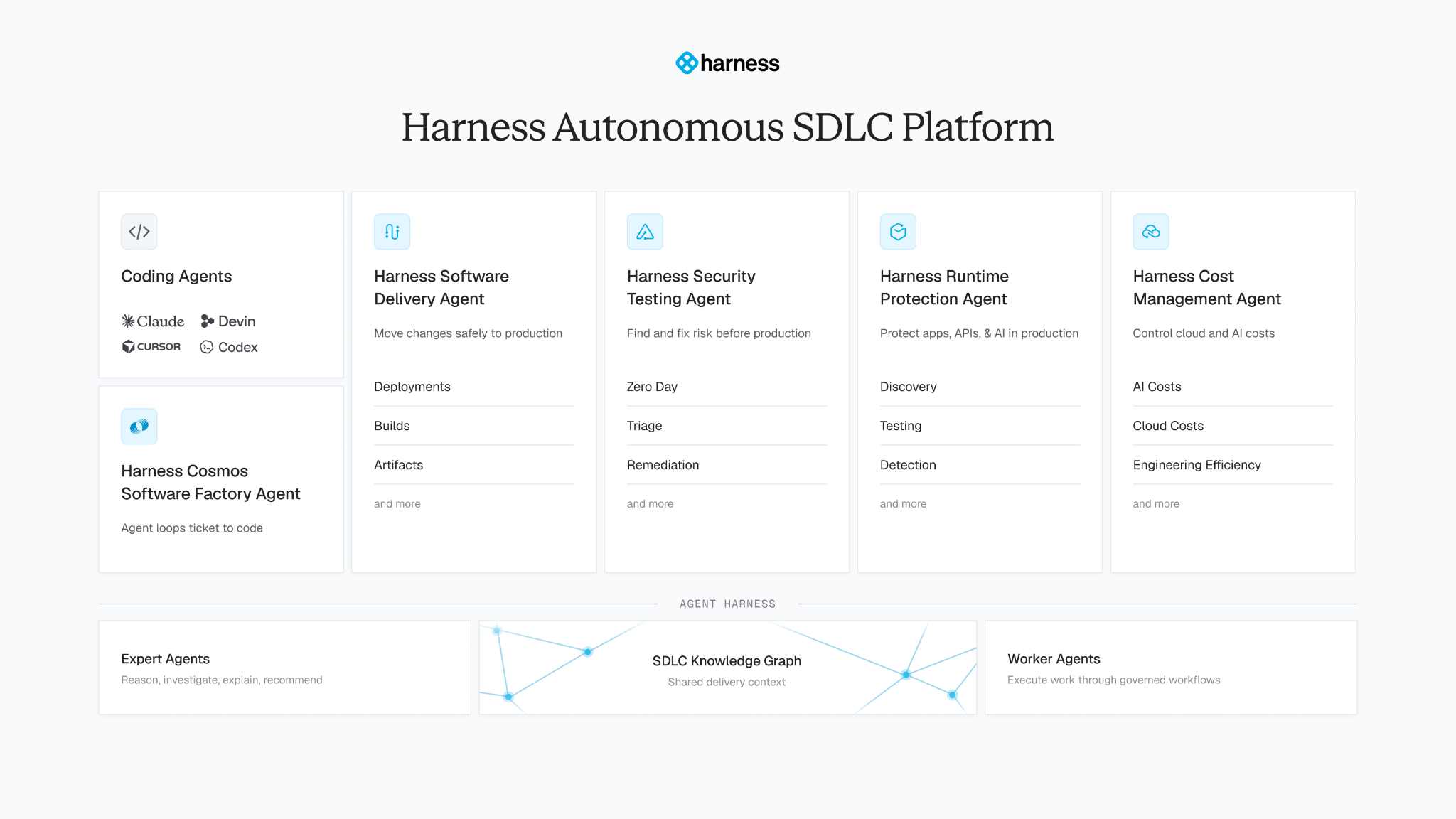
This is why we are building the Harness Autonomous SDLC Platform.
Today, we announced that Harness has acquired select Augment Code assets, including Cosmos and the Auggie CLI products, the Code Context Engine, and related technology. The team behind these products will join us as we execute on the vision of enabling an autonomous SDLC.
Cosmos will become the Harness Cosmos Software Factory Agent. Its role is Clear: : automate engineering work from idea to merge-ready code.
Code context meets delivery and production context
One of the most important reasons for this acquisition is the opportunity to connect Augment’s Code Context Engine with Harness’s Software Delivery Knowledge Graph.
The Code Context Engine helps agents find relevant information in a codebase and understand the relationships that matter to a task. The Software Delivery Knowledge Graph connects context around how software is built, deployed, secured, and operated.
An agent should understand not just the code it is changing, but what it takes for that change to work in the real world.
We plan to bring those perspectives together for two complementary benefits. First, better-informed code from the start. Testing expectations, security requirements, deployment constraints, and operational experience should inform the engineering work before a change is written, not only become feedback after it fails a check.
Second, tighter feedback when something needs fixing. A review finding, failed test, security issue, or deployment regression should return to the engineering workflow with the evidence needed to investigate, correct, and revalidate the change.
The value runs in both directions. Delivery and production context can help Harness Cosmos make better-informed engineering decisions. Codebase understanding can help Harness Agents reason about dependencies, risk, and the validation a change needs.
The goal is to connect what changed in the code with what happened in testing and production.
Technically, that means connecting the relationships among a code change, its build and artifact, the affected service, the deployed version, and the associated findings. An agent needs to understand which test result or production signal belongs to which version of the software. Access to more documents alone does not provide that connection.
This shared context is more than a benefit for one product. It is an opportunity to strengthen the entire Harness platform.
From a downstream finding to a verified fix
Work that starts after code often leads back to code. A vulnerability needs a patch. A failed test may expose a defect. Deployment verification may reveal a regression that requires another change.
A downstream finding should not end at an alert. It should connect to the engineering work needed to fix it—and the checks needed to verify the fix.
Consider the experience we are building toward for a vulnerable dependency in a deployed service. The connected context helps identify the affected code, the deployed version, the relevant dependencies, and the checks a correction must pass. That gives the engineering workflow a more informed starting point than a vulnerability report alone.
Harness Cosmos prepares a proposed fix. Review, quality tests, and security tests provide feedback. The Software Delivery Agent takes the approved change through deployment and verification. If a test or deployment check reveals a regression, the evidence returns to the engineering workflow so the change can be corrected and checked again. A rollout can be held or rolled back according to the configured delivery policy.
The objective is not merely to produce a patch. It is to establish, through the relevant checks, whether the change addresses the finding and behaves as expected.
Engineers should not have to reconstruct the problem and manually carry its context between every tool.Findings can inform the change while it moves through delivery, or start the next piece of engineering work after software is running in production.
Bring the same discipline to creating a change as releasing it
More autonomy should reduce repetitive work, not remove accountability.
Teams need to decide what an agent may change, which checks must pass, and where a person must approve the work. A reviewed pull request and a verified deployment are different stopping points; teams should choose the scope that fits the task and its risk.
Harness already provides policy-as-code, access controls, approvals, and audit trails for governed delivery. We intend to connect Harness Cosmos workflows with those controls so the work of creating a change can be governed alongside the work of releasing it.
The goal is less manual coordination, with engineers in control.
What makes Harness Cosmos a software factory
Harness Cosmos brings building blocks for repeatable engineering work, rather than another interface for prompting a model.
Reusable agents. Its reusable agent configurations are called “Experts.” Each brings together instructions, a model, connected tools, and an execution environment. An Expert can delegate focused work to other agents, allowing teams to separate responsibilities such as implementation, review, and verification.
Work that starts from events. Automations connect engineering events to the appropriate Expert. Repository activity, ticket updates, schedules, and webhooks can initiate work without someone manually starting every task.
Environments for execution. Agents need repositories and toolchains in which to work, execute commands, and run checks. The product’s environments provide that execution context. Proposing a code change and testing its behavior are different activities; a useful workflow needs both.
Coordinated follow-through. A change does not have to stop at the first pull request. The PR Author can continue responding to review comments, failed checks, and merge conflicts, reducing the manual follow-up needed to move work forward.
Teams can configure these workflows through Cosmos Advisor, which helps set up Experts, integrations, environments, and automations. For programmatic management, APIs and the Auggie CLI expose factory resources, with configuration that can be managed as versioned YAML and reviewed through a development workflow.
These capabilities give teams a way to define how engineering work should happen and reuse that process across tasks. Bringing the product, technology, and its builders into Harness lets us invest in that software factory and its connection to the wider platform together.
Four Harness Agents for production and beyond
Harness Cosmos adds a software factory to the platform. The four Harness Agents retain their roles.
Software Delivery Agent — Move changes safely to production. It brings together builds, deployments, artifacts, infrastructure, and database changes, with policies, approvals, deployment verification, and rollback where configured.
Security Testing Agent — Find and fix risk before production. It brings together code and dependency security, supply-chain controls, and security-testing orchestration, including prioritization and proposed fixes.
Runtime Protection Agent — Protect applications, APIs, and AI in production. It addresses API and AI security posture and runtime threats, including protection for AI interactions.
Cost Management Agent — Control and optimize cloud and AI costs. It provides visibility and optimization across cloud and AI spending, along with engineering-efficiency insights.
Together, these products address the work required to turn an engineering change into software that runs securely and efficiently in production.
Your coding tools remain your choice
Customers can adopt Harness Cosmos Software Factory, continue using their preferred coding tools, or use both. They can use any of the four Harness Agents without adopting Harness Cosmos.
A customer who needs continuous delivery should not have to adopt a software factory first. A customer investing in a software factory should have a strong path from the code it creates to production. We will keep investing in both paths.
No matter how your code is written, Harness Agents take every change from there to production and beyond.
Building the next chapter together
We plan to invest in Harness Cosmos as a product, in the technology behind it, and in the people joining us to keep building it. I look forward to welcoming our new colleagues from Augment and bringing their expertise together with the Harness team.
Connecting code context with delivery and production context is central to that next chapter: better- informed changes from the start, with feedback connected to the work needed to fix and verify them.
Our ambition is bigger than generating more code. It is helping organizations turn more of their ideas into software that makes a difference.
From idea to production and beyond.