Mythos-Readiness
Zero-days, exploding vulnerability counts, and AI-powered attackers have collapsed the time you have to respond. Keeping up requires security + engineering working together to find, fix, and ship to production, fast.
Sources: Project Glasswing · Zero Day Clock · Edgescan 2025 · 2025 DORA Report
Frontier LLMs can discover software vulnerabilities faster than any human ever could. What that means to you depends on what side of the discovery you're on.
Zero-Day Exposure
New vulnerabilities can be weaponized within hours, leaving almost no window to respond.
LLM Scanning
LLM scanners surface 10x more flaws than existing tools, requiring more time to triage and fix.
AI-Powered Attackers
Frontier models can help attackers find and exploit vulnerabilities you didn’t even know were there.
Whether it's a zero-day, a flood of new findings, or an AI-powered attacker, your response needs to move at machine speed, from find to fix to production.
Governed Pipelines
Build foundation
Zero-Day Response
Manage OSS exposure
AI Code Scanning + Remediation
Find, prioritize, fix
Runtime Protection
Stop the unknown
One platform. Security + engineering work in one system, so nothing stalls in a handoff between tools.
AI does the work. Agents find the zero-days, triage, and fix at a pace no human team could match.
Signal over noise. Lowest FPs and reachability surface real risks that are actually exploitable.

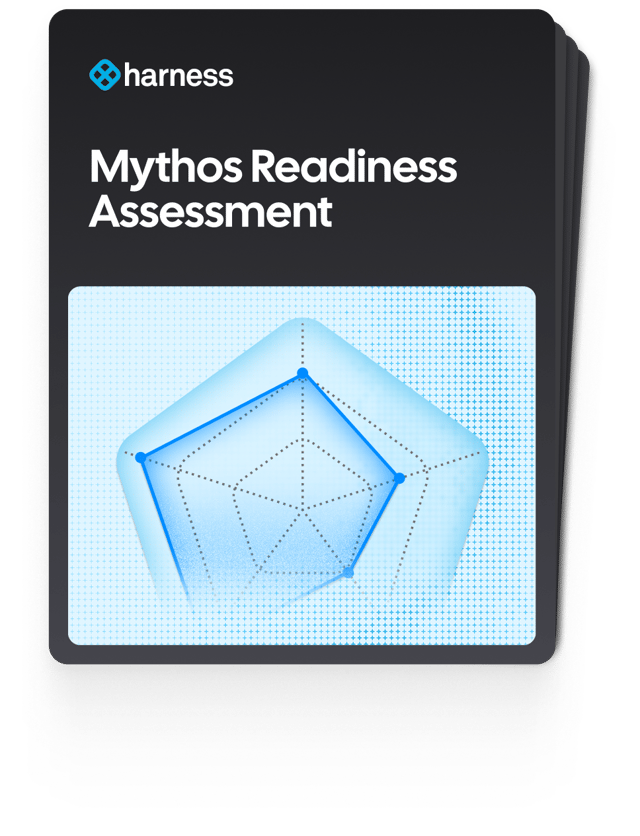
See how you stack up across five security + engineering criteria, then get an action plan to close the gaps.
Zero-day intelligence. Automatically start the response workflow on notification of a new zero-day from Harness threat intelligence.
Zero-Day Agent. Identify use of any affected package across all your pipelines and deployed artifacts.
Remediation Agent. Auto-generate a fix, validate against breaking builds, and create a pull request for your developers to accept.
Code property graph. Understand application flow with a structural map of your codebase, tracing every path from input to sink.
AI reasoning layer. Identify complex vulnerabilities that pattern-matching scanners miss, reasoning over how your code actually behaves.
AI confidence scoring. Reduce false positives by scoring every finding, so your team focuses on what is real.
Agentic Workflow. Prioritize vulnerabilities based on reachability and exploitability, auto-generate a fix, and create a pull request.
Multi-step attack detection. Correlate user requests across a session to catch attackers chaining multiple low-signal steps into a real attack.
Security data lake. Retain and analyze every API request and response to detect anomalous behavior that rule-based detection can’t.
Virtual patching. Shield a detected vulnerability in production the moment it’s found in testing, blocking exploitation while you make the fix in code.
Every patch pulled in more engineers than it should have and took longer than the business could tolerate. They automated the process end to end on Harness.
Microservices
Large application footprint requiring security patches
Patch cycle
Bi-weekly patch cycle for security notifications
Patch cycle time (before)
Time required to patch a single microservice before Harness
LoE per patch (before)
Manual toil to review, test, and rollout a patch before Harness
Annual toil saved
Automating repetitive tasks with agentic DevSecOps platform
Zero-day response
Ability to respond to new zero-days instantly and at any time
Patch cycle time (after)
Time required to patch a single microservice with Harness
LoE per patch (after)
Harness automates the process to review, test, and rollout every patch
Claude Mythos is a frontier AI model developed by Anthropic with advanced cybersecurity capabilities. It can analyze complex software, discover previously unknown vulnerabilities, develop proof-of-concept exploits, and help generate patches at a speed and scale beyond traditional security research. Mythos demonstrates how AI could dramatically accelerate vulnerability discovery, for both defenders and attackers, compressing the time organizations have to understand, contain, and remediate software risk.
Project Glasswing is Anthropic's defensive cybersecurity initiative created to put Mythos's capabilities to work securing critical software. Through the program, selected technology providers, infrastructure operators, and open-source maintainers use Claude Mythos to identify and remediate vulnerabilities in their systems. The project gives defenders early access to frontier AI capabilities while generating lessons intended to help the broader industry prepare for AI-driven vulnerability discovery.
It means your security and engineering teams can find, fix, and ship a fix to production fast enough to stay ahead of zero-days, AI-discovered vulnerabilities, and AI-powered attackers, without waiting on a slow, manual handoff between tools and teams.
Traditional vulnerability management assumes you have days or weeks to triage and fix. Mythos-readiness assumes you have hours, so detection, triage, remediation, and deployment all need to happen on one connected platform instead of across disconnected point tools.
No. Harness connects zero-day detection, AI-powered SAST, triage and remediation, virtual patching, CI/CD, and runtime protection into a single workflow, so findings move straight to a fix without stalling in a queue.
LLM-based scanning and traditional deterministic scanning are good for different things. Deterministic scanners give you the same result on the same code every time, which is what lets you measure real improvement in your AppSec program over time, so they should stay the backbone of your pipeline. LLM scanners bring more creative, context-aware reasoning that can catch what rule-based tools miss, but results can vary between runs. Harness can help you bring LLM-based scanning into the pipeline alongside deterministic tools as part of your overall security posture.
Yes. Virtual patching through API testing and WAAP blocks exploitation of a known vulnerability in production while the permanent fix ships through your normal pipeline.
Try Harness free. No credit card. Full access to zero-day detection, AI-powered SAST, triage and remediation, virtual patching, and CI/CD.