AI Posture

You can't protect what you can't see

Harness Runtime Protection Agent discovers every AI asset and agent, assesses its security posture, and closes the gaps before attackers find them.

Why Teams Switch

Most AI security starts with the AI you already know about

Discovery

You only see AI you're told about

Registries, integrations, and questionnaires miss unknown models, MCPs, and agents.

Discover AI from traffic

Continuously discover AI assets and agents from live production traffic.

Govern

You get findings, not policy

Generic risk scores don't reflect your policies, and violations go unmonitored.

Govern AI on your terms

Define AI security policies, score risk your way, and monitor for violations.

Test

You assess risk you haven't tested

A risk score assumes exploitability, but it doesn't prove it.

Break AI before attackers do

Simulate real-world attacks against AI and agents to uncover what's exploitable.

Discovery

Discover every AI asset

Harness digs deeper than registries and self-reported inventories, discovering AI from production traffic so nothing stays hidden.

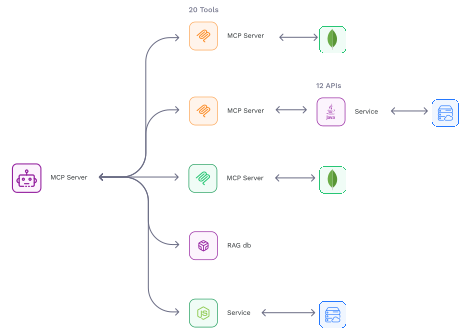
Asset & agent discovery. Continuously discover AI agents, MCP servers and tools, AI APIs, and other AI assets across your environment.

Sensitive data flow mapping. See what sensitive data flows through AI systems, prompts, and the services they connect to.

Ungoverned AI discovery. Find undocumented AI activity, including third-party AI services and integrations your security team may not know exist.

Govern

Govern AI on your terms

Generic risk scores don't reflect your policies. Score AI risk your way, and continuously monitor AI and MCP assets for policy violations.

AI security policies. Continuously identify vulnerabilities, misconfigurations, and policy violations across AI and MCP assets.

AI risk & data governance. Prioritize AI assets using exposure, authentication, sensitive data, and detected issues, with configurable risk scoring.

AI runtime policies. Monitor AI-specific policy violations and risks, including unauthorized model usage, PII exposure, and suspicious activity.

Test

Break AI before attackers do

Assessing posture isn't enough. Simulate real-world attacks to uncover what's actually exploitable before attackers do.

AI security testing. Test AI agents and applications for prompt injection, tool abuse, and other AI-specific vulnerabilities.

Agentic attack simulation. Simulate real-world attacks against AI systems and agent workflows before they reach production.

Risk-based prioritization. Prioritize findings by exploitability, exposure, and potential business impact.

WHO OWNS AI POSTURE?

New risks. Everybody owns it.

Know your AI attack surface

Automatically discover and continuously inventory every AI asset and agent in your environment.

Prioritize remediation with risk scoring based on authentication, exposure, and vulnerability data.

Test every AI asset against OWASP Top 10 LLM and MCP risks before it reaches production.

FAQs

Common questions answered

AI-native application security is the practice of securing applications built with AI components such as LLMs, MCP servers, and third-party GenAI services. It requires runtime visibility into AI APIs, data flows, and model behavior to detect threats specific to AI systems, unlike traditional approaches focused solely on code vulnerabilities.

The AI blind spot refers to undiscovered AI components deployed without security team awareness. 62% of security practitioners say they have no way to tell where LLMs are in use across their organization, creating exploitable gaps that attackers can target.

Discovery requires continuous monitoring of runtime traffic to identify every LLM, MCP server, and GenAI service. Runtime API traffic analysis can detect AI assets as they appear, including ungoverned AI that was never formally inventoried.

MCP security protects connections between MCP servers, clients, tools, and resources. MCP servers represent a significant and often overlooked attack surface that requires continuous monitoring and vulnerability assessment.

AI-SPM continuously assesses the security posture of AI assets including authentication, encryption, exposure, and data flows, providing a risk-based view of your AI attack surface.

Prompt injection inserts malicious instructions into LLM inputs. Protection requires real-time inspection of prompts and model responses at the API layer to detect and block malicious inputs before they reach the model.

All AI components communicate via APIs. Without deep visibility into runtime API traffic, security teams cannot discover all AI assets, monitor their behavior, or detect threats in real time.

AI security adds runtime protection layers that traditional tools lack. Static code analysis alone cannot detect threats like prompt injection, LLM jailbreaking, or sensitive data leakage through AI APIs.

Compliance requires automated discovery, risk scoring, and policy enforcement. Out-of-the-box compliance policies aligned with frameworks like the OWASP LLM Top 10 provide a starting point for governance.

LLM security protects models from prompt injection, jailbreaking, data leakage, and overconsumption. It requires visibility into every API connection to and from the model and continuous monitoring of model inputs and outputs.

Get started with Harness AI Posture

Have a question? We are here to help!