Most Operational Readiness Testing (ORT) programs follow the same ritual. A checklist gets filled out. Someone runs a load test in a war room the week before launch. A failover drill gets scheduled, and everyone hopes it goes cleanly. Then the release is shipped and testing is done. But with Harness you can make this process continuous and your services resilience is protected with the same ORT check list with every small change that is happening in your SDLC.


The Operational Readiness Testing or ORT testing programs follow a checklist which gets filled out before the big release. The sign-off happens. That sign-off answers one question well: was this service ready on launch day? If yes, the release is shipped.
Much more important question to answer is : is it still ready today?
The checklist was never built to survive shipping software
Here's the problem. The moment a service goes live, it starts changing. A dependency gets swapped. A config drifts. Someone removes a health probe during a refactor and nobody notices because nothing broke — yet. By the time a team ships its fiftieth deployment after go-live, the conditions the original ORT checklist tested against may not exist anymore, but the sign-off document still says "ready" in permanent ink.
This isn't a discipline problem. Nobody is skipping steps. It's a structural one: ORT is usually run as a milestone, not a practice. It happens once, produces a document, and that document starts going stale the day after it's signed.
Reframing the ORT questions as ongoing, not one-time
Strip away the checklist format and most ORT programs are really asking five things:
- Can the service survive a dependency, infrastructure, or zone failure?
- Does it hold up under expected and peak traffic?
- Can you prove your recovery time and recovery point objectives, not just state them?
- Are there configuration gaps — missing health probes, no autoscaling, a single replica standing in for redundancy — that quietly erode resilience?
- Is the service still in that state after the next deployment, and the one after that?
None of these are questions with a permanent answer. They're questions a system should be able to answer continuously, from the same pipeline that ships the code — not from a separate exercise bolted on before launch.
What Harness Resilience Testing changes
This is the gap Harness Resilience Testing (RT) can help close. Instead of treating readiness as a one-time gate, RT AI Agents run a continuous loop directly inside the CI/CD pipeline: predict the resilience risk in a service, rank and explain it, generate and run the test that proves it, then analyse the result and gate the pipeline on it. The same loop that validates day-0 readiness runs again on day 50, day 500, and every deployment in between.
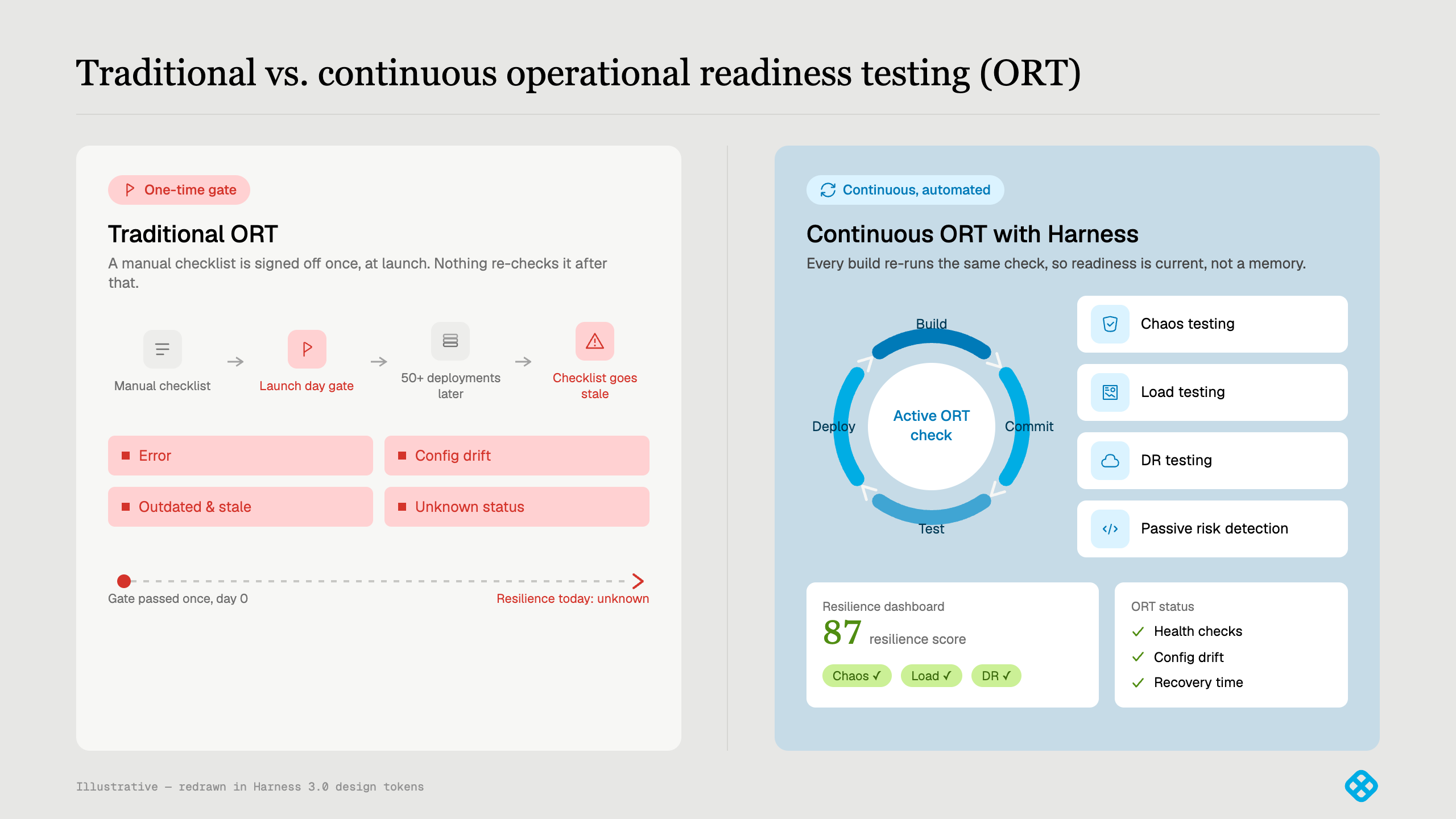
Mapped against a typical ORT programme, the fit looks like this:
Resilience under failure is covered by Chaos Testing, built on CNCF's LitmusChaos with over 200 fault templates across Kubernetes, Linux, Windows, and cloud infrastructure — producing a pass/fail result per fault, logged as evidence, not a one-off war-room exercise.
Capacity and load readiness is covered by Load Testing, with tests written in Java, Python, or JavaScript. Add resilience probes to a load test and it becomes a Composite Load Test — producing a resilience score for how the system behaves when a real problem hits under load, which is a different question than whether it merely meets an SLO.
Failover and DR readiness is covered by DR Testing, which produces proven RTO/RPO evidence per service, repeatable on demand instead of once a year in a scheduled drill.
Configuration and coverage gaps — the missing health probes and single-replica services that never make it into a manual checklist — are caught by Passive Risk Detection, a zero-config scan of pipeline and service metadata that produces a ranked FAIL/WARN/INFO risk list before a single active test ever runs.
Staying ready after go-live, the piece a traditional ORT programme has no good answer for, is handled by RT AI Agents sitting directly in the CI/CD gate — turning every promotion into an evidence check, not a one-off sign-off from six months ago.
What this doesn't replace
Worth being direct about scope: Harness RT proves technical resilience — failure handling, capacity, failover, and configuration coverage. It doesn't replace the operational and process side of ORT. Runbook and documentation review, on-call handover, and physical or site checks still belong to your existing process. What RT supplies is the technical evidence that process depends on, produced the same way every time instead of once.
Why this is worth changing
The value isn't just automation for its own sake. It's that the proof a service was ready on day 0 and the proof it's still ready today come from the same system, running the same way, instead of a repeat manual exercise that only happens when someone remembers to schedule it. Operational readiness stops being a document you file after launch and becomes a property of the pipeline itself — something you can check on demand, not something you have to take on faith six months later.
Summary
Harness can help improvise your ORT efforts with its Resilience Test product and Pipeline Technology.
Harness offers a free plan for Resilience Testing, where you can get all the capabilities, for free, for a limited number of monthly runs. Signup Now. Sign up for free