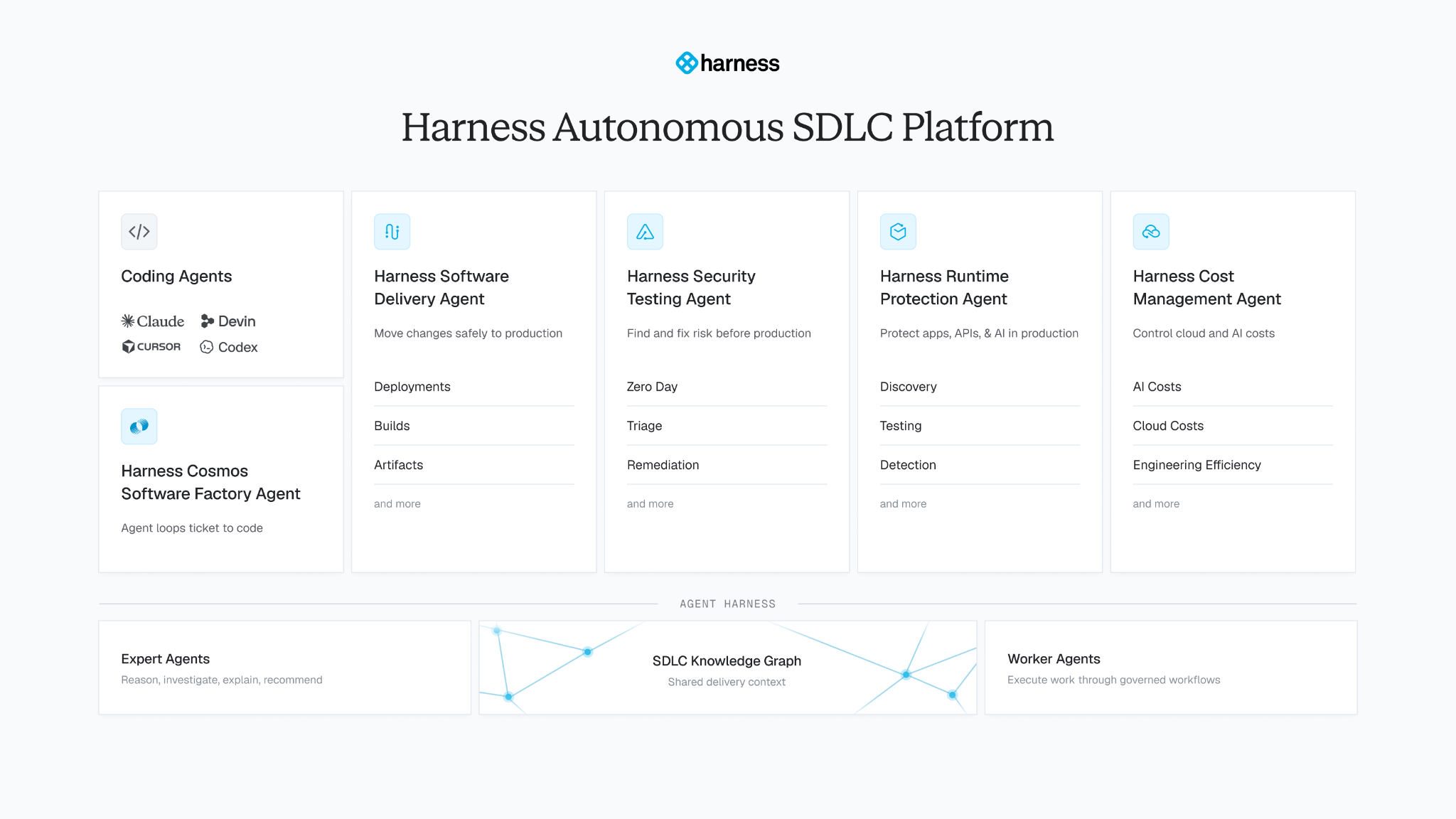
Harness Cosmos Software Factory Agent automates engineering from idea to code, connecting code context with delivery, security, testing, and production workflows.
.webp)
The world runs on software. Better healthcare, more accessible financial services, more efficient businesses, and better everyday experiences all depend on our ability to build and improve it.
AI is making that faster, but the outcome that matters is not simply how much code we generate. It is how much valuable software reaches users—and how reliably, securely, and efficiently it runs in production.
That is why we have been building the Harness Autonomous SDLC Platform.
Today, I’m excited to announce that Harness has acquired select Augment Code assets, including Cosmos, the Auggie CLI, the Code Context Engine, and related technology. The team behind these products will join us to build the next chapter together.
Cosmos will become the Harness Cosmos Software Factory Agent, with a clear role: automate engineering work from idea to code. Harness agents take that code to production.
What makes Harness Cosmos a software factory
There is a difference between asking a coding agent to make a change and establishing a repeatable workflow that carries the work through implementation, review, and testing.
When a ticket is assigned or a bug is reported, Harness Cosmos can coordinate agents to plan the change, write code and tests, open a pull request, and respond to feedback. The goal is to prepare a change for the team’s merge decision—not just produce an initial code suggestion.
Harness Cosmos brings the building blocks for that workflow:
- Work starts from events—not just prompts. Ticket updates, pull requests, schedules, and webhooks can initiate the appropriate work without someone manually starting every task.
- Agents follow through. Work can continue through review comments, failed checks, and merge conflicts. Instead of stopping at the first pull request, agents help address what is needed to move the change forward.
- Teams customize specialized Experts. Teams can start with prebuilt Experts such as PR Author, Deep Reviewer, Risk Analyzer, and Verifier, then adapt their instructions, tools, and environments to the way their organization works.
- The infrastructure to run and manage the factory is included. Execution environments, model routing, the Code Context Engine, tool integrations, shared organizational memory, and configuration and budget controls give teams the components to build repeatable workflows rather than assemble every piece themselves.
Teams define what agents can do independently and where people need to review or approve the work.
Extending the Harness Autonomous SDLC Platform
Creating a code change is only part of delivering useful software. The Harness agents bring the capabilities to take it to production and beyond.
- Software Delivery Agent — Move changes safely to production. Build and deploy software, manage infrastructure and database changes, and verify deployments, with rollback where configured.
- Security Testing Agent — Find and fix risk before production. Identify, prioritize, and address risks across code, dependencies, and the software supply chain.
- Runtime Protection Agent — Protect applications, APIs, and AI in production. Understand security posture and defend against runtime threats.
- Cost Management Agent — Control and optimize cloud and AI costs. Connect spending visibility and optimization with engineering-efficiency insights.
Harness Cosmos expands this platform with a software factory for engineering work, connecting the understanding used to create software with the understanding needed to deliver and operate it.
Connecting code context with delivery and production context
One of the most important opportunities created by this acquisition is connecting Augment’s Code Context Engine with Harness’s Software Delivery Knowledge Graph.
The Code Context Engine helps agents understand a codebase and the relationships relevant to a task. The Software Delivery Knowledge Graph connects context about how software is built, tested, secured, deployed, and operated.
We plan to bring those perspectives together for two complementary benefits.
- Better-informed code from the start. Testing expectations, security requirements, deployment constraints, and operational experience can inform engineering work before a change is written—not just become feedback afterward.
- Tighter feedback when something needs fixing. Findings from review, quality testing, security testing, and deployment verification can return to the engineering workflow with the evidence needed to investigate, correct, and revalidate the change.
The goal is to connect what changed in the code with what happened in testing and production: the affected service, the build and artifact, the deployed version, and the findings associated with that change. An agent needs to understand which evidence belongs to the software it is changing, not simply have access to more information.
The value runs in both directions. Delivery and production context can help Harness Cosmos make better-informed engineering decisions. Codebase understanding can help Harness agents make better-informed decisions about dependencies, risk, and the validation a change needs.
An agent should understand not just the code it is changing, but what it takes for that change to work in the real world.
From a downstream finding to a verified fix
The software lifecycle is not linear. Findings during testing, deployment, or production often lead back to code.
A vulnerability needs a patch. A failed test may expose a defect. Deployment verification may uncover a regression. Engineers often have to reconstruct the context and manually carry it between tools.
Our next step is to connect that feedback more directly to the engineering workflow.
Consider a vulnerability in a deployed service. Connected context helps identify the affected code, deployed version, relevant dependencies, and the checks a correction must pass.
Harness Cosmos prepares a proposed fix. Review, quality tests, and security tests provide feedback. After the required checks and approvals, the Software Delivery Agent takes the change through deployment and verification.
If a test or deployment check reveals a regression, that evidence returns to the engineering workflow so the change can be corrected and checked again. A rollout can be held or rolled back according to the team’s delivery policies.
The objective is not simply to generate a patch. It is to establish, through the relevant checks, whether the change addresses the finding and behaves as expected.
A downstream finding should connect to the engineering work needed to fix it—and the checks needed to verify the fix.
Bringing governance to autonomous engineering
Autonomy should reduce repetitive work, not accountability.
Teams need control over what an agent may change, which checks must pass, and where human approval is required. The level of autonomy should reflect the risk: a documentation-only update may need less oversight than a change to payment processing.
Routine, low-risk work can proceed within approved policies, while higher-risk changes require additional validation or human judgment. Teams define those boundaries rather than manually directing every step.
Harness already provides policy-as-code, access controls, approvals, and audit trails for governed software delivery. Harness Cosmos workflows will connect with those controls, bringing the same discipline to creating a change that enterprises expect when releasing it.
The goal is less manual coordination, with engineers in control.
Your coding tools remain your choice
Customers can adopt the Harness Cosmos Software Factory Agent, continue using their preferred coding tools, or use both.
No matter how your code is written, Harness Agents take every change from there to production and beyond.
Building the next chapter together
I’m excited to welcome the team behind Cosmos, Auggie, and the Code Context Engine to Harness. We are investing in the products, the technology, and the people who built them.
Together, we are working toward a simple goal: help organizations turn more ideas into software that runs reliably, securely, and efficiently—with better context, less manual coordination, and engineers in control.
Get started with Harness Cosmos
Harness Cosmos is available now. Start with an engineering workflow your team wants to automate, from implementing a ticket to preparing a pull request, and build from there.