November marks Harness AI's evolution into a truly AI-native platform spanning code-to-cloud delivery, with AWS integration and autonomous database migration finally bringing database DevOps into the modern, automated era alongside applications

November was another big month for Harness AI, with new capabilities that deepen our work with AWS, bring AI-native automation to the database, and keep our model stack on the cutting edge across the SDLC.
Harness + Amazon: AI-Powered DevOps
We are expanding our partnership with Amazon to connect AI-powered development directly to intelligent delivery. As AI tools like Amazon Q and Kiro accelerate code development, this integration focuses on safely moving that code into production with built-in governance, security, cost controls, and delivery intelligence. Together, Harness SaaS on AWS and Harness’s Software Delivery Knowledge Graph provide teams with a single, trusted path from code to cloud, eliminating the need to stitch together point tools.
For developers, this shows up as AI-infused workflows in the IDE and CI/CD pipelines that understand context across 160+ tools exposed via the Harness MCP server. Teams can see faster pipeline onboarding, dramatically reduced debugging time, and safer rollouts, while platform and security leaders get unified governance across AWS environments without sacrificing velocity. Learn more about the partnership in this blog post.
AI-Powered Database Migration Authoring
Application delivery has become highly automated, but databases have historically lagged behind. Schema changes are still often managed with manual SQL scripts, spreadsheets, and late-night deployments. That gap makes databases one of the most common sources of release friction and risk, turning them into a bottleneck even when CI/CD is mature. Database DevOps matters because it applies the same discipline used for applications—Git, policy-as-code, governed pipelines, automated rollback—to the systems that hold your most critical data.
Harness Database DevOps tackles this directly by treating database changes like application code: versioned, tested, governed, and observable across environments. As one of the fastest-growing modules in the Harness platform, it helps teams ship safely without waiting on a small group of DBAs or accepting 2 a.m. change windows as normal.
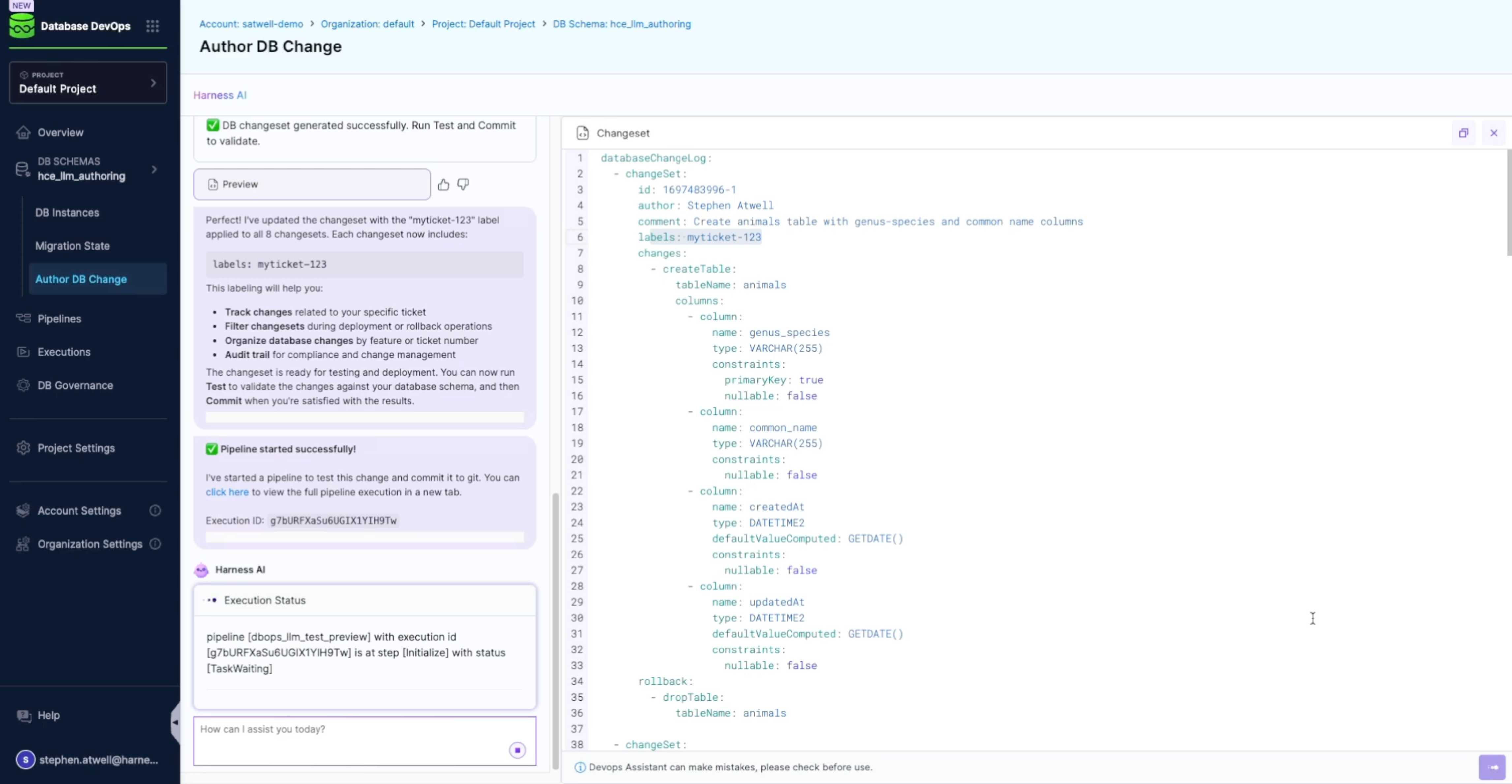
We have introduced AI-powered database migration authoring inside our Database DevOps product. Developers can now describe the change they want in natural language, and Harness generates production-ready migrations that are backward-compatible, validated against policies, wired into Git, and paired with rollback scripts. Every migration is governed and auditable, so DBAs maintain control through policy-as-code and approvals while the AI handles the heavy lifting.
Under the hood, this capability is powered by the Software Delivery Knowledge Graph and the Harness MCP server, which bring awareness of schemas, pipelines, and best practices into each suggestion. The result is a database layer that finally moves at DevOps speed, with fewer incidents, stronger governance, and far less manual toil for both developers and database teams. Learn more about AI-powered database migration authoring here.
Improved Pipeline Error Analyzer
Error Analyzer is a great example of how Harness AI applies deep context, not just raw model power, to real DevOps problems. When a pipeline fails, our improved Error Analyzer automatically correlates recent changes, checks dependencies, identifies historical patterns, and pinpoints the most likely root cause, allowing teams to skip scrolling through logs and jump straight to fixes. The analysis view highlights which commits or configuration edits are likely to have triggered the regression, whether an external service or infrastructure dependency is unhealthy, and how similar this failure is to previous incidents across your organization.
From there, Harness AI turns insights into concrete action. Error Analyzer presents prioritized recommendations with clear justifications, and in many cases, can generate and apply YAML fixes on your behalf, with a before-and-after diff, so you stay in control. With built-in impact assessment and an audit trail of pipeline changes, teams can diagnose issues more quickly, understand the blast radius, and continuously harden their pipelines and dramatically reducing debugging time while maintaining high reliability.

Always-On Model Optimization
Behind these experiences, Harness AI continually evaluates and upgrades its underlying model stack, including the latest generations, such as Claude 4.5, Sonnet 4.5, and GPT-5. Instead of betting on a single LLM, Harness runs internal evaluations and real-world tests to benchmark performance, reliability, and safety for specific software delivery jobs, such as pipeline generation, error analysis, and database migration authoring. The platform then dynamically selects the best model for each task, with guardrails and fallbacks built in, so customers achieve the strongest results without having to manage model churn themselves.
Closing the AI Velocity Gap
Taken together, November’s updates are another step toward Harness’s vision of AI-native software delivery: where agents understand intent, enforce policy, and automate work from code to cloud to database. Deep AWS integrations remove friction between AI-powered development and production, Database DevOps eliminates the last major manual bottleneck, and continuous model optimization keeps Harness AI ahead of the curve for real-world DevOps use cases. As AI continues to increase code velocity, these capabilities make sure your pipelines, databases, and platforms can keep up with confidence.
