

Break Free From Jenkins in 24 Hours
Stop wrestling with Groovy scripts and plugin hell. Use our patented Migration Assistant to convert Jenkins pipelines to modern, AI-powered CI instantly.


Stop wrestling with Groovy scripts and plugin hell. Use our patented Migration Assistant to convert Jenkins pipelines to modern, AI-powered CI instantly.
Harness CI is fundamentally faster, safer, and cheaper to maintain.
Features
Jenkins (Legacy)
Test Acceleration
Does it run every test, every time?

No. AI selects only relevant tests (8x faster)

Yes. Runs full suites (slow)
Maintenance
How hard is it to maintain?
Easy. Fully managed SaaS, control pipeline sprawl with templates
Hard. "Plugin hell” & pipeline sprawl
Migration Effort
How do we move pipelines?
Automated 1-Click Import
Manual rewrite of Jenkinsfiles
Security & Governance
Compliance enforcement?
Built-in OPA Policy & SBOMs
Difficult. Relies on discipline

Harness CI (Modern)
Jenkins (Legacy)
Test Acceleration
Does it run every test, every time?
No. AI selects only relevant tests (8x faster)
No. Runs full suites (slow)
Maintenance
Who patches the server?
Us. Fully managed SaaS. No plugins
You. “Plugin Hell” & weekly patching
Migration Effort
How do we move pipelines?
Automated 1-Click Import
Manual rewrite of Jenkinsfiles
Security & Governance
Compliance enforcement?
Built-in OPA Policy & SBOMs.
Difficult. Relies on discipline.

Migration doesn't have to mean rewriting thousands of lines of code. Our Al engine handles the heavy lifting so you can focus on shipping.

Connect & Scan
Connect Harness to your Jenkins instance. We automatically map your topology and identify high-value pipelines vs. abandoned junk.

Al Conversion
Our engine translates imperative Groovy scripts into declarative Harness YAML, replacing fragile plugins with native steps.

Side-by-Side Validation
Run your new Harness pipeline alongside Jenkins. Compare the build times and artifacts to verify parity before you switch.


We are so confident in the performance gains, we'll handle the migration costs. Get a free assessment of your current Jenkins environment today.
Start Your Migration Today


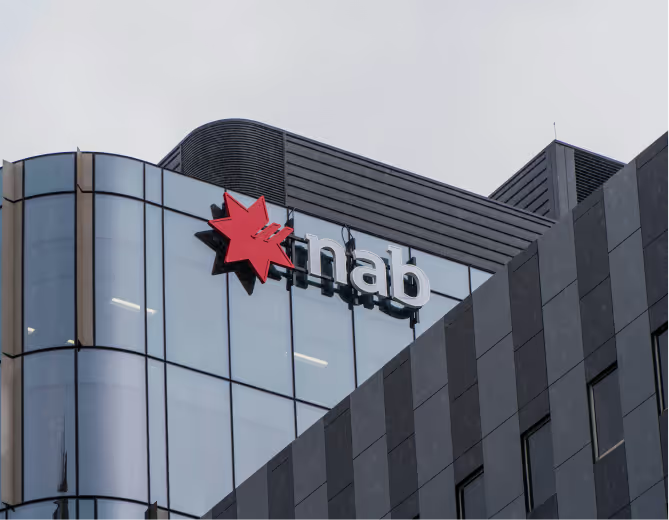

Before Harness
500 Jenkins instances across NAB
20k scripts for provisioning infrastructure
With Harness
67% reduction in build failures
85% better troubleshooting efficiency
Offers (valid till July 31, 2026)
Available to eligible customers, subject to mutual execution of Harness’s standard order form and agreement to standard terms.
Eligibility
Disclaimer
Today, software delivery solutions need to quickly and easily scale alongside organizations and teams advancing their software delivery capabilities. Not every architecture solution is designed to scale with you. Consider what it means to support your organization as application workloads scale horizontally and vertically. Use Harness to quickly deploy artifacts into production and into the hands of your users. Harness integrates with Jenkins to manage your CD process.

Use cases that surround Continuous Delivery are challenging for a platform like Jenkins, which has been designed for Continuous Integration. Items that are post-build, e.g. deployment, verification, and additional operational steps such as rollbacks, are challenging in Jenkins and need to be heavily scripted out.
We compare Jenkins and Harness in detail and highlight the pains of scripting in Jenkins. See how you can migrate easily from Jenkins to Harness in minutes to accelerate deployments and solve your CI/CD problems.

In this blog, we map out four reasons why your Jenkins pipeline may be brittle. Learn how plug-ins, jobs/scripts, debugging in Jenkins, and other issues are affecting your CI/CD performance.
Today, software delivery solutions need to quickly and easily scale alongside organizations and teams advancing their software delivery capabilities. Not every architecture solution is designed to scale with you. Consider what it means to support your organization as application workloads scale horizontally and vertically. Use Harness to quickly deploy artifacts into production and into the hands of your users. Harness integrates with Jenkins to manage your CD process.
Use cases that surround Continuous Delivery are challenging for a platform like Jenkins, which has been designed for Continuous Integration. Items that are post-build, e.g. deployment, verification, and additional operational steps such as rollbacks, are challenging in Jenkins and need to be heavily scripted out.
We compare Jenkins and Harness in detail and highlight the pains of scripting in Jenkins. See how you can migrate easily from Jenkins to Harness in minutes to accelerate deployments and solve your CI/CD problems.
In this blog, we map out four reasons why your Jenkins pipeline may be brittle. Learn how plug-ins, jobs/scripts, debugging in Jenkins, and other issues are affecting your CI/CD performance.
Jenkins genesis and lineage started as a build server for JAVA projects, then evolved into a build server for multiple languages. The introduction of their pipeline domain specific language [DSL] allowed for scripted steps and manipulations to broaden the capabilities into automation.
Harness is purpose-built to enable software delivery with self-service in mind. Challenging items around Continuous Delivery such as verification, canary deployments, and auditing are all automated and convention-based. The Harness Platform has cloud cost efficiency and Continuous Integration portions with the same ease of use and capabilities.
Harness has the ability to natively call Jenkins jobs. As a wrapper around Jenkins jobs, customers (if needed) can start to decompose lengthy deployment scripts in Jenkins and just have Jenkins focus on build-centric steps. By leveraging Harness CI, Jenkins can potentially be removed altogether.
Learn how SaaS company Meltwater, after switching to Harness for Continuous Integration, eliminated the problems it faced while using Jenkins. Read about how they built 1200 artifacts a day using Harness CI (Drone).
In this case study, we see how Marketron tripled its deployment frequency and decreased deployment time 75% using Harness. Prior, Marketron had deployed its legacy applications using Jenkins and manual executions.