Learn agentic development best practices with spec-driven development, AI system testing, and operational readiness for secure AI delivery.

Everyone talks about moving faster with AI. But here's what nobody mentions: AI amplifies both good and bad practices alike.
You can build code 10x faster with AI agents. But if your testing, operational controls, and failure mode analysis aren't keeping up, you'll deploy bugs 10x faster too. Speed without guardrails is just a faster path to production incidents.
The uncomfortable truth is this: knowing you can use AI agents to build software and actually knowing how to do it safely and maintain operational control are two entirely different problems. Most organizations are optimizing for the first without solving for the second.
This is the defining challenge of the agentic era. How do you gain the speed that AI agents promise without compromising the quality and operational risk you're expected to deliver?
The Four Pillars of Agentic Engineering Excellence
After six months of redesigning their SDLC around AI-driven development, Harness identified four core pillars that enable both speed and safety. These aren't aspirational. They're now standard practice across their engineering organization.
1. Spec-Based Development: Make Context Explicit
Traditional product requirements documents live outside code. Specs exist in Confluence. Design docs languish in Google Drive. Tech specs might be on a wiki. The result is that context is fragmented, outdated, and inaccessible when you need it.
With agentic development, context is everything. AI agents need to understand product vision, technical constraints, design decisions, and test requirements. Scattered documentation defeats that purpose.
The solution is moving specs into code repositories. They should be versioned, searchable, and always in sync with implementation. This includes:
- Product specs: Domain knowledge, competitive landscape, roadmap, finished and in-progress features
- Tech specs: Design docs, resilience patterns, API contracts, scalability requirements
- UI specs: Mock implementations in code (using tools like Claude or Figma), shared styles, design system inheritance
- Test specs: Test cases, performance targets, SLA requirements, operational constraints
When specs live in code, AI agents can access them directly. More importantly, they stay current. Engineers reference them during implementation. Leaders can experiment with UI mockups in 30 minutes instead of weeks. Context becomes a core asset, not an afterthought.
2. Agent-Ready Architecture: Know When to Delegate
Not every problem needs an agent. The instinct to use agents everywhere will kill your ROI fast.
The right pattern is: use agents for open-ended, multi-step tasks that require dynamic decision-making and reasoning. Code review? Good candidate for an agent. Analyzing a Jira ticket to generate a full solution? Excellent. Routing a request to the right microservice? No. Use a traditional API.
At Harness, they found that roughly 15-20% of work is truly agent-driven (fully autonomous from Jira to PR), while 80% is AI-assisted (developers using agents as tools). Both are valuable.
The architecture looks like traditional microservices with agent endpoints (using Model Context Protocol). Services are still built for scalability, resilience, and multi-tenancy. But where there's ambiguity or complex reasoning, agents can operate on context and collaborate across systems.
The key is scope. Each agent has a specific role with bounded permissions. A code review agent doesn't implement changes. A testing agent doesn't modify production. A specification agent doesn't decide architecture. Granular, specialized agents are faster and cheaper than bloated omniscient agents trying to do everything.
3. Multi-Layer Verification: Test Everything Differently
Traditional testing doesn't work for agentic systems. You need six layers:
- Front-end verification: Visual tests (Vitest, Playwright), UI correctness
- Product and API testing: Unit, integration, and functional tests for services
- Agent efficacy testing: Does the agent produce correct outputs? Baseline the agent's behavior against known-good examples
- Data verification: Cross-check that training data and validation data are correct. This is critical for agents that hallucinate.
- Continuous efficacy monitoring: The most crucial layer. Just like regression tests catch regressions in code, efficacy tests catch regressions in agent quality. If you change a prompt or context, your agent's output might degrade. Continuous monitoring catches this automatically.
- Agentic feedback loops: Monitor agent behavior in production, not just in tests
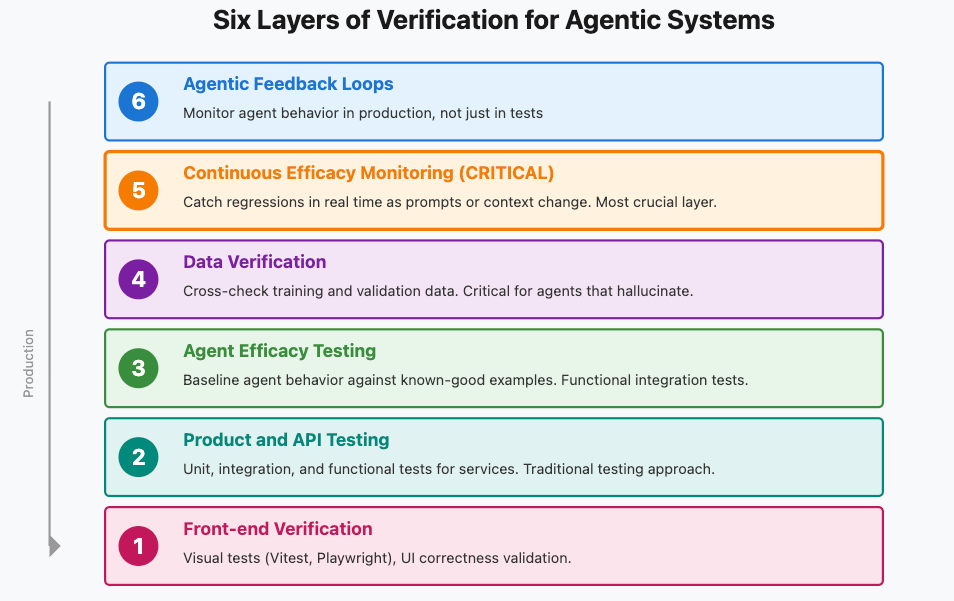
The difference is layer 5. With AI agents, quality isn't static. Change a system prompt slightly? The agent's outputs change. Update the context knowledge base? Efficacy drops. You need continuous verification that catches regressions in real time, just like you do with code tests.
4. Operational Excellence: Inspect Before Launch, Monitor Always
Most organizations surface operational concerns after development. That forces expensive rework and delays launches.
Operational Readiness Reviews (ORR) shift this left. During design review and test specification, teams ask: What about GDPR compliance? How do we ensure availability? What's the data residency strategy? What are our SLAs?
Instead of surprises at launch, ORR creates a checklist with documented evidence. Load tests prove you hit 200 TPS targets. Game days show incident response works. Security audits validate compliance. By launch, you don't wonder if you're ready. You know.
Then, post-launch, teams meet weekly for operational reviews. Dashboards show service health, customer issues, and RCAs from incidents. Engineering leadership meets separately for cross-calibration on operational excellence.
This discipline isn't just about preventing incidents. It's about continuously learning from operations and feeding that back into architecture and design.
The Results: Speed Without Sacrificing Safety
After six months of implementing these four pillars, Harness shipped 23% more features, reduced incidents by 44%, and achieved 45% AI ROI. More importantly, they now operate with predictable velocity and confidence in operational control.
That's not just faster. It's smarter.
Why This Matters
The agentic era doesn't have to be a choice between speed and safety. Teams that treat agentic development as a discipline (with specs, verification, architecture discipline, and operational rigor) gain speed and control.
Teams that just turn agents loose and hope for the best will gain speed and lose control. They'll ship faster. They'll also cause incidents faster. They'll accumulate technical debt faster. The cost of speed without structure compounds quickly.
The question isn't whether to use AI agents. You will. The question is whether you'll engineer for the agentic era with the same rigor you'd apply to critical systems. Agentic systems are critical systems now. They're making architectural decisions, generating code, and running production.
The organizations winning in the agentic era aren't the ones using the newest models or the most agents. They're the ones who slowed down just enough to build the guardrails, specs, and operational discipline that lets them move fast safely.
That's engineering excellence. That's the new baseline.
Ready to engineer for the agentic era safely? Learn how to implement spec-driven development, multi-layer verification, and operational excellence in your organization. The four pillars of agentic engineering aren't optional. They're table stakes.
Form Submission Thank You Message
Thank You Message Copy (Full Version):
"Thanks for downloading! You've just unlocked the framework that got Harness to 23% more features shipped with better quality. Check your email for the complete four-pillar implementation guide plus templates for spec-driven development, agent governance policies, and operational readiness reviews. See exactly how multi-layer verification catches AI regressions before they hit production. Your team can achieve the same results. Questions? Reach out anytime."
Thank You Message Copy (Short Version):
"Got it! Your guide is on the way. While you're reading, explore how Harness teams reduced incidents by 44% using operational readiness reviews and continuous efficacy monitoring for AI systems. Watch our live demo showing spec-driven development in action and how to chain agents safely. Or book a session with our engineering experts to design your agentic SDLC framework."