AI DLC Insights helps teams measure AI ROI by tracking AI-generated code from prompt to production, connecting token spend, commits, PRs, deployments, and delivery impact in one view.

AI coding tools made code generation faster. Measuring what actually ships is the hard part.
Over the last eighteen months, tools like Cursor, Claude Code, Copilot, and Windsurf have fundamentally changed how software gets built. AI-generated pull requests are increasing, developers are producing more code than ever before, and workflows that once took hours now happen in minutes. But most organizations struggle to clearly explain what that investment is actually producing.
Only a fraction of AI-generated code ultimately survives review and reaches production, yet engineering leaders still lack visibility into which coding agents improve delivery performance and which workflows simply contribute to tokenmaxxing with no clear ROI.
That gap exists because traditional engineering systems were built for a world where development started with a commit. But AI fundamentally changed where the software development lifecycle begins. Development no longer starts with a commit. It starts with a prompt. The model choice, token consumption, generated code, review cycles, deployments, and production outcomes are now all part of the same engineering workflow. Measuring only what happens after code is committed is no longer enough.
That shift is what led Harness to evolve Software Engineering Insights into AI DLC Insights, to help organizations measure how AI-generated work moves through the entire development lifecycle from prompt to production.
Three questions every engineering organization is trying to answer
These three operational gaps exist inside almost every team running AI at scale today:
- Are we more productive? Seats don't equal usage, and usage doesn't equal productivity. But most teams still cannot draw a clear line between AI investment and engineering output.
- Are we spending efficiently? Leaders need to know how much spend produced shipped code versus how much was wasted on uncommitted sessions, wrong model choices, and missed cache opportunities.
- Are we shipping better products faster? Faster code generation does not automatically mean better products. Leaders must measure how AI impacts code quality, security vulnerabilities, and quality regressions.
These three gaps are exactly what AI DLC Insights is organized around. Together, they give engineering leaders a complete picture of what AI is producing inside their engineering organization, from the first prompt to the last deployment.
Adoption: See exactly how AI is being used
The first question starts with understanding what AI adoption actually looks like at the team and individual level. Seat counts and API usage aggregates give you a surface view. Understanding whether AI-generated code is actually making it into production requires something deeper.
Most engineering systems were never designed to observe AI-assisted development workflows directly. Source control can show what was committed. Billing systems can show token consumption. Neither can explain which generated code actually survived review, reached production, or improved delivery performance.
That is why AI DLC Insights introduces a new Agent that runs directly inside the developer environment. The agent observes AI interactions in real time, captures AI-generated code, tracks token consumption across coding agents and models, and connects that activity directly to commits, pull requests, deployments, and production outcomes.
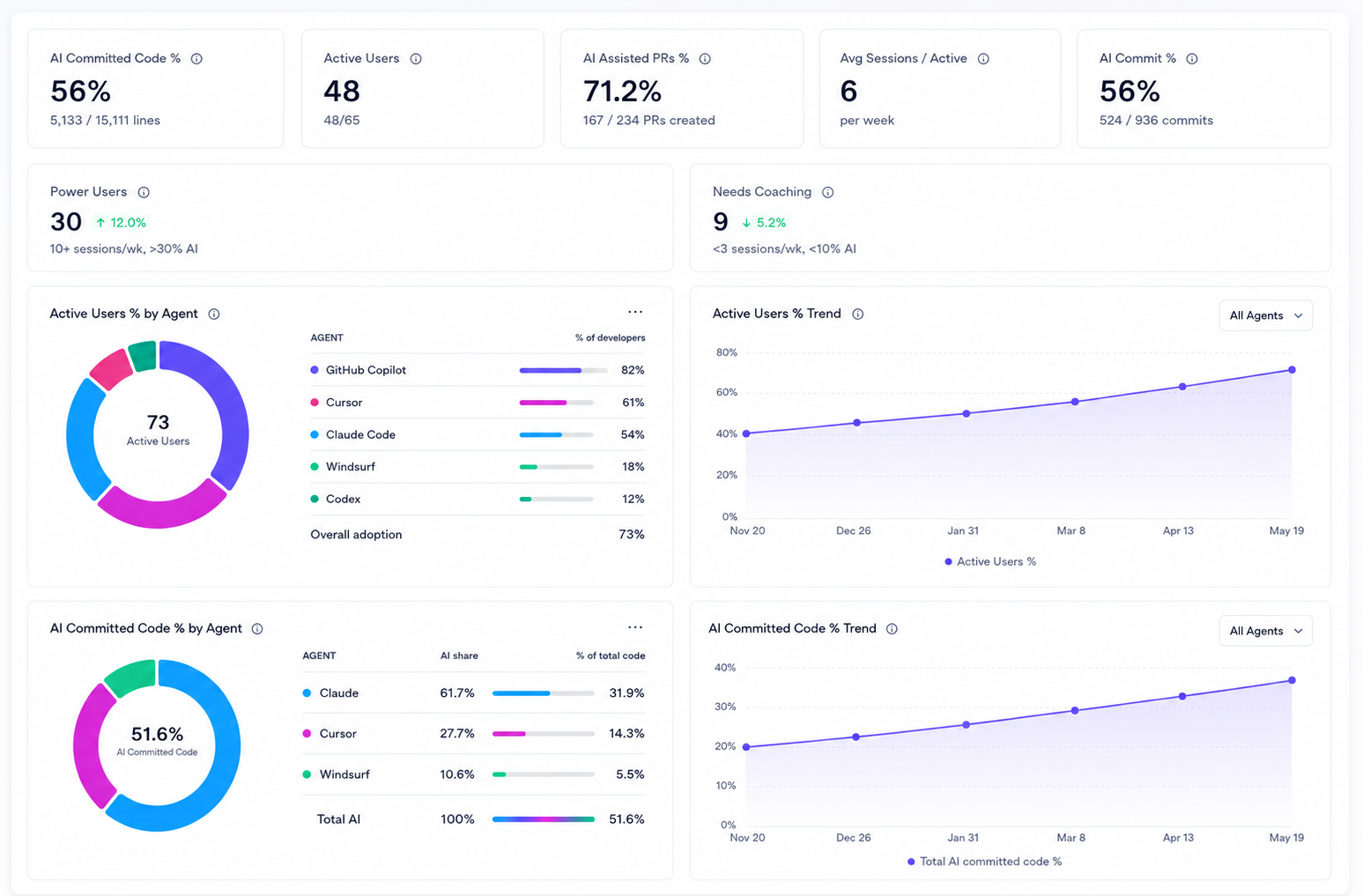
What that makes visible:
- AI Code Percentage: See exactly how much shipped code was AI-generated, broken down by developer, team, or repository.
- AI-Assisted PRs & Commits: Track the percentage of merged PRs and commits containing AI-attributed code to measure real adoption growth.
- Active Users & Agent Breakdown: See which tools (Cursor, Claude, Windsurf, Copilot) engineers actually rely on to produce committed code.
- Power User Identification: Surface engineers with high AI commit velocity to understand winning patterns and scale them across the org.
Efficiency: Know where every AI dollar is going
Developer token consumption is increasing every month, but most teams still cannot explain which workflows are producing production-ready code and which are simply burning tokens.
That gap exists because token spend and engineering outcomes typically live in completely separate systems. Finance teams can see the monthly invoice, while engineering teams can see sprint activity and pull requests. Connecting token consumption directly to shipped code, deployment velocity, and engineering throughput is still difficult for most organizations.
As tokenmaxxing behaviors emerge, activity can easily be mistaken for impact. Some workflows generate meaningful production-ready code and improve delivery throughput, while others consume enormous amounts of tokens without improving what actually ships.
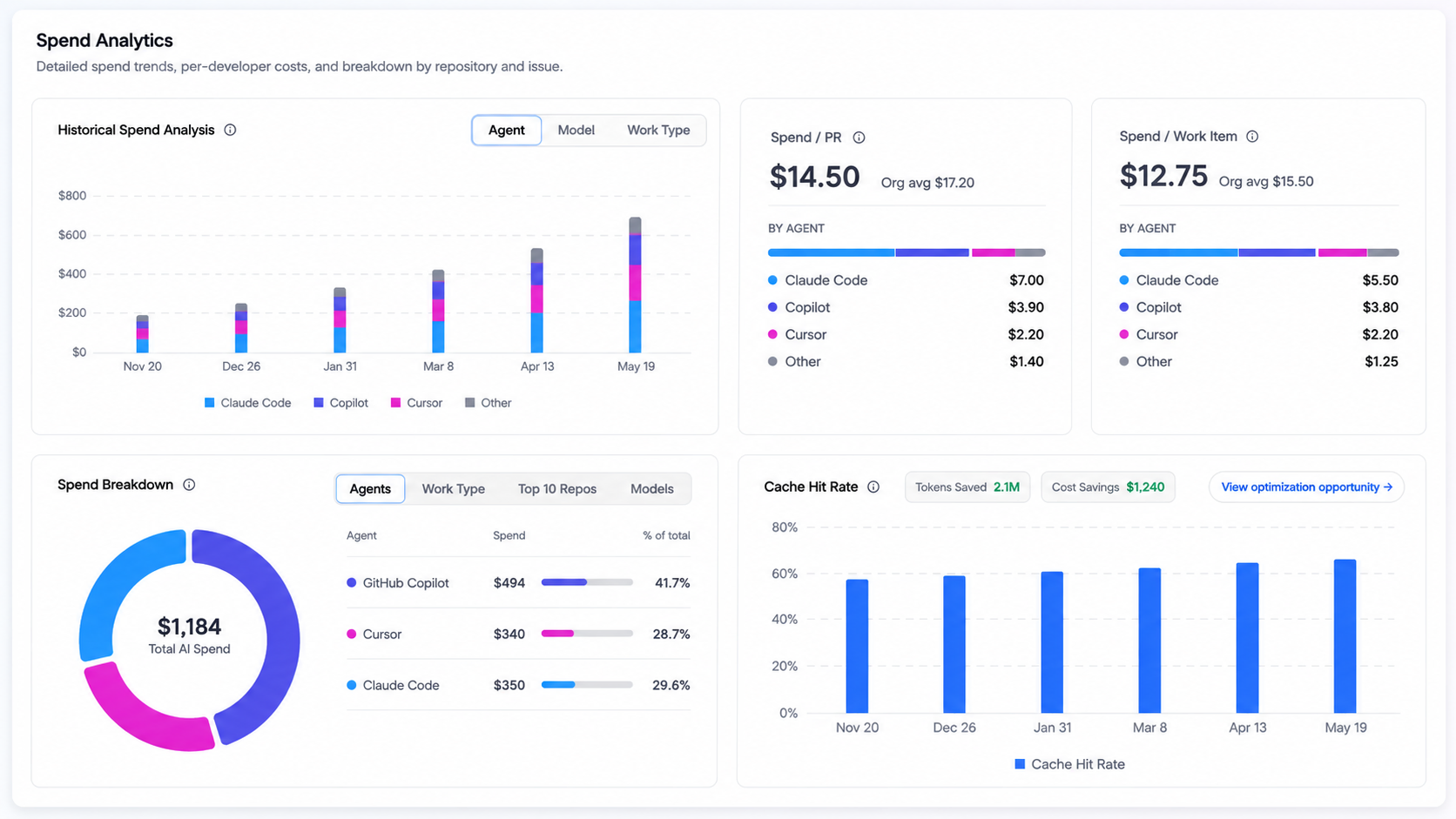
AI DLC Insights closes that gap, breaking down spend by developer, team, agent, and workflow:
- Wasted Spend: Spot tokens burned in sessions that produce no committed code (e.g., a developer generates output in Cursor but closes the session without saving) to eliminate unproductive workflows.
- Optimizable Spend: Catch inefficient patterns—like using an expensive frontier model for a simple task, suffering low cache hit rates, or having high turn counts on basic prompts—to restructure workflows and stretch your budget.
- Cost Per Work Item: Correlate session costs with issue trackers to calculate the exact AI spend required to close a backlog item, ship a feature, or resolve an incident.
Impact: Measure AI-generated code in production
Adoption and efficiency are inputs. Impact is the output. And the output is not lines of code generated or tokens consumed. Its features shipped, bugs resolved, lead time reduced, security posture improved, and customers getting better software faster.
More AI-generated code does not automatically produce those outcomes. Without the right visibility, AI adoption can quietly produce the opposite: more code volume with more review burden, more complexity with more regressions, faster generation with slower delivery cycles. The organizations that catch those patterns early are the ones that maintain quality as velocity increases.

AI DLC Insights connects AI activity to the delivery metrics that reveal what is happening downstream:
- Features Delivered & Backlog Reduction: Compare teams at different adoption levels to see if higher AI usage actually translates to more shipped features.
- PR Velocity & Lead Time: Track if PRs are merging faster. High open rates combined with low merge rates indicate AI is increasing the review burden, not reducing it.
- DORA Metrics: Out-of-the-box tracking for deployment frequency, change failure rate, lead time, and MTTR to ensure AI adoption correlates with delivery health.
- Business Alignment: Map engineering output directly to executive priorities to prove where your investment is going.
The next phase of engineering visibility
The first generation of engineering analytics platforms measured software delivery after the commit. The next generation will measure how humans and AI systems build software together.
Boards are no longer asking whether engineering teams are using AI coding tools. They’re asking whether the investment is improving software delivery in measurable ways. Whether teams are shipping more production-ready code. Whether delivery metrics are moving alongside token consumption. Whether the spend is generating real engineering leverage or just increasing the invoice.
Answering those questions requires visibility into how AI-generated code actually behaves across the full development lifecycle, from the prompt that created it to the deployment that shipped it.
That is what AI DLC Insights was built to deliver.
Ready to prove the ROI of your AI engineering investment? Request a demo to learn more.