Shift-Left FinOps moves cost optimization earlier in development. Reduce cloud waste with governance and automation. Learn more.

TL;DR
- Shift-Left FinOps prevents cloud waste by embedding cost governance directly into development workflows before infrastructure is deployed.
- Policy as Code frameworks enforce tagging, resource sizing, and lifecycle policies automatically during CI/CD validation, eliminating manual governance bottlenecks.
- Real-time cost visibility during infrastructure planning allows developers to evaluate tradeoffs (instance sizing, storage tiers, service configs) before provisioning.
- Organizations gain proactive cost management, accurate cost attribution across teams and environments, and financial accountability without sacrificing developer velocity. [Source: Flexera, "2025 State of the Cloud Report", 2025, https://www.flexera.com/about-us/press-center/new-flexera-report-finds-84-percent-of-organizations-struggle-to-manage-cloud-spend]
What Is Shift-Left FinOps?
Shift-Left FinOps reframes cloud cost optimization as an engineering responsibility rather than a retrospective financial review.
Instead of analyzing cloud spend after infrastructure has already been deployed, organizations integrate FinOps automation and cost governance directly into development workflows.
Developers receive immediate feedback about the financial impact of infrastructure changes during development, not weeks later during billing reconciliation.
This approach aligns FinOps best practices with modern platform engineering workflows built around:
- Infrastructure as Code (IaC)
- automated CI/CD pipelines
- Policy as Code governance
- real-time cost visibility
The result is proactive cost management, where waste is prevented before resources ever reach production.
Why Traditional FinOps Creates Cloud Cost Governance Gaps
Most organizations still treat FinOps as a retrospective discipline.
Finance teams review monthly cloud bills, identify anomalies, and ask engineering teams to investigate cost spikes.
This approach worked when infrastructure provisioning happened slowly through manual processes.
Modern cloud environments operate differently.
Teams now deploy infrastructure changes dozens or even hundreds of times per day through automated pipelines.
By the time billing data arrives, the operational context behind those provisioning decisions has already disappeared.
This delay introduces several operational challenges.
Cost Attribution Becomes Difficult
Without consistent tagging and governance policies, organizations struggle to determine:
- which team owns specific resources
- which service generated costs
- which environment the infrastructure belongs to
Missing metadata makes cloud financial management and cost attribution significantly harder.
Optimization Becomes Reactive Remediation
When cost issues are discovered weeks later, teams must retrofit governance controls onto already-running infrastructure.
This reactive approach introduces operational risk and disrupts delivery schedules.
Instead of preventing waste, teams are forced into post-deployment cloud cost optimization efforts.
Developers Lack Cost Visibility
Developers often make infrastructure decisions without understanding their financial implications.
Without real-time cost visibility, engineers cannot evaluate tradeoffs between:
- instance sizes
- storage tiers
- managed service configurations
Shift-Left FinOps addresses these problems by embedding Infrastructure as Code cost control and governance earlier in the development lifecycle.
Core Components of Shift-Left FinOps Implementation
Implementing Shift-Left FinOps requires three foundational capabilities:
- Policy as Code governance
- Infrastructure as Code cost control integration
- Automated cost visibility and feedback loops
Together, these capabilities enable FinOps automation and proactive cost management across cloud environments.
Codifying Cloud Cost Governance with Policy as Code
Policy as Code frameworks translate financial governance requirements into enforceable rules.
These rules automatically evaluate infrastructure definitions before resources are deployed.
Instead of relying on documentation or manual enforcement, policy as code provides automated cloud cost governance directly within engineering workflows.
Effective cost governance policies typically address three categories of waste.
Tagging Enforcement
Policies ensure every resource includes metadata required for cost attribution.
Examples include:
- environment
- team ownership
- cost center
Resource Sizing Policies
Governance rules prevent developers from provisioning oversized instances for workloads that do not require maximum capacity.
This supports long-term cloud cost optimization and prevents overprovisioning.
Lifecycle Management Policies
Policies identify resources missing automated shutdown schedules, retention rules, or lifecycle controls.
These controls prevent idle resources from generating unnecessary costs.
Example conceptual tagging policy:
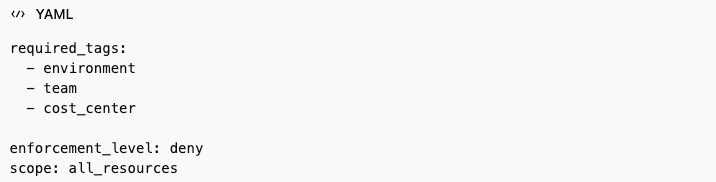
With Policy as Code enforcement, developers receive immediate feedback during infrastructure validation rather than after deployment.
Integrating Infrastructure as Code Cost Control into Development Workflows
Infrastructure as Code provides the technical foundation for shift-left cloud cost governance.
IaC allows infrastructure changes to be:
- reviewed
- tested
- validated
- audited
before deployment.
These characteristics create natural enforcement points for Infrastructure as Code cost control policies.
Local Development Validation
Developers run policy checks locally before committing infrastructure changes.
This prevents cost policy violations from entering shared repositories.
Early validation enables proactive cost management during development.
CI/CD Pipeline Enforcement
Pull request pipelines automatically validate infrastructure definitions against governance policies.
If cost policies fail, the merge is blocked.
Example validation workflow:

This ensures consistent cloud cost governance across all infrastructure deployments.
Deployment Pipeline Validation
Production deployment pipelines include a final validation step before infrastructure changes are applied.
This layered validation model creates defense in depth for FinOps automation:
- development validation prevents wasted effort
- CI/CD validation prevents policy drift
- deployment validation prevents actual cost impact
Enabling Real-Time Cost Visibility for Developers
Shift-Left FinOps only works when developers have access to cost insights during infrastructure planning.
Without cost visibility, governance policies feel arbitrary and difficult to follow.
Cost estimation should occur during infrastructure planning stages, not after deployment.
When developers run terraform plan, they should also see estimated monthly costs associated with proposed infrastructure changes.
This allows developers to evaluate architectural tradeoffs such as:
- instance sizing
- storage tier selection
- service configuration
Integrating cost feedback into existing workflows improves adoption.
Examples include:
- pull request comments showing cost impact
- budget alerts routed to engineering channels
- optimization recommendations during infrastructure review
These feedback loops support FinOps best practices by making cost awareness part of everyday development work.
Common Pitfalls in Shift-Left FinOps Implementation
Organizations implementing shift-left cloud cost governance frequently encounter predictable challenges.
Understanding these patterns helps teams implement FinOps automation successfully.
Overly Restrictive Policies
Governance policies that generate frequent false positives slow developer velocity.
Developers may attempt to bypass governance controls.
Policies should focus on real sources of cloud cost waste.
Manual Governance Processes
Shift-left cost governance fails when platform teams must manually review every infrastructure change.
All governance rules should be automated through Policy as Code and CI/CD validation pipelines.
Lack of Cost Context
Providing policies without cost visibility creates confusion.
Developers need both:
- clear governance rules
- cost impact insights
Disrupting Developer Workflows
Successful governance systems integrate into existing workflows such as:
- Terraform development
- pull request review
- CI/CD deployment pipelines
The most effective governance systems remain invisible until violations occur.
Implementing Proactive Cost Management with Harness Cloud & AI Cost Management
Harness Cloud & AI Cost Management enables organizations to implement Shift-Left FinOps and proactive cost management at scale.
The platform integrates FinOps automation and cost governance directly into platform engineering workflows.
Harness CACM connects cloud environments across:
- AWS
- Azure
- GCP
This provides unified cost visibility across multi-cloud infrastructure.
Real-time cost allocation allows developers to see cost breakdowns during infrastructure provisioning rather than waiting for billing cycles.
Teams can enforce governance policies such as:
- tagging requirements
- resource sizing policies
- budget constraints
These policies automatically validate infrastructure changes during development and CI/CD pipelines.
Harness CACM also supports cloud cost optimization through automated insights and recommendations, including:
- rightsizing underutilized instances
- deleting orphaned resources
- optimizing storage tiers
These capabilities help organizations implement modern cloud financial management practices while maintaining developer velocity.
Frequently Asked Questions
How does Shift-Left FinOps support cloud cost optimization?
Shift-Left FinOps prevents waste before resources are deployed by embedding cost governance directly into development workflows.
This proactive model improves cloud cost optimization and cloud financial management outcomes.
What tools enable Policy as Code cost governance?
Typical implementations include:
- Infrastructure as Code tools such as Terraform
- policy frameworks like Open Policy Agent
- CI/CD pipeline integrations
These technologies enable automated cloud cost governance through policy as code.
Does shift-left governance slow developer velocity?
No. When implemented correctly, automated cost policies provide immediate feedback without manual approvals.
This improves delivery speed while maintaining cost control and FinOps automation.
How do organizations enforce governance across multiple clouds?
Organizations define standardized governance policies that apply across AWS, Azure, and GCP.
These policies focus on universal patterns such as:
- tagging
- resource sizing
- lifecycle management
This approach supports consistent multi-cloud cost governance and financial management.
Conclusion
Shift-Left FinOps transforms cloud cost optimization from a reactive financial process into a proactive engineering practice.
By embedding Policy as Code governance, Infrastructure as Code cost control, and automated FinOps workflows into development pipelines, organizations prevent waste before infrastructure reaches production.
The result is stronger cloud cost governance, improved cloud financial management, and more efficient cloud operations.
Developers gain real-time cost insights.
Platform teams enforce governance automatically.
Finance teams gain accurate cost attribution across environments.
At the scale of modern cloud infrastructure, proactive cost management is essential for sustainable cloud growth.