Announcing AI DLC Insights and Cloud & AI Cost Management: two new products that give engineering organizations real answers on what they are spending on AI, and whether that investment is worth it.

Gartner expects worldwide AI software spending to hit $2.59 trillion in 2026, 47% more than organizations spent last year. The dollars are real and growing fast. But most organizations still can't measure the ROI of that spend.
The problem has two sides: developers and infrastructure. On the developer side, engineers are using AI to write nearly every line of new code, and leaders have no way to tell whether that spend is producing software that ships. On the infrastructure side, agents in production consume tokens with every customer interaction, every resolved ticket, every automated workflow, and the invoice is the only signal on whether any of it is worth what it costs.
Organizations can tell you what they spend on AI. Very few can tell you what they got for it. According to our 2026 State of Engineering Excellence report, 94% of engineering leaders say the metrics that matter most are missing from their current measurement frameworks.
Today, Harness is launching two products to close both gaps.
AI DLC Insights builds on Harness Software Engineering Insights and ties every AI-generated line of code to the PR, ticket, and deployment it produced, so engineering leaders can see where token spend is turning into shipped work and where it isn't.
Cloud & AI Cost Management extends Harness Cloud Cost Management with unit economics, anomaly detection, and budget governance for every dollar of AI infrastructure spend, so the question "is this agent worth what it costs?" finally has a number behind it.
"AI spend isn't the conversation anymore — ROI is. Every dollar we put into AI, from tokens consumed to customers served, has to earn its keep. That's what my executives are asking about today."
Josefa Roche, Sr. Cloud FinOps Engineer, Revionics, an Aptos Company
Developer Token Costs: AI DLC Insights
Every developer writing software today is coding with AI. Copilot, Cursor, Claude, Gemini: the tools vary but the pattern is universal. Adoption is not the problem.
The problem is that token spend has never been connected to efficiency or outcomes. Developers generate code with AI coding agents, a fraction of it ships, prompts are longer than necessary, and generated code gets rejected in review. Engineering leaders have no visibility into any of it — not the ship rate, not the wasted tokens, not the rejected code.
Harness CEO Jyoti Bansal recently described this behavior as tokenmaxxing: an engineer burns 500K tokens generating code that gets rejected in review. By the leaderboard, they beat the engineer who shipped a clean 50-line patch. Tokenmaxxing made sense as a forcing function when adoption was the goal. That phase has an expiration date.
AI DLC Insights includes a new on-machine developer agent that runs directly in the developer's environment. It observes the IDE and terminal in real time, captures every AI-generated line of code, records the token cost per model and tool, and maps that spend through the delivery chain to the PR, the ticket, and the deployment that shipped.
An engineering leader can now say "it cost us $5,200 in AI credits to fix that bug" and mean it. Here’s what’s in the release:
- Unified AI coding adoption visibility — One place to track adoption, sessions, and AI-generated code across every coding agent — Claude Code, Cursor, GitHub Copilot, Windsurf. Which tools your developers actually use, not just which seats you bought.
- Per-developer attribution — Token spend, sessions, and shipped code traced to the developer, agent, repository, team, and business unit behind them, turning bulk AI invoices into per-developer ROI you can act on.
- Wasted spend detection — Tokens burned on abandoned code, bloated prompts, expensive model choices, and missed cache hits surfaced automatically. The first time a team doubles its token bill without shipping more code, you know before the next renewal.
- Coding-to-production impact — Track AI-generated code from prompt to production using ship rate, PR cycle time, and DORA metrics, correlated with incident and vulnerability data. Know whether coding agents are actually making your team faster.
- Benchmarking and governance — Adoption, efficiency, and impact metrics compared across teams against an org baseline, with role-based access control and Harness-native engineering governance included.
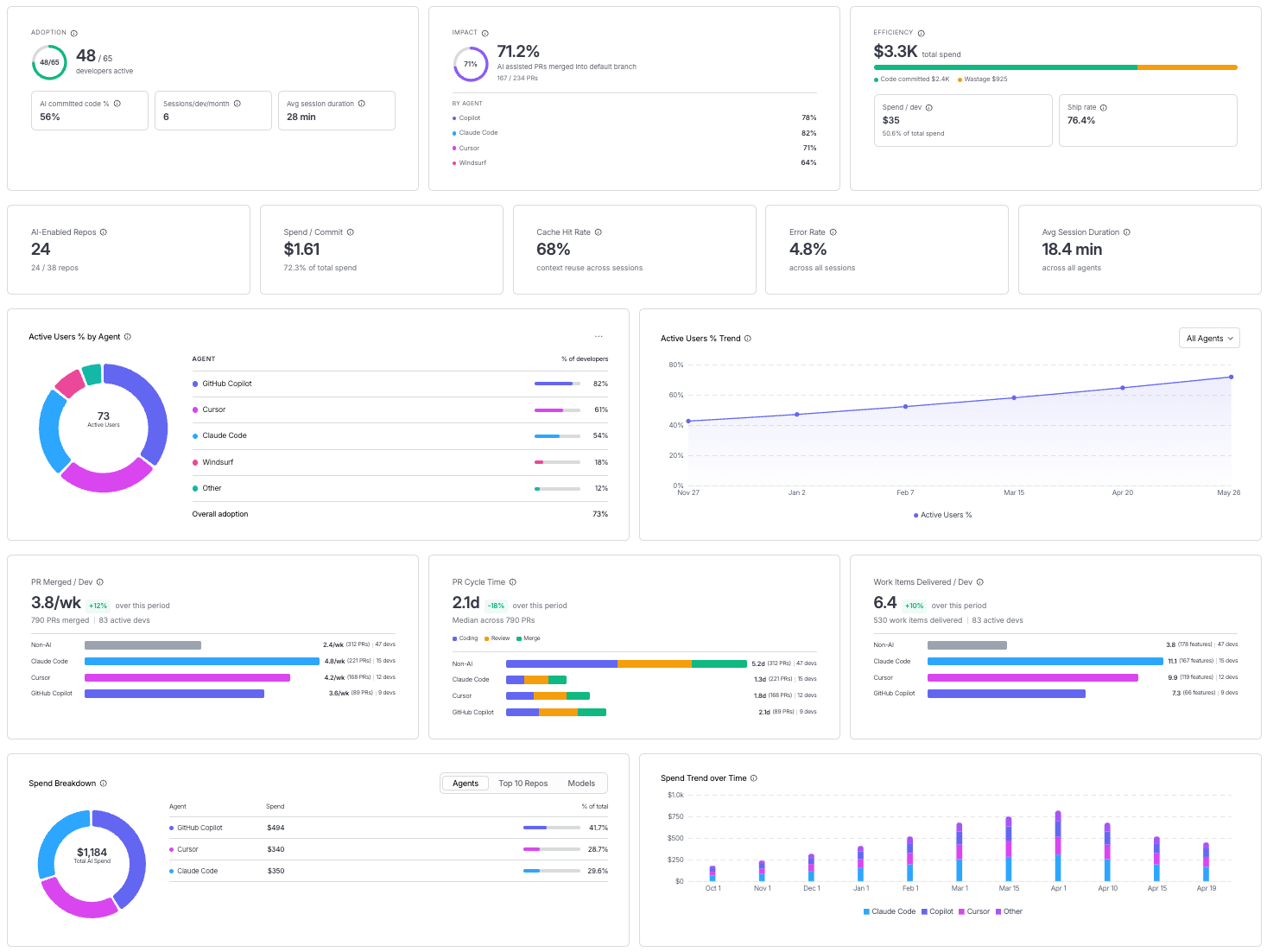
Fig. 1: AI DLC Insights gives engineering leaders a unified view of AI adoption, spend efficiency, and delivery impact across coding agents, teams, and workflows.
AI Infrastructure Costs: Cloud & AI Cost Management
Once an AI agent ships to production, a different cost equation takes over. Every customer interaction, every resolved ticket, every automated workflow triggers inference. The spend is continuous, scales with usage, and in most organizations is visible only at the invoice level. That tells you which line item is growing, but tells you nothing about whether the spend growth is worth it.
A $28,000 monthly spend on a customer support agent is a completely different number depending on how many tickets it resolved. If it cost $0.60 per resolved ticket and the human alternative costs more, it is one of the best investments in your stack. If the math runs the other way, you are paying more for automation than the process it replaced. Most organizations cannot tell the difference today.
Cloud & AI Cost Management closes that gap. Harness connects directly to your AI providers and production agents, capturing spend at the level of each individual request and tying it to the agent, session, or workflow that triggered it. The same cost categories, budgets, and anomaly detection already running on your cloud spend now apply to every AI token your infrastructure consumes. Harness applies the same [[cloud cost optimization]] discipline to AI spend as it does to cloud spend.
A finance leader can finally answer the question the business is asking: is this agent worth what it costs? Here’s what’s in the release:
- Unified AI cost visibility — A single view of spend across every AI provider and managed service provider, from OpenAI and Anthropic to AWS Bedrock and GCP Vertex AI.
- Full spend attribution — Cost traced to the agent, model, team, and business unit driving it.
- Anomaly detection — Unusual AI spend spikes are proactively flagged for action.
- Budget and governance — Controls set at the agent, team, or business unit level, extending existing FinOps controls to AI spend.
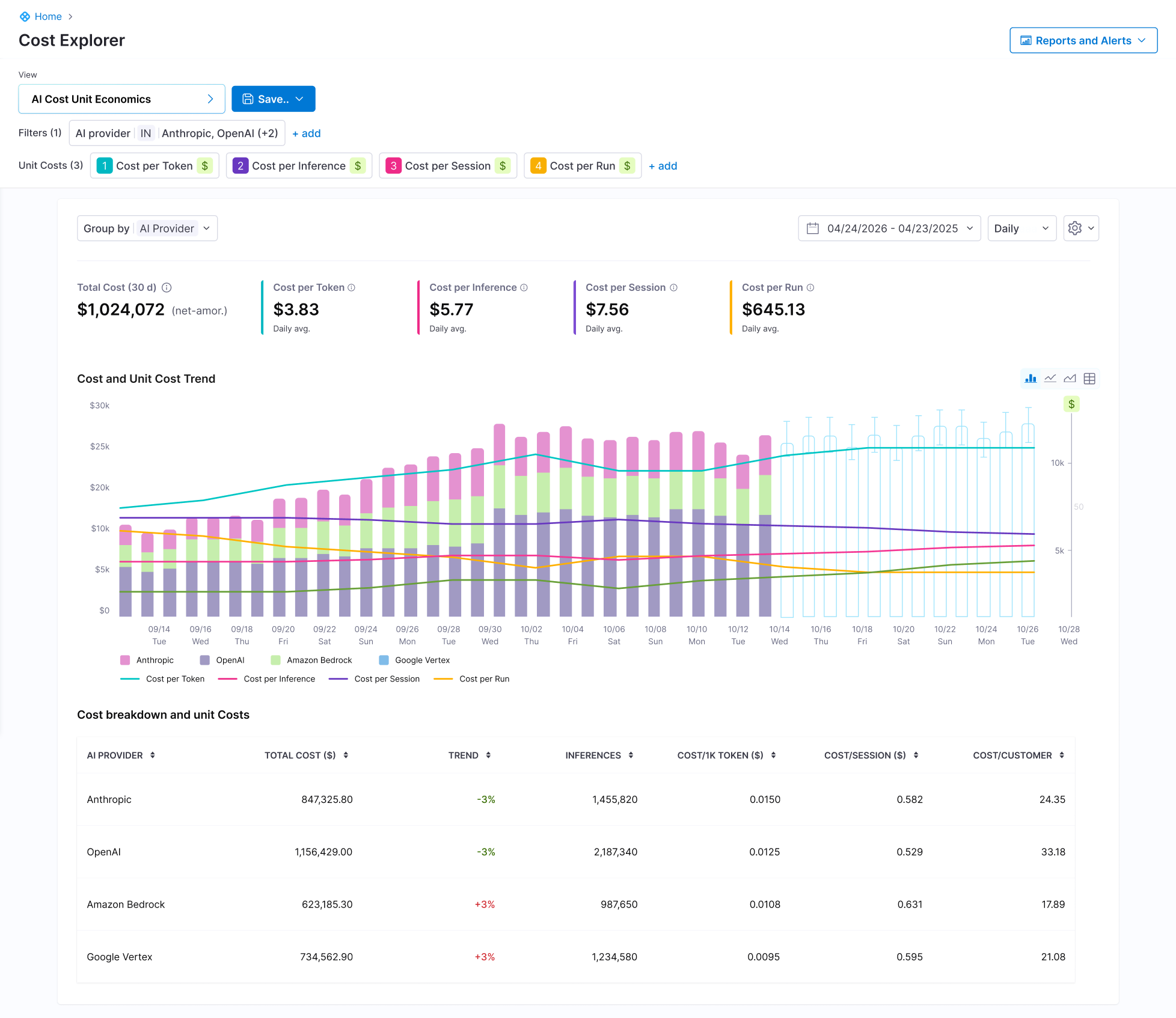
Fig. 2: AI Cost Unit Economics dashboard connects total AI spend to the metrics that matter, giving leaders a cross-provider breakdown of cost per token, per inference, and per session across providers.
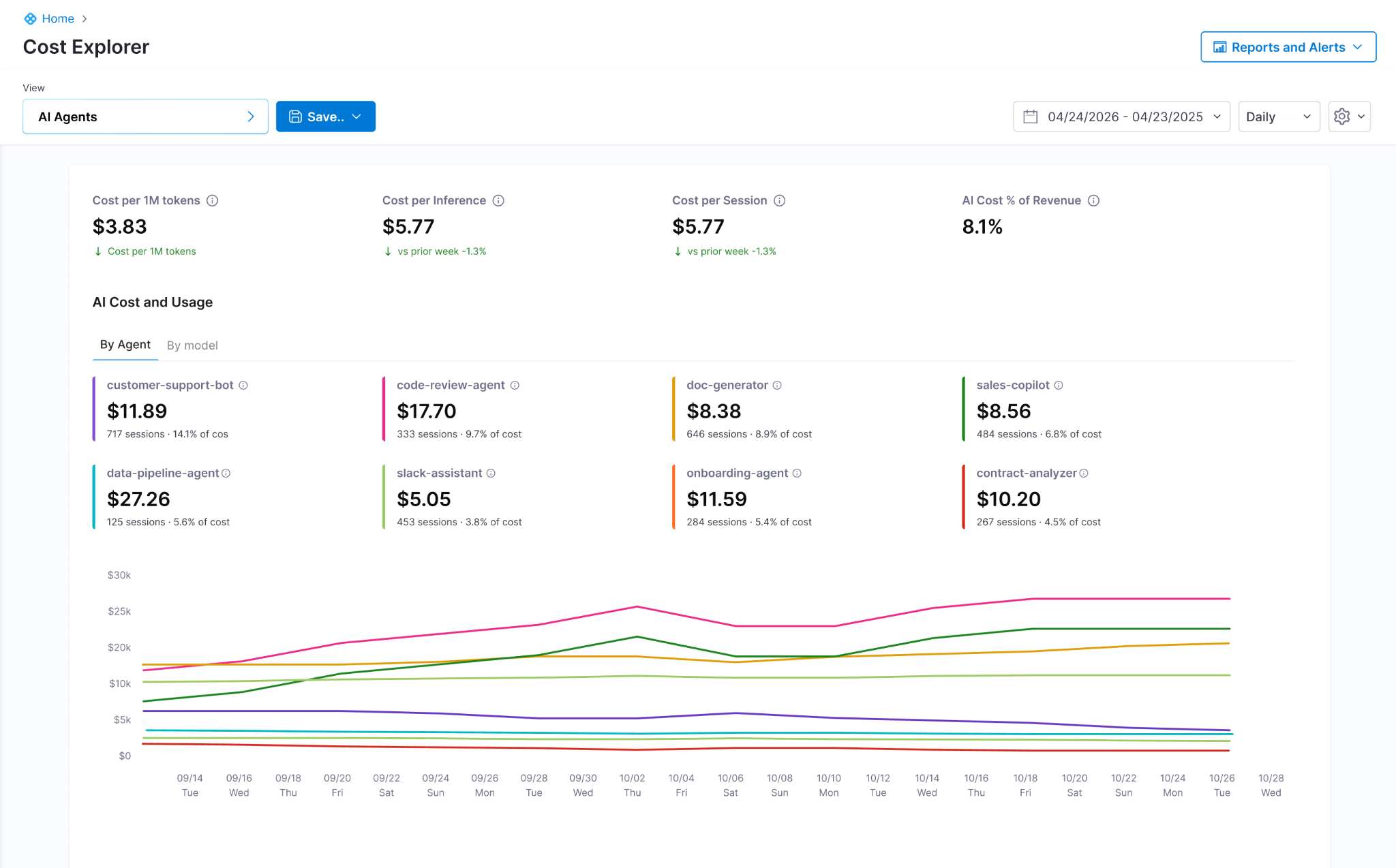
Fig. 3: AI spend, attributed by agent. At a glance: which agents are growing, which sessions are getting more expensive, and what AI cost looks like as a share of revenue.
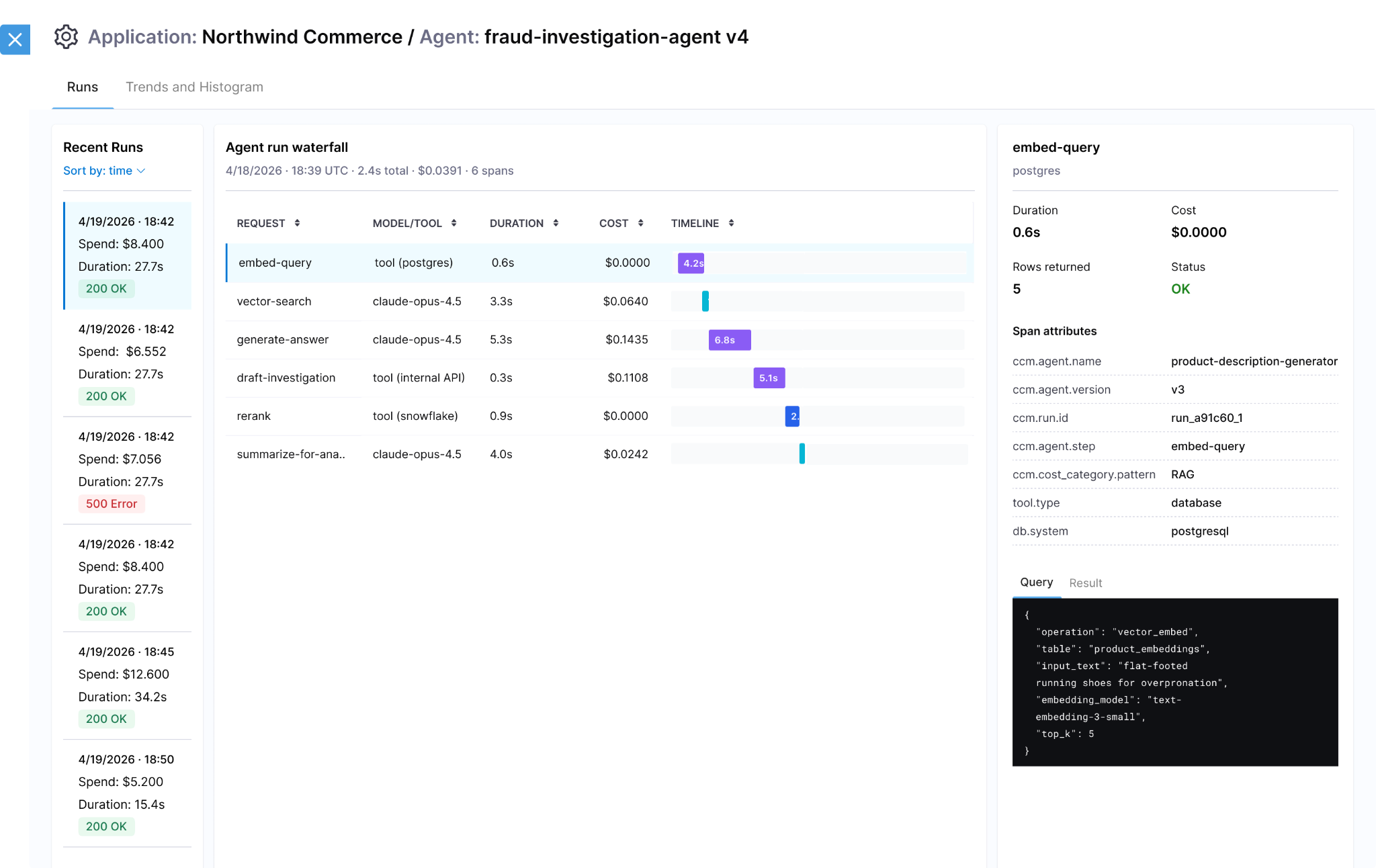
Fig. 4: Run-level waterfall for a single agent run. The cost and latency of every step, every model call, and every tool invocation, with span attributes for debugging.
ROI of AI Spend, All in One Platform
AI DLC Insights answers the developer question: is token spend turning into shipped work? Cloud & AI Cost Management answers the infrastructure question: is each agent worth what it costs in production? Both questions now have a direct answer in the same platform.
The first phase of enterprise AI was adoption. The next is about proving the tools are worth their cost. The organizations that can show where the money goes and what it produces will spend the next dollar with confidence. The rest will keep approving line items they can't explain.
AI DLC Insights and Cloud & AI Cost Management are available in beta now. [Learn more: AI DLC Insights Demo]