Move beyond bespoke CI/CD scripts. Learn how to architect a "Golden Standard" pipeline that enforces governance, accelerates security testing, and guarantees artifact integrity using a Zero Trust approach.

TL;DR
- Shift governance to Step Zero by implementing Policy as Code (OPA) at pipeline start to prevent non-compliant builds from wasting compute and exposing secrets.
- Parallelize security orchestration (linting, SAST, secrets scanning) to reduce wall-clock time while running expensive unit tests only after fast, cheap security checks pass.
- Generate three supply chain artifacts with every build: an SBOM (ingredient list for Log4j-style incident response), SLSA Provenance (unforgeable build identity), and cryptographic signature (tamper-proof seal).
- Deploy the same immutable artifact to QA and production using digest-based references and approval gates, eliminating environment-specific rebuild risks.
We’ve all seen it happen. A DevOps initiative starts with high energy, but two years later, you’re left with a sprawl of "fragile agile" pipelines. Every team has built their own bespoke scripts, security checks are inconsistent (or non-existent), and maintaining the system feels like playing whack-a-mole.
This is where the industry is shifting from simple DevOps execution to Platform Engineering.
The goal of a modern platform team isn't to be a help desk that writes YAML files for developers. The goal is to architect a "Golden Path"—a standardized, pre-vetted route to production that is actually easier to use than the alternative. It reduces the cognitive load for developers while ensuring that organizational governance isn't just a policy document, but a reality baked into every commit.
In this post, I want to walk through the architecture of a Golden Standard Pipeline. We’re going to look beyond simple task automation and explore how to weave Governance, Security, and Supply Chain integrity into a unified workflow that stands the test of time.
The Architectural Blueprint
A Golden Standard Pipeline isn't defined by the tools you use—Harness, Gitlab, GitHub Actions—but by its layers of validation. It’s not enough to simply "build and deploy" anymore. We need to architect a system that establishes trust at every single stage.
I like to break this architecture down into four distinct domains:
- Governance Domain: checking if we should run this pipeline before we even start.
- Integration Domain (The Inner Loop): getting fast feedback to developers.
- Trust Domain (Supply Chain): creating proof that the software is safe.
- Delivery Domain (The Outer Loop): getting it to production reliably.
Visualizing the Flow

Layer 1: Governance as the First Gate
The Principle: Don't process what you can't approve.
In traditional pipelines, we often see compliance checks shoehorned in right before production deployment. This is painful. There is nothing worse than waiting 20 minutes for a build and test cycle, only to be told you can't deploy because you used a non-compliant base image.
In a Golden Standard architecture, we shift governance to Step Zero.
By implementing Policy as Code (using frameworks like OPA) at the very start of execution, we solve a few problems:
- Drift Prevention: Pipelines simply won't run if they’ve been hacked to bypass standard steps.
- Resource Efficiency: We don't waste expensive compute building artifacts that are doomed to fail compliance.
- Security Baseline: Unauthorized workflows are stopped dead before they can access secrets or internal networks.
Layer 2: Parallelized Security Orchestration
The Principle: Security must speed the developer up, not slow them down.
The "Inner Loop" is sacred ground. This is where developers live. If your security scanning adds friction or takes too long, developers will find a way to bypass it. To solve this, we rely on Parallel Orchestration.
Instead of running checks linearly (Lint → then SAST → then Secrets), we group "Code Smells," "Linting," and "Security Scanners" to run simultaneously.
This gives us a huge architectural advantage:
- Reduced Latency: We squash the wall-clock time by running I/O heavy checks in parallel.
- Cost Optimization: We only trigger expensive Unit Test runners after the cheap, fast security checks pass. There is zero value in running a heavy test suite on a codebase that contains a hardcoded API key.
Layer 3: The Trust Layer (Supply Chain Security)
The Principle: Prove the origin and ingredients of your software.
This is the biggest evolution we've seen in CI/CD recently. We need to stop treating the build artifact (Docker image/Binary) as a black box. Instead, we generate three critical pieces of metadata that travel with the artifact:
- SBOM (Software Bill of Materials): Think of this as the ingredients list on a food packet. It’s a machine-readable inventory of every library inside your container. When the next Log4j happens, you don't need to scan the world; you just query your inventory.
- SLSA Provenance: This is an unforgeable ID card for your build. It proves where the build happened, when it happened, and what inputs were used. This is your defense against tampering attacks (like SolarWinds).
- Cryptographic Signing: Finally, we sign the artifact using a private key (via Cosign). This acts like a digital wax seal; if the image is modified by even one bit after the build, the seal breaks, and your cluster will refuse to run it.
Layer 4: Immutable Delivery
The Principle: Build once, deploy everywhere.
A common anti-pattern I see is rebuilding artifacts for different environments—building a "QA image" and then rebuilding a "Prod image" later. This introduces risk.
In the Golden Standard, the artifact generated and signed in Layer 3 is the exact same immutable object deployed to QA and Production. We use a Rolling Deployment strategy with an Approval Gate between environments. The production stage explicitly references the digest of the artifact verified in QA, ensuring zero drift.
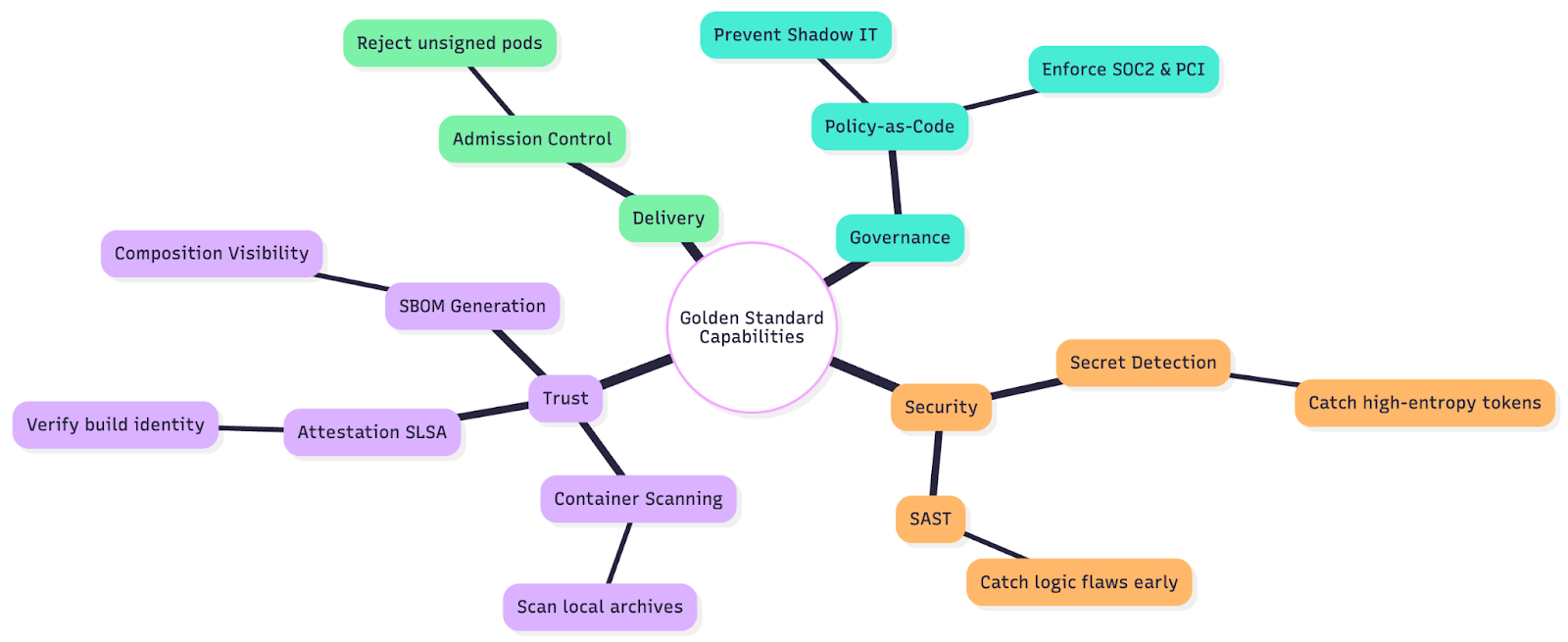
The Capability Map
To successfully build this, your platform needs to provide specific capabilities mapped to these layers.
Future-Proofing Your Platform
Tools change. Jenkins, Harness, GitHub Actions—they all evolve. But the Architecture remains constant. If you adhere to these principles, you future-proof your organization:
- Decouple Policy from Pipeline: Store your policies separately from your pipeline YAML. This lets you update security rules globally without needing a massive migration project to edit hundreds of pipelines.
- Standardize Interfaces: Use standard formats for your metadata (SPDX for SBOMs, In-toto for attestations). This prevents vendor lock-in and ensures your data is portable.
- Invest in "Shift Left" Culture: The best architecture in the world fails if developers see it as a hurdle. Position the Golden Pipeline as a product that solves developer pain points (like setting up environments or managing credentials) while silently enforcing security in the background.
Conclusion
Adopting a Golden Standard architecture transforms the CI/CD pipeline from a simple task runner into a governance engine. By abstracting security and compliance into these reusable layers, Platform Engineering teams can guarantee that every microservice—regardless of the language or framework—adheres to the organization's highest standards of trust.

What makes a Golden Standard pipeline different from a regular CI/CD pipeline?
A regular CI/CD pipeline automates build, test, and deploy tasks but often lacks enforced governance and supply chain security. A Golden Standard pipeline architects four trust domains into the workflow: governance-as-code gates that prevent policy violations before builds start, parallelized security checks that accelerate feedback, cryptographically signed artifacts with SBOM and SLSA provenance for supply chain integrity, and immutable artifact promotion that deploys the exact same verified image across all environments. The difference is architecture, not just automation.
How does Policy as Code at Step Zero reduce compute waste?
Traditional pipelines run compliance checks late in the process, often right before production deployment. This means you spend 15 to 20 minutes building, testing, and packaging an artifact only to discover it uses a non-approved base image or violates security policies. By validating policy compliance (via OPA or similar) at pipeline start (Step Zero), you reject non-compliant builds immediately, saving expensive build infrastructure, test runner costs, and developer wait time on artifacts that will never deploy.
Why sign artifacts instead of just scanning them for vulnerabilities?
Vulnerability scanning (SAST, container scanning) detects known security issues in your code and dependencies, but it does not prove the artifact is authentic or unmodified. Cryptographic signing (using Cosign or similar) creates a digital seal that breaks if even one byte of the artifact changes after the build. This defends against supply chain tampering attacks (like SolarWinds) where malicious actors inject code between your CI system and production. Signing proves integrity; scanning proves safety. Both are required.
Can I use a Golden Standard pipeline with GitHub Actions, GitLab, or Jenkins?
Yes. The Golden Standard architecture is tool-agnostic. The principles (governance gates, parallel security, supply chain attestations, immutable delivery) can be implemented in any modern CI/CD platform including Harness, GitHub Actions, GitLab CI, Jenkins, CircleCI, or Azure DevOps. The key is to decouple your policy definitions (stored as OPA Rego files or equivalent) from your pipeline YAML so you can update security rules globally without editing pipeline files across every repository. The architecture persists even as tools evolve.
Q: What is SLSA Provenance and why do I need it?
A: SLSA Provenance is a standardized, unforgeable metadata document (defined by the SLSA framework at slsa.dev) that records exactly where, when, and how your software artifact was built. It includes the Git commit SHA, build timestamp, builder identity, and input materials. This acts like a birth certificate for your software. When the next supply chain breach happens, you can instantly verify whether your artifacts came from your trusted build system or were tampered with externally. It is your defense against build system compromise and dependency confusion attacks.