.png)
Harness AI is starting 2026 by doubling down on what it does best: applying intelligent automation to the hardest “after code” problems, incidents, security, and test setup, with three new AI-powered capabilities. These updates continue the same theme as December: move faster, keep control, and let AI handle more of the tedious, error-prone work in your delivery and security pipelines.
Harness AI SRE now includes the Human-Aware Change Agent, an AI system that treats human insight as first-class operational data and connects it to the changes that actually break production. Instead of relying only on logs and metrics, it listens to real incident conversations in tools like Slack, Teams, and Zoom and turns those clues into structured signals.
By unifying human observations with the software delivery knowledge graph and change intelligence, teams get a much faster path from “what are we seeing?” to “what changed?” to “what should we roll back or fix safely?” The result is shorter incidents, clearer ownership, and a teammate-like AI that reasons about both people and systems in real time. Learn more in the announcement blog post.
Effective application security starts with knowing what you actually have in production. Traditional API naming based on regex heuristics often leads to over-merged or under-merged API groups, noisy inventories, and false positives across detection workflows.
This month, API naming in our Traceable product gets a major upgrade with AI-powered API semantics:
For security leaders trying to tame API sprawl, this is a foundational improvement that boosts signal quality across the entire platform.
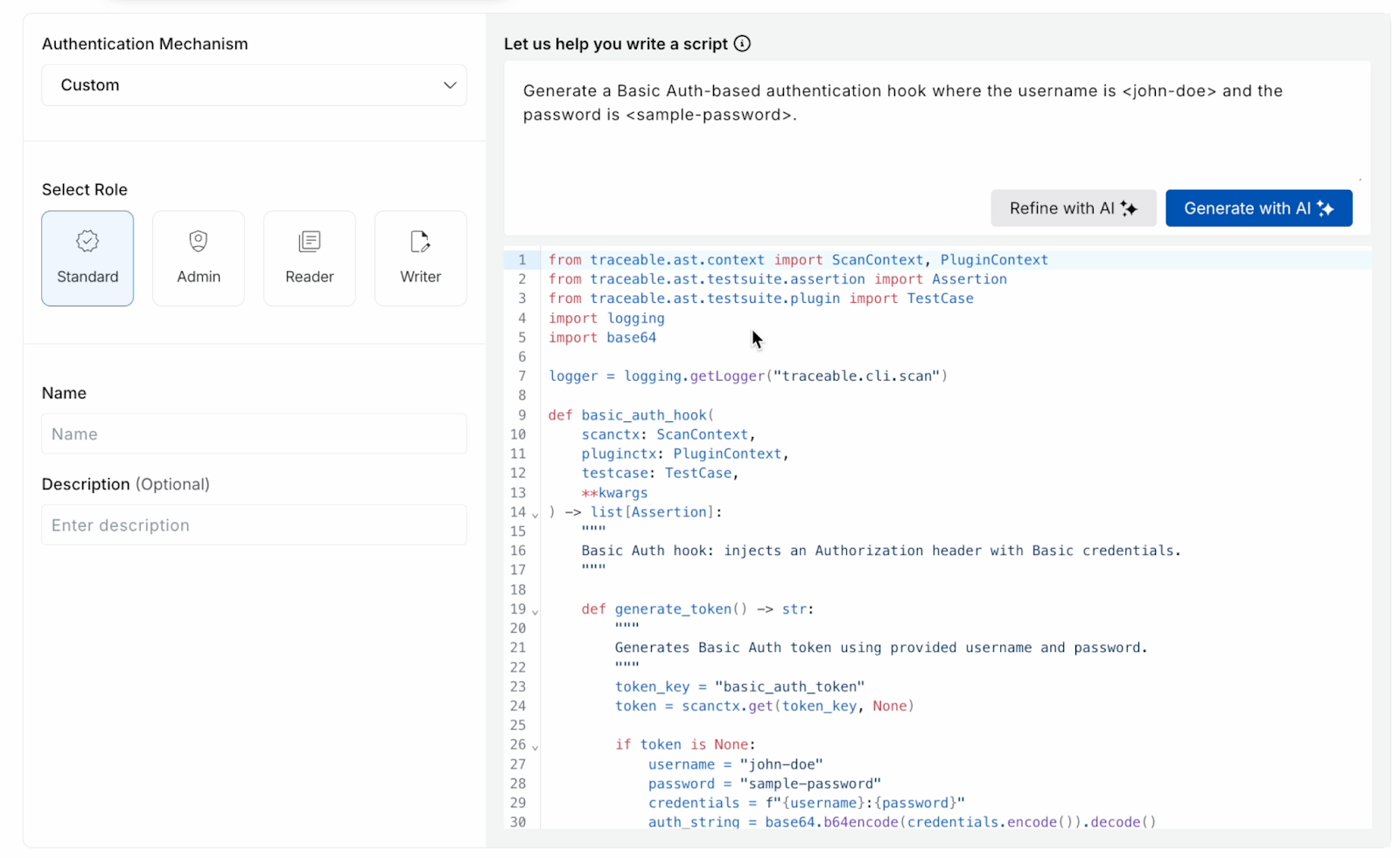
Authentication setup has been one of the most consistent sources of friction for application security testing. Manual scripting, validation cycles, and back-and-forths often create bottlenecks — and a broken auth script can quietly invalidate an entire scan run.
To solve this, all API Security Testing customers now get AI-based Authentication Script Generation:
The result is less time lost to brittle auth setup, faster onboarding for new apps, and fewer failed scans due to script errors.
You can find implementation details and examples in the docs.

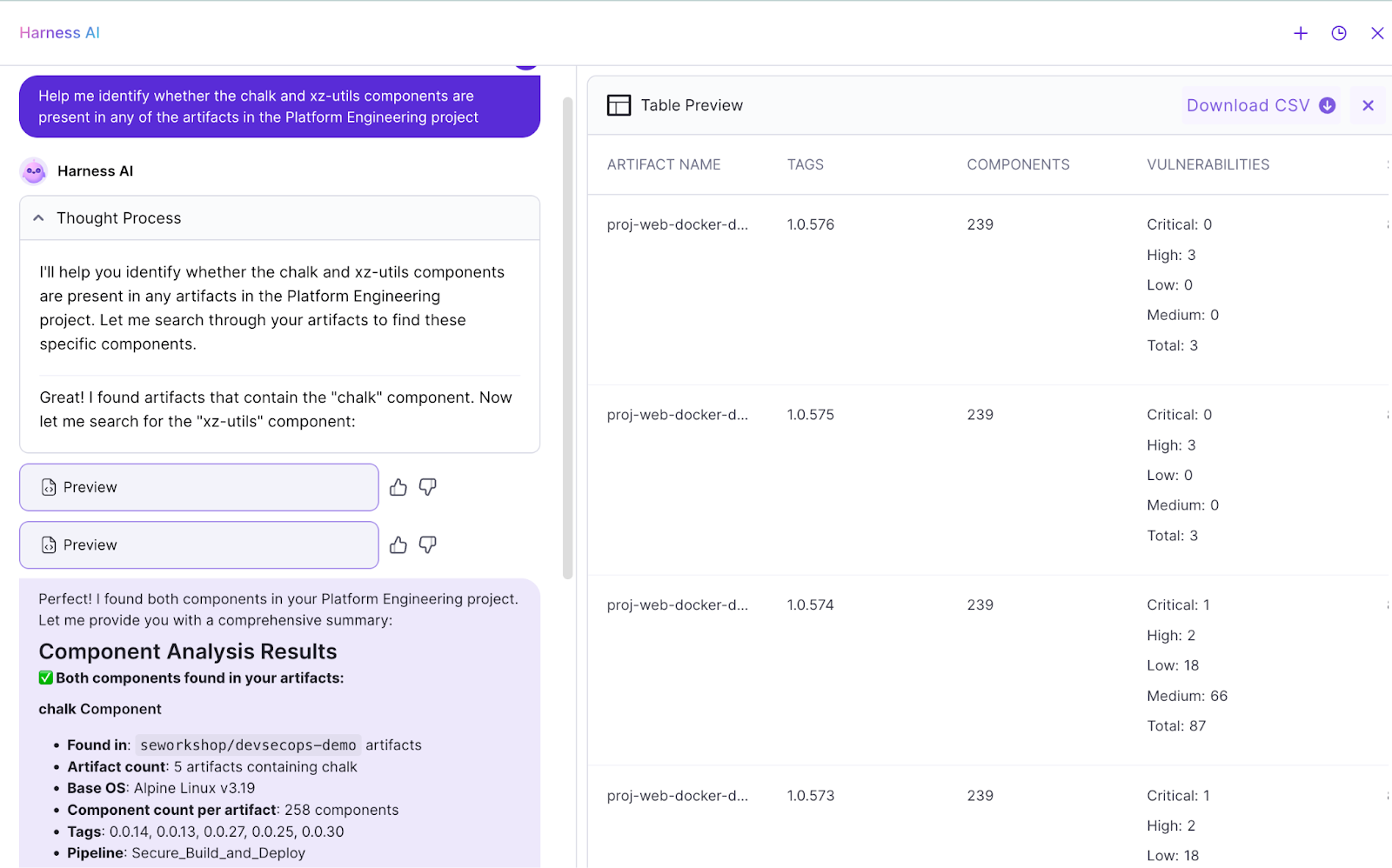
Security and platform teams often know the question they want to ask: “Where is this component used?” “Which exemptions are still pending?” , but answering it requires hopping across dashboards and stitching together filters by hand.
The new AppSec Agent makes this dramatically easier by letting you query AppSec data using natural language.

This is a big step toward making AppSec data as queryable and collaborative as the rest of your engineering stack. Learn more in the docs.
Harness AI is focused on everything after code is written — building, testing, deploying, securing, and optimizing software through intelligent automation and agentic workflows. January’s updates extend that vision across:
Teams adopting these features can ship changes faster, investigate less, and focus more of their time on the work that actually moves the business — while Harness AI quietly handles the complexity in the background.
.png)
Our December Harness AI updates focus specifically on enhancements to Harness AI governance. You can review our Harness AI November updates here.
Every platform engineering team faces the same tension: developers want to move fast, while security and compliance teams need guardrails. Too much friction slows delivery. Too little creates risk.
What if AI could help you have both?
With Harness AI, you can accelerate pipeline creation while automatically enforcing your organization's policies. Every AI-generated resource is traceable, auditable, and compliant—by design.
Open Policy Agent (OPA) policies are the backbone of governance in Harness. They enforce rules across:
The challenge? Writing Rego policies requires specialized knowledge. Most teams have a handful of people who understand OPA, and they're constantly backlogged.
Harness AI changes this.
Now, anyone can describe a policy in plain English and let AI generate the Rego code:
"Create a policy that requires approval from the security team for any deployment to production that hasn't passed a SAST scan."
Harness AI generates the policy. Your experts review and approve. Governance scales without bottlenecks.
Here's where governance and productivity intersect.
Your organization has invested in "golden" pipeline templates - battle-tested, approved configurations that encode your best practices. The problem: developers don't always know they exist, or they take shortcuts to avoid the complexity.
With Harness AI, developers simply ask:
"Build me a deployment pipeline that references our golden Java microservices template."
Harness AI:
The result? Developers get pipelines in seconds. Platform teams get compliance by default. Learn more about referencing templates here.

Any AI-generated resource can be saved as a template for others to reuse, thereby compounding your investment in standards.
What happens when AI generates something that doesn't meet your policies?
It gets caught immediately.
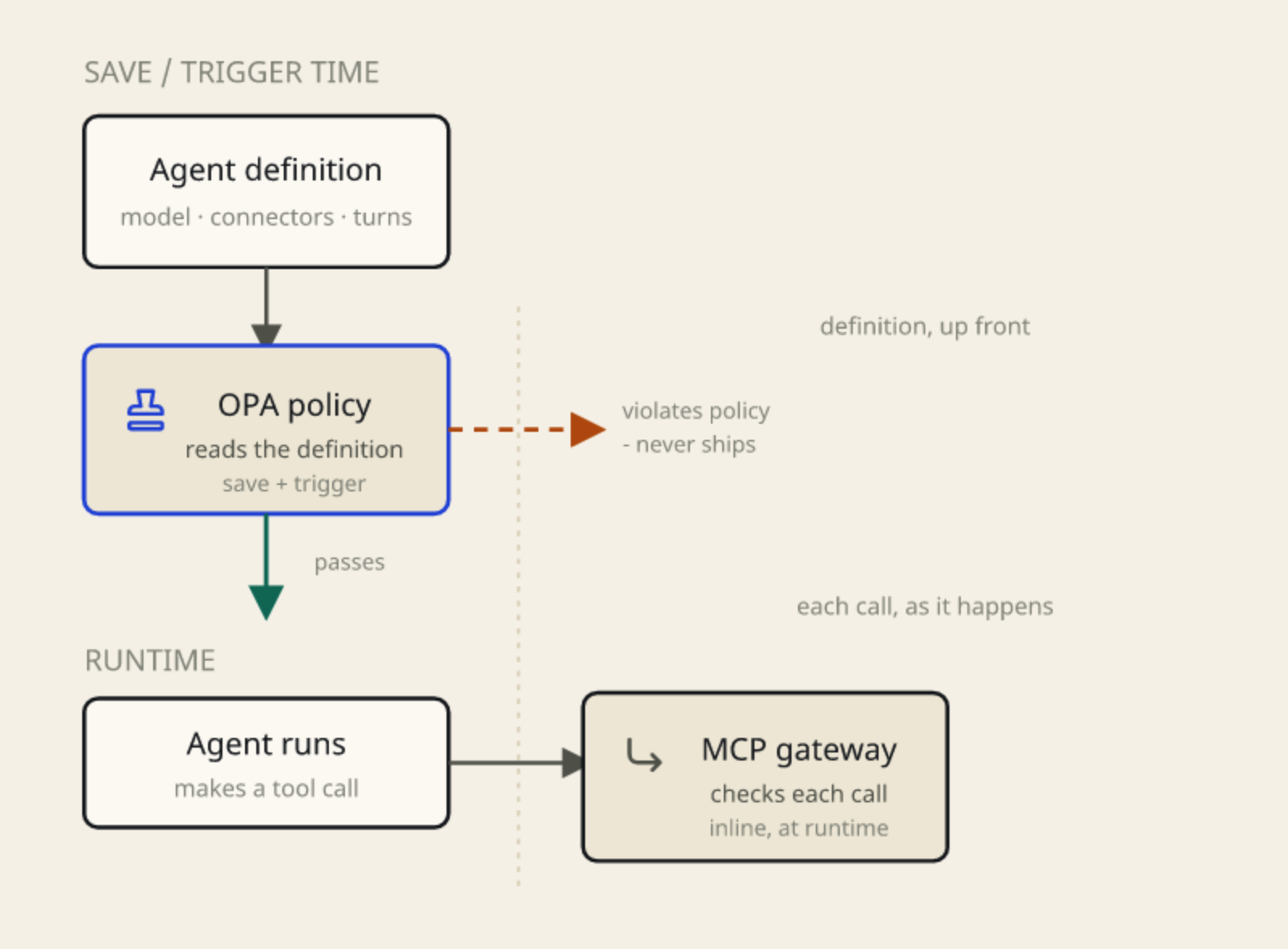
When a user saves or runs an AI-generated pipeline, Harness evaluates it against your OPA policies in real-time. If there's a violation:
For example:
Policy Violation: "Production deployments require a manual approval stage. Your pipeline is missing this step."
User prompt: "Add a manual approval stage before the production deployment."
Harness AI: Updates the pipeline to comply.
This feedback loop turns policy violations into learning moments, without leaving the AI experience. Learn more about Harness AI and OPA policies here.
In regulated industries, "an AI built it" isn't an acceptable audit response. You need traceability.
Harness AI provides it:
Every resource created by Harness AI is automatically labeled:
ai_generated: true
This label persists through the resource lifecycle. You always know what was created by humans versus AI-assisted.
All AI-generated entities appear in the Harness Audit Trail with:
For AI-generated pipelines, you can:
This gives auditors and compliance teams the evidence they need—without manual documentation overhead.
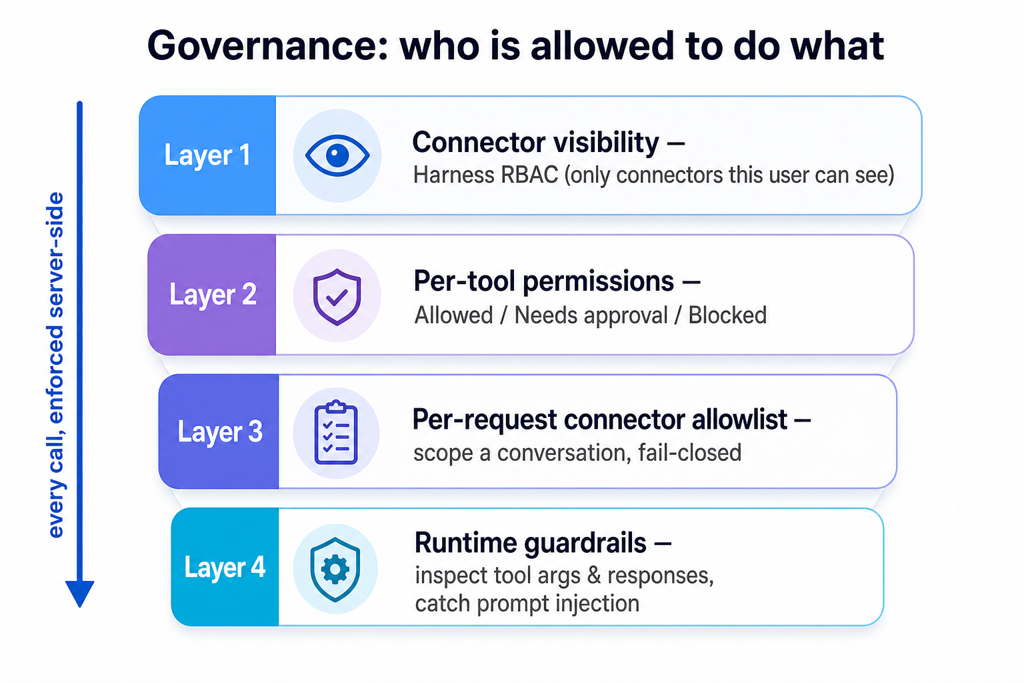
A common concern with AI assistants: "What if it does something the user shouldn't be able to do?"
Harness AI eliminates this risk with a fundamental design principle:
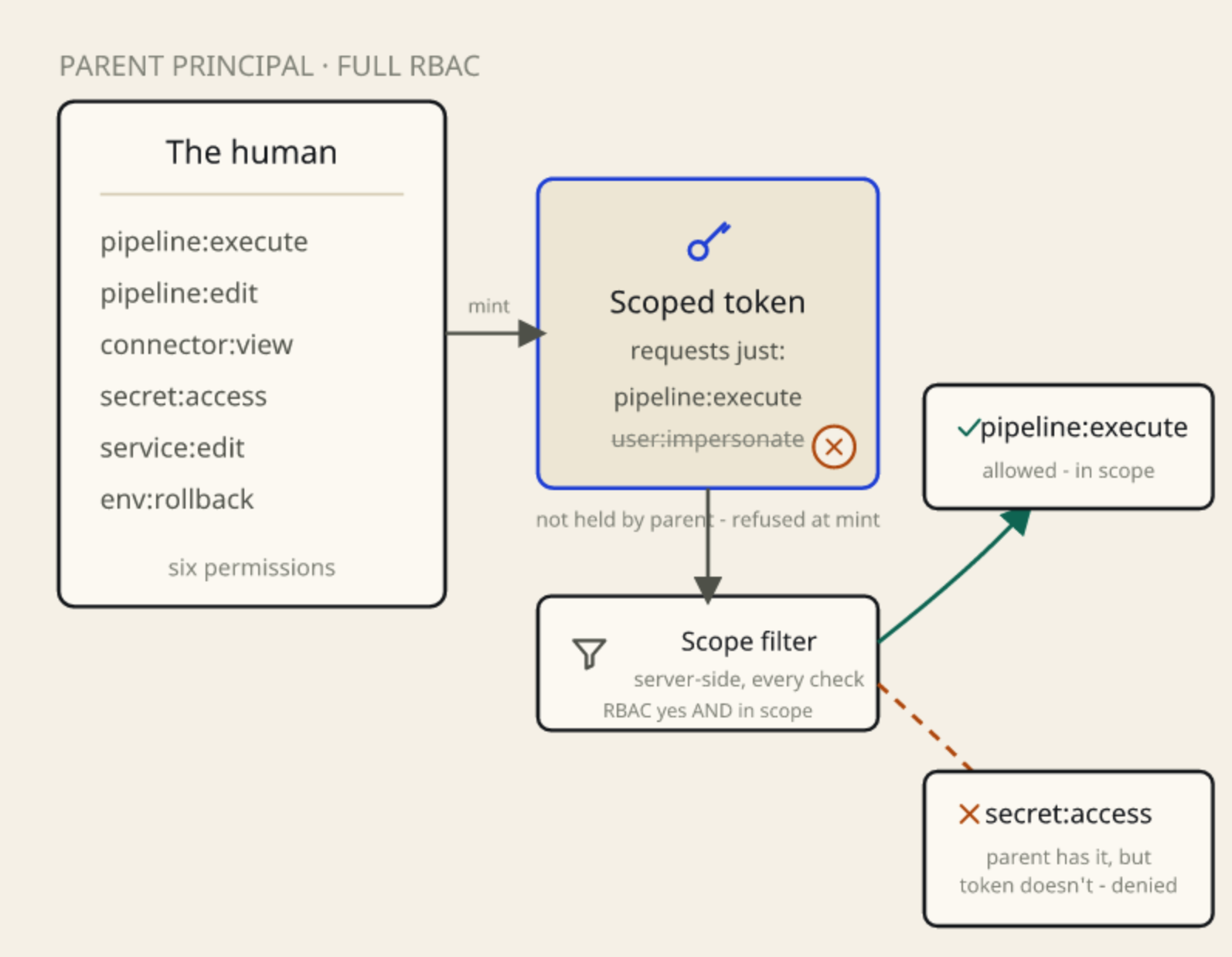
Harness AI can only do what the user can do.
The AI operates on behalf of the authenticated user, inheriting their exact Role-Based Access Control (RBAC) permissions:

There's no privilege escalation. No backdoors. No "AI admin" account. The AI is an extension of the user—bound by the same rules.
Here's how it all comes together:

Already a Harness customer? Harness AI is available across the platform. Start by:
New to Harness? Request a demo to see AI-powered governance in action.
.png)
Today, we’re excited to announce our expanded partnership with Amazon, bringing together the power of Amazon Kiro, Amazon Q Developer, and Harness SaaS on AWS to revolutionize how your team builds, troubleshoots, secures, and deploys software. This collaboration is designed to deliver a seamless, intelligent, and scalable software delivery experience for all AWS customers.
Harness SaaS on AWS empowers engineering and DevOps teams to deliver software faster, safer, and more efficiently across cloud-native environments. By leveraging the robust infrastructure of AWS, Harness provides an AI platform that scales with your business needs. With Harness SaaS on AWS, you get:
The Harness Platform is now even more powerful with the integration of Amazon Kiro and Q Developer. This agentic IDE revolution enables developers to manage, optimize, and resolve CI/CD pipeline, security, and testing issues directly from their development environment using natural language. No more switching between Kiro and the Harness platform. Now, you can ask Kiro for your AWS infrastructure information, along with Harness pipeline executions, in the context of your IDE. Learn more about the different use cases in this blog post.
Context is the key for any AI to be effective. Harness’s Software Delivery Knowledge Graph ensures that this automation is tailored to your AWS environment, providing actionable insights rather than generic recommendations. Whether you’re a seasoned expert or a new team member, this integration makes shipping code faster and more intuitive. Learn more about the Knowledge Graph.
Harness is already helping customers achieve accelerated build and deployment using AI-powered features such as Test Intelligence and Continuous Verification. Organizations such as United Airlines and Trust Bank have enhanced their software delivery experience with Harness and AWS.
Specifically, for Trust Bank, Harness's cloud-first capabilities enable Trust Bank to efficiently deploy changes across its containerized applications on AWS, utilizing Amazon EKS. Trust Bank also leverages AWS services such as Amazon Athena, Amazon RDS, and Amazon Aurora, resulting in a resilient, secure, and optimized infrastructure that scales with its growth. Trust Bank sought a solution to integrate with its AWS environment, reduce developer workload, and prioritize innovation, aiming to offload the onerous supply delivery chain lifecycle. By integrating Harness with AWS and automating compliance, security, and risk checks in the CI/CD pipeline, Trust Bank cut its deployment lead time from two weeks to just 24 hours. Automated compliance ensures all industry-standard controls are met, maintaining high security. This automation enables Trust Bank to focus on delivering innovative products, rather than being hindered by manual processes.
This partnership delivers enterprise-grade automation, contextual intelligence, and seamless cloud-native delivery, all backed by the reliability of AWS. Harness SaaS on AWS is available for purchase through the AWS Marketplace, making it easy for your organization to get started and scale as your needs grow. Together with Amazon Kiro, Q, and Harness SaaS on AWS, Harness and Amazon are committed to removing bottlenecks and empowering teams to ship software with confidence.
Register for the “Securing AI Velocity” webinar to learn more about how Harness and AWS can make software delivery better.
.png)
.png)
Harness AI is starting 2026 by doubling down on what it does best: applying intelligent automation to the hardest “after code” problems, incidents, security, and test setup, with three new AI-powered capabilities. These updates continue the same theme as December: move faster, keep control, and let AI handle more of the tedious, error-prone work in your delivery and security pipelines.
Harness AI SRE now includes the Human-Aware Change Agent, an AI system that treats human insight as first-class operational data and connects it to the changes that actually break production. Instead of relying only on logs and metrics, it listens to real incident conversations in tools like Slack, Teams, and Zoom and turns those clues into structured signals.
By unifying human observations with the software delivery knowledge graph and change intelligence, teams get a much faster path from “what are we seeing?” to “what changed?” to “what should we roll back or fix safely?” The result is shorter incidents, clearer ownership, and a teammate-like AI that reasons about both people and systems in real time. Learn more in the announcement blog post.
Effective application security starts with knowing what you actually have in production. Traditional API naming based on regex heuristics often leads to over-merged or under-merged API groups, noisy inventories, and false positives across detection workflows.
This month, API naming in our Traceable product gets a major upgrade with AI-powered API semantics:
For security leaders trying to tame API sprawl, this is a foundational improvement that boosts signal quality across the entire platform.
Authentication setup has been one of the most consistent sources of friction for application security testing. Manual scripting, validation cycles, and back-and-forths often create bottlenecks — and a broken auth script can quietly invalidate an entire scan run.
To solve this, all API Security Testing customers now get AI-based Authentication Script Generation:
The result is less time lost to brittle auth setup, faster onboarding for new apps, and fewer failed scans due to script errors.
You can find implementation details and examples in the docs.

Security and platform teams often know the question they want to ask: “Where is this component used?” “Which exemptions are still pending?” , but answering it requires hopping across dashboards and stitching together filters by hand.
The new AppSec Agent makes this dramatically easier by letting you query AppSec data using natural language.

This is a big step toward making AppSec data as queryable and collaborative as the rest of your engineering stack. Learn more in the docs.
Harness AI is focused on everything after code is written — building, testing, deploying, securing, and optimizing software through intelligent automation and agentic workflows. January’s updates extend that vision across:
Teams adopting these features can ship changes faster, investigate less, and focus more of their time on the work that actually moves the business — while Harness AI quietly handles the complexity in the background.
.png)
.png)
Our December Harness AI updates focus specifically on enhancements to Harness AI governance. You can review our Harness AI November updates here.
Every platform engineering team faces the same tension: developers want to move fast, while security and compliance teams need guardrails. Too much friction slows delivery. Too little creates risk.
What if AI could help you have both?
With Harness AI, you can accelerate pipeline creation while automatically enforcing your organization's policies. Every AI-generated resource is traceable, auditable, and compliant—by design.
Open Policy Agent (OPA) policies are the backbone of governance in Harness. They enforce rules across:
The challenge? Writing Rego policies requires specialized knowledge. Most teams have a handful of people who understand OPA, and they're constantly backlogged.
Harness AI changes this.
Now, anyone can describe a policy in plain English and let AI generate the Rego code:
"Create a policy that requires approval from the security team for any deployment to production that hasn't passed a SAST scan."
Harness AI generates the policy. Your experts review and approve. Governance scales without bottlenecks.
Here's where governance and productivity intersect.
Your organization has invested in "golden" pipeline templates - battle-tested, approved configurations that encode your best practices. The problem: developers don't always know they exist, or they take shortcuts to avoid the complexity.
With Harness AI, developers simply ask:
"Build me a deployment pipeline that references our golden Java microservices template."
Harness AI:
The result? Developers get pipelines in seconds. Platform teams get compliance by default. Learn more about referencing templates here.

Any AI-generated resource can be saved as a template for others to reuse, thereby compounding your investment in standards.
What happens when AI generates something that doesn't meet your policies?
It gets caught immediately.
When a user saves or runs an AI-generated pipeline, Harness evaluates it against your OPA policies in real-time. If there's a violation:
For example:
Policy Violation: "Production deployments require a manual approval stage. Your pipeline is missing this step."
User prompt: "Add a manual approval stage before the production deployment."
Harness AI: Updates the pipeline to comply.
This feedback loop turns policy violations into learning moments, without leaving the AI experience. Learn more about Harness AI and OPA policies here.
In regulated industries, "an AI built it" isn't an acceptable audit response. You need traceability.
Harness AI provides it:
Every resource created by Harness AI is automatically labeled:
ai_generated: true
This label persists through the resource lifecycle. You always know what was created by humans versus AI-assisted.
All AI-generated entities appear in the Harness Audit Trail with:
For AI-generated pipelines, you can:
This gives auditors and compliance teams the evidence they need—without manual documentation overhead.
A common concern with AI assistants: "What if it does something the user shouldn't be able to do?"
Harness AI eliminates this risk with a fundamental design principle:
Harness AI can only do what the user can do.
The AI operates on behalf of the authenticated user, inheriting their exact Role-Based Access Control (RBAC) permissions:

There's no privilege escalation. No backdoors. No "AI admin" account. The AI is an extension of the user—bound by the same rules.
Here's how it all comes together:

Already a Harness customer? Harness AI is available across the platform. Start by:
New to Harness? Request a demo to see AI-powered governance in action.
.png)
.png)
Knowledge graphs and RAG (Retrieval-Augmented Generation) are complementary techniques for enhancing large language models with external knowledge, and each brings unique strengths for DevOps use cases. While they are often mentioned together, they are fundamentally different systems, and combining them delivers far better outcomes than relying on either approach alone.
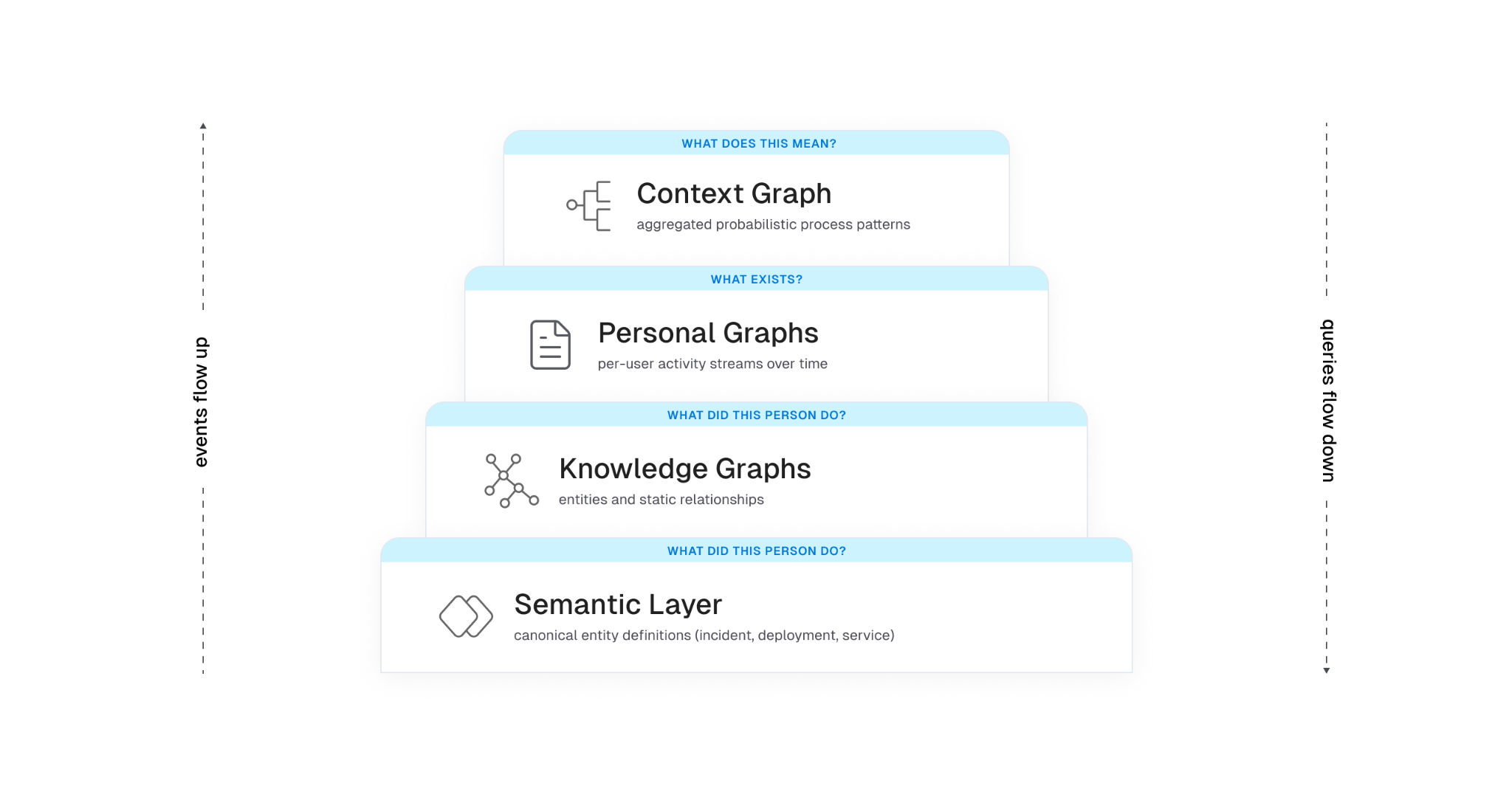
A knowledge graph is a semantic model composed of entities and relationships that reflect how systems, services, code, environments, and people connect. These entities may come from Harness or from third-party DevOps tools. Retrieval from a knowledge graph can be:
The foundation of the knowledge graph is its semantic layer, which serves as the source of truth for the structure and meaning of the data. This semantic layer defines what an “application,” “pipeline,” “service,” “environment,” “deployment,” or “policy” means - not just how it is stored. This enforces consistent definitions across tools, eliminates ambiguity, and grounds all reasoning in shared meaning.
Because the semantic layer governs how data flows into the graph, it ensures the graph scales cleanly, remains governable, and can incorporate new tools, relationships, and metadata without becoming chaotic.
RAG, by contrast, retrieves unstructured text (documents, runbooks, incident notes, commit messages, architecture diagrams) using embedding similarity and feeds the retrieved content to an LLM. RAG does not model structure or relationships; it retrieves relevant fragments of text.
The fundamental distinction lies in structure:
This is why the two approaches excel at different types of problems.
Knowledge graphs excel at multi-hop reasoning, where answering a question requires walking multiple relationships — linking a failing service to its owning team, its CI pipeline, the associated environment, and the policies governing that environment.
They offer:
The primary limitation is that a knowledge graph is limited by the data it models.
RAG systems shine when working with unstructured information at scale. They are excellent for:
However, RAG struggles with questions that require:
RAG retrieves text. It does not understand structure.
Modern DevOps AI systems increasingly combine both approaches:
The result is retrieval and reasoning that are not only relevant but also organized, contextualized, and aligned with the real structure of the software delivery environment.
DevOps environments are inherently relationship-heavy: pipelines, services, environments, teams, approvals, policies, artifacts, and dependencies all interact tightly.

A knowledge graph captures these interactions explicitly.
The semantic layer ensures that as systems evolve, definitions remain consistent.
This gives AI agents true organizational context — not just textual familiarity.
With a graph-backed semantic model, agents can reason about:
This is essential for generating pipelines, validating changes, automating deployments, and performing impact analysis.
RAG is excellent for retrieving documentation, API references, runbooks, and historical incidents. But it cannot reliably infer:
RAG retrieves text; it does not reason across structured relationships.
This limits RAG-only approaches to “chatbots over docs,” which is useful but insufficient for deeper automation.
A hybrid system uses both unstructured retrieval (RAG) and structured context (knowledge graph) to produce highly accurate, domain-aware answers. The semantic layer ensures that the graph remains consistent and scalable even as the organization grows.
This combination enables:
Knowledge graphs — and especially the semantic layer behind them — benefit the entire engineering ecosystem, not just AI.
They provide:
AI simply leverages this foundation to become more grounded, less error-prone, and deeply contextual.
Harness uses a Software Delivery Knowledge Graph built on a semantic model that continuously synchronizes entities and relationships across Harness modules and third-party DevOps tools. The semantic layer defines meaning and ensures structure, while RAG enriches the system with unstructured context.
This enables AI agents to:

Results include:
This is possible because the system blends semantic structure (knowledge graph), meaning (semantic layer), and breadth of context (RAG), producing far more reliable DevOps automation than any single method alone. We'll be writing more about Knowledge Graph in upcoming blog posts.
.png)
.png)
November was another big month for Harness AI, with new capabilities that deepen our work with AWS, bring AI-native automation to the database, and keep our model stack on the cutting edge across the SDLC.
We are expanding our partnership with Amazon to connect AI-powered development directly to intelligent delivery. As AI tools like Amazon Q and Kiro accelerate code development, this integration focuses on safely moving that code into production with built-in governance, security, cost controls, and delivery intelligence. Together, Harness SaaS on AWS and Harness’s Software Delivery Knowledge Graph provide teams with a single, trusted path from code to cloud, eliminating the need to stitch together point tools.
For developers, this shows up as AI-infused workflows in the IDE and CI/CD pipelines that understand context across 160+ tools exposed via the Harness MCP server. Teams can see faster pipeline onboarding, dramatically reduced debugging time, and safer rollouts, while platform and security leaders get unified governance across AWS environments without sacrificing velocity. Learn more about the partnership in this blog post.
Application delivery has become highly automated, but databases have historically lagged behind. Schema changes are still often managed with manual SQL scripts, spreadsheets, and late-night deployments. That gap makes databases one of the most common sources of release friction and risk, turning them into a bottleneck even when CI/CD is mature. Database DevOps matters because it applies the same discipline used for applications—Git, policy-as-code, governed pipelines, automated rollback—to the systems that hold your most critical data.
Harness Database DevOps tackles this directly by treating database changes like application code: versioned, tested, governed, and observable across environments. As one of the fastest-growing modules in the Harness platform, it helps teams ship safely without waiting on a small group of DBAs or accepting 2 a.m. change windows as normal.
We have introduced AI-powered database migration authoring inside our Database DevOps product. Developers can now describe the change they want in natural language, and Harness generates production-ready migrations that are backward-compatible, validated against policies, wired into Git, and paired with rollback scripts. Every migration is governed and auditable, so DBAs maintain control through policy-as-code and approvals while the AI handles the heavy lifting.
Under the hood, this capability is powered by the Software Delivery Knowledge Graph and the Harness MCP server, which bring awareness of schemas, pipelines, and best practices into each suggestion. The result is a database layer that finally moves at DevOps speed, with fewer incidents, stronger governance, and far less manual toil for both developers and database teams. Learn more about AI-powered database migration authoring here.

Error Analyzer is a great example of how Harness AI applies deep context, not just raw model power, to real DevOps problems. When a pipeline fails, our improved Error Analyzer automatically correlates recent changes, checks dependencies, identifies historical patterns, and pinpoints the most likely root cause, allowing teams to skip scrolling through logs and jump straight to fixes. The analysis view highlights which commits or configuration edits are likely to have triggered the regression, whether an external service or infrastructure dependency is unhealthy, and how similar this failure is to previous incidents across your organization.
From there, Harness AI turns insights into concrete action. Error Analyzer presents prioritized recommendations with clear justifications, and in many cases, can generate and apply YAML fixes on your behalf, with a before-and-after diff, so you stay in control. With built-in impact assessment and an audit trail of pipeline changes, teams can diagnose issues more quickly, understand the blast radius, and continuously harden their pipelines and dramatically reducing debugging time while maintaining high reliability.

Behind these experiences, Harness AI continually evaluates and upgrades its underlying model stack, including the latest generations, such as Claude 4.5, Sonnet 4.5, and GPT-5. Instead of betting on a single LLM, Harness runs internal evaluations and real-world tests to benchmark performance, reliability, and safety for specific software delivery jobs, such as pipeline generation, error analysis, and database migration authoring. The platform then dynamically selects the best model for each task, with guardrails and fallbacks built in, so customers achieve the strongest results without having to manage model churn themselves.
Taken together, November’s updates are another step toward Harness’s vision of AI-native software delivery: where agents understand intent, enforce policy, and automate work from code to cloud to database. Deep AWS integrations remove friction between AI-powered development and production, Database DevOps eliminates the last major manual bottleneck, and continuous model optimization keeps Harness AI ahead of the curve for real-world DevOps use cases. As AI continues to increase code velocity, these capabilities make sure your pipelines, databases, and platforms can keep up with confidence.
.png)
.png)
Today, we’re excited to announce our expanded partnership with Amazon, bringing together the power of Amazon Kiro, Amazon Q Developer, and Harness SaaS on AWS to revolutionize how your team builds, troubleshoots, secures, and deploys software. This collaboration is designed to deliver a seamless, intelligent, and scalable software delivery experience for all AWS customers.
Harness SaaS on AWS empowers engineering and DevOps teams to deliver software faster, safer, and more efficiently across cloud-native environments. By leveraging the robust infrastructure of AWS, Harness provides an AI platform that scales with your business needs. With Harness SaaS on AWS, you get:
The Harness Platform is now even more powerful with the integration of Amazon Kiro and Q Developer. This agentic IDE revolution enables developers to manage, optimize, and resolve CI/CD pipeline, security, and testing issues directly from their development environment using natural language. No more switching between Kiro and the Harness platform. Now, you can ask Kiro for your AWS infrastructure information, along with Harness pipeline executions, in the context of your IDE. Learn more about the different use cases in this blog post.
Context is the key for any AI to be effective. Harness’s Software Delivery Knowledge Graph ensures that this automation is tailored to your AWS environment, providing actionable insights rather than generic recommendations. Whether you’re a seasoned expert or a new team member, this integration makes shipping code faster and more intuitive. Learn more about the Knowledge Graph.
Harness is already helping customers achieve accelerated build and deployment using AI-powered features such as Test Intelligence and Continuous Verification. Organizations such as United Airlines and Trust Bank have enhanced their software delivery experience with Harness and AWS.
Specifically, for Trust Bank, Harness's cloud-first capabilities enable Trust Bank to efficiently deploy changes across its containerized applications on AWS, utilizing Amazon EKS. Trust Bank also leverages AWS services such as Amazon Athena, Amazon RDS, and Amazon Aurora, resulting in a resilient, secure, and optimized infrastructure that scales with its growth. Trust Bank sought a solution to integrate with its AWS environment, reduce developer workload, and prioritize innovation, aiming to offload the onerous supply delivery chain lifecycle. By integrating Harness with AWS and automating compliance, security, and risk checks in the CI/CD pipeline, Trust Bank cut its deployment lead time from two weeks to just 24 hours. Automated compliance ensures all industry-standard controls are met, maintaining high security. This automation enables Trust Bank to focus on delivering innovative products, rather than being hindered by manual processes.
This partnership delivers enterprise-grade automation, contextual intelligence, and seamless cloud-native delivery, all backed by the reliability of AWS. Harness SaaS on AWS is available for purchase through the AWS Marketplace, making it easy for your organization to get started and scale as your needs grow. Together with Amazon Kiro, Q, and Harness SaaS on AWS, Harness and Amazon are committed to removing bottlenecks and empowering teams to ship software with confidence.
Register for the “Securing AI Velocity” webinar to learn more about how Harness and AWS can make software delivery better.
.png)
.png)
The AI Velocity Paradox is real. While teams are writing code faster than ever, they're hitting a wall downstream. Deployments are failing. Security vulnerabilities are slipping through. Manual toil is eating up whatever time developers saved with AI-assisted coding. The speed boost from one part of the software delivery lifecycle is being strangled by legacy processes in another.
Harness is solving this the only way that works: by bringing intelligent AI deeper into the delivery process itself.
Last quarter, we introduced transformative updates to Harness AI that address the exact problem plaguing most organizations: understanding complex pipelines, troubleshooting failures in seconds instead of hours, and building persistent AI memory to evolve alongside your team's workflows.
Here's what we're seeing in the field: teams adopting AI for coding are experiencing a 25% increase in adoption, but Google's DORA research tells us the uncomfortable truth — that AI adoption is actually decreasing delivery stability by 7.2% and throughput by 1.5%. Why? Because the downstream bottleneck is real.
Developers can generate code in minutes. But when that code hits a pipeline, they run into walls:
October has been a busy month for us as we released a bunch of updates to bring intelligent automation to everything after the code is written, exactly where teams need it most.
Harness AI now automatically analyzes your most complex pipelines and summarizes what they do, why they exist, what stages matter, and how they're connected. No more hunting through YAML. No more waiting for the one person who understands the legacy pipeline configuration.
This is about velocity without the toil. When a new developer joins, they can understand pipeline design in minutes, rather than days. When you're troubleshooting a failure, you immediately know which stages are relevant and why. When you optimize your delivery process, you gain clarity on what each pipeline actually does.
The impact: Faster comprehension of pipeline design and intent without digging through multiple configurations. Teams spend less time context-switching and more time shipping.

Ask Harness AI why your deployment failed. Not a generic error code. An actual conversation.
"Why did this deployment fail?"
"How do I fix it?"
"What changed between the last successful deployment and this one?"
The enhanced Error Analyzer now supports natural language interactions across more stage types. Instead of squinting at logs and error messages, you're having a dialogue with an AI that understands your pipeline, your errors, and how to resolve them. The AI provides instant, contextual explanations that get to the root cause.
The impact: Root-cause analysis that takes hours becomes a conversation that takes minutes. Time-to-resolution drops dramatically. Teams spending 40%+ of their time on toil suddenly have hours back to focus on actual innovation.


Harness AI now supports chat history, enabling teams to organize conversations, revisit past troubleshooting sessions, and maintain context between interactions. This is similar to the AI IDE experience, but for DevOps. It's the difference between a helpful chatbot that forgets everything and an AI teammate that learns alongside you.
The impact: Continuous context, smarter collaboration, and evolving intelligence that gets better the more your team uses it. Teams aren't restarting investigations from scratch. Memory compounds over time.

We've also enhanced Harness Continuous Delivery with AI verification and rollback capabilities. New integration with Dynatrace Grail, an increasingly popular logs platform, means teams using Grail can now connect it directly to Harness, triggering automatic rollback on abnormal log telemetry after a deployment.
This closes the loop on the Velocity Paradox. Code moves fast. Verification is intelligent and automated. When something goes wrong, the system acts before customers notice.

Our Model Context Protocol (MCP) server is evolving with expanded Feature Management and Experimentation (FME) toolset capabilities, laying the groundwork for even deeper agentic automation across the platform. This is how AI teams get integrated into your existing workflows, not as replacements, but as force multipliers. Learn more about using this toolset with Claude Code.
In case you missed it, we also announced the IDP Knowledge Agent at our Unscripted conference. The Knowledge Agent is now available and resides within the Harness IDP, serving as an AI-powered teammate. It helps developers find the information they need, understand how systems work, and take action faster. You can ask questions like, “Who owns the authentication service?” or “How can I improve my score?” and get relevant, trustworthy answers in seconds. Learn more about the Knowledge Agent in this blog post.
The worst trap organizations fall into is measuring AI by how fast developers can code. That's missing the entire point.
AI's real value is in the systems. It's in understanding complexity that humans can't easily parse. It's in eliminating repetitive troubleshooting. It's in the memory that builds over time, making teams smarter with every deployment.
Harness AI for DevOps addresses the real problem: the downstream bottleneck that's choking velocity gains from upstream AI adoption.
By bringing intelligent automation to pipeline understanding, instant troubleshooting, and persistent context, we're not just making deployments faster. We're making them safer, smarter, and more resilient. We're turning the Velocity Paradox on its head—ensuring that when code moves fast, everything downstream can keep up.
This is what AI-native software delivery looks like. Not faster chaos. Faster, safer, smarter execution.
These updates represent a shift in how Harness approaches AI. We're not adding features. We're solving a fundamental problem in modern software delivery: the gap between upstream speed (code generation) and downstream automation (testing, security, deployment).
The teams winning today aren't the ones with the fastest developers. They're the ones with the most intelligent pipelines. The most resilient deployments. The deepest context about what's actually happening in production.
For everything after the code is written, Harness AI makes that possible.


Picture this: your QA team just rolled out a comprehensive new test suite ; polished, precise, and built to catch every bug. Yet soon after, half the tests fail. Not because the code is broken, but because the design team shifted a button slightly. And even when the tests pass, users still find issues in production. A familiar story?
End-to-end testing was meant to bridge that gap. This is how teams verify that complete user workflows actually work the way users expect them to. It's testing from the user's perspective; can they log in, complete a transaction, see their data?
The Real Problem Isn't Maintenance. It's Misplaced Focus.
Maintaining traditional UI tests often feels endless. Hard-coded selectors break with every UI tweak, which happens nearly every sprint. A clean, well-structured test suite quickly turns into a maintenance marathon. Then come the flaky tests: scripts that fail because a button isn’t visible yet or an overlay momentarily blocks it. The application might work perfectly, yet the test still fails, creating unpredictable false alarms and eroding trust in test results.
The real issue lies in what’s being validated. Conventional assertions often focus on technical details- like whether a div.class-name-xy exists or a CSS selector returns a value, rather than confirming that the user experience actually works.
The problem with this approach is that it tests how something is implemented, not whether it works for the user. As a result, a test might pass even when the actual experience is broken, giving teams a false sense of confidence and wasting valuable debugging time.
Some common solutions attempt to bridge that gap. Teams experiment with smarter locators, dynamic waits, self-healing scripts, or visual validation tools to reduce flakiness. Others lean on behavior-driven frameworks such as Cucumber, SpecFlow, or Gauge to describe tests in plain, human-readable language. These approaches make progress, but they still rely on predefined selectors and rigid code structures that don’t always adapt when the UI or business logic changes.
What’s really needed is a shift in perspective : one that focuses on intent rather than implementation. Testing should understand what you’re trying to validate, not just how the test is written.
That’s exactly where Harness builds on these foundations. By combining AI understanding with intent-driven, natural language assertions, it goes beyond behavior-driven testing, actually turning human intent directly into executable validation.
Harness AI Test Automation reimagines testing from the ground up. Instead of writing brittle scripts tied to UI selectors, it allows testers to describe what they actually want to verify, in plain, human language.
Think of it as moving from technical validation to intent validation. Rather than writing code to confirm whether a button exists, you can simply ask:
Behind the scenes, Harness AI interprets these statements dynamically, understanding both the context and the intent of the test. It evaluates the live state of the application to ensure assertions reflect real business logic, not just surface-level UI details.
This shift is more than a technical improvement; it’s a cultural one. It democratizes testing, empowering anyone on the team, from developers to product managers, to contribute meaningful, resilient checks. The result is faster test creation, easier maintenance, and validations that truly align with what users care about: a working, seamless experience.
Harness describes this as "Intent-based Testing", where tests express what matters rather than how to check it, enabling developers and QA teams to focus on outcomes, not implementation details.
Traditional automation for end-to-end testing/UI testing often breaks when UIs change, leading to high maintenance overhead and flaky results. Playwright, Selenium, or Cypress scripts frequently fail because they depend on exact element paths or hardcoded data, which makes CI/CD pipelines brittle.
Industry statistics reveal that 70-80% of organizations still rely heavily on manual testing methods, creating significant bottlenecks in otherwise automated DevOps toolchains. Source
Harness AI Test Automation addresses these issues by leveraging AI-powered assertions that dynamically adapt to the live page or API context. Benefits include:
Organizations using AI Test Automation see up to 70% less maintenance effort and significant improvements in release velocity.
Harness uses large language models (LLMs) optimized for testing contexts. The AI:
Together, these layers of intelligence make Harness AI Assertions not just smarter but contextually aware, giving you a more human-like and reliable testing experience every time you run your pipeline.
This context-aware approach identifies subtle bugs that are often missed by traditional tests and reduces the risks associated with AI “hallucinations.” Hybrid verification techniques cross-check outputs against real-time data, ensuring reliability.
For example, when testing a dynamic transaction table, an assertion like “Verify the latest transaction is a deposit over $500” will succeed even if the table order changes or new rows are added. Harness adapts automatically without requiring code changes
Harness Blog on AI Test Automation.
Crucially, we are not asking the AI to generate code (although for some math questions it might) and then never consult it again; we actually ask the AI this question with the context of the webpage every time you run the test.
Successful or not, the assertion will also give you back reasoning as to why it is true:


Organizations across fintech, SaaS, and e-commerce are using Harness AI to simplify complex testing scenarios:
Even less-technical users can author and maintain robust tests. Auto-suggested assertions and natural language prompts accelerate collaboration across QA, developers, and product teams.


You can also perform assertions based on parameters.

An early adopter reported that after integrating Harness AI Assertions, release verification time dropped by more than 50%, freeing QA teams to focus on higher-value work. DevOpsDigest coverage
Harness AI Test Automation empowers teams to move faster with confidence. Key benefits include:
Harness AI Test Automation turns traditional QA challenges into opportunities for smarter, more reliable automation, enabling organizations to release software faster while maintaining high quality.
Harness AI is to test what intelligent assistants are to coding: it allows humans to focus on strategy, intent, and value, while the AI handles repetitive validation (Harness AI Test Automation).
Harness AI Test Automation represents a paradigm shift in testing. By combining intent-driven natural language assertions, AI-powered context awareness, and self-adapting validation, it empowers teams to deliver reliable software faster and with less friction.
If you are excited about and want to simplify maintenance while improving test reliability, contact us to learn more about how intent-driven, natural-language assertions can transform your testing experience.


Teams have always been under pressure to deliver software faster. But here's what we've learned from working with thousands of engineering teams: writing the code has never been the real bottleneck. It's everything that happens after - the testing, security scans, deployments, and optimizations that determine whether your innovations actually reach customers quickly and reliably. Even in the era of AI, the speed boost is uneven, creating the AI Velocity Paradox.
That's why we're excited to share how our collaboration with Google Cloud changes the game for your team. This isn't just about new technology - it's about solving the daily challenges that prevent you from shipping with confidence.
You might have experienced the frustration of watching perfectly good code sit in limbo while your CI/CD pipelines break, tests fail, or security scans slow everything down. Nearly 45% of all deployments linked to AI-generated code lead to problems.
With Harness AI enabled by Google Cloud's Vertex AI platform, you get intelligent automation across every stage after code. Your team can now create enterprise-grade pipelines in seconds using natural language, automatically generate and maintain tests that adapt to changes, and deploy with confidence knowing AI is detecting issues in real time.
The results speak for themselves. Teams using Harness AI are already seeing test cycle times slashed by up to 80%, pipeline onboarding accelerated by 85%, and issue resolution that's 7 times faster. That's not just incremental improvement - it's getting back hours of your day to focus on innovation instead of toil.
We know what keeps you up at night. You need speed, but you can't compromise on security or compliance. This is where our partnership with Google Cloud becomes critical for your peace of mind.
Harness AI is enabled by Vertex AI, Google Cloud’s advanced AI platform that provides private, dedicated access to cutting-edge models like the Gemini 2.5 series. Your data is never stored or used for training. Every insight and recommendation is generated using only your organization's context through our Software Delivery Knowledge Graph, which remains completely isolated.
You get built-in privacy, governance, scalability, and compliance guardrails, ensuring you can adopt AI without risk. Security scanning happens in real time, vulnerabilities get detected and remediated automatically, and every change is tracked for full auditability.
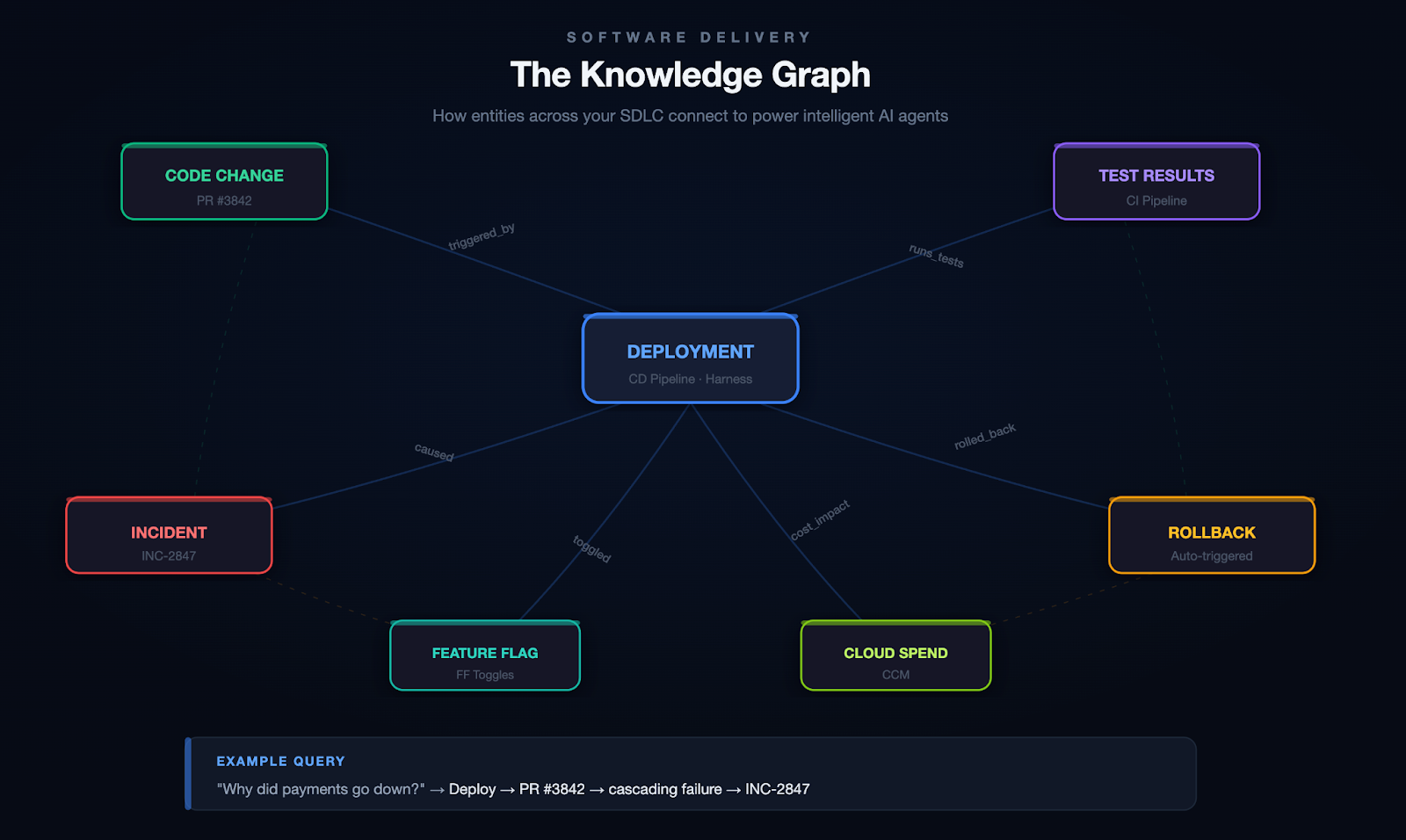
Powering Harness AI is our Software Delivery Knowledge Graph, which helps it understand your entire software delivery environment. Our Knowledge Graph is purpose-built exclusively for the software delivery lifecycle, capturing relationships across every stage from code to production in a secure, privacy-first manner.
Unlike generic knowledge graphs, it continuously ingests and connects a wide range of data from builds, tests, deployments, incidents, infrastructure changes, security scans, feature flags, rollbacks, test results, cloud spend, and database changes into a unified, real-time intelligence layer. This comprehensive mapping enables Harness AI to understand not just individual components, but the causal relationships between code changes, deployment outcomes, system behavior, and business impact. We also plan to integrate data from Google Cloud Platform into our knowledge graph, enhancing the AI's understanding of your GCP workloads.

Need to troubleshoot a broken pipeline? AI-powered error analysis translates cryptic error messages and provides actionable next steps based on your environment, saving you hours of debugging time. Want to optimize your cloud costs? You get smart recommendations tailored to your actual usage patterns, not generic best practices.
You don't need to install anything new, manage external credentials, or lose control of your workflows. Harness AI works directly within the Harness Platform you already use, integrating seamlessly with your CI/CD pipelines, Feature Flags, Cloud Cost Management, and Security Testing. Behind the scenes, specialized AI agents work together to automate tasks intelligently.
Your engineers can simply describe what they need in natural language through a chat interface, and Harness AI handles the complexity. Whether it's onboarding new team members who can now deploy with confidence in minutes instead of days, or automatically rolling back deployments when regressions are detected, the intelligence adapts to your workflows.
Recently, we were the launch partner for Gemini CLI extensions, which enables AI to seamlessly interact with Harness tools and GCP services using the Model Context Protocol (MCP) standard. This allows engineers to leverage powerful CLI capabilities that effortlessly reach multiple tools through standardized communication.
Our collaboration with Google Cloud goes beyond today's capabilities. We're investing in Google Cloud's Agent2Agent (A2A) protocol for enhanced interoperability, and customers already have expanded access to Harness through Google Cloud Marketplace. This shared foundation means tighter integration and more powerful automation for your team as we continue building together.
The partnership reflects a shared commitment: helping you move at the speed of innovation while ensuring the enterprise safety and compliance your business depends on. With roots in Google Cloud, Harness AI gives you the scale and resilience global enterprises demand.
Harness AI is available now for all Harness customers. Your team no longer has to choose between speed and trust - with our Google Cloud collaboration, you get both.
.png)
.png)
The modern software development landscape moves fast, with AI-powered coding assistants generating code at unprecedented speeds. However, even the most sophisticated code generation is only half the battle. The real challenge lies in ensuring that code successfully navigates through CI/CD pipelines to reach production. Pipeline failures remain one of the most frustrating bottlenecks in software delivery, often requiring manual investigation and complex debugging processes. This blog post describes how the powerful combination of Amazon Kiro and Harness’s MCP server helps you fix CI/CD issues, right from your IDE.
Amazon Kiro represents a new category of development tools: an agentic IDE that helps developers move from prototype to production with the structure that production-ready code requires. Unlike traditional AI coding assistants that focus primarily on code generation, Kiro uses an agentic reasoning loop of planning, reasoning, taking actions, and evaluating results to handle multi-step tasks.
What sets Kiro apart is its context awareness and integration capabilities through the Model Context Protocol (MCP) framework. This allows Kiro to run locally while connecting to specialized tools and services through standardized MCP servers. The platform includes features like specs for defining project requirements, steering rules to guide AI behavior across projects, and agent hooks that automate repetitive tasks using smart triggers.
Harness is the AI platform for everything after code, focusing on testing, security, deployment, and optimization. Built on eight years of AI innovation in software delivery, Harness has evolved from pioneering AI-driven Continuous Verification in 2017 to today's agentic AI capabilities that autonomously perceive, reason, act, and learn across the entire software delivery lifecycle.
The platform delivers measurable improvements in software delivery performance. Organizations using Harness AI have seen 85% faster pipeline onboarding, 7x faster issue resolution through AI-powered troubleshooting, and 50% reduction in pipeline debugging time. At its core lies the Software Delivery Knowledge Graph: a continuously updated intelligence layer that captures and connects data from every stage of the SDLC, enabling contextual automation and decision-making.
Harness's MCP Server provides a unified interface for AI agents to interact with Harness's comprehensive suite of DevOps tools and services. The integration of Harness MCP server and Amazon Kiro brings the power of Harness's 161 DevOps tools directly into Kiro's development environment, creating a high level of automation for CI/CD pipeline management and troubleshooting. This integration enables developers to seamlessly understand and fix pipeline failures without leaving their coding environment.
Consider a real-world scenario where a developer makes changes to a code repository, triggering a build that fails during the compile step. Traditionally, this would require manually navigating to the CI/CD platform, examining logs, identifying the root cause, and then returning to the code editor to implement fixes. With the Kiro-Harness integration, this entire workflow becomes streamlined and intelligent.
The developer simply configures the Harness MCP server within Kiro, providing access to all Harness tools through standardized protocols. Using natural language, they can ask Kiro to list all pipelines in their organization. Behind the scenes, Kiro calls the appropriate Harness API through the MCP server, retrieving and presenting pipeline information in a conversational format.
When investigating a specific pipeline with build and deploy failures, the developer can request a detailed description directly through Kiro. The AI agent automatically calls the GET pipeline tool, providing a comprehensive breakdown that immediately surfaces the last execution status. Upon discovering the failure, the developer can simply ask, "Why did the last execution fail?".
Kiro then orchestrates a sophisticated investigation process: it retrieves the last execution details using the get execution tool, downloads the complete execution logs, analyzes them for error patterns, and presents a clear diagnosis.
In the demonstrated use case, the AI identified that the pipeline failed in the compile step due to an incorrect package name: a simple typo where "platformm" should have been "platform".
Most remarkably, Kiro doesn't just identify the issue…it takes action. The AI agent can directly modify the problematic file, correcting the package.json entry with the proper package name. The developer can then review the change, commit it, and push upstream, with the confidence that the pipeline will succeed on the next run.
Beyond basic troubleshooting, the Kiro-Harness integration unlocks numerous advanced use cases that transform how development teams interact with their CI/CD infrastructure.
Pipeline Creation and Optimization: Developers can describe their deployment intent in natural language within Kiro, and the integration will generate enterprise-grade pipelines that automatically adhere to organizational policies and standards. This eliminates the learning curve for new team members and ensures consistency across projects.
Proactive Issue Detection: The integration leverages Harness's AI-powered continuous verification capabilities to detect anomalies in deployment metrics and logs. When issues are identified, Kiro can automatically suggest code-level fixes or configuration changes, creating a feedback loop between production monitoring and development practices.
Security and Compliance Automation: Real-time vulnerability detection and remediation become seamlessly integrated into the development workflow. Kiro can automatically generate security fixes as pull requests, ensuring that security doesn't become a bottleneck in the development process while maintaining compliance with organizational standards.
The integration of Amazon Kiro and Harness represents a fundamental shift in how developers interact with their CI/CD process. By bringing the full power of Harness's DevOps intelligence directly into the development environment, this collaboration eliminates the traditional barriers between coding and deployment operations. As the software industry continues to accelerate, such intelligent integrations will become essential for maintaining both development velocity and DevOps excellence.
Read more: Effective strategies to optimize your Amazon Cloud Services costs
Also learn about Eight deployment model frameworks to enhance your CI/CD
.png)
.png)
The widespread adoption of AI coding assistants is transforming software engineering. According to our recently published State of AI in Software Engineering report, 63% of organizations now ship code faster, and nearly three-quarters of developers say AI is already “part of the engine,” not just a sidecar.
But this acceleration has uncovered a critical bottleneck. While AI-powered tools supercharge code creation, downstream processes, such as testing, security, deployment, and compliance, still rely on manual workflows and fragmented point solutions. The result is the AI Velocity Paradox: teams move code faster than ever, but they risk shipping unverified, insecure, and unreliable software into production.

Most organizations find themselves in the “Danger Zone”: high AI adoption for coding, but low automation and intelligence downstream. This creates a fragile, high-risk environment where velocity is a mirage, and technical debt compounds.
Velocity Leaders, i.e., organizations that have automated and instrumented their entire software delivery lifecycle with AI, aren’t just fast; they’re resilient. They use AI not just for coding, but for testing, security, deployment, and observability. This end-to-end approach transforms AI from a productivity boost into a true competitive advantage.
Harness is built for the era of AI-driven software delivery and specifically to help organizations escape the AI Velocity Paradox.
AI-powered coding is table stakes. But true velocity comes from unifying speed with safety and resilience across the entire software delivery lifecycle. Harness brings intelligent automation to the critical, often overlooked phases of delivery, turning the AI Velocity Paradox into a sustainable advantage. Organizations that embrace a platform approach - where AI powers everything after code - will be the Velocity Leaders of the next decade.
Here’s a quote from the report:
“Purpose-built platforms that automate the end-to-end SDLC will be far more valuable than solutions that target just one specific task in the future.”
— 81% of engineering leaders surveyed
Harness doesn’t just help you move fast. It helps you move fast and not break things.
Learn more about the State of AI in Software Engineering.
Explore more resources: 3 Ways to Optimize Software Delivery and Operational Efficiency


This year at Unscripted 2025, the energy has been unmistakable as we’ve visited cities across the United States and Europe. The conversations in the hallways and on stage all pointed to a single, powerful truth: AI is fundamentally reshaping how we build and deliver software. We’ve all seen the explosion of AI-powered coding assistants that accelerate writing code. But a massive bottleneck remains. Getting that code from a developer’s laptop to a happy customer in production is still a complex, high-friction process.
Coding has sped up, but software delivery hasn't.
At Harness, our vision for AI extends beyond coding. AI needs to be applied to the entire software delivery lifecycle: automating toil, eliminating risk, and freeing engineers to solve the problems that matter.
Today, we’re excited to share a preview of the next wave of Harness AI capabilities revealed at Unscripted, which will make autonomous software delivery a reality.
Nothing drains developer productivity like codebase maintenance. The endless cycle of dependency upgrades, bug fixes, refactoring, and paying down technical debt is tedious, error-prone work that pulls engineers away from building new features.
Harness Autonomous Code Maintenance (ACM) turns these manual chores into automated, intent-driven workflows. Developers can now state their intent in plain English, with prompts like, "Upgrade the front end from React 15.6 to 16.4". From there, the Harness AI agent drives the workflow: branching, coding, testing, and working iteratively with the engineer until it delivers a build that not just compiles, but runs through your pipelines passing security and functional testing as well. While the AI is doing the heavy lifting, developers are always in the loop and in control.
Some other use cases that Autonomous Code Maintenance supports are
Our first AI/ML capability, Continuous Verification, made Harness the first Continuous Delivery tool to understand observability telemetry and trigger rollbacks when deployments caused trouble. We knew we could do more to eliminate the friction involved in its setup. Deploying with confidence shouldn't require a coordination meeting between DevOps, SREs, and developers just to configure the right health checks.
That’s why we’re introducing the next generation: AI Verification and Rollback.
We’ve moved beyond just AI-powered analysis to AI-powered setup. The Harness AI Agent now bridges the knowledge gap between application and SRE teams. It autonomously connects to your observability platforms, discovers the relevant metrics and log queries for the service you're deploying, and builds a comprehensive health verification profile. If it detects a problem, it triggers an automatic rollback to the last known good version, providing the ultimate safety net. This eliminates the trade-off between speed and safety, making verification a zero-effort, default part of every deployment.
AI assistance needs to be at every stage of the software delivery process, providing contextual help and proactive solutions.
These are just a few of the new capabilities we’re rolling out. Want to learn more? Join us at the Unscripted 2025 Virtual Conference.
Software development has changed forever. With AI-assisted coding, features that once took weeks can be written in hours. But generating the code is only the beginning. Testing, securing, deploying, and optimizing software remain the real bottlenecks. These steps determine whether innovation reaches customers quickly and reliably. According to the 2024 DORA report, software delivery stability and throughput have gone down significantly.
Harness AI is engineered to eliminate these bottlenecks.
Starting today, Harness AI is generally available (GA) for all Harness customers. Harness AI is the platform for everything after code, combining intelligence and automation to make software delivery faster, safer, and more efficient than ever before.
But Harness AI is more than a solution for today’s delivery challenges; it’s the foundation for the next generation of software delivery - a generation that delivers software not just for today’s applications but also for AI-powered applications with the same speed, reliability, and security.
AI has transformed how code is written, but software delivery remains stuck in the past. Only a small fraction of engineering time is spent coding. The rest is eaten up by repetitive, time-consuming tasks: managing pipelines, maintaining tests, running security scans, tracking deployments, and analyzing costs.

Even when AI is applied to these later stages, it often makes things worse. Different tools handle different parts of the lifecycle, creating tool sprawl without shared context. Pipelines become fragile, policy enforcement becomes inconsistent, and production failures become more frequent.
In a recent Harness survey, we found that nearly 80% of SDLC failures occur after coding, with CI/CD as the most common breaking point. The result isn’t just instability. It’s burnout. Developers are stuck balancing speed with safety, and the tools meant to help are often part of the problem.
Harness AI is here to change that.
We believe every stage after code – DevOps, AppSec, Testing, and FinOps – should be just as fast, intelligent, and automated as modern code generation. That’s the next frontier of software delivery.
Harness AI delivers on this vision by unifying intelligence across the entire delivery lifecycle. It transforms software delivery from a fragmented, failure-prone pipeline into a single, cohesive, adaptive system - built for scale, speed, and trust.
Harness has spent the last eight years pushing the boundaries of AI in software delivery, from pioneering innovations like Continuous Verification to introducing Test Intelligence. With Harness AI, we’re extending that leadership by delivering a truly unified AI platform that brings intelligence to every step after code.
Users typically interact with Harness AI through a simple chat interface. Behind the scenes, a network of intelligent agents handles the heavy lifting. These agents—specialized in DevOps, SRE, Release, AppSec, Test, and FinOps—work together silently to deliver faster, safer, and more automated software delivery. You don’t see them, but you feel their impact across every workflow.

Imagine a world where:
This is the power of Harness AI. These are not just promises. They are measurable outcomes that mean faster time-to-market, lower risk, and a team that can focus on innovation.
With Harness AI, enterprises have already seen:
At the heart of Harness AI is the Software Delivery Knowledge Graph—a continuously updated intelligence layer that brings full context to how your organization delivers software.
It captures and connects data from every stage of the SDLC: builds, tests, deployments, incidents, infrastructure changes, and cloud spend. This allows Harness AI to automate tasks, surface better insights, and make decisions that reflect your unique environment.
The knowledge graph pulls from both Harness and your existing DevOps tools, mapping relationships across people, pipelines, services, incidents, and policies. It’s how Harness AI understands not just what’s happening—but why.
Security and privacy are built in. Your data remains isolated and is never used to train shared models. Every insight and recommendation is generated using your own context, making Harness AI more precise, more secure, and more aligned with your standards.
The knowledge graph powers the AI agents across Harness—enabling everything from pipeline generation and one-click rollbacks to cost anomaly detection and automated root-cause analysis.
In short, the Software Delivery Knowledge Graph:
This is what makes Harness AI truly intelligent—software delivery decisions grounded in your reality, not someone else’s.
Harness AI is developed in close collaboration with Anthropic, OpenAI, Google Gemini, AWS, Windsurf, and Cursor. These partnerships ensure our AI is not just cutting-edge but deeply embedded into the developer workflow—whether you’re coding, testing, or monitoring production.

Software delivery has been a bottleneck for too long. With Harness AI, we’re removing the friction, reducing the risk, and allowing teams to innovate without compromise. This is the future of software delivery, and it starts today.
Harness AI is here, and it’s already transforming how teams deliver software.
Join us at Harness Unscripted on September 30th to see Harness AI in action.

.png)
.png)
AI-assisted coding tools have dramatically increased the speed and quantity of code generation, yet software delivery remains a key bottleneck. While AI accelerates development, the real challenge lies in integrating, validating, and deploying code reliably. Without end-to-end automation, from code creation through delivery, the true impact of AI-generated code is delayed, highlighting the need for platforms that streamline the entire software lifecycle. That’s the problem we’re solving every day while building Harness AI.
That is why, today, we’re thrilled to announce that Harness AI’s code agent has climbed to #4 on the SWE‑Bench Verified leaderboard, one of the most rigorous benchmarks for autonomous software engineering, taking us one step closer to building AI that is designed for everything after code generation.

SWE-bench is a benchmark for evaluating LLMs on real-world software issues collected from GitHub. SWE-bench Verified is its human-validated version. It tests AI’s real-world agentic coding skills, the kind required for coding tools like Cursor or Claude Code. Here’s the actual scenario:
500 real GitHub issues across production-grade Python repos. No hints. No scaffolding. Just raw code, and a single attempt.
To solve a task, an agent must:
Harness AI did exactly that, and it did it better than almost every other AI out there!
At the heart of Harness AI is a clean, modular architecture that mimics how real developers work, but with the speed and precision of AI.
We use Claude 4 in Thinking Mode, letting it reason deeply, generate step-by-step strategies, and revise plans on the fly. Unlike traditional prompting, “Thinking Mode” creates an internal monologue (a scratchpad), where the agent can brainstorm ideas, evaluate outcomes, and course-correct before taking action. This drastically reduces hallucinations and brittle plans.
SWE‑Bench doesn’t require fancy or complex tools. In most cases, simple file editing, shell execution, and structured planning are enough to solve tasks effectively.
| Tool | Purpose |
|---|---|
| read_file | Read the contents of a file |
| write_file | Write content to a file (creates new or overwrites existing) |
| replace_in_file | Replace text in a file using string matching or regex patterns |
| execute_command | Execute a shell command and return the output |
| search_tool | Search for files and patterns in any directory |
| sequential_thinking_tool | Think step-by-step. Plan. Adjust. Retry. Adopted from Mcp Sequential Thinking Tools |
All tool usage is guarded with better error handling, intelligent fallbacks, and timeouts. If a tool fails (e.g., a test command hangs or a grep query returns nothing), the agent doesn’t break; it adapts.
While we are proud of the results, we see it more as a signal. AI agents are no longer limited to toy coding problems or compiler tricks. They can now read real codebases, understand architecture, fix bugs, and prove it works.
We built Harness AI to tackle SWE‑Bench with precision, using just a few well-defined tools and sub-agents. That’s all the benchmark needed.
But enterprise-grade engineering problems go far beyond that. In real-world environments, AI agents must reason across systems, interact with external services, and collaborate with developers in dynamic workflows. That’s where Harness AI truly excels, with a scalable architecture, intelligent sub-agents, and advanced tools built for the complexity of modern software delivery.
Lookout for more such awesome work from our engineering team. Speaking about the team, special shoutout to the team that made this happen
Srikar Mannepalli
Himanshu Agrawal
Hang Zhang
Harshit Mahajan
Vistaar Juneja
Raj Patel
Gurashish Brar
Learn more about Harness AI’s capabilities across the SDLC.


Addressing vulnerabilities at each stage of the software delivery process is essential to prevent security issues from escalating into active threats. For DevOps and security teams, minimising time-to-remediation (TTR) is critical to delivering more secure applications without degrading velocity. With Harness’s Security Testing Orchestration (STO) module, teams can quickly identify and assess application security risks. At the same time, remediation often becomes a delivery bottleneck due to the time, expertise, and coordination needed to fix vulnerabilities.
With Harness AI integrated into STO, the remediation process advances significantly. Harness AI leverages generative AI to provide effective remediation guidance, reduce developer toil, manage security backlogs, address critical vulnerabilities, and even allow teams to make direct code suggestions or create pull requests from STO. This approach improves TTR and enhances security responsiveness throughout the software lifecycle without compromising speed.
Security scans for container images, code repositories, and IaC can be initiated by triggering the configured pipelines through automation based on events or on a set schedule, and you do not need to make any changes to your pipeline to use Harness AI. Once scans are complete, Harness AI in STO integrates seamlessly with the scan results for analyzing and providing a clear, context-driven remediation for vulnerabilities identified throughout the software delivery lifecycle. Here's what the complete process looks like.

The results from each successful scan—detailing specific security issues—are examined and processed to generate a structured prompt. This prompt is then passed to Harness ML infrastructure, invoking the LLM APIs built on top of foundational LLMs from Google & OpenAI. Also, Harness allows developers to raise pull requests and make code suggestions directly to the source code from STO.
The following sections dive into specific aspects of this workflow, detailing how Harness AI processes scan data and delivers targeted remediation guidance.
Effective interactions with LLMs rely heavily on prompt quality. For LLMs to generate precise, contextually accurate responses, they must receive well-structured, comprehensive prompts that cover all relevant details of the task. In the context of security vulnerability remediation, a high-quality prompt ensures that LLMs can interpret the issue accurately and provide actionable, reliable solutions that align with the needs.
In Harness STO, the prompt creation process involves gathering and structuring detailed data from each scan. For every identified security issue, STO collects key information, including
Also, when scanner results lack remediation steps or specific vulnerable code snippets, STO attempts to locate the vulnerable code using contextual clues provided by the scanner, such as file names, line numbers, or other indicators, it will then retrieve the relevant code snippet from the source code (to which it has access) and incorporates this into the prompt, ensuring our AI has all the information it needs to provide appropriate fixes. All this information is formatted into a structured prompt and sent to the Harness ML infrastructure for magic to happen.
After generation, the LLM’s response is standardised for display within the STO scan results, providing developers with consistent and relevant remediation insights across various scan types and stages of the software delivery lifecycle.
The remediation suggestions generated by the LLM are carefully structured and presented in a clear, user-friendly format with detailed, actionable steps. For greater contextualisation and accuracy, these suggestions can also be edited and reprocessed. Importantly, the AI-generated code suggestions maintain the code's functionality and do not impact the behavior.
Given the variety of scanners that Harness AI integrates with, a consistent format for remediation output is essential. This standardised structure ensures that AI-generated guidance is easy to interpret and apply.
Harness AI delivers each response in a standardised format, which may vary based on the issue processed and the LLM response, this includes:
For scan results from code repository scans–specifically, SAST and secret detection scans– Harness AI enables direct remediation at the source code. With AI-generated remediation suggestions, developers can either open a new pull request (PR) to address the issue or integrate fixes into an existing PR if it’s already in progress.
The Suggest Fix option which is for making a code suggestion, appears when the affected file matches a file modified in the open PR. This ensures that suggested changes are applied directly to the relevant code without requiring a separate PR, streamlining the remediation process.
The Create Pull Request option is available for both branch scans and PR scans. In the case of PR scans, this option is shown only if the remediation applies to files outside those already modified in the current PR. This allows you to address new or existing vulnerabilities in the base branch without altering the active PR’s changes directly.
To refine the AI’s recommendations, STO allows users to edit the suggested remediation. Teams can add additional context by adding code, helping the AI to understand the codebase better and to offer even more precise suggestions. Quality gates are in place to ensure that any edits remain safe, filtering out potentially harmful code and limiting inputs to safe, relevant content. Refer to our documentation for more information.

Security and privacy stand as a top priority for Harness, and in Harness AI, the entire process goes through security and privacy reviews, incorporating both standard and internal protocols to ensure total protection for Harness users. Additionally, we implement hard checks to safeguard against AI-specific risks, such as prompt injection attacks and hallucination exploits. This process evaluates potential risks related to security, inappropriate content, and model reliability, making sure the AI-based solutions maintain the highest standards of safety.
To further enhance our AI-driven solutions, we track anonymised telemetry data on usage by account and issue. This anonymised data allows us to make data-driven improvements without accessing or identifying specific customer information.
To learn more about Harness STO and auto-remediation, please visit our documentation.


Software developers are the force behind the world’s innovation. They are the architects of the future, shaping how we live, work, and interact with everything around us. From the infrastructure that keeps our digital lives connected and secure to the apps we use to communicate, shop, and create, their work enables us to experience the benefits of modern technology across nearly every industry.
At Harness, our mission is to create the best possible experiences for software developers, enabling them to deliver code to end users quickly, reliably, and securely - without manual toil. By removing the friction of repetitive tasks and complex workflows, we help developers focus on what they do best—innovating at speed.
Today at {unscripted} 2024, our annual AI-Native Software Delivery conference, I’m excited to share our latest product innovations, including how we are embedding AI deeper into the core of our platform. With nine brand-new or significantly updated products, and hundreds of additional enhancements, we’ve made significant progress toward our goal of building the world’s most comprehensive software delivery platform.
The momentum of today’s announcements builds on our incredible progress over the last year. More than 900 customers are using the Harness AI-Native Software Delivery Platform and making real progress in their modernization initiatives, getting more work done faster, seeing tangible gains in their business, and vastly improving their developer experience.

Thank you to our customers for your support, trust, and partnership. We are incredibly proud to have the opportunity to work with some of the most innovative companies on the planet, and we are inspired by the results they have achieved with Harness. These success stories represent just a glimpse of the meaningful impact our platform delivers across so many industries:
And that’s just to name a few!
Our commitment to innovation has never been stronger. We have systematically built out our platform to transform your DevOps modernization journey and developer experience. Our engineering velocity has never been higher—today, it’s 27% faster than it was a year ago, allowing us to deliver more powerful features and improvements that accelerate your development process and enhance your productivity.
Over the last year, we added five new modules, shipped 11,000 new features and enhancements, and made the game-changing acquisition of Split Software — boosting our capabilities in feature management and experimentation. And for the first time, Harness was named a leader in the Gartner Magic Quadrant for DevOps Platforms, citing our pace of innovation as one of the key strengths. And those are just a few of the highlights!
The new products we’re announcing today mark the next chapter in our vision for the future of AI-native software delivery. Below is an overview of what’s new. We invite you to be the first to experience these innovations by signing up for early access. I am excited for you to dive in and see what is possible!
– Jyoti
Our vision is a multi-agent architecture embedded directly into the fabric of the Harness Platform. We are building a powerful library of ‘assistants’ designed to make software delivery faster, more efficient, and more enjoyable for developers. These AI-powered agents work seamlessly within our platform, handling everything from automating complex tasks to providing real-time insights, freeing developers to focus on what they do best: creating innovative solutions to some of the most challenging problems with software.
Today, we are announcing our first three AI Assistants and an enhanced offering to measure and assess the productivity impact of AI.
Our goal is to build the most comprehensive end-to-end software delivery platform in the world. That means providing you and your teams with the tools to accelerate your entire software development lifecycle. Our platform delivers a unified experience that supports everything from developer onboarding to coding, deployment, security, measurement, and everything in between.
Today, we are excited to build this foundation with powerful new products and capabilities designed to streamline your processes, tackle the challenges you face, and unleash the full potential of your software development teams.
Renowned organizations like Citibank, United Airlines, Choice Hotels, and Ancestry rely on Harness to expedite their software development life cycle and enhance their development experiences. We’re excited to extend the benefits of our platform to all software organizations, regardless of size or budget, and continue our commitment to open source.
Visit harness.io for more information on these new capabilities and experience the power of our platform firsthand!