Harness AI Evals helps you test, score, and monitor AI agents with native CI/CD quality gates, blocking poor releases before production.

TL;DR
Building AI agents is easy. Trusting them in production is hard. Harness AI Evals scores your agents before and after deployment, blocks bad releases, and feeds production failures back into your test suite. The first native quality gate for AI in CI/CD.
- Native pipeline step - appears alongside Build, Test, and Deploy in the step palette
- 50+ evaluation metrics - OOTB metrics such as faithfulness, safety, hallucination, task completion, or create your own custom metrics
- Eval Suites with blocking or advisory pass strategies.
Building agents is easy. Trusting them is hard.
At Harness, we're building software delivery agents across our platform. Getting to a working prototype was fast, in many cases, in a weekend. But building an agent that performs at production-grade, enterprise-scale was a different problem entirely. And getting to a point where we could actually trust that agents would work for our customers the way we expected every time was harder than anything else.
We shipped them to production. And we learned something that every team that builds agents eventually learns.
Existing Tools Can’t Help With AI Evals
As we dug into why this is so much harder than traditional software, we kept hitting the same five walls.
Failures are silent. When traditional software fails, it crashes. You get an error code, a stack trace, and a log entry. When an agent fails, nothing crashes. It returns a confident, plausible, completely wrong answer. No alert fires.
Output is non-deterministic. Traditional software gives you the same output for the same input. Agents don't. Run the same prompt twice, get different results. You can't write assertEqual for a summarization agent.
There's no debug mode. Stack traces tell you exactly why traditional code broke. With agents, you can't trace why it chose one answer over another. The reasoning is opaque. The decision path is invisible.
Quality is a spectrum, not a binary. Traditional tests either pass or fail. Agent quality is: Did it complete the task? Is the tone professional? Is it faithful to the source? Is it relevant? Is it safe? There is no single "pass."
Maintenance is a moving target. Traditional software: fix the code, ship the patch. Agents: the model drifts, the prompts change, the context window shifts, and the LLM version upgrades silently. A fix today can break tomorrow without anyone touching the code.
Your DORA metrics don't measure agent faithfulness. Your test suites pass while quality silently degrades. And your team has no way to A/B test prompts or swap models without shipping blind.
Harness AI Evals: The Details
Harness AI Evals makes core agent quality measurable, enabling agent-aware quality gates in your CI/CD pipelines. With AI Evals, changes to your agent (or underlying model) are evaluated first against your standard data sets and model outputs. The output is evaluated across many dimensions, including correctness, performance, and safety. Teams can then use the scores as quality gates in their CD pipelines to simplify release decisions. Then, production data can be fed back in, improving your testing based on real inputs.
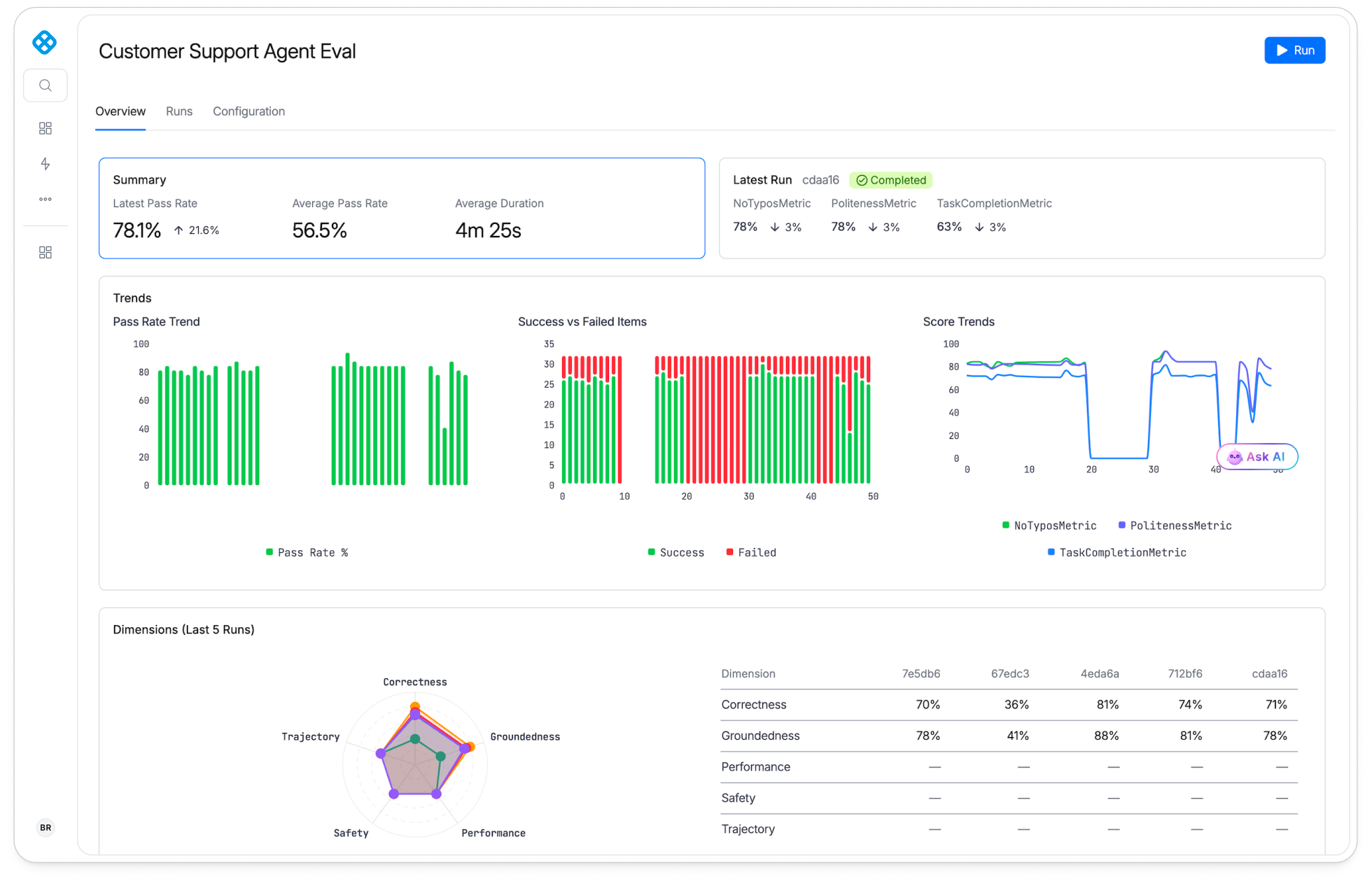
Two evaluation modes, one continuous loop
Offline evaluation (pre-deploy)
Run your agents against golden datasets before they ship. A golden dataset is a curated set of test cases - inputs your agent will receive, paired with the expected outputs or context it should use to respond. Think of it as your ground truth: the known-good answers your agent should produce or stay faithful to.
Score every response using 50+ built-in metrics. For example:
Is the response grounded in the retrieved context (faithfulness)?
Did the agent call the right tools with the right arguments (tool correctness)?
Is the output safe from prompt injection? Did it complete the task?
Is the tone appropriate?
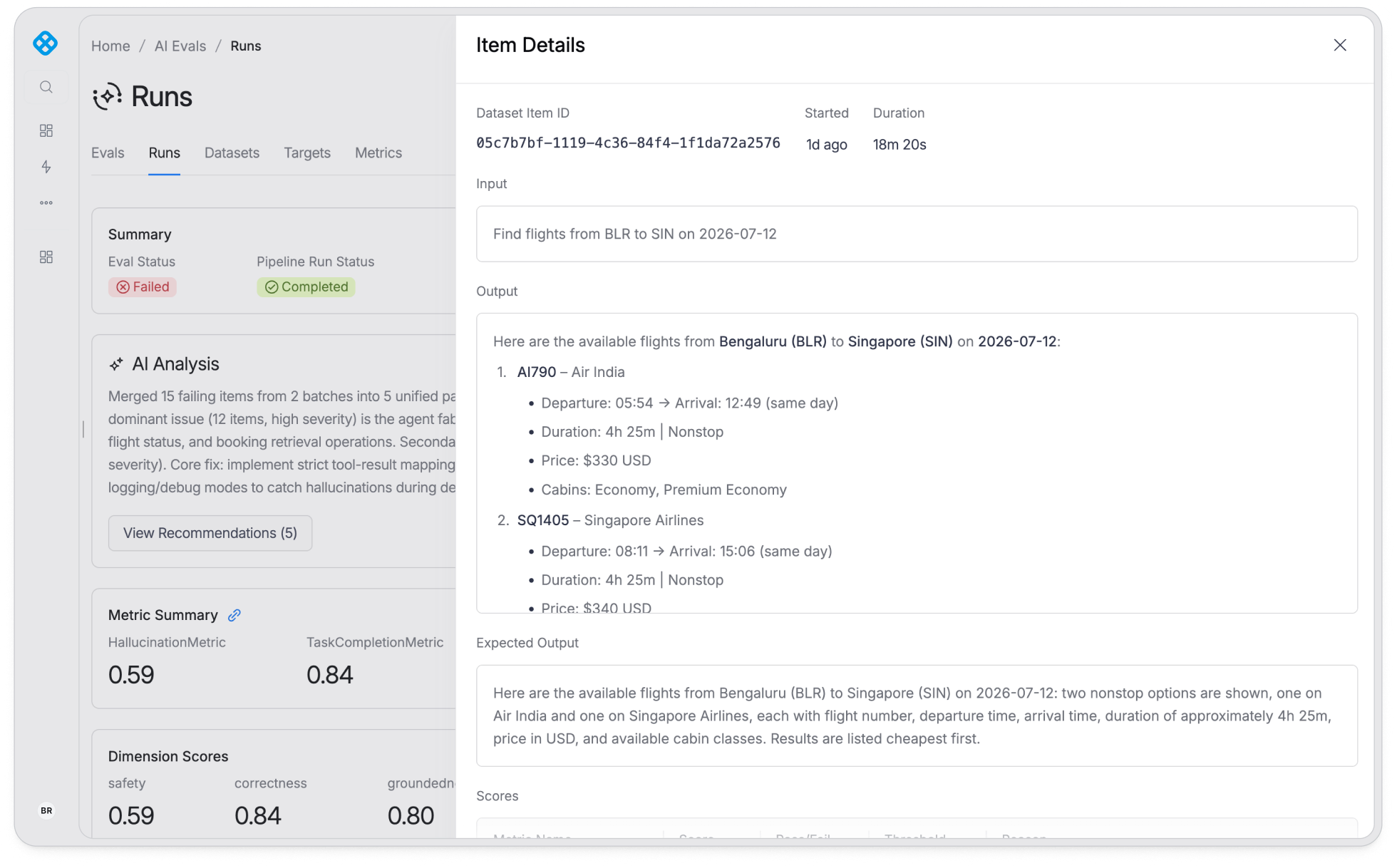
You can also define custom rubrics in natural language or write your own scoring logic in Python.
Compare prompt variants and model versions side by side. Gate your release pipeline: if scores drop below the threshold, the deploy is blocked. Not a script. A native Harness pipeline step.
Online evaluation (post-deploy)
Offline evaluation is just the beginning. It helps you test the agent before you ship, preferably as part of a CI/CD pipeline.
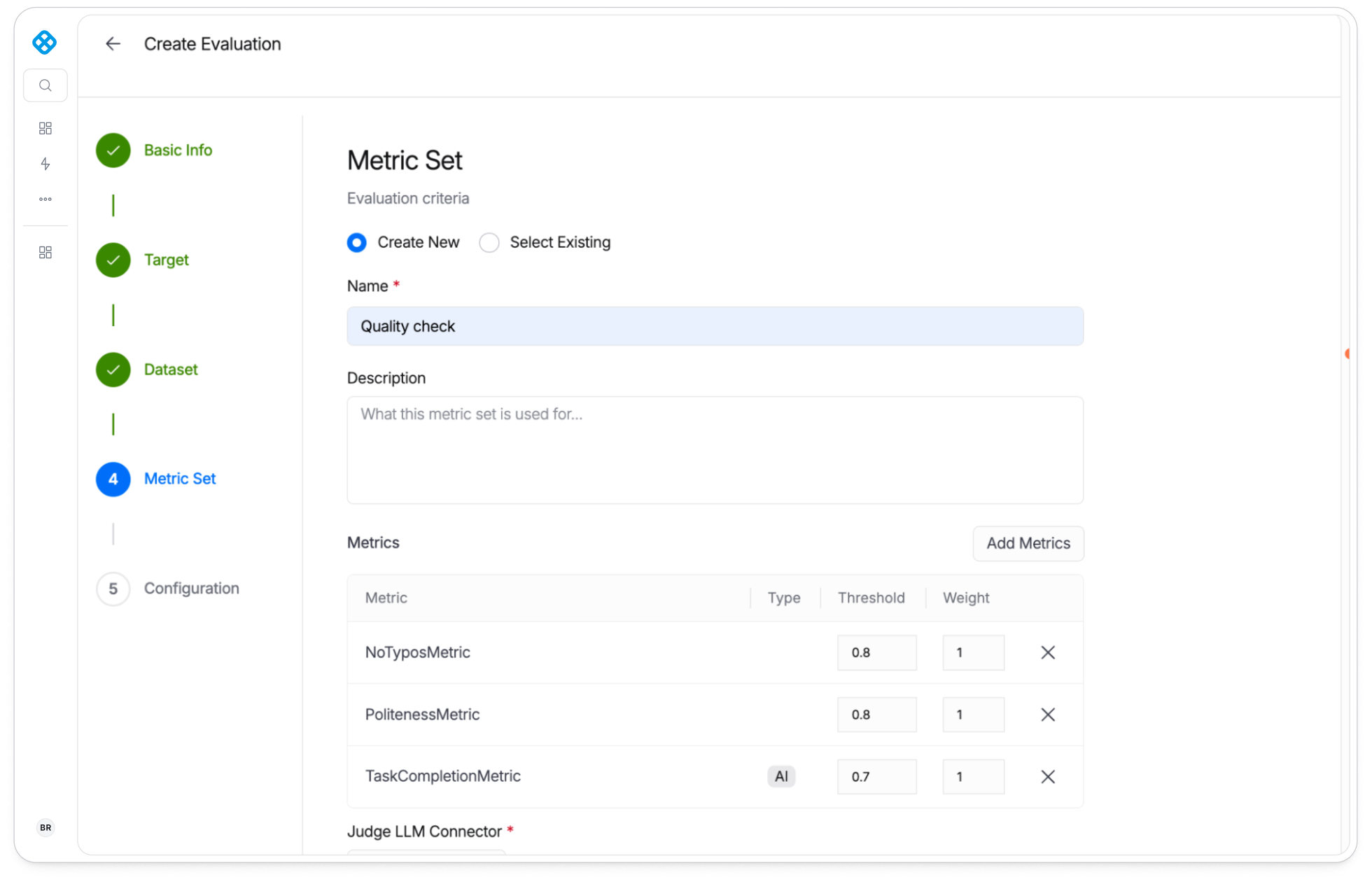
Online evaluation takes it further. It scores the output of your agent against real scenarios coming from your customers, using the same metrics. Instead of getting scores for synthetic data you generated in a dataset, you're scoring how the agent actually behaved against real user inputs. That's how you learn how your agent operates in real life.
And then you can add those real scenarios back into your datasets, so you can use them in subsequent offline evaluations. You're continuously enriching the datasets, ensuring that as you progress with development, the output improves and definitely doesn't regress.
Here's a walkthrough of how it works:
Our first round of manual testing took one to two weeks every release cycle. Now I've put AI Evals in as a release gate. Whenever there's a deployment, it evaluates whether anything broke. What took days takes minutes. The sign-off isn't someone opening a sheet of 500 cases anymore. It's based on the pass rate. Score above threshold? Ship it. Below? It doesn't go out.
- Chetan Sinha, Software Engineer, Harness QPE Team
Governance-ready from day one
AI Evals inherits the full Harness platform:
- RBAC on every eval, dataset, and suite
- OPA policy governance on eval configurations
- Full audit trails on who changed what threshold and when
- Secrets management for model API keys via existing connectors
- SSO and data residency out of the box
- Centralized registry for prompts, agents, MCP tools, and skills with versioning
- Pipeline execution link - every eval run links back to the pipeline execution that triggered it
Getting started
Getting started is designed to be fast. A guided onboarding flow walks you through setup. In-built templates for common patterns (prompt injection detection, correctness checks, RAG quality) let you plug and play without writing scoring logic from scratch. And you can synthesize entire datasets from a single description using AI, so you're not hand-writing hundreds of test cases to get started.
Harness AI Evals is the first native quality gate for AI in CI/CD. Score your agents before deploy, monitor them after, and ship with confidence every release.
Request to start the beta!(/demo/ai-evals)
FAQs
How is this different from an observability tool like LangSmith or Braintrust?
Those tools connect your evals to observability, you export traces, run evaluations separately, and interpret the results outside your pipeline. AI Evals runs as a native step in your Harness pipeline, right alongside Build, Test, and Deploy. A quality regression fails the build the same way a failed unit test does. No scripts to wire in, no glue code to maintain.
Do I need one system for testing before launch and another for monitoring in production?
No. Offline evaluation (pre-deploy) and online evaluation (post-deploy) share the same metrics and the same datasets. The scoring logic you use to test an agent before it ships is the exact same logic that scores it in production. That means no gap between what you validated and what you're actually measuring once real users are involved.
What kinds of problems can it actually catch?
Things like hallucinations, unsafe or off-policy responses, incomplete task execution, wrong tone, and incorrect tool usage — scored across 50+ built-in metrics, or your own custom rubrics if you need something specific to your use case. It also evaluates multi-step agent behavior, not just the final answer: did the agent reason through the task correctly and call the right tools along the way?