Learn how to move from ad hoc DR tests to a mature, metrics-driven resilience program with risk-aligned schedules, automation, and the KPIs that prove your recovery actually works.

TL;DR
A strong disaster recovery program is built through regular testing, automation, and continuous improvement, not just occasional recovery drills. Track the right metrics and keep refining your process so your systems become more reliable and resilient over time.
Most teams know how to run a disaster recovery test. Few know how to run a DR program. The gap between the two is what separates organizations that survive incidents from those that scramble through them.
A single test gives you a snapshot. A program gives you a trajectory. It is proof that your resilience is improving over time, evidence for auditors, and the operational muscle to recover predictably when something goes wrong.
If you haven't read the earlier posts in this series, start with our introduction to disaster recovery testing for the fundamentals, and the step-by-step DR testing guide for the operational playbook. This post builds on both, focusing on best practices, automation, and metrics that show whether your program is actually working.
From Ad Hoc Testing to a Mature DR Program
Most DR programs evolve through four stages. In the ad hoc stage, tests happen reactively, usually after an incident or before an audit. In the scheduled stage, tests follow a calendar but still rely heavily on manual coordination. In the automated stage, recovery procedures are codified and validated through pipelines. In the continuous stage, resilience is measured constantly, and improvements compound.
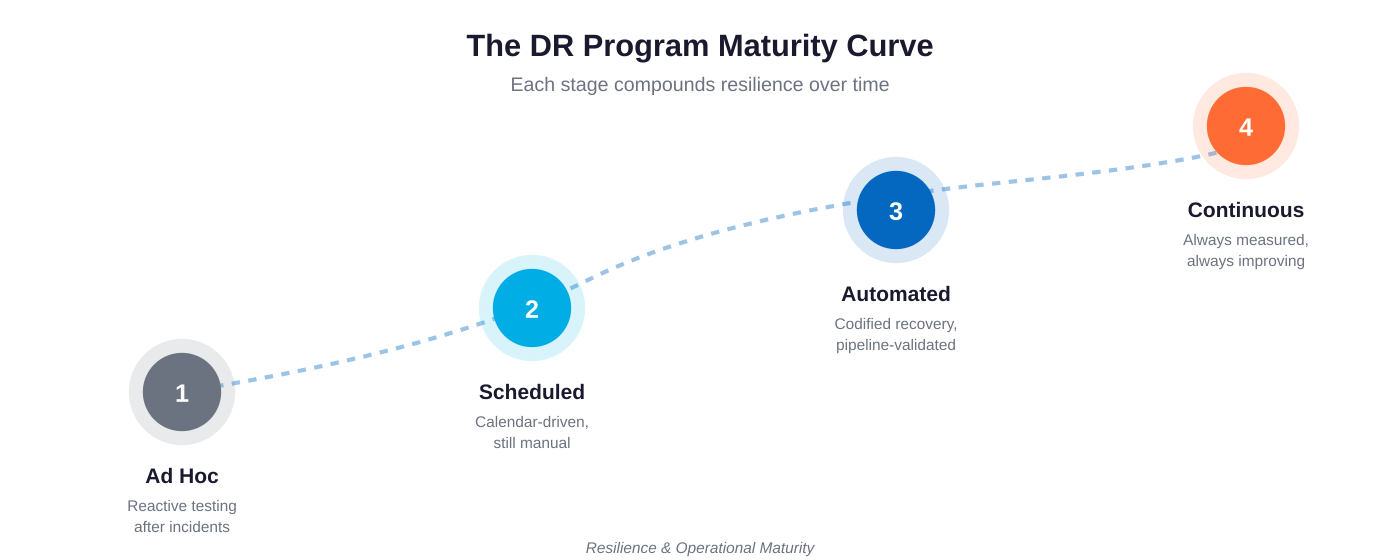
Mature programs aren't just faster. They're cheaper, more auditable, and more reliable under pressure. They produce documented evidence on demand, surface configuration drift before it causes outages, and turn DR from a quarterly fire drill into a steady operational practice.
The rest of this blog walks through the practices and metrics that get you there.
Establish a Risk-Aligned Testing Schedule
Testing every system at the same frequency wastes resources and burns out teams. The most effective programs match testing depth and cadence to business risk.
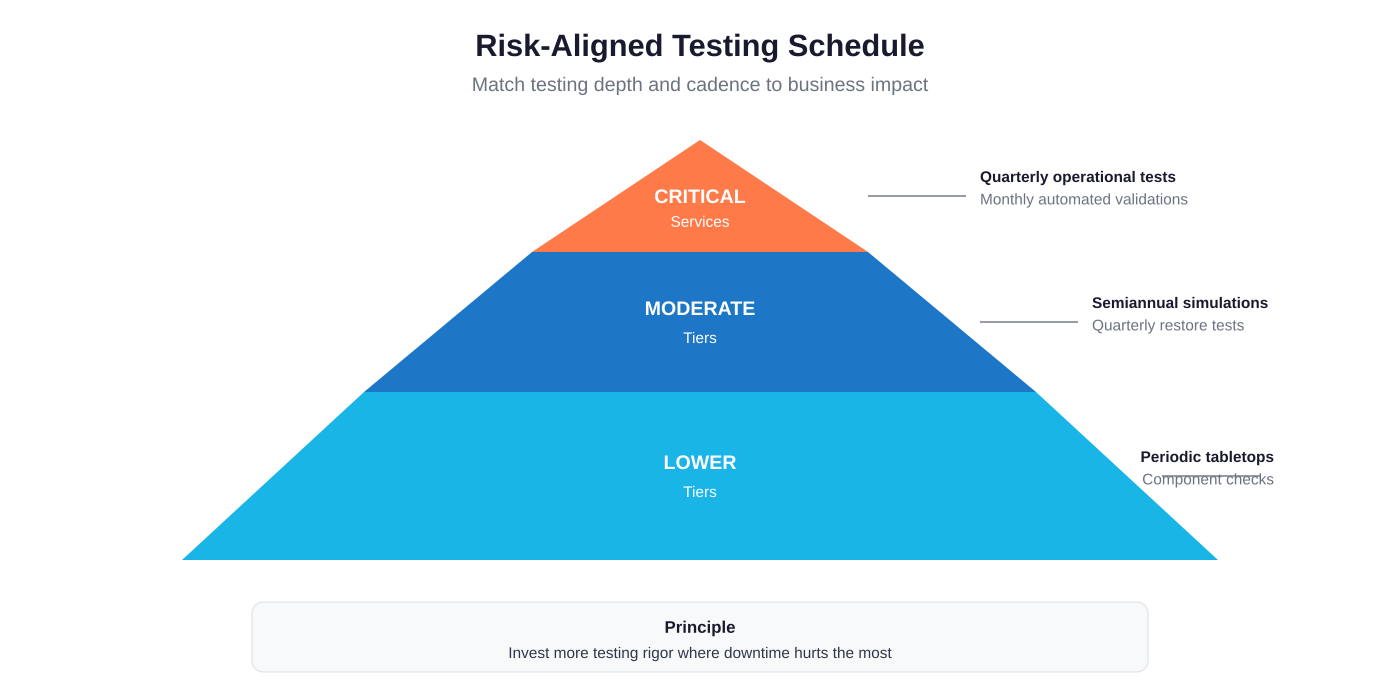
Critical services
- Quarterly or semiannual operational tests that exercise the full recovery path
- Monthly automated validations to catch drift between major exercises
- Annual full-scale simulations that include cross-functional teams and external dependencies
Moderate tiers
- Semiannual tabletop exercises or simulations
- Quarterly restore tests in isolated environments to verify backup integrity
- Targeted failover drills for individual components or services
Lower tiers
- Periodic tabletop exercises focused on process and communication
- Component-level checks tied to deployment or configuration changes
Stagger tests across business units to avoid resource bottlenecks. If every team runs a full failover in the same week, no one gets meaningful results. The goal is consistent coverage across the year, not a flurry of activity right before an audit.
The principle underneath all of this is simple. Invest more testing rigor in systems where downtime hurts the most. A risk-aligned schedule keeps your highest-impact systems sharp without exhausting the teams that maintain them.
Continuously Incorporate Lessons Learned
Every test produces data. Mature programs turn that data into changes: runbook updates, dependency fixes, process improvements. Immature programs file the report and move on.
Three practices separate the two:
- Maintain a living knowledge base of incidents and test outcomes, including playbook revisions, updated dependency maps, and contact list changes
- Convert lessons into measurable action items with named owners and due dates. Vague "we should improve X" notes don't get resolved
- Use regression tests to confirm fixes hold and that environmental changes haven't reintroduced old issues
The discipline here matters. Tests that don't produce closed action items are theater. Tests that close items but don't verify the fixes worked are wishful thinking. The combination of capture, act, and verify is what builds genuine resilience over time.
Another underrated practice: share lessons across teams. A failure mode discovered in one service often exists in others. Building a culture where DR learnings circulate widely turns each test into organizational improvement, not just team improvement.
Leverage Automation and Modern Tooling
Automation is what makes the difference between a DR program you can sustain and one that quietly atrophies. Manual coordination doesn't scale, and tests that depend on hero effort eventually stop happening.
Modern programs build automation across four layers:
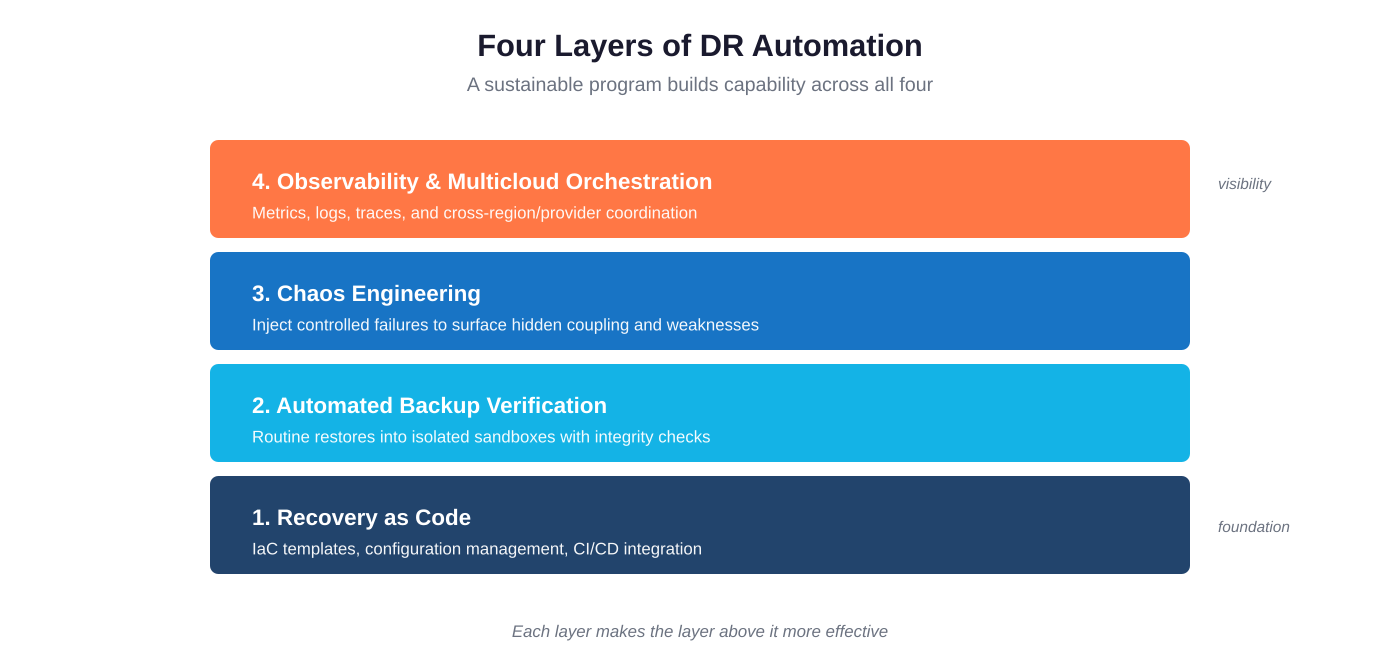
Recovery as Code
Codify your recovery procedures using infrastructure-as-code templates, configuration management tools, and CI/CD integration. When recovery steps live in version control, they're reviewable, repeatable, and resistant to drift. Treat your DR pipelines like any other production code, with tests, reviews, and change management.
Automated Backup Verification
Backups that haven't been restored are unverified. Automate routine restores into isolated sandboxes and run integrity checks on the restored data. The point isn't just to confirm files exist. It's to confirm the data is usable for recovery.
Chaos Engineering
Apply chaos engineering selectively to validate failure domains and surface hidden service-to-service couplings. Start with controlled experiments in non-production environments, then graduate to production once teams trust the process. The goal is to find weaknesses in your schedule, not in the attacker's or the cloud provider's.
Observability and Multicloud Orchestration
Use observability platforms to capture metrics, logs, and traces during tests. This is your evidence trail for audits and your debugging trail for after-action reviews. For hybrid and multicloud environments, adopt orchestration tools that coordinate failovers across clusters, regions, and providers. The operational complexity is too high to manage by hand.
How Harness Brings This Together
Building each of these capabilities separately is expensive and slow. Harness Resilience Testing consolidates chaos testing, load testing, and disaster recovery testing into a single platform that plugs into your existing pipelines.
Instead of stitching together separate tools for chaos experiments, load generation, and failover validation, teams orchestrate the full resilience workflow in one place. Recovery steps run as pipeline stages. Chaos experiments and load tests share the same environment, evidence trail, and reporting. The Harness Resilience Testing documentation walks through how to set this up end-to-end, including integration with existing CI/CD workflows.
The result is a DR program that fits naturally into how engineering teams already work. That is the single biggest predictor of whether a program gets sustained over time.
Align with Security, Compliance, and Legal
DR testing isn't just an engineering concern. It intersects with security policies, compliance frameworks, and legal obligations, and mature programs treat those teams as partners, not afterthoughts.
Map your test evidence to the control frameworks that apply to your business. ISO 22301, NIST SP 800-34, HIPAA, and PCI DSS all have specific requirements for documented testing, evidence retention, and remediation tracking. Aligning your evidence capture with these requirements up front saves enormous time at audit.
Ensure data handling in test environments complies with privacy and retention policies. Production data in non-production systems is a common audit finding, even when used for legitimate recovery validation. Use synthetic or properly masked data when possible.
Coordinate with legal and communications teams for customer-facing test scenarios and any required external notifications. If a test could trigger customer-visible behavior or contractual obligations, the conversation needs to happen before the test, not after.
Finally, don't forget SaaS and managed services. Many critical workloads depend on third-party providers whose recovery capabilities you can't directly control. Validate that contractual recovery promises actually hold by testing them. Verify contact paths, escalation procedures, and any vendor-side failover commitments.
Track Metrics That Actually Matter
If you can't measure your DR program, you can't improve it. The right metrics turn DR from a series of one-off exercises into a function with clear performance signals.
Track these across every test cycle:
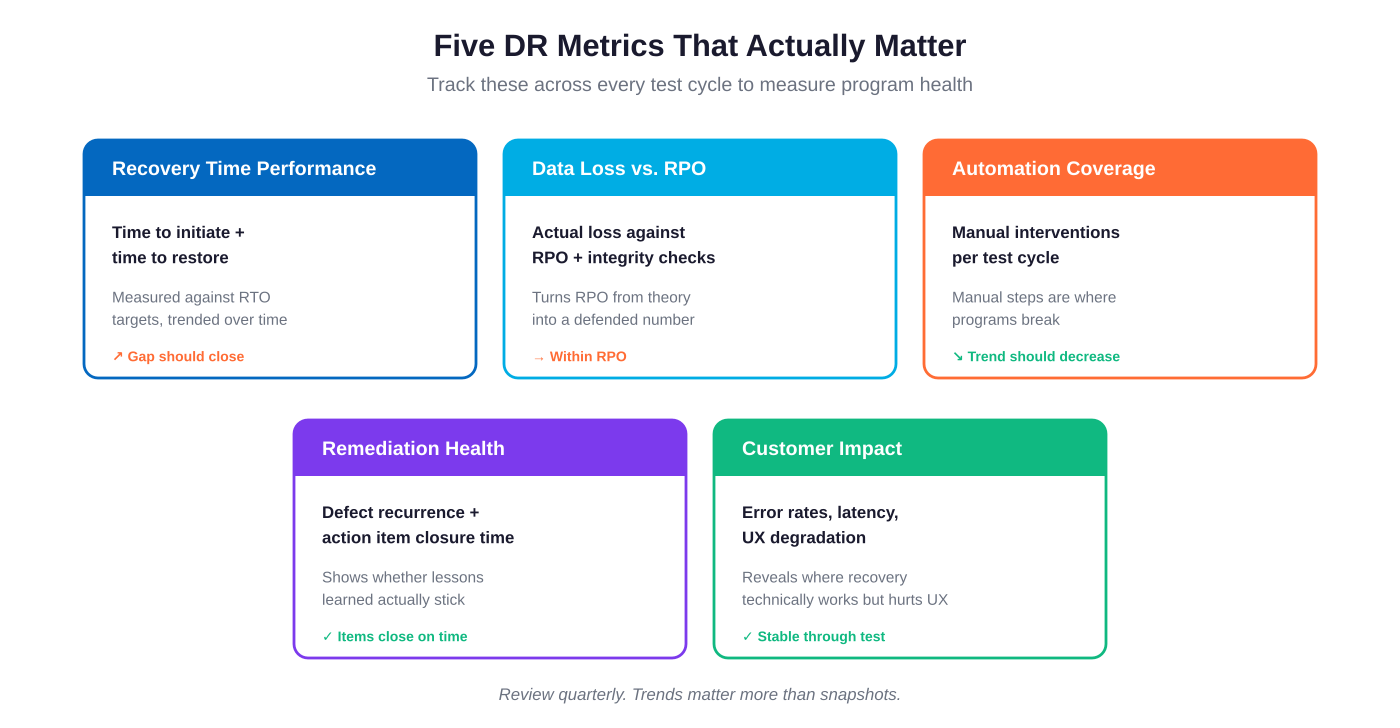
Recovery Time Performance
Time to initiate recovery and time to restore services, measured against your RTO targets. Trend these over time. A program is improving if the gap between the target and the actual closes. Persistent gaps point to runbook problems, automation gaps, or unrealistic targets that need revisiting.
Data Loss vs. RPO
Measure actual data loss against your RPO and check for any integrity discrepancies in restored data. RPO is often treated as theoretical, just a metric on a slide deck. Real testing turns it into an operational number you can defend.
Automation Coverage
Track the number of manual interventions per test and the trend in that count. Manual steps are where tests slow down and where they break under stress. A healthy program steadily replaces manual coordination with automated workflows.
Remediation Health
Defect recurrence rates and closure times for action items tell you whether your lessons-learned process is actually working. If the same issues keep surfacing across tests, the after-action discipline isn't yet in place. If items take months to close, ownership and prioritization need attention.
Customer Impact Indicators
During tests, capture error rates, latency, and any degradation in user experience. Even in controlled exercises, these indicators reveal blind spots in your recovery design. They show you places where the system technically recovers, but the customer experience suffers.
Review these metrics regularly. Quarterly is typical for most teams. Dashboards help, but the discussion matters more than the visualization. Trends matter more than snapshots. And every metric should connect to a specific improvement initiative. Tracking numbers nobody acts on is just noise.
Resilience Is a Compounding Discipline
A mature DR program isn't built in a single quarter. It's built through small improvements that compound over time: sharper runbooks, more automation, faster recovery times, cleaner audit evidence. Each cycle should make the next one easier and more revealing.
The best programs treat resilience as a competitive advantage, not compliance overhead. They recover faster than their competitors. They demonstrate trust to customers, regulators, and insurers with documented evidence. They give engineering teams the confidence to ship faster because the safety net is real.
If you're just starting out, return to the basics with our introduction to disaster recovery testing, or work through the operational playbook in the step-by-step DR testing guide. And whenever you're ready to consolidate chaos testing, load testing, and DR testing into a single platform, Harness Resilience Testing is built to make that consolidation straightforward.