Discover why disaster recovery testing is essential in 2026. Learn simple types of tests, the role of artificial intelligence, and practical steps to protect your business from costly downtime.

TL;DR
Disaster recovery testing helps your business practice getting systems back online quickly after any failure. In 2026, regular testing is more important than ever because threats like cyber attacks and cloud outages are rising. It builds real confidence, reduces costly downtime, and keeps your team ready. Modern tools now make testing easier and smarter with automation and artificial intelligence.
Businesses today run on computers, cloud systems, and digital tools. One big failure can stop everything. A cyber attack, a power outage, or a software glitch can shut down operations for hours or days. Disaster recovery testing is how you prove you can restore critical services when the unexpected happens.
In 2026, with hybrid and multi-cloud estates, distributed data, and tighter oversight, this is not a once-a-year fire drill. It is a continuous discipline that validates plans, uncovers weak links before they cause outages, and gives leaders confidence that customer-facing and internal systems can bounce back on demand.
Disaster recovery testing is a simple way to practice getting your systems back online after something goes wrong. It checks if your backup plans actually work before a real problem hits. This blog gives you a clear, step-by-step look at what it is, why it is essential right now, and how to get started.
What Is Disaster Recovery Testing?
Disaster recovery testing is a structured way to confirm that systems, data, and services can be restored to meet defined recovery goals after a disruption. The mandate is simple: verify that recovery works as designed and within the time and data loss thresholds the business requires. Effective programs test more than technology. They exercise people, processes, communications, and third-party dependencies end to end. The goal is to prove you can bring back data, apps, and services quickly with little loss.
A strong disaster recovery test plan typically covers:
- Clear recovery time objectives (RTOs) and recovery point objectives (RPOs) for each application tier.
- A current asset and application inventory with criticality tiers and upstream/downstream dependencies.
- Documented runbooks and playbooks for failover and failback, including decision criteria.
- Data protection strategies such as backups, replication, and snapshots with defined retention and immutability.
- Communication plans for internal teams, executives, customers, and partners.
- Roles and responsibilities, escalation paths, and an incident command structure.
- Third-party and vendor recovery commitments, service level agreements, and contact procedures.
- Metrics, governance, and reporting for audits and continuous improvement.
Without regular tests, even the best plan stays unproven. Many companies learn this the hard way when an outage lasts longer than expected.
Types of Disaster Recovery Tests
Different systems require different levels of validation based on their criticality, risk, and business impact. A layered testing strategy helps teams build confidence gradually starting with low-risk discussions and moving toward full-scale failovers.
By combining multiple types of tests, organizations can validate both technical recovery and team readiness without unnecessary disruption.
Tabletop Exercises:
Tabletop exercises are discussion-based sessions where stakeholders walk through a hypothetical disaster scenario step by step. These are typically the starting point for any disaster recovery program, as they help clarify roles, responsibilities, and decision-making processes. While they do not involve actual system changes, they are highly effective in identifying communication gaps and aligning teams on escalation paths.
Simulations:
Simulations introduce more realism by creating scenario-driven drills with staged alerts and mocked dependencies. Teams respond as if a real incident is happening, but without impacting production systems. This type of testing is useful for validating how teams react under pressure and ensuring that tools, alerts, and workflows function as expected in a controlled environment.
Operational Walkthroughs:
Operational walkthroughs involve executing recovery runbooks step by step to verify that all prerequisites such as permissions, tooling, and sequencing are in place. These tests are more hands-on than simulations and are often conducted before attempting partial or full failovers. They help reduce surprises by ensuring that recovery procedures are practical and executable.
Partial Failovers:
Partial failovers test the recovery of specific services, components, or regions, usually during off-peak hours. This approach allows teams to validate critical dependencies and recovery workflows without risking the entire system. It is especially useful for building confidence in complex environments where a full failover may be too risky or costly to perform frequently.
Full Failovers:
Full failovers are the most comprehensive form of disaster recovery testing, where production systems are completely switched to a secondary site or region. After validation, systems are failed back to the primary environment. These tests provide the strongest proof of resilience, as they validate end-to-end recovery, including performance and data integrity, but they require careful planning due to their potential impact.
Automated Validations:
Automated validations use codified workflows or pipelines to continuously test recovery processes. These tests can automatically spin up recovery environments, validate configurations, and run health checks. They are ideal for frequent, low-risk testing and help reduce human error while providing fast and consistent feedback. Over time, automation becomes a key driver for maintaining continuous assurance in disaster recovery readiness.
Here’s the table outlines the primary types of disaster recovery testing and where they fit.
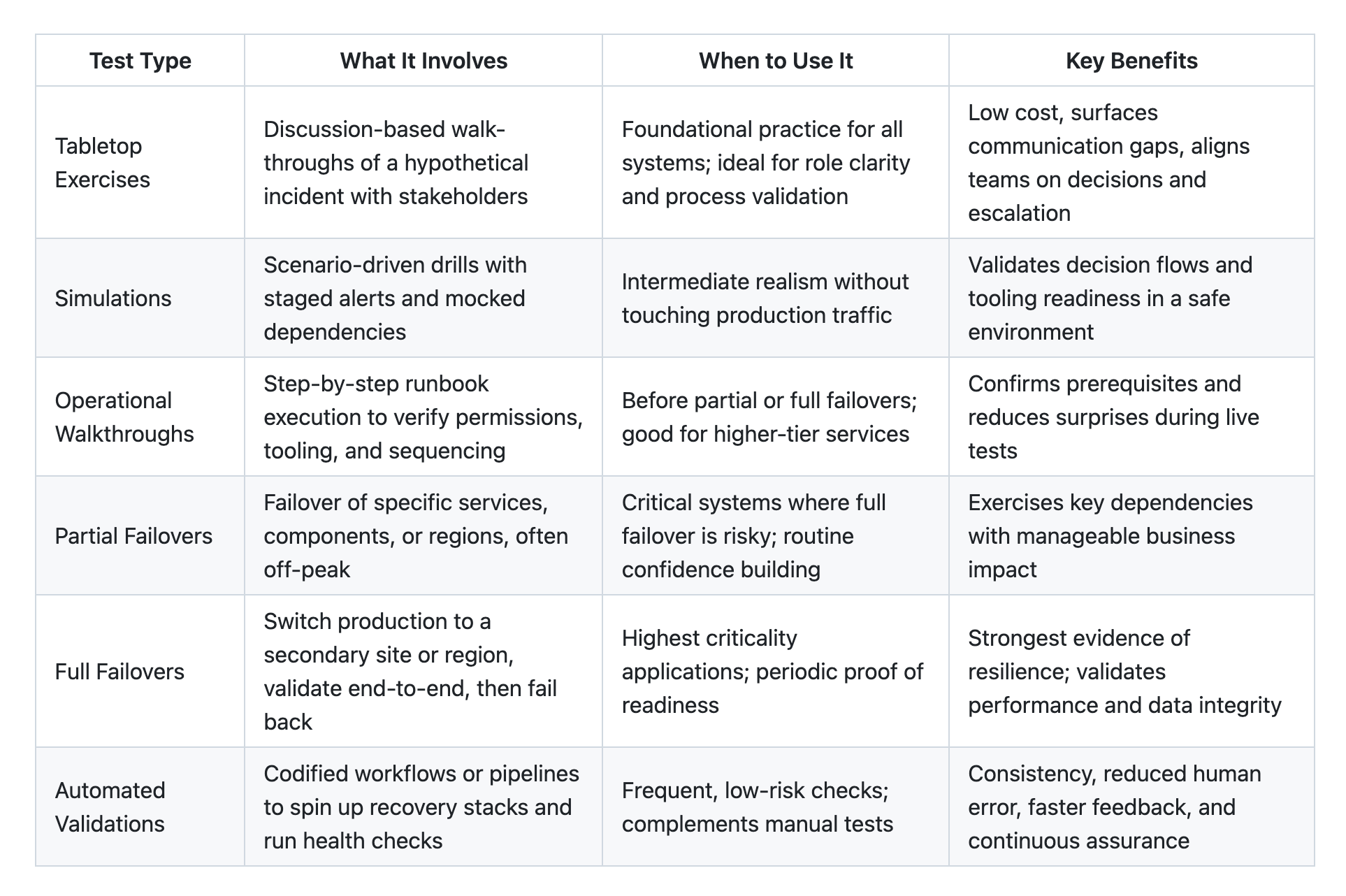
If you are building a disaster recovery testing checklist, include a mix of these types of disaster recovery testing and map each to the systems they protect. Over time, increase the frequency of automated validations and reserve full failovers for the highest-value services.
Why Disaster Recovery Testing Matters More in 2026
The world is more connected than ever. Companies rely on cloud services, remote teams, and AI tools. At the same time, threats keep growing. Cyber attacks like ransomware are more common. Natural events and supply chain problems add extra risk. Cloud systems can fail without warning.
Recent studies show the cost of downtime keeps rising. For many large companies, one hour of downtime can cost more than 300,000 dollars. Some industries see losses climb into the millions per hour. Smaller businesses lose thousands per minute in lost sales and unhappy customers.
In 2026, experts note that most organizations still test their recovery plans only once or twice a year. That is not enough. Systems change fast. New software updates, new cloud setups, and new team members can break old plans.
Regular testing gives you confidence. It cuts recovery time and protects revenue. It also helps meet rules from banks, healthcare groups, and government agencies that require proof of preparedness.
How Modern Tools Make Disaster Recovery Testing Easier
Traditional testing took weeks of manual work. Today, platforms combine different testing methods in one place. This approach saves time and gives better results.
For example, Harness recently released its Resilience Testing module. It brings together chaos testing (to inject real-world failures safely), load testing (to check performance under stress), and disaster recovery testing. You run everything inside your existing pipelines. This means you can test recovery steps automatically, validate failovers, and spot risks early.
Teams using this kind of integrated platform report faster recovery times and fewer surprises. It fits right into daily development work instead of feeling like an extra project.
The Role of AI in Disaster Recovery Testing
Artificial intelligence is making disaster recovery testing much smarter in 2026. It turns testing from a once-a-year chore into something fast, ongoing, and more accurate.
AI helps teams spot problems early by analyzing system data and predicting where failures might happen, allowing issues to be fixed before they cause real damage. It also enables continuous and automated testing, running scenarios in the background without interrupting normal business operations. Instead of manually creating test plans, AI can generate and recommend the most relevant scenarios based on your actual system setup, saving time and improving coverage.
Another major advantage is how quickly AI can analyze results. It processes test outcomes in real time and clearly points out what needs to be fixed, removing the guesswork. Over time, it learns from every test run and continuously improves your disaster recovery strategy, making it more reliable with each iteration.
Overall, AI helps teams recover faster and with fewer mistakes. Rather than relying on assumptions, teams get clear, data-driven insights to strengthen their systems. Tools like the Resilience Testing module from Harness already bring these capabilities into practice by combining chaos testing, load testing, and disaster recovery testing. With AI built into the platform, it can recommend the right tests, automate execution, and provide simple, actionable steps to improve system resilience.
Conclusion
Disaster recovery testing is not a one-time task. It is an ongoing habit that protects your business in 2026 and beyond. The companies that test regularly recover faster, lose less money, and keep customer trust.
Take a moment now to review your current plan. Pick one critical system and schedule a simple test this quarter. If you want a modern way to make the process simple and powerful, look at solutions like the Resilience Testing module from Harness. It helps you combine multiple testing types and use AI so you stay ready no matter what comes next.
Your business depends on technology. Make sure that technology can bounce back when it counts. Start testing today and build the confidence your team needs for whatever 2026 brings.