Secure AI-generated code in real time with Harness SAST & SCA embedded in Cursor — detecting, fixing, and preventing vulnerabilities inside the IDE. Intended target keywords: AI coding, AI coding assistant, application security

Bringing real-time security into the agent workflow
AI coding assistants like Cursor are fundamentally changing how software is built. Code is no longer written line by line, it is generated, modified, and executed by agents that operate at a speed and scale traditional workflows were never designed for. While this unlocks massive gains in developer productivity, it also introduces a new and growing risk: vulnerabilities are now being created just as quickly as the code itself.
The challenge is not new, but it is amplified. AI-generated code carries the same classes of vulnerabilities as human-written code, but it is produced in larger volumes, with less scrutiny, and often accepted without deep review. As highlighted in recent industry findings, organizations are already seeing a widening gap between development velocity and their ability to validate and secure what is being shipped. In this new model, security can no longer afford to operate downstream.
Harness is addressing this shift by moving security directly into the point where risk is introduced: the agent workflow itself.
Introducing Secure AI Coding (Harness SAST & SCA)
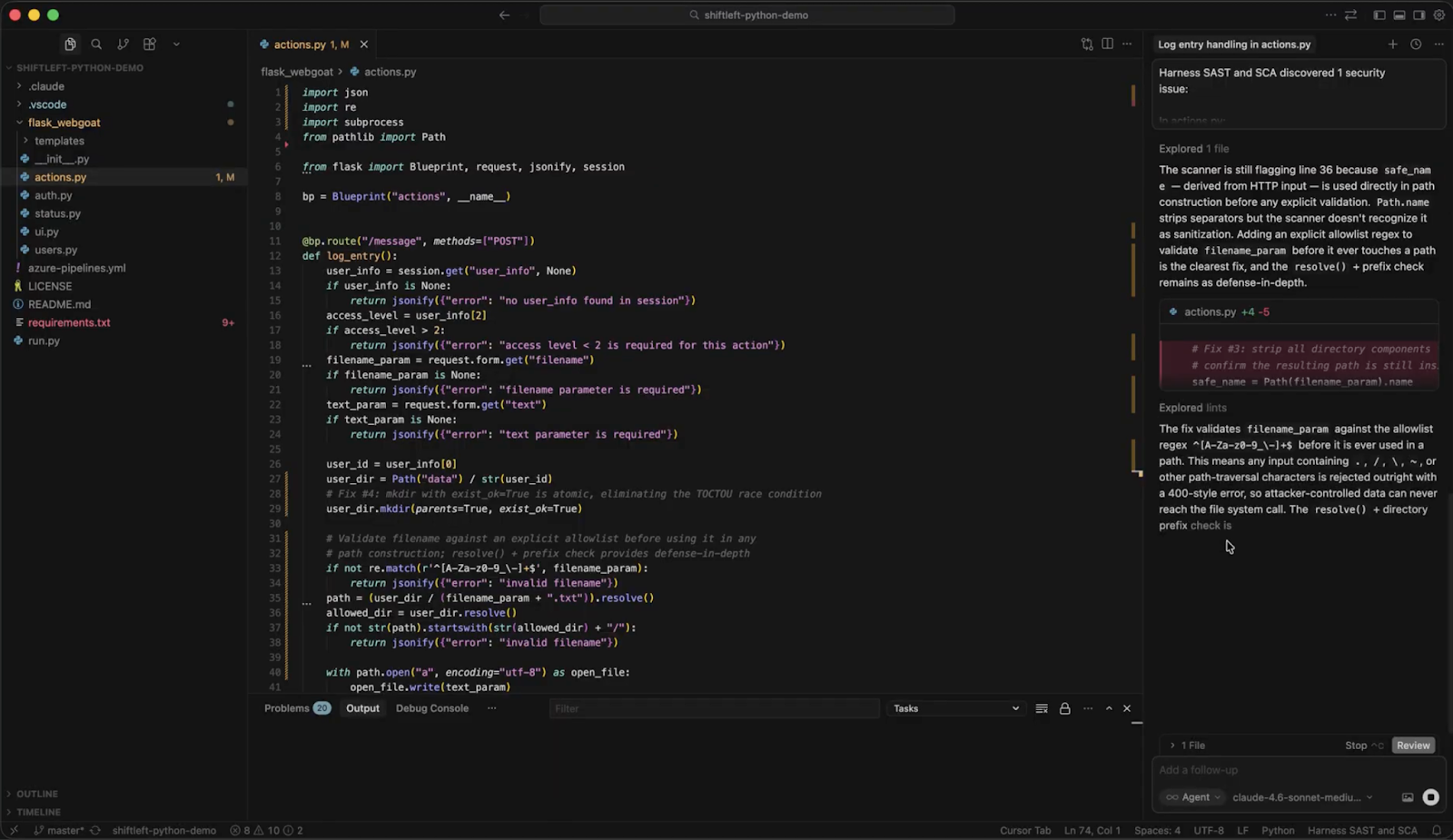
Secure AI Coding brings real-time security into Cursor by embedding Harness SAST and SCA directly within the AI-assisted development loop. Instead of waiting for pull requests or CI pipelines to surface issues, every AI-generated change is scanned, validated, and remediated as it happens, inside the IDE.
This fundamentally changes how security operates. As code is generated or edited, vulnerabilities are immediately detected and surfaced inline, allowing developers to act in context. More importantly, this is not just detection, it introduces a built-in fix-and-verify loop, where code can be sent back to the agent for automatic remediation and re-validation until it meets security standards.
The result is a continuous, real-time feedback cycle that ensures code is secure before it ever leaves the developer’s environment.
To make this scalable, Secure AI Coding leverages Cursor’s hooks to enforce security deterministically. Post-edit hooks such as afterFileEdit and stop trigger fast, diff-aware scans that focus only on what has changed, ensuring performance without compromising depth. This guarantees that every AI-generated change is consistently scanned and validated.
Security is no longer dependent on prompts or developer behavior. It becomes automatic, enforced, and always on.
Security that understands your application
What sets Secure AI Coding apart is not just when it runs, but how it analyzes code. Harness uses Code Property Graph (CPG) analysis to evaluate AI-generated code by examining the changes introduced by the agent in the context of the broader application.
This approach enables the detection of real, exploitable vulnerabilities that only emerge when code is understood end-to-end, rather than in isolation. By focusing on how changes interact with the rest of the codebase, it surfaces issues that truly matter.
In practice, this reduces noise and provides developers with high-confidence, context-aware findings. Combined with real-time feedback, it eliminates the traditional tradeoff between speed and security.
From detection to prevention
While real-time detection is a major step forward, Secure AI Coding is designed to go further, toward preventing vulnerabilities before they are even introduced.
Harness is actively expanding support for pre-generation security guardrails. This will allow security context, best practices, and organizational policies to be injected before any code is generated, guiding the agent toward safer outputs from the start.
Instead of fixing vulnerabilities after the fact, teams will now be able to prevent insecure code from being written in the first place.
At the same time, Secure AI Coding is expanding beyond code vulnerabilities to address the broader risks introduced by AI-assisted development. This includes bringing dependency (SCA) scanning directly into the agent workflow, where dependencies are analyzed both before installation and immediately after AI-generated manifest changes. This will create a critical control point to block malicious, typosquatted, or risky OSS packages before they enter the codebase.
Secrets detection will also be integrated into post-edit workflows, ensuring that sensitive data is identified instantly as it is introduced.
Together, these capabilities will extend Secure AI Coding into a comprehensive, end-to-end security layer across the entire agent lifecycle.
A new model for application security
The shift to AI-assisted development requires a new approach to security. Traditional models rely on scanning code after it has been written, reviewed, and prepared for deployment. In an agent-driven world, that is already too late.
Secure AI Coding introduces a model where security operates continuously, proactively, and in real time within the development workflow. Every change is evaluated as it happens, every issue is addressed in context, and every fix is validated before code progresses further.
Developers stay in flow. Security teams gain consistent, deterministic enforcement. Organizations can scale AI adoption without increasing risk.
Secure code before CI
This is the new standard for AI-native development. Security should not be something that happens before deployment, it should be something that prevents insecure code from ever being written.
With Harness × Cursor, organizations can move from reactive detection to proactive prevention, securing code at the moment it is created and enabling teams to innovate faster without compromising safety.
Secure AI Coding (Beta) is now available through the Harness IDE extension with support for Cursor.