Discover how Harness complements NVIDIA OpenShell with agent discovery, AI red teaming, API security, and runtime threat detection and response.

An AI agent retrieves a document, follows a hidden instruction, and uses an approved tool to access customer data. Every connection may be permitted, but the resulting action can still be harmful.
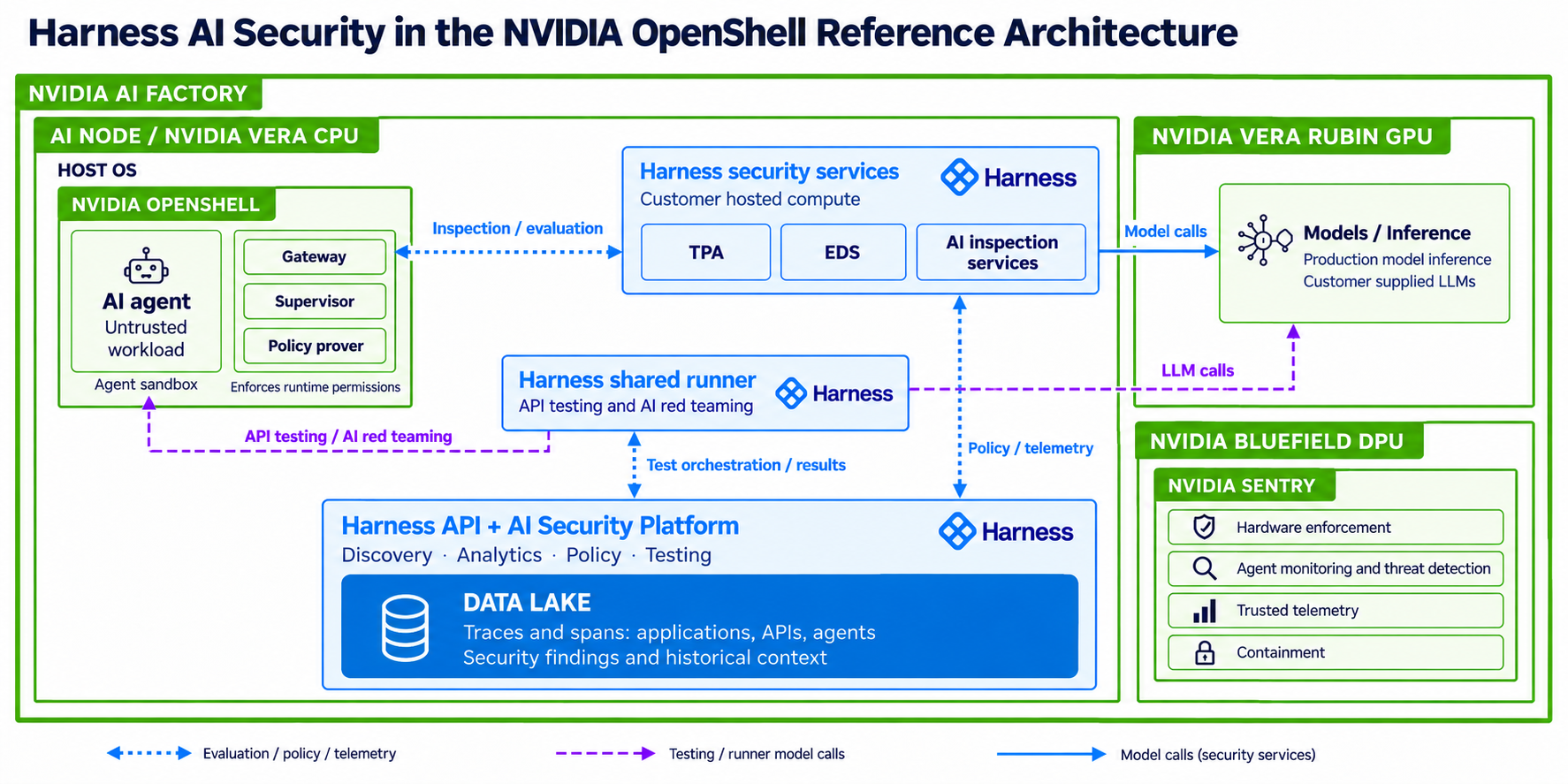
NVIDIA’s OpenShell Reference Architecture establishes boundaries around agent execution. OpenShell governs runtime access, while optional NVIDIA Sentry on BlueField adds independent monitoring and enforcement. Harness AI Security can complement these controls through agent discovery, AI red teaming, AI detection and response, and API security.
Discover agents and build their context graph
Understanding an agent starts with understanding its dependencies. Harness discovers agents from observed runtime traffic and builds a context graph connecting agents, models, MCP servers, tools, and enterprise APIs.
That graph brings together observed interactions, sensitive data flows, authentication, exposure, and vulnerabilities, helping security teams understand an agent’s connected attack surface and potential impact.
Red team agents and test their connected services
Harness AI red teaming simulates attacks against agents to uncover how malicious inputs can manipulate their behavior, misuse tools, or expose sensitive data. Testing uses the context of the agent and its connected services to identify weaknesses across the workflow.
API security testing extends that assessment to the APIs behind MCP servers and tools, identifying authentication weaknesses, authorization flaws, and data exposure. A shared runner brings both testing capabilities into the customer environment, helping teams assess the agent and the services it depends on together.
Secure agents during runtime
Harness AI detection and response monitors agent interactions for threats and policy violations. At supported gateways and application enforcement points, Harness applies protection against prompt injection, tool misuse, sensitive data exposure, and API attacks.
Harness’ Traceable Platform Agent (TPA) connects the enforcement path to the decision service, which coordinates AI inspection and returns security decisions for enforcement. The platform connects security findings with traces and spans across applications, APIs, and AI agents in its data lake, providing historical context for investigation and response.
Keep security within the customer environment
Our proposed deployment places the self managed Harness API and AI Security platform, including its data lake, within the customer environment. The data lake stores traces and spans across applications, APIs, and AI agents, alongside security findings and historical context. This collects activity across the application and agent workflow while keeping the collected telemetry and analysis within the customer’s infrastructure.
The platform, decision services, and testing Runner run on customer CPU infrastructure. Customer supplied LLMs support red teaming and other AI powered features through local inference endpoints, using GPU resources where required.
Within this architecture, Rubin GPU infrastructure provides a potential home for customer hosted LLMs, while NVIDIA Sentry remains an optional independent security layer.
Harness connects discovery, testing, and runtime defense around the agent context graph, helping enterprises secure both their AI agents and the APIs through which they act.