The March 2026 drone strikes on AWS data centers in the UAE and Bahrain — the first confirmed military attack on a hyperscale cloud provider — exposed how unprepared many organisations are for a real regional cloud failure. The blog argues that havin

TL;DR
Regular DR testing is no longer a compliance checkbox — it is a critical engineering discipline that determines whether an organisation can survive a real cloud outage with its services and revenue intact. As the AWS Middle East incident demonstrated, regional cloud failures can strike without warning and defeat standard redundancy models, making untested DR plans dangerously unreliable. Organisations that test their DR posture frequently — simulating realistic failure scenarios and validating recovery objectives — are the ones that will maintain uptime and customer trust when the next disaster strikes.
Resilience Is Not a Feature — It Is a Business Imperative
In today's digital economy, every organisation's revenue, reputation, and customer trust is inextricably linked to the uptime of its cloud-based services. From banking and payments to logistics and healthcare, a cloud outage is no longer just an IT problem — it is a business crisis. Despite this reality, Disaster Recovery (DR) testing remains one of the most neglected disciplines in enterprise technology operations.
Most organisations have a DR plan. Far fewer test it regularly. And even fewer have the tools to simulate realistic failure scenarios with the confidence needed to validate that their recovery objectives — Recovery Time Objectives (RTO) and Recovery Point Objectives (RPO) — are actually achievable when it matters most.
A DR plan that has never been tested is not a plan — it is a hypothesis. And in the event of a real disaster, a hypothesis is not good enough.
The question is no longer whether disasters will happen to cloud infrastructure. The question is whether your organisation is prepared to survive them — and emerge with your business services intact.
A New Era of Risk: When War Comes to the Cloud
March 1, 2026 — A Watershed Moment for the Cloud Industry
On March 1, 2026, something unprecedented happened: physical warfare directly struck hyperscale cloud infrastructure. Drone strikes — part of Iran's retaliatory campaign following the joint U.S.-Israeli Operation Epic Fury — hit three Amazon Web Services (AWS) data centers in the United Arab Emirates and Bahrain. It marked, according to the Uptime Institute, the first confirmed military attack on a hyperscale cloud provider in history.
AWS confirmed that two facilities in the UAE were directly struck in the ME-CENTRAL-1 region, while a third in Bahrain sustained damage from a nearby strike. The attacks caused structural damage, disrupted power delivery, and triggered fire suppression systems that produced additional water damage to critical equipment. Two of the three availability zones in the UAE region were knocked offline simultaneously — a scenario that defeated standard redundancy models designed for hardware failures and natural disasters, not military strikes.
"Teams are working around the clock on availability." — AWS CEO Matt Garman, speaking to CNBC on the drone strike impacts.
The Ripple Effect: From Data Centers to Digital Services
The cascading business impact was immediate and wide-ranging. Ride-hailing and delivery platform Careem went dark. Payments companies Alaan and Hubpay reported their apps going offline. UAE banking giants — Emirates NBD, First Abu Dhabi Bank, and Abu Dhabi Commercial Bank — reported service disruptions to customers. Enterprise data company Snowflake attributed elevated error rates in the region directly to the AWS outage. Investing platform Sarwa was also impacted.
AWS subsequently urged all affected customers to activate their disaster recovery plans and migrate workloads to other AWS regions. For many organisations, that recommendation revealed an uncomfortable truth: they had workloads running in a conflict zone without knowing it, and they had DR plans that had never been meaningfully tested.
The event was not merely a localised incident. It sent shockwaves through global financial markets, triggered fresh concerns about cloud infrastructure security, and forced technology and business leaders worldwide to confront a question they had been deferring: are we actually prepared for a regional cloud failure?
The Uncomfortable Truth About Cloud Dependency
AWS is, by any measure, the world's most reliable cloud platform. With a global network of regions, availability zones, and decades of engineering investment in fault tolerance, it represents the gold standard of cloud infrastructure. And yet — disasters still happen.
The Middle East drone strikes illustrate a new class of risk that sits entirely outside the traditional taxonomy of cloud failure modes. Hardware faults, software bugs, network misconfigurations, and even natural disasters are all scenarios that cloud providers engineer against. But a sustained, multi-facility military attack that simultaneously disables multiple availability zones in a region is a different beast entirely.
Even the most reliable cloud provider cannot guarantee immunity from geopolitical events, physical infrastructure attacks, or large-scale regional disruptions. DR planning must account for the full spectrum of failure scenarios.
For enterprises that depended on AWS's Middle East regions — whether knowingly for local operations or unknowingly through traffic routing — the incident transformed abstract geopolitical risk into an immediate operational reality. Financial institutions could not process transactions. Customers could not access banking apps. Businesses that had single-region deployments had no failover path.
The lesson is not to distrust AWS or any cloud provider. It is to accept that no infrastructure, however well-engineered, is beyond the reach of catastrophic failure. Disaster Recovery planning is not a reflection of distrust in your cloud provider — it is a reflection of maturity in your own risk management.
And if DR planning is the strategy, DR testing is the discipline that gives you confidence the strategy will actually work.
The Case for Regular, Rigorous DR Testing
Disaster recovery has historically been treated as a compliance checkbox. Organisations document a DR plan, conduct an annual tabletop exercise, and file it away until the next audit. The problem with this approach is that it bears no resemblance to the actual experience of a regional cloud failure.
Real DR scenarios involve cascading failures, unexpected dependencies, human coordination under pressure, and recovery steps that take far longer in practice than on paper. RTO targets that look achievable in a spreadsheet often prove wildly optimistic when an engineering team is scrambling to restore services during an actual outage.
Effective DR testing requires three things that most organisations lack:
- Realistic failure simulation: The ability to actually replicate the conditions of a regional cloud outage, not just talk through what might happen.
- End-to-end recovery validation: A structured workflow that tests not just failover, but the complete path from disaster simulation through recovery confirmation.
- Repeatable, frequent execution: DR tests should not be annual events. In a world where geopolitical risk is rising and infrastructure attacks are a documented reality, quarterly or even monthly DR validation is increasingly necessary.
However, there is a fundamental challenge that has historically limited the frequency and quality of DR testing: creating a realistic disaster scenario — such as a full region failure — in a production cloud environment is extremely complex, risky, and operationally demanding. Getting it wrong can itself cause the very outage you are preparing for.
This is precisely where purpose-built DR testing tooling becomes essential.
Enter Harness Resilience Testing: DR Testing Without the Drama
Harness has long been a leader in the chaos engineering and software delivery space. With the evolution of its platform to Harness Resilience Testing, the company has now brought together chaos engineering, load testing, and disaster recovery testing under a single, unified module — purpose-built for the kind of comprehensive resilience validation that modern organisations need.
Simulating Region Failure — Safely and Repeatably
One of the most powerful capabilities within Harness Resilience Testing is the ability to simulate an AWS region failure. Rather than requiring engineering teams to manually orchestrate complex failure conditions — or worse, waiting for a real disaster to find out what happens — Harness provides a controlled simulation environment that replicates the conditions of a full regional outage.
This means organisations can observe exactly how their systems behave when, for example, the AWS ME-CENTRAL-1 region goes offline. Which services fail? How quickly do failover mechanisms activate? Are there hidden dependencies that were not accounted for in the DR plan? Does the recovery path actually meet the RTO and RPO targets?
Harness Resilience Testing enables organisations to simulate AWS region failure scenarios in multiple ways (AZ blackhole, Bulk Node shutdows or coordinated VPC misconfigurations etc — giving engineering teams the ability to experience and validate their DR response before a real disaster strikes.
End-to-End DR Test Workflow: From Disaster to Recovery
What distinguishes Harness Resilience Testing from point solutions is its comprehensive, end-to-end DR Test workflow. The platform does not just simulate failure — it orchestrates the entire DR testing lifecycle:
- Disaster Simulation: Harness injects failure conditions that replicate real-world scenarios — including region-level AWS outages — in a controlled, configurable manner.
- Recovery Validation: The platform then validates that recovery procedures execute correctly, services restore within defined objectives, and the system reaches a healthy state.
- Observability and Reporting: Harness captures detailed metrics, failure indicators, and recovery timelines — giving teams the data they need to identify gaps and continuously improve their DR posture.
This end-to-end approach transforms DR testing from a manually intensive, high-risk activity into a structured, repeatable, and automatable workflow — one that can be run as frequently as the business requires.
Harness Resilience Testing provides DR workflows for region failures
Harness Resilience Test module provides the required chaos steps that can be pulled into the DR Test workflow to introduce a region failure.
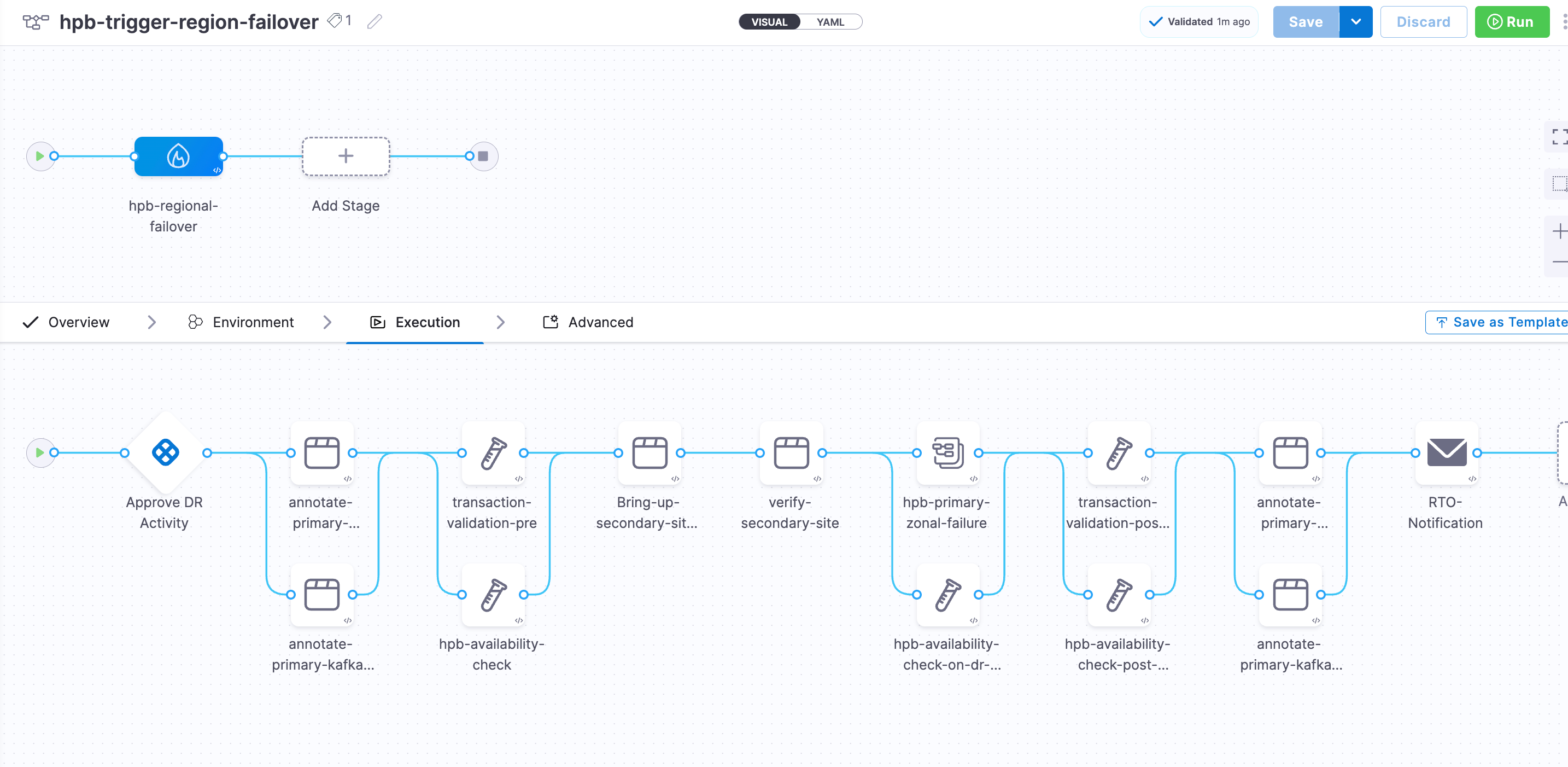
Follow the DR test documentation here to understand how to get started with DR Test workflows.
Conclusion: Make DR Testing a Continuous Practice, Not an Annual Event
The drone strikes on AWS data centers in the Middle East on March 1, 2026 were a stark reminder that the risks facing cloud infrastructure are no longer theoretical. Geopolitical events, physical attacks, and unprecedented failure scenarios are now part of the operational reality that technology leaders must plan for — and test against.
AWS remains one of the most reliable, battle-tested cloud platforms on the planet. But reliability does not mean immunity. Even the best-engineered infrastructure can be overwhelmed by events outside its design parameters. That is not a weakness of AWS — it is a fundamental truth about the physical world in which all digital infrastructure ultimately exists.
Organisations that depend on AWS — for regional workloads, global operations, or anywhere in between — need to take a hard look at their DR readiness. Not just whether they have a plan, but whether that plan has been tested, validated, and proven to work under realistic failure conditions.
Harness Resilience Testing makes it straightforward to simulate AWS region failures and execute comprehensive end-to-end DR tests — enabling organisations to validate their recovery posture with confidence, at a frequency that matches the pace of modern risk.
With Harness, DR testing for AWS region failures is no longer a complex, resource-intensive undertaking reserved for annual compliance exercises. It becomes an efficient, repeatable, and continuously improving practice — one that can be integrated into regular engineering workflows and scaled to meet the demands of an increasingly unpredictable world.
The organisations that will emerge strongest from the next regional cloud disaster are not the ones with the best DR documents. They are the ones that have already run the test — and know exactly what to do when the alert fires.
With Harness Resilience Testing, that organisation can be yours. Book a demo with our team to explore more.