Harness Artifact Registry secures Docker images and dependencies with OCI compliance, vulnerability scanning, SBOM generation, and seamless CI/CD integration.

If you've worked with builds and deployments, then you already know how central Docker images, dependencies, and containers are to modern software delivery. The introduction of Docker revolutionised how we package and run software, while the Open Container Initiative (OCI) brought much-needed standardisation to container formats and distribution. Docker made containers mainstream; OCI made them universal.
Even though Docker Hub and private registries have served us well, they often introduce challenges at scale:
- Limited governance and control — OCI defines standards, but managing how standardised images are used, updated, and secured across environments is often left to manual processes.
- Security at the edge instead of by design — vulnerability scans and policy checks typically happen after the fact, leaving pipelines exposed to build failures or compromised dependencies.
- Exposure to supply chain risks — even perfectly built artifacts can fall victim to typosquatting or malicious dependency injection, quietly introducing malware into trusted environments.
And even after every dependency and sanity check passes, one question remains:
How effectively can you integrate and deploy artifacts through your CI/CD supply chain, without risking credential leaks or losing end-to-end visibility?
The Problems Are Clear — So Is the Solution
This is exactly where Harness Artifact Registry comes in.
Harness Artifact Registry is a cloud-native, secure artifact storage and management platform built for the future. Unlike traditional Docker registries or basic container registries, it's designed not just to store your Docker images and artifacts but also to actively secure and govern them. It's fully OCI-compliant, supporting Docker containers and other container formats natively, whilst integrating directly with CI/CD pipelines, policy engines, and vulnerability scanners.
Let me walk you through the complete journey of how an artifact moves through Harness Artifact Registry, from the moment you build it to when it's deployed in production.
The OCI-Compliant Artifact Journey
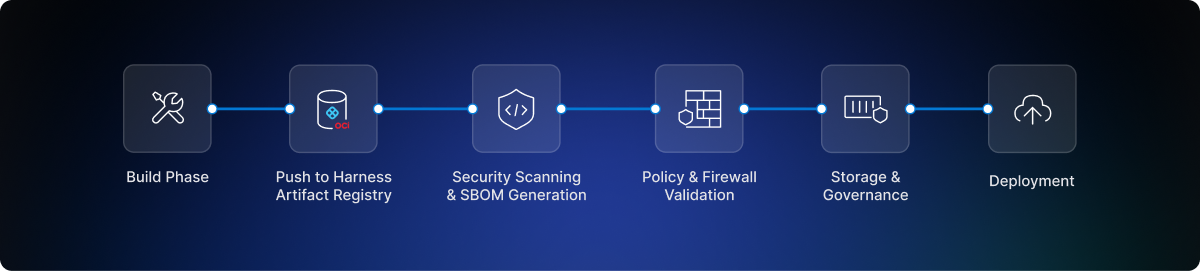
Docker Registry Client Setup
It all begins with the very first step after you build your Docker image on your system: storing it in a secure artifact storage layer through your container registry. Harness Artifact Registry supports more than 16 registry types and is fully OCI-compliant. You can simply use Docker to push the artifacts into the registry or even use the Harness CLI for it.
It is as simple as pushing to Docker Hub. Once you've authenticated with your Harness Artifact Registry, you can use standard Docker commands to push Docker images:
# Step 1: Tag the existing image (using its digest) with a new tag
docker tag <REGISTRY_URL>/<REPOSITORY>/<IMAGE_NAME>@<DIGEST> <REGISTRY_URL>/<REPOSITORY>/<IMAGE_NAME>:<NEW_TAG>
# Step 2: Push the newly tagged image to the registry
docker push <REGISTRY_URL>/<REPOSITORY>/<IMAGE_NAME>:<NEW_TAG>
Because Harness Artifact Registry is fully OCI-compliant, it works seamlessly with any OCI-compatible client. This means you don't need to learn new tools or change your existing Docker workflows. Whether you're migrating from Google Artifact Registry, Azure Container Registry, AWS ECR, or Docker Hub, the experience remains consistent.
Pulling from External Resources
We understand that a build requires many dependencies and versioning, with some even pulling from open-source repositories. These sources can vary significantly for enterprises. That's why we've made it easy to integrate custom registries so you can cache artifacts via a proxy.
Harness Artifact Registry allows you to configure upstream registries as remote repositories. This means you can:
- Cache dependencies locally to reduce external network calls and improve build times
- Control access to external Docker registries and artifact repositories through a single point of entry
- Scan external artifacts before they enter your environment
Apart from Docker Hub, Google Artifact Registry, and AWS ECR, you can set up custom registries with just a Remote Registry URL and basic authentication using a username and password. This proxy capability ensures that even when your teams pull Docker images from public registries, everything flows through Harness Artifact Registry first, giving you complete visibility, governance, and unified artifact storage control.
Security by Design
This is where Harness Artifact Registry truly shines. Rather than treating security as an afterthought, it's baked into every layer of the artifact lifecycle.
Built-in Container Scanners
Container vulnerability scanners detect security issues in your Docker images and container images before they can cause problems. Harness Artifact Registry integrates with industry-leading scanners like Aqua Trivy and Snyk, allowing you to automatically scan every artifact that enters your registry.
Here's what makes this powerful: when a Docker image is pushed, Harness automatically triggers a security pipeline that scans the artifact and generates a complete Software Bill of Materials (SBOM) along with detailed vulnerability reports. You get immediate visibility into:
- Known CVEs (Common Vulnerabilities and Exposures) with severity ratings
- All packages and libraries included in the Docker image
- Outdated dependencies and their versions
- Licence compliance issues
- Configuration vulnerabilities
The SBOM and vulnerability details are displayed directly in the Harness interface, giving you complete transparency into what's inside your containers and their security posture. This level of container security goes beyond what traditional Docker registries offer.
Dependency Firewall
When you're pulling dependencies from external sources through the upstream proxy, the Dependency Firewall actively blocks risky or unapproved packages before they even enter your registry. You can configure it to either block suspicious dependencies outright or set it to warn mode for your team to review. This means malicious dependencies are stopped at the gate, not discovered later in your pipeline.
Policy Sets
Beyond vulnerability scanning, you can assign policy sets to be evaluated against each artifact. These policies act as automated gatekeepers, enforcing your organisation's security and compliance requirements.
For example, you might create policies that:
- Block Docker images with critical vulnerabilities from being deployed
- Require all container images to be signed
- Enforce naming conventions for artifacts
- Mandate specific base images for Docker containers
Policies are evaluated automatically, and non-compliant artifacts can be quarantined or blocked entirely.
Quarantine
When an artifact fails a security scan or violates a policy, it can be automatically quarantined. This prevents it from being used in deployments whilst still allowing your team to investigate and remediate the issues. This proactive approach significantly reduces your attack surface and ensures only verified artifacts make it to production.
Integrating with Harness CI/CD Pipelines
Your artifact is now ready, fully scanned for vulnerabilities, and stored securely in your container registry. This is where everything comes together for developers and platform engineers alike. The seamless integration between Harness Artifact Registry and Harness CI/CD pipelines means you can build Docker images, store artifacts, and deploy without context switching or managing complex credentials across multiple registry systems.
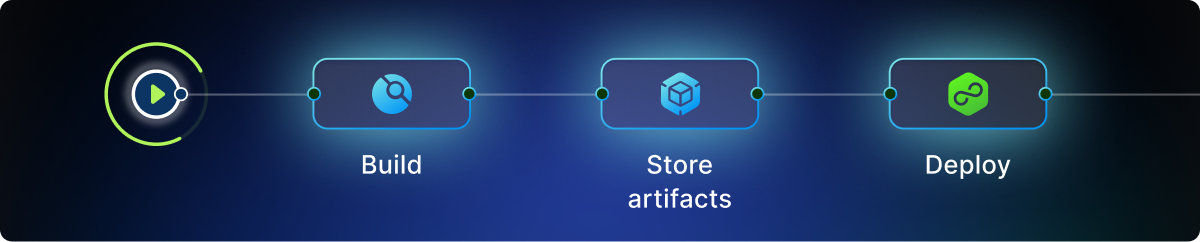
Building and Publishing with Harness CI
Harness CI is all about getting your code built, tested, and packaged efficiently. Harness Artifact Registry fits naturally into this workflow by providing native steps that eliminate the complexity of managing Docker registry credentials and connections.
Build and Push to Docker: This native CI step allows you to build your Docker images and push them directly to Harness Artifact Registry without any external connectors. The platform handles Docker registry authentication automatically, so you can focus on your build logic rather than credential management.
Upload artifacts: Beyond Docker images, you can publish Maven artifacts, npm packages, Helm charts, or generic files directly to Harness Artifact Registry. This unified artifact management approach means all your build outputs live in one place, with consistent vulnerability scanning and policy enforcement across every artifact type.
The essence here is simplicity: your CI pipeline produces artifacts and Docker containers, and they're automatically stored, scanned, and made available for deployment, all within the same platform.
Deploying with Harness CD
Every deployment needs an artifact. Whether you're deploying Docker containers to Kubernetes, AWS ECS, Google Cloud Run, or traditional VMs, your deployment pipeline needs to know which version of your application to deploy and where to get it from.
This is where Harness Artifact Registry becomes invaluable. Because it's natively integrated with Harness CD, your deployment pipelines can pull Docker images and artifacts directly without managing external Docker registry credentials or complex authentication flows.
Harness CD supports numerous deployment types (often called CD swimlanes), and Harness Artifact Registry works seamlessly with all of them. When you configure a CD service, you simply select Harness Artifact Registry as your artifact source, specify which container registry and artifact to use, and define your version selection criteria.
From there, the deployment pipeline handles everything: authenticating with the registry, pulling the correct Docker image version, verifying it's passed vulnerability scans and security checks, and deploying it to your target environment. You can deploy to production with strict version pinning for stability, or to non-production environments with dynamic version selection for testing. The choice is yours, and it's all configured through the same intuitive interface.
The real power lies in the traceability. Every deployment is logged with complete details: which artifact version was deployed, when, by whom, and to which environment. If you need to roll back, the previous Docker image versions are right there, ready to be redeployed.
Why This Matters
From the moment you build a Docker image to when it's running in production, Harness Artifact Registry provides a complete, secure, and governed artifact lifecycle. You get container security that prevents issues before they occur, complete visibility through SBOM generation and audit logs, and native CI/CD integration that eliminates the complexity of managing multiple Docker registries and credentials.
This isn't just about storing Docker images. It's about building confidence in your software supply chain with a secure, OCI-compliant container registry.
In a world where supply chain attacks are increasingly common and compliance requirements continue to grow, having a robust artifact management and container registry strategy is essential. Harness Artifact Registry delivers that strategy through a platform that's both powerful and intuitive.
Whether you're a developer pushing your first Docker image, a platform engineer managing deployment pipelines, or a security professional ensuring compliance, Harness Artifact Registry provides the tools you need to move fast without compromising on security.
Ready to experience a fully OCI-compliant Docker registry with built-in vulnerability scanning, dependency firewall, and seamless CI/CD integration? Explore Harness Artifact Registry and see how it transforms your software delivery pipeline with secure artifact management.