Learn about Harness's new Release Orchestration capability for coordinated multi-team or multi-service releases.

TL;DR
- Release Orchestration automates multi-team coordination by ingesting AI-generated workflows and mapping cross-service dependencies
- Teams eliminate manual status chasing and Friday war rooms with unified pipeline orchestration
- Native CD integration means no context-switching between disconnected release tools
- Progressive delivery and governance controls ship faster without bypassing compliance gates
AI has officially made writing code cheap.
Your developers are shipping more changes, across more microservices, more frequently than ever before. If you’re a developer, it feels like a golden age.
But for the Release Engineer? This isn't necessarily a celebration; it’s a scaling nightmare.
We’re currently seeing what I call the "AI delivery gap." It’s that uncomfortable space between the breakneck speed at which we can now generate code and the manual, spreadsheet-driven processes we still use to actually release it.
The reality is that while individual CI/CD pipelines might be automated, the coordination between them remains a stubbornly human bottleneck. We’ve automated the "how" of shipping code, but we’re still stuck in the Dark Ages when it comes to the "when" and "with whom."
Today, we are introducing Harness Release Orchestration alongside four other capabilities that ensure confident releases. Release Orchestration is designed to transform the release management process from a fragmented, manual effort into a standardized, visible, and scalable operation.
The Architecture of a Modern Release: A "Pipeline of Pipelines"
Most release engineers I talk to spend about 40% of their time "chasing humans for status." You’re checking Slack threads for sign-offs, updating Confluence pages, and obsessively watching spreadsheets to ensure Team A’s service doesn't break Team B’s dependency. (And let’s be honest, it usually does anyway.)
We could call it a team sport, but it’s really a multi-team sport. Teams from multiple services and functions need to come together to deliver a big release.
If we rely on a person to coordinate, we can’t move fast enough.
Harness Release Orchestration moves beyond the single pipeline. It introduces a process-based framework that acts as your release "blueprint."
- Visual Release Blueprints: Instead of hundreds of bespoke scripts, you define reusable processes composed of phases (Dev, QA, Security, Production) and activities. These activities represent the complete workflow, including manual sign-offs and automated progressive delivery.
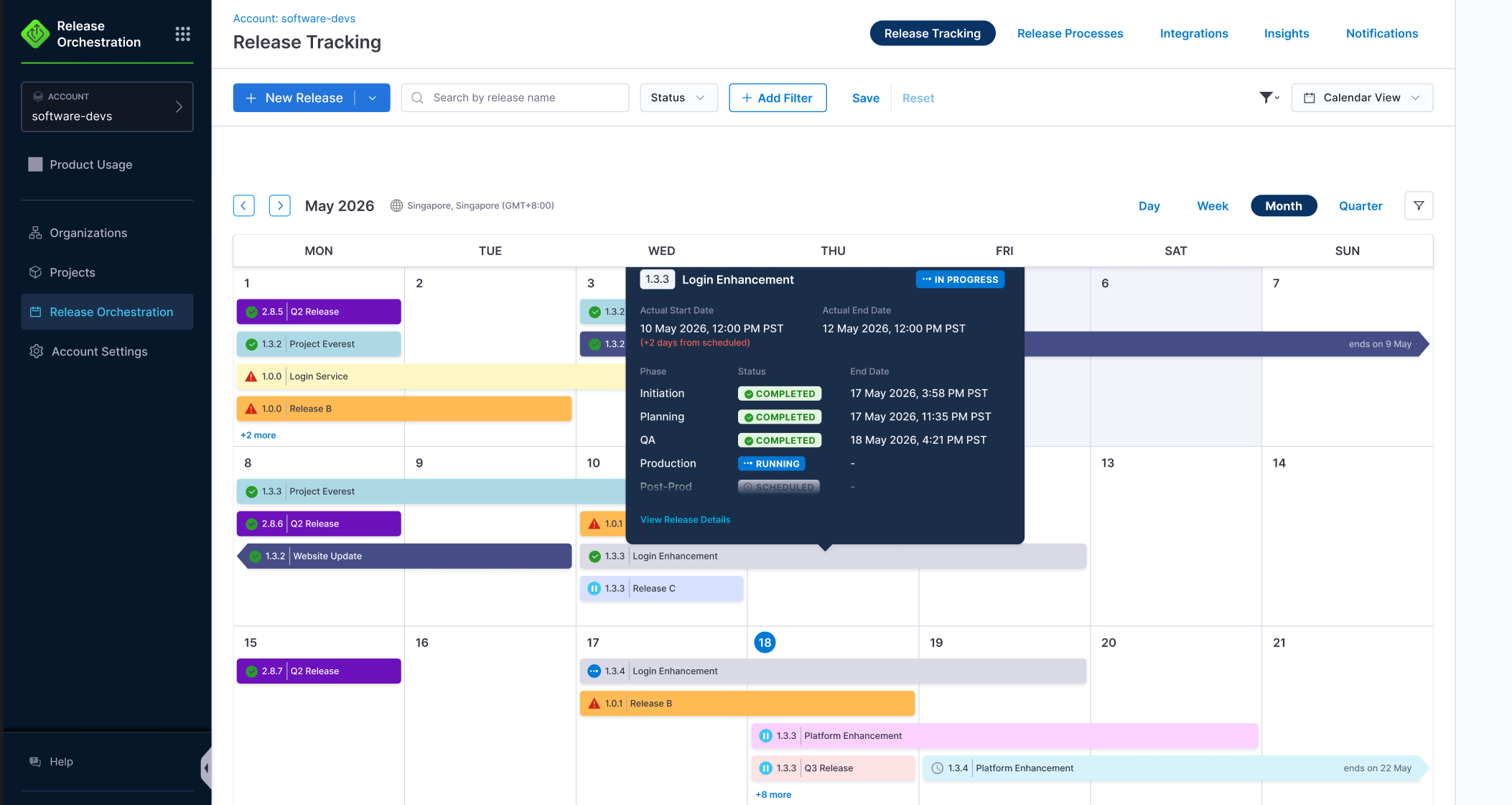
- The Shared Release Calendar: No more "When is [Service X] shipping?" questions. The shared calendar provides a single source of truth for planning and deconflicting release schedules. It gives visibility to stakeholders from Engineering all the way to Product and Marketing.
- Governance at Speed: We’ve built in "paved roads." You can establish standards that allow developers to self-serve their releases without bypassing the safety checks that keep you out of the news for the wrong reasons.
Native to Continuous Delivery
Release management software isn’t an entirely new idea. It’s been tried before, but never widely adopted. The industry went wrong by building separate tools for continuous delivery and release orchestration.
With separate tools, you incur integration overhead, have multiple places to look, and experience awkwardness.
We’ve built ours alongside our CD experience, so everything is as seamless and fast as possible. Yes, this is for releases that are more complex than a simple microservice, which the app team delivers on their own. No, that doesn’t mean introducing big processes and standalone tools.
AI to the Rescue: Migration and Ingestion
Here’s the “gotcha”: the biggest barrier to adopting a new release tool is the hassle of migrating. You likely have years of proven workflows documented in SharePoint/Confluence, in early-release management tools like XL Release, or in the fading memory of that one person who isn't allowed to retire.
Harness AI now handles the heavy lifting. Our AI Process Ingestion can instantly generate a comprehensive release process from a simple natural-language prompt, existing documentation, or export from a tool.
What used to take months of manual configuration now takes seconds. Simply put, we’re removing the friction of modernization.
Leverage, Not Heroics
For the Release Engineer, the goal is leverage. You shouldn't need to perform heroics every Friday night to ensure a successful release. (Though if you enjoy the adrenaline of a 2:00 AM war room, I suppose I can’t stop you.)
Harness Release Orchestration creates a standardized release motion that scales with AI-driven output. It allows you to move from being a "release waiter" to a "release architect."
AI made writing code cheap. Harness makes releasing it safe, scalable, and sustainable.