Learn how to build an A/B testing framework in your CI/CD pipeline. Accelerate software delivery, reduce risk, and boost innovation. Start now!

- An A/B testing framework works best when it lives inside your CI/CD pipeline, not outside of it.
- Feature flags, progressive delivery, and guardrail metrics help teams test safely without slowing releases down.
- Automation makes it easier to detect regressions early, roll back fast, and keep experiment debt under control.
Most engineering teams still tie A/B tests to major releases, waiting weeks or even months to validate impact while users suffer through broken features. Feature flag interdependencies create hidden technical debt at scale, making big-bang experiments even riskier. Instead: decouple deployment from release entirely.
The most effective A/B testing framework lives inside your CI/CD pipeline, not bolted on afterward. Deploy code with features disabled, then use progressive delivery and real-time metrics to prove impact before full rollout. This approach treats experimentation as a first-class deployment capability, with automated verification wired directly into your release process.
Ready to ship 50x faster with built-in experimentation? Harness Feature Management & Experimentation unifies feature flags, release monitoring, and A/B testing in a single platform.
What is an A/B testing framework?
An A/B testing framework is a tool that lets teams compare a control experience to a variation, divide traffic between the two, measure the results, and then act on those results.
That framework is more than just a dashboard when it comes to software delivery. It has:
- Traffic distribution
- Flags for features or controls for runtime
- Rules for targeting and defining experiments
- Tracking exposure
- Business and reliability metrics
- Logic for promotion and rollback
- Rules about who can start, change, or end an experiment
The main point is simple: deployment shouldn't have to mean release. You should be able to send code safely, keep a feature hidden, and then slowly show it to real users when you're ready to learn from them.
Why traditional A/B testing breaks down in modern delivery
Traditional A/B testing often assumes a slower release cycle. Teams launch a change, wait for a handoff, then run an experiment after the fact. That model creates friction for engineering teams that deploy often.
It also creates avoidable problems:
- Experiments get delayed until after the release windows
- Teams rely on manual traffic changes
- Business metrics and system health live in different tools
- Rollback decisions take too long
- Stale flags and one-off test logic pile up over time
Modern delivery needs something tighter. If teams are shipping daily or several times a day, the A/B testing framework has to move at the same pace. That means the workflow for building, testing, releasing, measuring, and rolling back should live in one delivery process instead of being spread across disconnected tools.
Architecture of an A/B testing framework inside CI/CD
The biggest mistake teams make is treating A/B testing like a separate system that sits beside the pipeline. That usually turns experimentation into another manual checkpoint. Velocity drops. Ownership gets fuzzy. Learning slows down.
A stronger setup keeps experimentation inside CI/CD from the start.
Separate the control plane from the data plane
Your control plane is where you define the experiment: feature flags, audience rules, rollout percentages, mutual exclusion rules, and success criteria. Your data plane is where the experiment runs: flag evaluations, telemetry, exposure events, and outcome tracking.
Keep those concerns separate. That gives teams a cleaner operating model:
- Changes to targeting rules do not require a redeploy
- Applications keep serving users even if the control plane is unavailable for a short period
- Experiment logic stays consistent across environments
- Release decisions are driven by data instead of manual guesswork
Wire experiments directly into pipeline stages
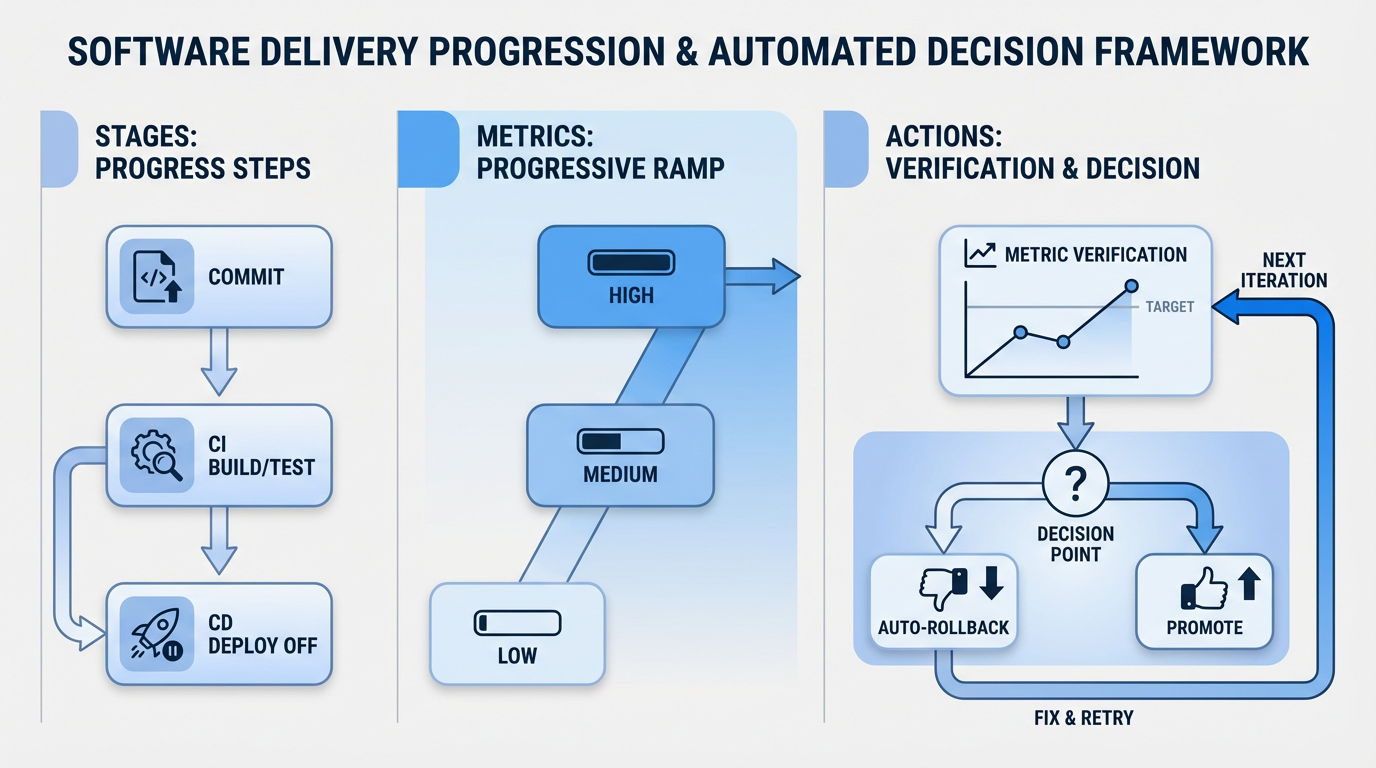
A practical A/B testing framework follows the same rhythm every time:
- Create the feature flag and experiment definition.
- Deploy the code with the feature turned off.
- Run smoke, regression, and integration checks.
- Expose the feature to a small audience.
- Measure business impact and guardrail metrics.
- Promote, pause, or roll back based on what the data says.
This flow mirrors how modern pipelines move from commit to validation to progressive rollout. As exposure increases, teams rely on real-time metrics to decide whether to continue ramping, hold steady, or roll back.
This is where CI/CD orchestration matters. Teams using pipeline as code can keep those steps visible, repeatable, and reviewable. And when teams need more flexibility across different targets and environments, capabilities such as Powerful Pipelines and Deploy Anywhere help keep the process consistent.
Store experiment rules as code
If experiment settings are stored in spreadsheets or in tribal knowledge, they will drift.
Store flag definitions, targeting rules, metric choices, and rollout policies in version control alongside the application and delivery config.
That gives you:
- A reviewable history of every change
- Cleaner audit trails
- Repeatable rollout patterns
- Fewer ad hoc experiments
- Less cleanup pain later
This is also the right place to enforce policy. Policy as code in CI/CD helps teams standardize approval logic, experiment guardrails, and release controls without forcing every decision through manual review. For broader controls across delivery workflows, DevOps Pipeline Governance fits naturally here.
How an A/B testing framework works in 6 steps
A clean framework does not have to be complicated. It just has to be disciplined.
1. Start with a real hypothesis
Do not test just because you can. Define what you believe will happen and why. For example, reducing the number of fields on signup will increase completed registrations without increasing fraudulent signups.
That kind of hypothesis gives the experiment direction. It also tells you what to measure.
2. Choose one primary metric and a small set of guardrails
Every experiment needs a main outcome metric. It also needs a few metrics that tell you whether the change is causing harm somewhere else.
A solid setup usually includes:
- One primary business metric
- Two to four guardrail metrics
- Optional diagnostic metrics for deeper analysis
3. Build the control and variation
Keep the comparison clean. If you change too many variables at once, the result gets muddy fast. This is one reason feature flags work well in delivery pipelines. They let teams isolate a change, ship it safely, and expose only the behavior they want to test.
4. Split traffic deliberately
Traffic allocation should be planned, not improvised. Early ramps should stay small until the change proves it is stable. From there, teams can widen exposure in steps. If your environment supports more advanced routing, traffic routing for A/B testing, canary, and blue-green deployments can make that progression much easier to manage.
5. Run the experiment long enough to learn something real
Ending a test too early is one of the fastest ways to make a bad decision look smart.
Set expectations up front for:
- Minimum sample size
- Minimum test duration
- Stop conditions for regressions
- Stop conditions for a clear winner
6. Decide what happens next
A useful A/B testing framework does not stop at analysis. It tells the pipeline what to do next. That action might be:
- Promote the change to a larger audience
- Keep the test running
- Pause and investigate
- Roll back automatically
- Retire the variation and document the result
Best practices for A/B testing in DevOps workflows
The best experimentation programs are not just fast. They are predictable.
Here are the practices that matter most:
- Write the hypothesis before the rollout starts. If the team cannot explain what success looks like, the test is not ready.
- Use feature flags as release controls. Deploy first, then decide who sees the change and when.
- Ramp exposure gradually. Start small, then increase only after the data looks healthy.
- Define business metrics and system metrics together. Conversion means very little if latency, errors, or support tickets spike.
- Make rollback automatic where possible. Teams should not need to watch dashboards by hand to know when something is going wrong.
- Document the result even when the test fails. A losing experiment can still save the team from shipping the wrong thing.
- Clean up flags on purpose. Every experiment should have an owner, a review date, and an end state.
This is also where CI performance matters. Faster feedback loops make experiments easier to run and easier to trust. Teams can shorten validation time with tools such as Test Intelligence, Incremental Builds, and Analytics & Insights.
For teams thinking through rollout patterns more broadly, it helps to understand where blue-green, canary, and other deployment strategies fit into the overall delivery model.
Metrics that matter in an A/B testing framework
Not every metric belongs in the decision path. A useful A/B testing framework usually groups metrics into three buckets.
Primary metrics
These answer the main business question.
Examples include:
- Conversion rate
- Signup completion
- Revenue per visitor
- Feature adoption
- Retention
Guardrail metrics
These tell you whether the experiment is causing damage while chasing the primary goal.
Examples include:
- Error rate
- Latency or response time
- Crash rate
- Checkout failures
- Support volume
- Abandonment rate
Diagnostic metrics
These help the team understand why a change won or lost.
Examples include:
- Click-through rate
- Time on task
- Drop-off by step
- Session depth
- API-level health signals
Teams also need a clean way to view these signals together. That is where CD Visualize DevOps Data can help delivery teams line up rollout activity with operational outcomes.
AI-powered automation for safer experimentation
Automation matters because humans are slow at repetitive judgment calls, especially during live rollouts.
In a modern A/B testing framework, automation should help with a few specific jobs:
- Correlate exposure data with health and performance signals
- Flag regressions during percentage ramps
- Enforce promotion criteria consistently
- Trigger rollback when guardrails fail
- Reduce the need for teams to babysit dashboards
This is especially useful during progressive delivery, where the question is not just “Did the feature work?” But also, “Should we widen exposure right now?”
For that part of the workflow, AI-Assisted Deployment Verification is a natural fit. It helps teams move from manual inspection to a more consistent release decision model.
Common A/B testing mistakes in CI/CD
Even the best teams can get caught in some common traps. Most of these mistakes aren't made with bad intentions. They happen when you move too quickly, read early signals too confidently, or think of experimentation as a one-time launch task instead of an ongoing process.
Starting without a clear hypothesis
The analysis will be vague if the team isn't sure what they want to happen. A good hypothesis should say what the change is, who it is for, and what effect it will have. Without that, teams often gather a lot of information but still can't figure out if the test worked.
Only measuring business lift
A variant can make conversions better while quietly hurting performance, reliability, or workflows that come after it. That's why experiments need both outcome metrics and guardrail metrics. If latency, error rates, or support volume go the wrong way, the apparent win may not be worth sending.
Stopping tests too soon
When the numbers start to go in the right direction, it's easy to pick a winner. It's much harder to say that the sample is still too small. Before launching the test, teams should agree on the minimum sample size, runtime, and stop conditions so that the test doesn't end on a whim.
Carelessly running experiments that overlap
When users end up in tests that don't match, the data gets messed up quickly. Rules about mutual exclusion are important. User bucketing that is consistent is also important. When experiments overlap and there aren't clear lines between them, teams can't figure out which change caused the result.
Forget about cleaning up
Flags that are never taken down cause confusion, branch logic, and technical debt. There should always be an exit plan for an experiment. That should include an owner, a date for making the decision, and a clear next step: promote the winner, remove the losing path, and get rid of flag logic that isn't needed anymore.
Ship faster with confidence
Adding an A/B testing framework to your CI/CD pipeline isn't just about adding another tool. It's about making decisions about releases with better signals and less guesswork. When teams separate deployment from release, they have more space to safely test changes. They can learn faster without making every release a risk by using feature flags, progressive delivery, metrics, and rollback logic together. That's what a modern framework is really worth. It helps teams ship, measure, and respond all at once.
Harness supports that model throughout the delivery lifecycle with tools for testing efficiency, managing rollouts, verifying, and governance. To go from basic flagging to a more complete experimentation workflow, you should start by making your rollout process easy to measure, repeat, and control.