Unify code and runtime security with Harness and Wiz. Correlate findings, prioritize real risks, and fix vulnerabilities faster across the SDLC.

Modern application security goes from code to runtime. Vulnerabilities are found at every stage of the software development lifecycle (SDLC) - in the code developers write, open source packages they pull in, container images they build, and cloud infrastructure where it all runs. But finding vulnerabilities is no longer enough. With attack surfaces sprawling across pipelines, registries, and production environments, the harder problem is fixing the vulnerabilities that actually matter.
Understanding what’s important increasingly depends on correlating multiple data points. A critical CVE buried in a dependency looks very different depending on whether the vulnerable function is actually reachable, the library is used in production, or the affected service is internet-facing. Without runtime context, security and development teams are often left triaging noise instead of actually reducing risk. And fixing vulnerabilities discovered in production can be challenging without being able to follow the trail back to the repo and line of code where the vulnerability can be found.
No matter where application security lives in your organization - and increasingly, it lives in more than one place - Harness and Wiz are working together to make sure you're covered. Whether your team is shifting left from cloud security or pushing right from the development pipeline, integrating Harness and Wiz brings code and runtime findings together so you always have the context you need to act.
Shift Left, Protect Right. Who Owns Application Security?
Application security used to have a clear owner. The AppSec team ran the scanners, triaged findings, and created tickets for developers. But "shift left" has been pushing security earlier into the development process and ownership has been migrating toward the teams that actually write and ship code. Today, the DevSecOps or platform engineering team owns application security tooling in many organizations. They're the ones who know exactly where a vulnerability lives in code, who owns it, and how to get developers to fix them.
But as applications move to the cloud, cloud security and infrastructure teams have a stake in application security outcomes as well. They're the ones with visibility into what's actually running in production - what's internet-facing, what's over-privileged, what's actively being exploited. Cloud security platforms have expanded their focus from purely infrastructure and runtime back through the SDLC to code. For many cloud teams, application security isn't a handoff; it feeds into their cloud risk picture.
The result is that application security now has multiple stakeholders with different vantage points. DevSecOps teams see risk through the lens of the CI/CD pipeline and the developer workflow. Cloud security teams see it through the lens of the deployed environment and the blast radius of a breach. Neither view is complete on its own. The good news is that these teams don't have to choose between their tools or their workflows. They need integration that lets each team work in their context while sharing the signals that make both more effective.
Integrating Wiz Code into CI/CD Pipelines with Harness STO
DevSecOps teams need to expand right. SAST and SCA tools often generate more findings than any team can fix. Runtime context helps separate signal from noise. Knowing that a vulnerable service is actively internet-facing or that a dependency with a critical CVE is actually loaded in production changes how a team prioritizes. Without it, developers are left triaging based on CVSS scores alone. With it, they can focus effort where exposure is real and the risk in production is highest.
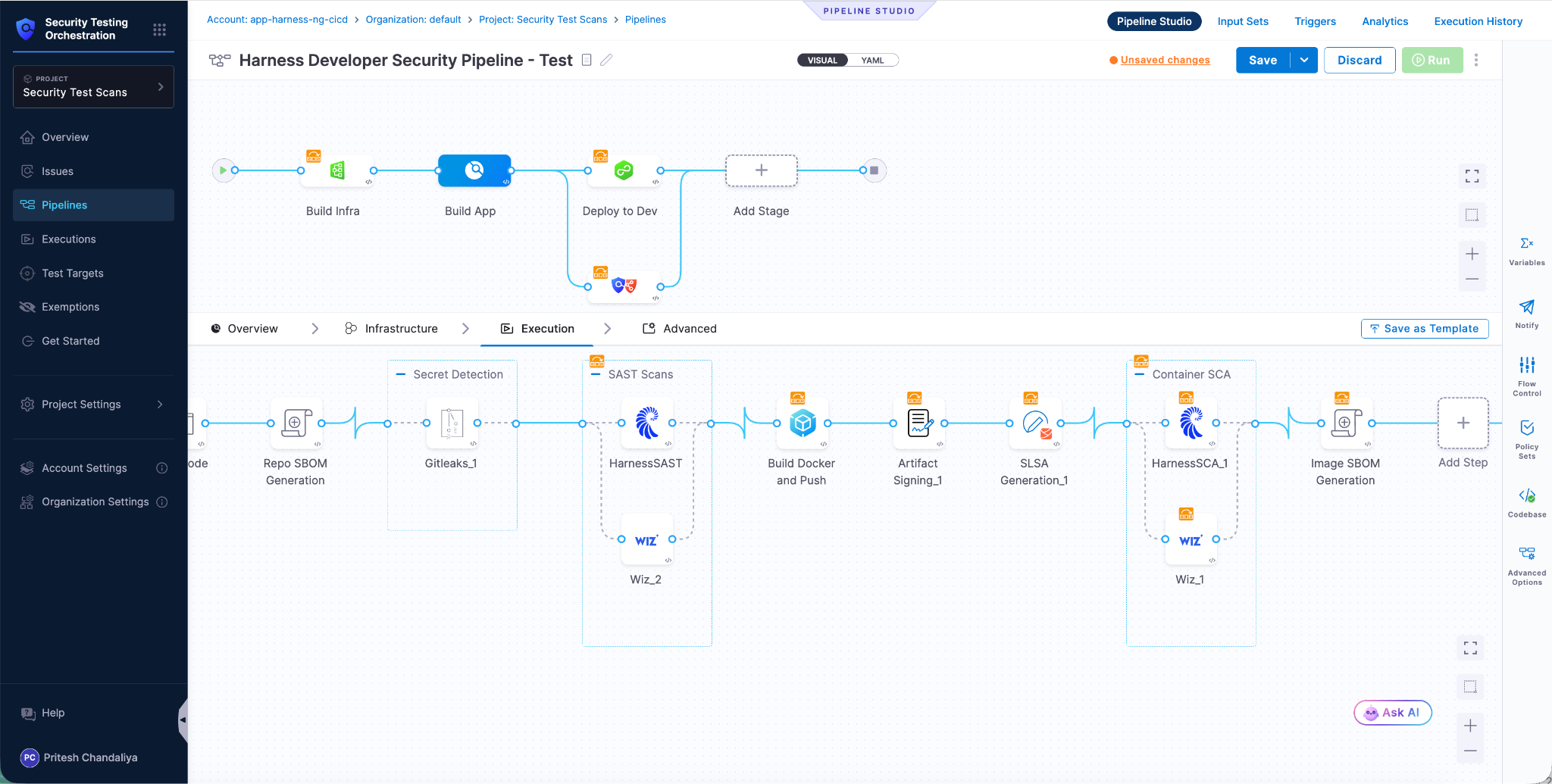
Harness Security Testing Orchestration (STO) makes it easy to orchestrate Wiz Code across your CI/CD pipelines. With a pre-built integration, you can deploy Wiz Code in just a few clicks instead of needing to create a custom integration or write custom scripts. Harness orchestrates Wiz Code alongside all your other scanners so you know your pipelines always get the required security tests, without needing to manually coordinate multiple tools.
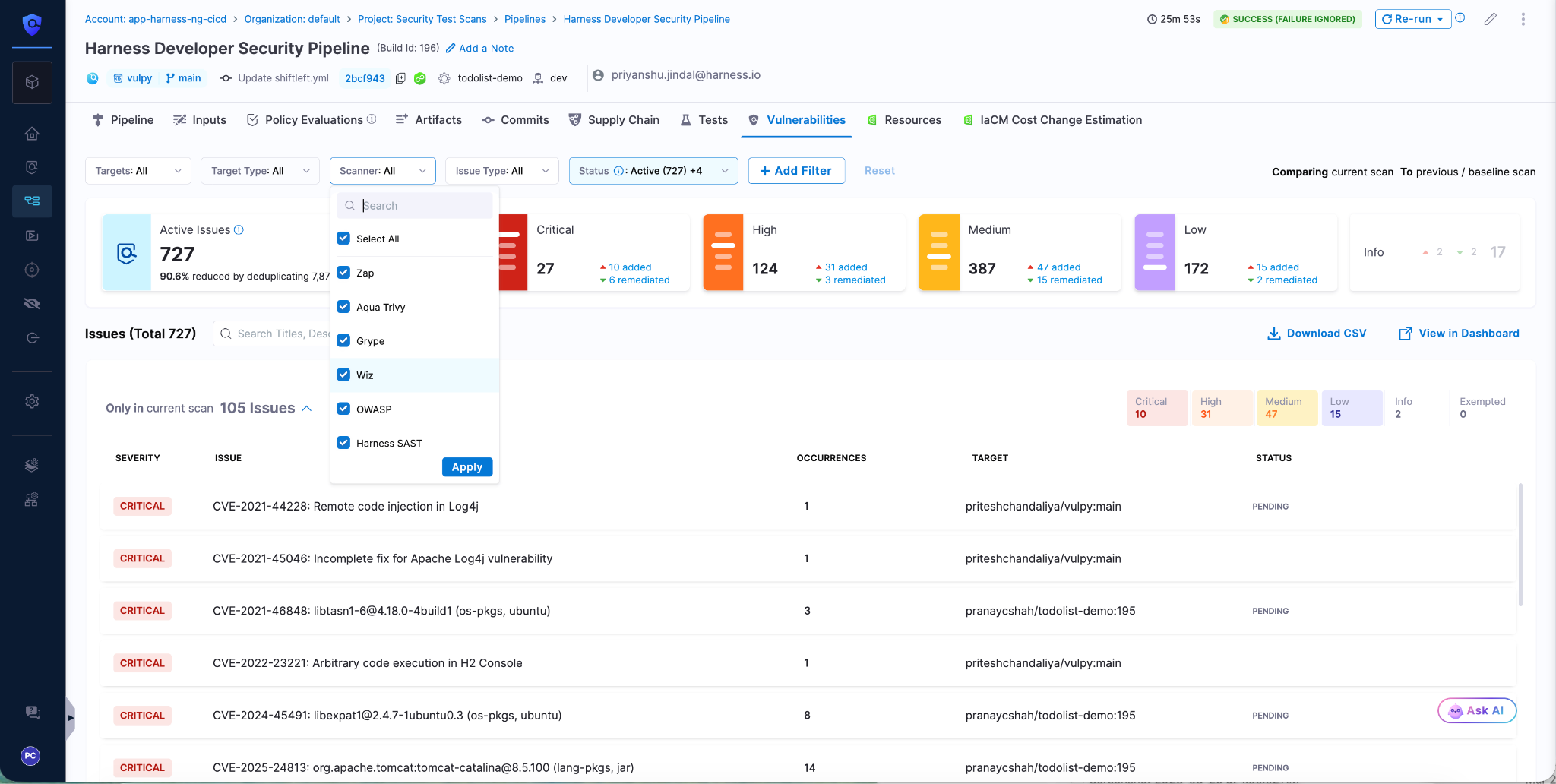
Once Wiz Code is integrated, STO aggregates findings with other scanners in your pipeline, automatically deduplicating vulnerabilities so teams aren't triaging the same issue twice. The consolidated view means developers and security engineers can see the full picture in one place, understanding pipeline-level risk and assigning tickets to developers. In addition, Harness Policy as Code lets teams define and take action at the pipeline level instead of tool by tool, so decisions about what to fail a build on, what to flag for review, and what to pass through are applied consistently and holistically across every scan and pipeline.
Feeding Harness SAST and SCA Findings Into Wiz
Cloud security is pushing left - past runtime, past containers, all the way back to the code and open source packages that vulnerabilities originate from. The driver is enabling action. A misconfigured cloud resource or a vulnerable container image is more actionable when you can tie it back to the specific dependency introduced in a pull request, the developer who owns the code, and the pipeline that shipped it. Runtime findings without code context are just alerts. With code context, they become actionable work items that can be routed to the right person and fixed at the source.
Wiz Application Security Posture Management (ASPM) is designed to aggregate findings from across the SDLC and correlate them with runtime context - what's deployed, what's exposed, and what's actually at risk. By integrating Harness SAST and SCA scanner findings directly into Wiz, cloud security teams can connect the dots between a vulnerable open source package or insecure code pattern and the running workloads it affects. That correlation is what turns a list of CVEs into a prioritized risk picture that reflects what's actually happening in production.
For cloud security teams already working in Wiz, this integration means Harness SAST and SCA become part of their existing workflow rather than a separate tool to check. Code-level findings surface alongside runtime signals in the same platform where cloud risk is already being managed, analyzed, and acted on. Teams get broader coverage without adding friction, and the context that makes those findings meaningful - reachability, exposure, business criticality - is already there when they need it.
AppSec Is a Team Sport. Your Tools Should Be Too.
DevSecOps and cloud security teams are not generally not competing - they're looking at risk from different angles. One team lives in the development pipeline; the other lives in the cloud. Both need visibility into what the other sees to do their jobs well. When those views are siloed, findings get duplicated, priorities diverge, and the vulnerabilities that matter most fall through the cracks between teams.
Harness and Wiz close that gap from both directions. DevSecOps teams get runtime signals from Wiz Code inside the pipeline context where they already work, so they can prioritize fixes based on real-world exposure. Cloud security teams get code-level findings from Harness SAST and SCA inside the risk context where they already work, so they can trace production risk back to its source. Each team keeps their workflow. Both teams get the full picture.
The right combination of these integrations depends on how your organization is structured, where application security ownership sits today, and where you want it to go. If you're a Wiz customer evaluating how Harness SAST and SCA fit into your security program, or a Harness customer looking to bring runtime context into your pipelines, contact your Harness account team to understand how you can map the integrations to your specific environment.