Move database changes out of ticket queues and into pipelines. See how expand/contract, policy gates, and rollback make schema delivery faster and safer.
TL;DR
The takeaway here is that teams get into trouble when they automate a risky process just to run it faster. Teams that pair schema as code, backward-compatible application changes, visibility into what is deployed where, and policy-governed pipelines tend to ship faster and break less.
Harness's State of DevOps Modernization 2026 report found that AI-assisted developers are shipping code 45% faster. Meanwhile, 69% of frequent AI users reported more frequent deployment problems, and average incident recovery time climbed to 7.6 hours. Code is getting faster. Everything after code is not, and schema changes sitting in a manual queue are one of the places where that shows up.
Application delivery went through this shift years ago, from coordinated operations run by privileged specialists to version-controlled, policy-governed changes run by pipelines. Database change management is making the same shift, and it isn't finished.
Coding assistants and agents now produce changes at machine speed. Everything after code is slower, and the database is often the slowest lane. The Harness Software Delivery Agent takes each change, including the schema change, through production under policy, with evidence and rollback. As code generation speeds up, a manual database step gets harder to ignore. If you've wondered how changes to database schemas slow down application delivery, this is the mechanism.
The ticket queue is the old model
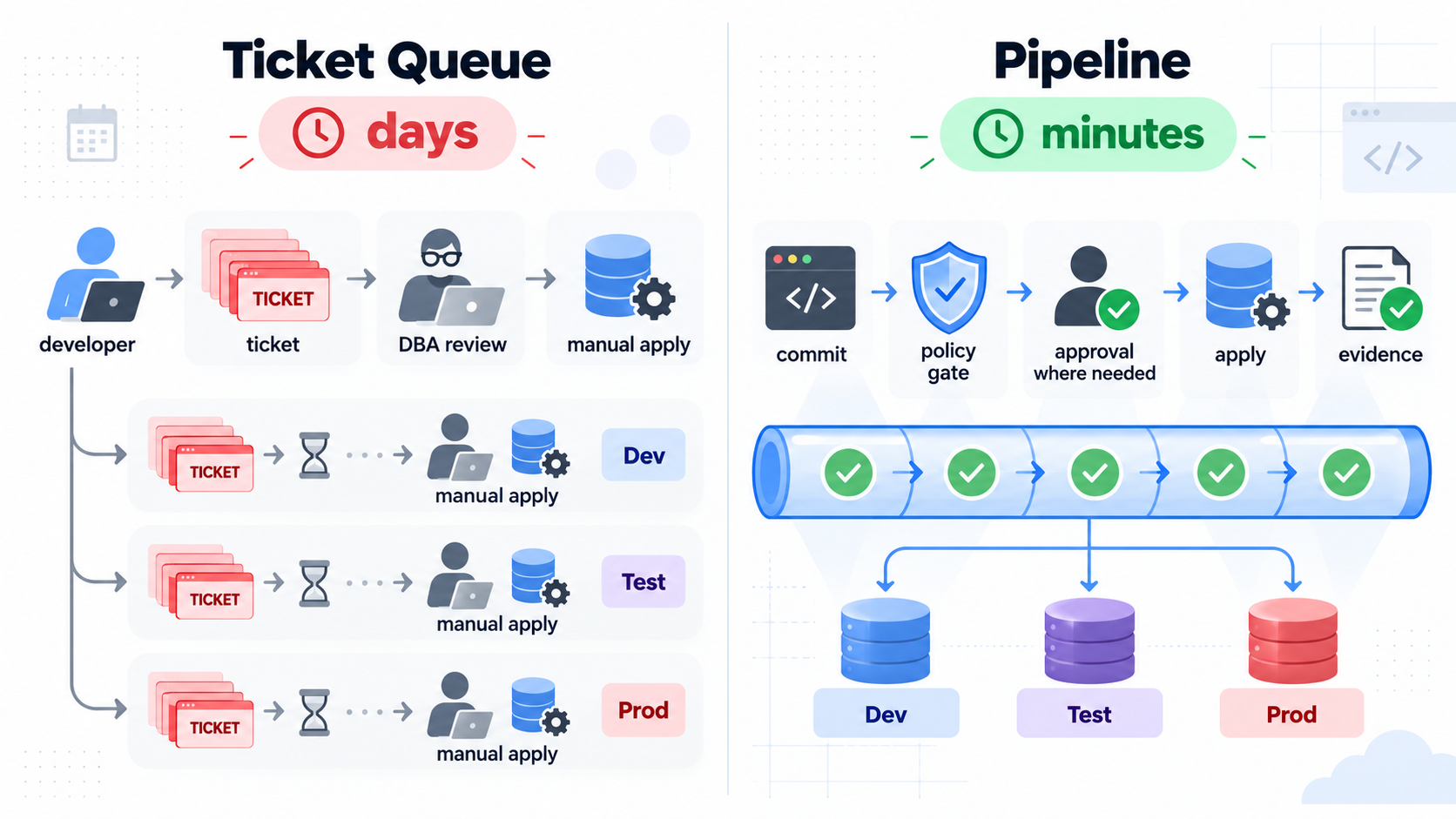
Picture what's probably playing out in your Slack channels and email threads right now. A developer files a database ticket and attaches a SQL script. A DBA reviews it. A privileged engineer applies it by hand, environment by environment.
The controls are procedural, and they arrive late: human review, scheduled windows, and checklists. A ticket queue may not catch a destructive migration before it ships, but at least it gives you a timestamp for the postmortem.
Why manual gatekeeping stops scaling
A few pressures are building:
- Most organizations use multiple database engines and each engine brings its own tooling and habits
- Database-per-service architectures reduce coupling, but multiply the number of data stores someone has to change
- The shift to agentic coding has accelerated the volume of change
Here's the challenge: Manual scripts diverge across environments, which cuts the link between an application release and the state of the database. Divergence is drift, meaning environments that no longer contain the same changes. Test environments are no longer representative of production and risk builds.
Teams end up in a situation where they can say, “Hey, it’s a lot of work but at least it’s risky.” Not great.
What pipeline-driven delivery looks like
The control point changes. Instead of an operator making a judgment call at a SQL console, a database change becomes a versioned artifact that passes automated gates for syntax, compatibility, integration, and operational health. High-risk changes can still go to a DBA or Security for review. Routine, low-risk changes should not wait in a human queue.
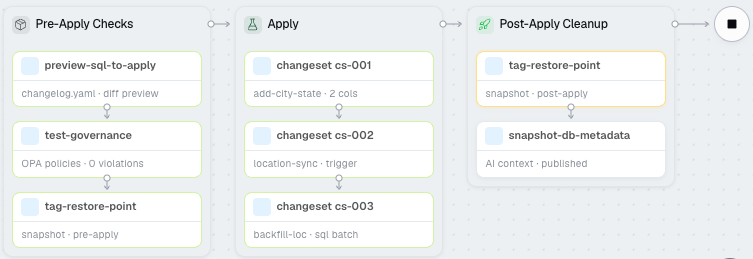
In the Software Delivery Agent, Database Deployments is the capability that does this. It runs schema changes through the same pipeline, policy engine, and audit trail as application code. Here is how it works:
- The Harness Delegate, which runs inside your network, executes the change, so secrets stay in your environment (see the Database Deployments docs overview)
- Before anything runs, OPA policies evaluate the change, using context such as the environment, the database type, and the deployment configuration (OPA is Open Policy Agent, an open-source policy-as-code engine)
- A policy can block a DROP TABLE with no rollback, enforce naming conventions, require approval for risky change types, or stop off-hours deployments
- Teams can preview the generated SQL and require a manual approval before the change is applied
- Every change records what was deployed, how it executed, and who approved it, as described in Building Governance, Auditability, and Visibility into Database DevOps
You choose how much of this runs hands-free. Low-risk additions, such as a new column in a dev environment, can run autonomously. Destructive operations on regulated data stay behind fixed gates and a human approval.
The Software Delivery Agent can also author the migration. Describe the change in plain language, and Harness AI writes the SQL, applies safe patterns such as concurrent index creation to avoid table locks, validates the result against OPA policy, and queues it for governed deployment.
State vs. script
When you modernize, your biggest design decision is whether the database is a sequence of changes or a desired state:
- Migrations as code (script): immutable, ordered scripts (DDL and DML) are committed to source control, which gives you an explicit sequence and an easy audit trail
- Declarative schema (state): the desired schema is stored as code, and tooling generates a plan by comparing it to the live state
Liquibase and Flyway are well-established choices on the script side. Each approach has trade-offs. A plan generated by diffing is good at showing differences, but it can't know the intent behind a data transformation. Script-based tooling records that intent, but it depends on discipline to keep ordering correct. If you are weighing the two, state vs script migrations in modern database DevOps goes deeper, and database DevOps vs database migration systems covers where migration tools stop.
Database Deployments sits on the script side. It natively runs Liquibase changelogs and Flyway SQL scripts as written, so existing changesets keep working with no migration project. It tracks which changesets are applied to which environment, so you can see that staging is two changesets ahead of QA, or that a production hotfix never made it back to lower environments. For a closer comparison, see Harness Database DevOps vs Liquibase vs Flyway.
The expand/contract pattern
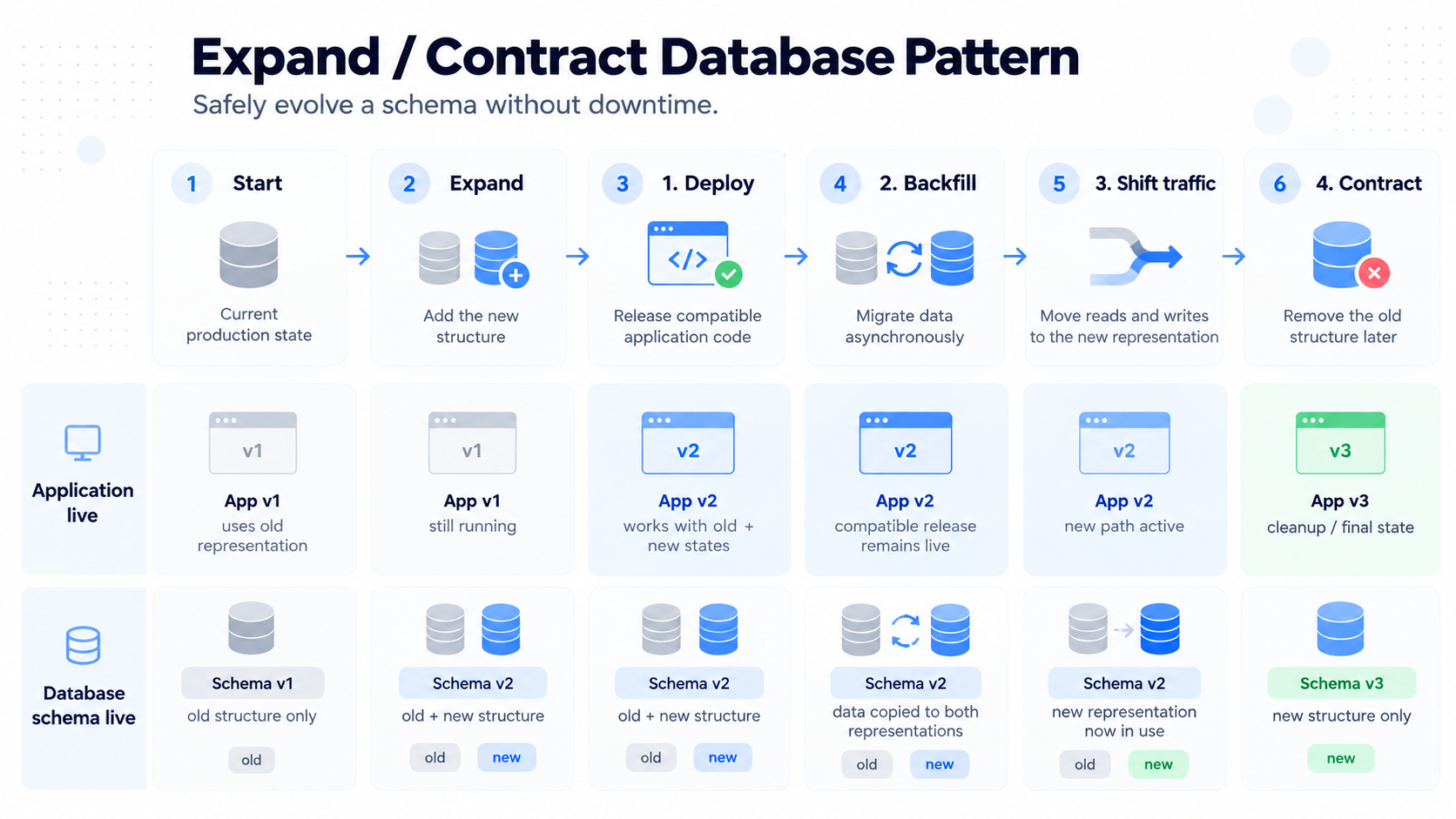
Putting an old ALTER TABLE script behind a deploy button just automates the risk. A pattern that works well is to split schema evolution into backward-compatible phases. Guidance on database change management describes this as expand/contract, which decouples application deployment from database migration. A typical zero-downtime sequence looks like this:
- Expand: add the new structure (a new column, for example)
- Deploy: release application code that works with both the old and new database states
- Backfill: migrate the data asynchronously
- Shift traffic: move reads and writes to the new representation
- Contract: remove the old structure in a separate, later deployment
As long as you make the decision before the contraction, an application rollback no longer requires a database rollback. That shrinks the blast radius.
For changes that do need a database rollback, the Rollback SQL step generates the rollback SQL so you can review it first, and it can feed downstream approval gates and OPA policy before anything executes. The rollback for database schemas page covers the available methods.Not every change can be backed out, though. Dropped data does not come back.
On the application side, the Software Delivery Agent uses AI Verification. It compares observability and logging data against previous versions and reverts a deployment that is performing worse.
The role of the DBA
Does this make the DBA obsolete? No. The goal is fewer routine DBA keystrokes.
Developers author the changes, and specialists encode the guardrails. DBAs and SREs stop being a per-change bottleneck and own platform standards, capacity rules, risk classifications, and recovery strategies. A scoped machine identity executes the approved changes in production. Think of it as a modernization of control, with DBAs still owning it.
Gentera replaced a custom Liquibase pipeline with Harness Database Deployments, dramatically reducing their failure rates and improving governance.
The takeaway
The takeaway here is that teams get into trouble when they automate a risky process just to run it faster. Teams that pair schema as code, backward-compatible application changes, visibility into what is deployed where, and policy-governed pipelines tend to ship faster and break less.
Learn more about Harness Database Deployments.