Find out how policy-driven pipelines, continuous delivery and AI-assisted verification are replacing manual CAB processes with automated release management.

- CABs optimize for perceived safety, not actual risk reduction. Batched releases, surface-level reviews, and meeting cadence latency create the very risks they are intended to mitigate.
- Policy as code, automated quality gates, and continuous change tracking enforce the same rules on every change, consistently and at scale.
- Speed and safety are not a trade-off if you build the right controls. Smaller, iterative releases with automated verification limit the blast radius and shorten recovery time.
The thing with Change Advisory Boards is that the intent was always good. Get smart people in a room, look at the evidence, and make sure nothing catastrophic goes out the door. In theory, that's hard to argue with.
It doesn't scale in practice. Things happen between meetings. Teams rush to hit the window. The CAB meeting may not catch every risky deployment, but at least everyone can feel good about the process before the incident happens.
Automated release management asks a different question entirely. Not "did a human approve this?" but "has this change actually proven it's safe?" Governance moves into the pipeline itself, running the same checks on every change at whatever speed your teams ship.
That's exactly what Harness Continuous Delivery is built for: policy-driven pipelines, automated assurance, and governance that scales with your teams.
Automated Release Management: What Is It?
Automated release management replaces manual review and approval steps with automated quality gates, policy enforcement, and deployment orchestration.
Rather than routing change decisions through a central committee, automated systems evaluate each change against defined criteria like test coverage, security scans, rollback definitions and compliance checks, then approve or block it based on objective results.
That does not get rid of governance. It brings governance into the delivery pipeline and consistently applies it to all changes, not just the ones that make it onto a CAB agenda.
Automated release management paired with a continuous delivery platform allows teams to deploy frequently, recover quickly, and audit completely, with no meeting necessary.
The Traditional Model: Why CABs Can't Keep Up
The CAB model made sense when software changed slowly and release cycles were long. Cross-functional stakeholders would review evidence packets, testing results, deployment plans, security scans and determine if a release was safe to promote.
The problem is that the model doesn't scale well as the speed of delivery accelerates. Some patterns keep repeating themselves:
- Surface inspection. CAB members typically don't have deep, application-level context on the changes they are approving. Reviews are about whether the evidence packet looks complete, not if the change is actually safe.
- Grouped risk. Changes build up between cycles and ship together in larger releases. The bigger the release, the bigger the blast radius when things go wrong.
- Delayed compounding. Delays build up across teams and sprints waiting for the next CAB slot. Delivery speed becomes a function of the meeting cadence, not the capability of the team.
- Big overhead for engineers. Senior engineers spend hours compiling evidence packets and presenting to committees, time that could be spent shipping.
DORA's research provides a useful gut-check here: high-performing engineering teams deploy far more frequently than their peers with lower change failure rates, not higher. It's not approval volume that matters; it's pipeline discipline.
The fundamental problem is not that governance is bad. It is that a meeting-based governance model cannot keep up with a continuous delivery operating model.
From Approval Gates to Automated Assurance
The difference in automated release management boils down to a different question at the heart of the process.
Old model: Who approved this? New model: What did this change prove before we shipped it?
That reframe yields a meaningfully different architecture. Governance takes place on every change, not at scheduled times. Pass/fail criteria are deterministic, not subjective. Compliance is an output of the pipeline, not a prerequisite to enter it.
Building an Automated Release Management Pipeline
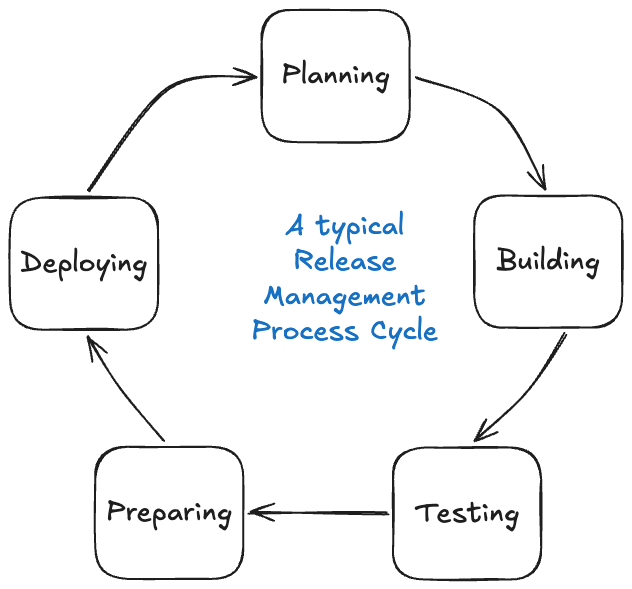
1. Continuous Change Tracking
All changes must be traceable without requiring manual compilation. Version control becomes the single source of truth. CI systems automatically generate commit history, build artifacts and deployment-linked changelogs as part of normal pipeline execution. By default, the audit trail is there.
Harness GitOps takes this a step further, using Git as the single source of truth for the state of the deployment. All configuration changes are versioned, all deployments are tracked, and drift is detected automatically.
2. Automated Quality Gates
Validation moves from presentations to execution. Quality gates run on every change: unit and integration tests, end-to-end validation, security and compliance scans, and performance checks. These are not release-window activities. They are part of the standard CI/CD pipeline, running continuously on every change that moves through.
Harness Powerful Pipelines supports multi-stage pipeline orchestration across complex environments with built-in test intelligence and conditional execution logic. Quality gates run fast and don't create unnecessary bottlenecks.
3. Policy as Code
CAB rules get codified in an automated release management model. No critical vulnerabilities before production promotion. Minimum thresholds for test coverage. Mandatory rollback procedure definitions. These policies are automatically enforced in the pipeline. Pass, and the change proceeds. Fail, and it's reliably blocked at scale, with no human bottleneck in the critical path.
That's what policy as code is all about: governance that's version-controlled, auditable and applied the same way every time.
Harness DevOps Pipeline Governance lets teams define and enforce pipeline policies in one place. Compliance is not something you check at the end. It's something the pipeline enforces throughout.
4. AI-Assisted Deployment Verification
Even with strong quality gates, production deployments carry residual risk. Test environments do not always mirror what production surfaces.
Harness AI-Assisted Deployment Verification automatically analyzes deployment health using ML to compare metrics, logs and traces against baseline behavior. When something drifts, it surfaces the signal quickly, enabling rollback before an incident escalates. This closes the loop between deployment and validation, making the pipeline genuinely self-correcting, not just self-approving.
Managing Complex, Interdependent Releases
In practice, systems rarely exist in isolation. One change can affect backend services, APIs, web apps, mobile apps and edge targets all at once. In tightly coupled systems, changes to one component can cause another to break, and partial deployments can be risky without careful coordination.
Traditional coordination uses spreadsheets, emails, and war rooms. Modern automated release management means orchestration: platforms that model service dependencies, trigger pipelines in the right order, and ensure all components pass quality gates before release. Multi-team coordination becomes a single-action, end-to-end deployment.
Harness Continuous Delivery has built-in support for orchestrated multi-service deployments with dependency mapping and conditional promotion logic. Deploy Anywhere extends this to cloud, hybrid, on-prem and edge environments without requiring separate toolchains for each target.
Harness pipelines also support canary deployments and GitOps-based progressive delivery for rollout strategies tailored to deployment risk.
Reducing Coupling Over Time
Managing interdependent releases is a good start. The goal is to reduce the coupling itself so teams can ship independently without synchronized multi-team deployments. Three practices tend to accelerate that:
- Contract testing. Services define and verify their contracts, so a change in one will not silently break others.
- Feature flags. Feature flags decouple code deployment from feature activation. Code ships continuously; features turn on when they're ready. They also act as a safety net post-deployment. If a feature causes unexpected behavior in production, it can be disabled instantly without a full rollback.
- Backward-compatible APIs. Designing for backward compatibility means downstream services do not have to be updated simultaneously with upstream changes.
Together, these patterns move teams toward the continuous delivery ideal: frequent, small, independent releases, each of which is safe on its own.
What Automated Release Management Delivers
The results of replacing CAB-driven processes with policy-driven pipelines and automated assurance are measurable:
- More velocity. Releases are continuous, not fixed to a cadence. Time to production goes from weeks to hours.
- Consistent quality. All changes go through the same validation, not just the ones that make it onto a CAB agenda.
- Less risk. Smaller incremental releases mean a smaller blast radius. Automated rollback means quicker recovery when things go wrong.
- Complete auditability. All changes, gates, policy checks and deployments are automatically documented with no manual evidence collection required.
Harness CD Visualize DevOps Data surfaces deployment frequency, change failure rates and mean time to recovery in real time. These are the DORA metrics that measure delivery health with zero instrumentation overhead.
Build Controls That Don't Slow You Down
CABs were created for a slower world, where a weekly review meeting could credibly keep up with the cadence of releases. That world is long gone for most engineering organizations today.
The takeaway here is this: automated release management doesn't remove governance. It rebuilds governance as a system that is fast, consistent, auditable and embedded directly in the delivery pipeline. The teams that move fastest aren't the ones with the loosest controls. They're the ones with controls that don't slow them down.
If you're ready to move from approval bottlenecks to automated assurance, Harness Continuous Delivery is built for exactly that.
Release Management: Frequently Asked Questions (FAQs)
What is automated release management?
Automated release management is the practice of using automated quality gates, policy enforcement and deployment orchestration to replace manual approval steps in the software release process. Rather than routing changes to a committee, the pipeline evaluates each change against predefined criteria and approves or blocks it based on objective results.
What is the difference between automated release management and a CAB process?
A CAB relies on scheduled human review to approve changes before they go into production. Automated release management takes that validation and builds it into the pipeline itself, running the same checks on every change instead of batching them for periodic review. The result is faster delivery with more consistent governance.
What are quality gates in a release pipeline?
Quality gates are automated checkpoints a change must pass before moving to the next stage. Common examples include test coverage thresholds, security scan results, and performance benchmarks. A change that fails a gate is blocked automatically, without human intervention.
What is policy as code?
Policy as code is the practice of expressing governance rules in version-controlled configuration files rather than documents or meeting agendas. The pipeline then automatically enforces those rules on every deployment, making compliance consistent and auditable by default.
What is the role of feature flags in automated release management?
Feature flags decouple code deployment from feature activation. Teams can ship code continuously without exposing unfinished features to users, and can disable a feature instantly if it causes issues in production, without triggering a full rollback.
What deployment strategies work best with automated release management?
Incremental strategies like canary deployments work well because they limit the blast radius of any given change. Paired with automated verification, the pipeline can catch problems early in the rollout and halt or roll back before they affect all users.
How does Harness support automated release management?
Harness Continuous Delivery provides end-to-end pipeline orchestration, built-in policy governance, GitOps-based change tracking, AI-assisted deployment verification, and real-time DORA metrics. It's designed to replace manual release processes with automated systems that scale across any environment.