Finding cloud waste is half the job. Harness agents turn cost recommendations into reviewable IaC pull requests and track what gets applied.

TL;DR
Today we're launching the Infrastructure Efficiency Loop, which connects Cloud Cost Intelligence to Infrastructure Deployments.
- Harness Infrastructure Deployments now shows cost-saving opportunities and accurate infrastructure costs for each workspace and resource.
- A new Infrastructure Remediation Agent turns cost and drift findings into pull requests.
- The Infrastructure Blast Radius agent scores the risk of a change before anyone approves it. People still approve and merge every change.
Cloud waste is an old problem, and AI is making it grow faster.
AI helps developers create new applications faster and brings citizen developers into the application creation process. Those applications need infrastructure. Meanwhile, test and preview environments are multiplied to keep up with change. The bill follows. Meanwhile, FinOps teams and engineering teams are both stretched thin, so the cost recommendations pile up in a backlog.
FinOps tools can identify where waste is. But infrastructure code management lives in other tools. So, to act on identified waste, someone has to file a ticket, someone else has to find and change the right Terraform configuration, and yet another expert has to judge whether the change will break production. At the speed teams ship now, that queue never clears.
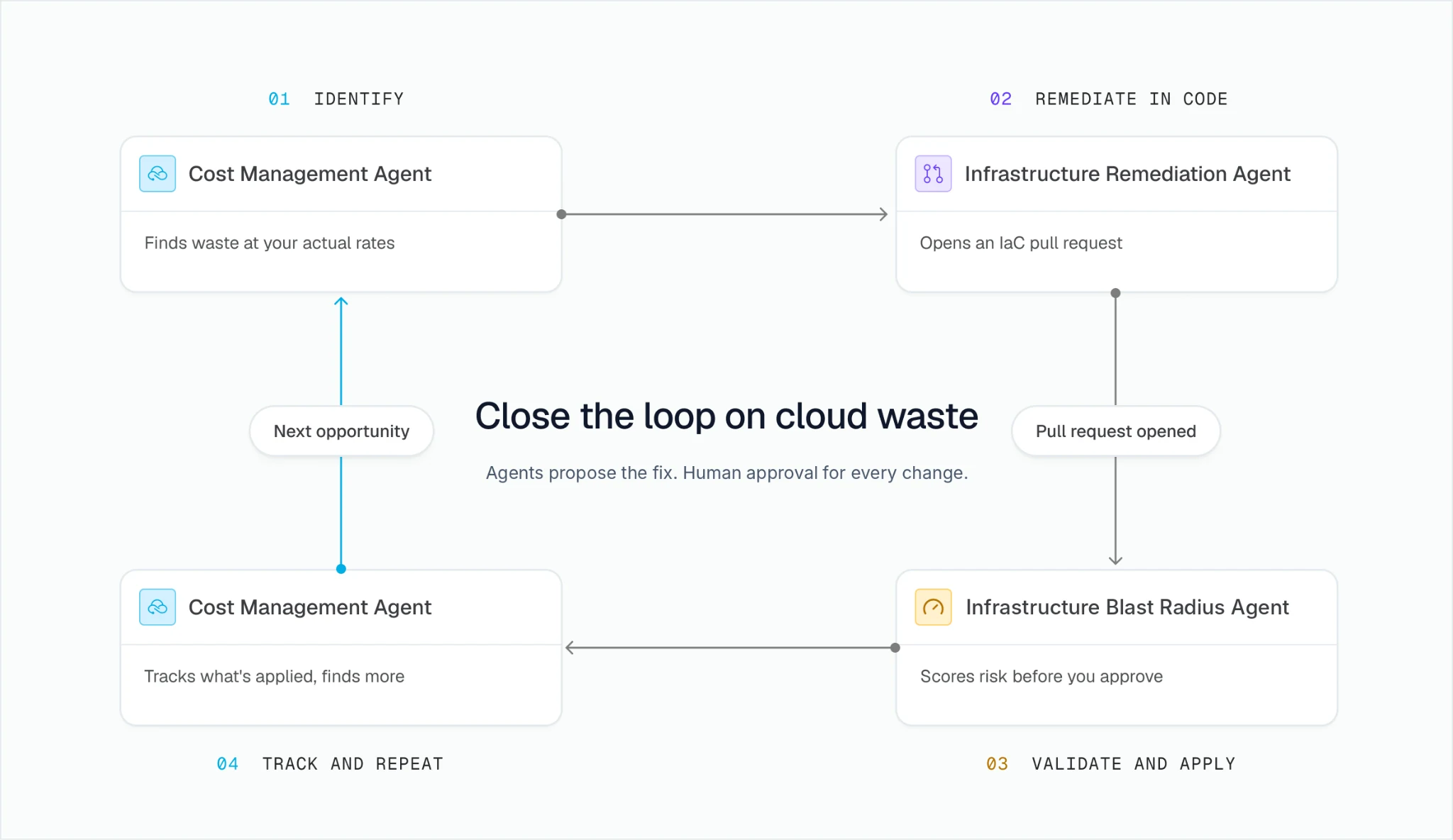
The fix is closed-loop FinOps. Today we're launching the Infrastructure Efficiency Loop, which connects cloud costs to infrastructure automation so that waste is identified, fixes are generated, risk is assessed, fixes are deployed through a governed pipeline, and monitoring identifies the next opportunity.
Know what each workspace actually costs
Harness Infrastructure Deployments already knows which resources it provisioned. The SDLC Knowledge Graph now correlates those resources with data from the Cost Management Agent. You see the cost of each workspace and resource after discounts and enterprise agreement next to the optimization opportunities for that resource.
A new Insights section in each workspace collects the findings. Today, cost optimization and drift insights are covered, but it's built to hold any insight that improves infrastructure posture. For example, we could bring security issues in here next.
Turn findings into pull requests
The Infrastructure Remediation Agent (docs) takes an insight and implements a fix. Click “Apply with Agent” on a cost or drift insight, and the agent gathers the workspace context, pulls the code, makes the change, and opens a pull request. The workspace links to the pipeline run and the PR, and an Applied section tracks past remediations.
For cost insights, that means right-sizing resources and similar changes. For drift, it means accepting an intentional console change by updating the code to match. If the console change was a mistake, you can run a provision to revert it.
Setup is a simple toggle at the project level. It creates a simple remediation pipeline for you, and you can edit that pipeline. Teams can opt specific workspaces out, such as production.
A person still reviews and merges every pull request. The agent stops at the PR.
See the blast radius before you approve
Speeding up infrastructure change raises an obvious question: what’s the risk? Infrastructure Blast Radius (docs) addresses that question inside the pipeline. Add the blast radius step after the plan to score the overall risk of the change based on the impact to each resource and its dependents.
An AI summary explains the score in plain language. In our demo, a plan that replaces S3 buckets and removes their public access blocks scores 10 out of 10.
The new dependency graph view shows every resource as a node, with its risk, upstream and downstream dependencies, and filters to focus on a single node. Drill into a node to see previous and new values, risk factors, and mitigations.
Under the hood, Infrastructure Blast Radius preprocesses the plan using node density, node type, and change type. An AI agent predicts risk for each node, and the node scores roll up into a score for the change. Today it covers the state of a single workspace. Cross-workspace dependencies are planned.
The risk score and level are available as expressions within the pipeline, allowing you to automate approvals. Require extra approvers on high-risk changes, or gate them with OPA policy. The approver sees the cost alongside the risk, making the decision informed.
How the loop runs
- The Cost Management Agent identifies a cost overrun and surfaces it in Infrastructure Deployments per workspace and resource.
- The remediation agent proposes the code change as a pull request.
- The pipeline evaluates the change. Blast radius scores the risk, cost shows beside it, and a person approves. The change applies to production.
- The Cost Management Agent watches the result and flags the next opportunity.
The Cost Management Agent has long acted on cost with capabilities like AutoStopping. This launch extends that action to changes that need a code update, and FinOps findings now apply to code instead of directly to infrastructure.
What this changes
Teams get cost findings that turn into pull requests without the ticket. They get a risk score before the change reaches production. They get code that stays in sync with the cloud footprint it describes. Expect lower cloud spend, fewer risky changes reaching production, and faster remediation.
These are the first agentic capabilities in Infrastructure Deployments. The model today is human in the loop, with people approving every change. Software factories get built loop by loop. Each loop senses a signal in production, turns it into a change, checks the change, and delivers it. Cosmos starts with loops for code review, ticket to pull request, vulnerability remediation, and incident response. Cloud efficiency is another one. The Infrastructure Efficiency Loop senses cost and drift, proposes the fix as a pull request, scores the risk, and leaves the merge to a person. The signal comes from the cloud bill instead of the backlog.
To try it, open a workspace in Infrastructure Deployments and look at the new Insights section. Learn more here.