Blog
Harness Platform

Harness Recognized as a Leader in The Forrester Wave™: DevOps Platforms, Q2 2025 | Harness Blog

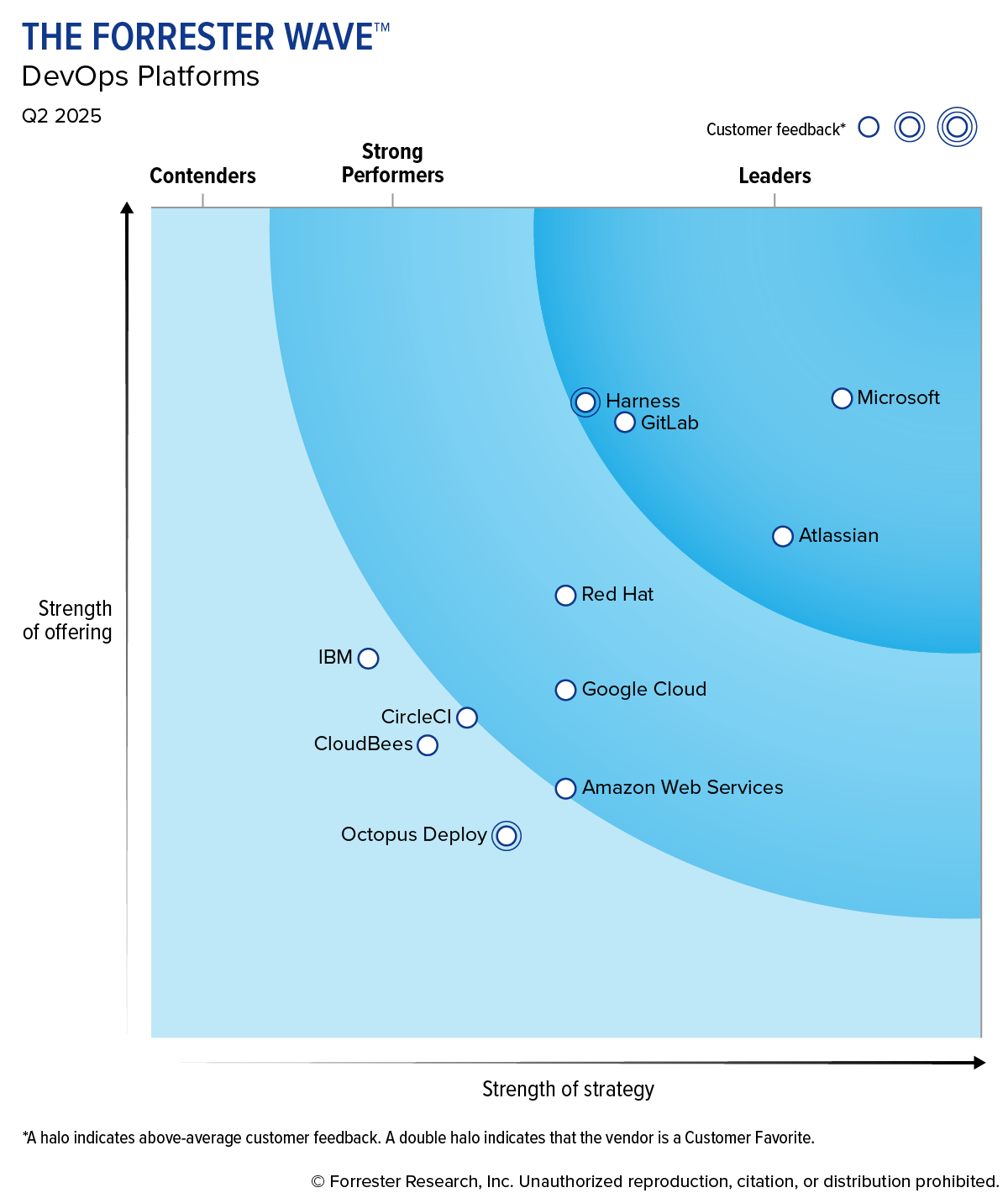
Harness is named a Leader in The Forrester Wave™: DevOps Platforms, Q2 2025 - recognizing our AI-driven vision to reduce engineering toil in the entire SLDC

TL;DR

Harness has been named a Leader in The Forrester Wave™: DevOps Platforms, Q2 2025, recognized for its AI-first vision, innovation, and strong DevOps capabilities. With top scores in AI infusion, deployment automation, and customer experience, Harness is redefining the future of DevOps through intelligent automation and customer-centric design.

AI-Driven Innovation Leading the Future of DevOps

We're honored to announce that Harness has been named a Leader in The Forrester Wave™: DevOps Platforms, Q2 2025. We believe recognition reflects our vision that artificial intelligence is fundamental to the future of DevOps platforms and our commitment to reducing toil for engineers across the entire software development lifecycle.
__wf_reserved_inherit
Access the full report

AI as the Foundation of Modern DevOps

At Harness, we understand that a key differentiator for DevOps platforms going forward is how AI eliminates toil and eases cognitive load for developers, platform engineers, and SREs. 

Harness received the highest scores possible in the “AI Infusion”, “Innovation”, and “Vision ”criteria. Harness has been moving quickly in the right direction.

Forrester's evaluation noted that "A vision of AI throughout the SDLC, a focus on security, and cloud cost self-service tools bring a strong mix of business value and developer experience." This aligns perfectly with our philosophy that AI shouldn't just be an add-on feature—it should be woven throughout every aspect of the development and delivery process for velocity, efficiency, reliability, and security.

Excellence Beyond AI: Proven DevOps Capabilities

While we believe our AI innovation sets us apart, Harness also excels in traditional DevOps capabilities. We received the highest score possible in deployment automation criterion, reflecting, in our opinion, our robust and mature approach to continuous delivery. Our platform provides deep out-of-the-box support for deployment strategies, intelligent handling of failures, detection of problematic deployments and AI-powered rollbacks.

Additionally, we achieved the top score in the data, analytics and reporting criteria, providing our users with superior capabilities to track developer efficiency, compare cloud costs, and create custom dashboards for a wide variety of personas. These capabilities help platform teams continuously improve and make data-driven decisions about their DevOps practices.

Customer-Centric Approach That Drives Success

What perhaps matters most to us is how our customers experience working with Harness. Forrester's research found that "Customers felt they got the excellent attention they needed and had more influence on the roadmap than they might have had with a larger vendor. Even smaller-sized organizations appreciated having direct access to the CEO."

We believe this feedback reflects our core belief that great technology is only as good as the partnerships we build with our customers. We're committed to providing not just innovative tools, but also the support and collaboration that helps our customers succeed in their DevOps transformation.

“Harness has been a great partner in our DevOps journey,” said Steve Day, CTO of National Australia Bank (NAB). “Their team moves fast, listens closely, and delivers real value. We’ve always seen them as a leader in this space, and it’s great to see that reflected in Forrester’s latest Wave.”

Looking Forward: Honored and Just Getting Started

We're deeply grateful to the customers who have put their trust in us and continue to share their feedback, helping us build a platform that truly serves the needs of modern engineering teams. Being named a Leader in the Forrester Wave for the first time is an incredible honor, and it's just the beginning.

As we continue to push the boundaries of what's possible with AI-driven DevOps, we remain committed to our founding principles: reducing complexity, eliminating toil, and empowering engineers to deliver software faster and more reliably than ever before.

To our customers, partners, and the broader DevOps community: thank you for being part of this journey. We're just getting started.

Access the full report

Forrester does not endorse any company, product, brand, or service included in its research publications and does not advise any person to select the products or services of any company or brand based on the ratings included in such publications. Information is based on the best available resources. Opinions reflect judgment at the time and are subject to change. For more information, read about Forrester’s objectivity here .

Contact a Harness expert

← Previous:
Next: →

Related Resources

Top Open Source Software Deployment Tools in 2025

Continuous Delivery & GitOps

Top Open Source Software Deployment Tools in 2025

August 7, 2025

Eric Minick

+ more
Time to Read

Choosing the right tool for automating software deployment is a critical decision for any engineering team. While proprietary software offers a managed, out-of-the-box experience, many organizations find themselves drawn to the power and flexibility of the open-source ecosystem.

Open source deployment software gives you direct control over your pipelines and the freedom to innovate without being tied to a vendor's roadmap. This guide will explore the most 11impactful open source software deploy tools today. We'll examine their different philosophies and strengths, and help you build a deployment strategy that is both powerful and pragmatic.

Understanding Open Source Deployment Tools

At its core, a deployment tool automates getting your software into a runtime environment - typically from an artifact registry of some sort. Open source deployment tools make the source code for this process available for you to inspect, modify, and extend.

The primary benefit is this freedom to tailor the tool to your exact needs. This can lead to lower direct costs and a vibrant community you can lean on for support. However, this trade-off means investing your team's time into the setup, maintenance, and scaling of the solution. Understanding that balance is key.

Top Open Source Software Deployment Tools in 2025

The world of open source deployment is rich with options, but a few key players represent the major approaches and philosophies you'll encounter.

Jenkins: The Old Man

It’s impossible to talk about CI/CD without mentioning Jenkins. It’s one of the most established and widely used open-source automation servers. Many teams began their automation journey using Jenkins to build their code and naturally extended it to handle deployments.

  • What it is: A CI/build tool at its heart.
  • Strengths: An enormous plugin ecosystem means Jenkins can be configured to do almost anything. If you can script it, Jenkins can run it.
  • Weaknesses: Jenkins wasn't purpose-built for modern, declarative deployments. Managing deployment pipelines through a maze of plugins and custom Groovy scripts can become brittle and complex, especially at scale. It lacks the native understanding of cloud-native targets like Kubernetes that newer tools possess.

Spinnaker: The Multi-Cloud CD Platform

Born at Netflix, Spinnaker is a heavyweight contender designed for large-scale, multi-cloud continuous delivery. It’s built on a pipeline-first model for deploying to cloud providers like AWS, GCP, and Azure.

  • What it is: An open-source, multi-cloud deployment platform prioritizing immutable images.
  • Strengths: Spinnaker excels at creating sophisticated deployment pipelines that include advanced strategies like canary releases and blue/green deployments out of the box. Its multi-cloud abstractions are incredibly powerful for organizations managing a diverse infrastructure footprint.
  • Weaknesses: With great power comes great complexity. Spinnaker is notoriously difficult to set up, manage, and operate. It requires significant dedicated resources and expertise, making it a better fit for large enterprises than for smaller teams. It was originally built for deploying VM images, as Kubernetes has become more prevalent its relevance has declined. 

Flux: The GitOps Pioneer

Flux is a lightweight GitOps tool that lives inside your Kubernetes cluster. It was one of the first projects to champion the idea that your Git repository should be the single source of truth for your cluster's state.

  • What it is: A continuous and progressive delivery solution for Kubernetes.
  • Strengths: Its lightweight, Git-centric model is powerful. By watching your image registry and Git repository, Flux automates deployment updates simply and effectively.
  • Weaknesses: Flux is laser-focused on Kubernetes. If you need to deploy to other targets—like virtual machines or serverless functions—you'll need to look elsewhere. It primarily handles the "deployment" part and doesn't offer broader pipeline orchestration or governance features.

Argo CD: The Declarative Deployment Engine

Like Flux, Argo CD is a declarative, GitOps-style tool for Kubernetes. It has gained immense popularity for its intuitive user interface and clear visualization of the application state.

  • What it is: A declarative continuous delivery tool for Kubernetes.
  • Strengths: Argo CD excels at visualizing the state of your cluster and how it compares to what's defined in Git. This makes it incredibly easy for developers to see if their deployments were successful and to roll back if necessary.
  • Weaknesses: That focus is also its main limitation. Argo CD is a fantastic deployment engine, but it's just one piece of the puzzle. It doesn't handle CI, governance, verification, or advanced deployment strategies like automated canary analysis on its own. It needs help with pipelining, and a recent companion open-source project named Kargo has been added to provide a deployment pipeline. The project is promising, but it’s still early.

Harness CD Community Edition: The Pipeline-Centric Approach

Harness offers a source-available, open-source version of its powerful Continuous Delivery platform. It provides a more holistic, pipeline-centric view of deployment that goes beyond simple synchronization.

  • What it is: An open-source, pipeline-as-code CI/CD platform.
  • Strengths: Harness CD Community Edition provides a visual pipeline builder alongside a powerful pipeline-as-code YAML experience. It has a built-in concept of environments, services, and infrastructure, providing more structure than script-based tools. It's designed to be a robust CI/CD foundation with a clear path to more advanced capabilities.
  • Weaknesses: As a self-managed solution, it requires you to run and maintain the platform yourself. The most advanced enterprise features, like AI-powered deployment verification and granular governance, are reserved for the commercial version.

Bridging the Gap: Combining Open Source with Commercial Power

This is where the strategic choices get interesting. The most effective deployment setups often don't rely on a single tool but instead combine the strengths of open source with the enterprise-grade features of a commercial platform.

Tools like Argo CD are good at their core task of moving the bits. But modern software delivery is more than just kubectl apply. You need to consider:

  • Governance and Compliance: Who can deploy what, and when? Do things need to be security-scanned or tested before release? How do you enforce security policies and track that everything was done for audits?
  • Advanced Orchestration: How do you coordinate deployments across multiple teams, environments, and Argo CD instances?
  • Intelligent Verification: How can you automatically verify that a new deployment is healthy using metrics from tools like Prometheus or Datadog, and then automatically roll back if it's not?

This is where a full continuous delivery tool like the Harness CD comes in. Harness embraces open source. You can use Harness as a control plane that integrates directly with tools like Argo CD or Flux. Let Argo handle the GitOps synchronization while Harness orchestrates the end-to-end pipeline - enforcing governance, running automated verification, and providing a unified view of your entire software delivery lifecycle. It's the classic "best of both worlds" scenario.

Choosing the Right Open Source Deployment Tool

So, how do you decide? Start by assessing your team's reality.

  1. Evaluate Your Target Environment: Are you 100% Kubernetes, or do you have a mix of VMs, serverless, and other targets? A Kubernetes-native tool won't be enough for a hybrid environment.
  2. Consider Your Team's Scale and Expertise: Is your team prepared to manage the complexity of a platform like Spinnaker, or is a simpler tool like Flux a better fit?
  3. Think Beyond Deployment: Do you just need to get code into production, or do you need a full-fledged continuous delivery pipeline with robust governance, security, and verification?

The best approach is often incremental. Start with a powerful open-source engine that fits your immediate needs. As your requirements for governance and orchestration grow, integrate it into a broader platform like Harness. This allows you to maintain the flexibility of open source while gaining the enterprise-grade capabilities you need to scale securely and efficiently.

Get Started

Get Started with Harness AI

Try the full platform free. No module restrictions, no credit card.

Harness Team
Harness
Harness delivers intelligent AI automation, so your team ships code faster, safer, and smarter.
harness-team
Harness Team
https://www.linkedin.com/company/harnessinc/