Java SE, Jakarta EE, and Spring Boot have converged more than most teams realize. A 2026 guide to choosing — and standardizing — your enterprise Java stack.

- The "Java EE vs Java SE" framing is dated. In 2026, every modern enterprise Java app runs on Java SE 21 or 25 LTS. The real decision is which framework or runtime sits on top — Spring Boot, Quarkus, Helidon, Micronaut, or vanilla Jakarta EE on Open Liberty, Payara, or WildFly.
- The javax.* → jakarta.* namespace migration is the upgrade gate most teams are still working through. Jakarta EE 9 (2020) renamed every package. Spring Boot 3 and 4 require the new namespace. Any framework or library jump in 2026 has to reckon with it.
- The "heavyweight app server" critique no longer applies to the runtimes anyone is choosing. Quarkus, Helidon, and Open Liberty's lightweight profiles compile to native images, start in tens of milliseconds, and run in under 100 MB — competitive with Go and Node on cold-start and footprint.
- Standardizing delivery velocity matters more than framework preference. Mixed Java fleets (Spring Boot + Quarkus + legacy Jakarta EE) are the norm. AI-powered CD, GitOps, and policy-as-code give platform teams a single operational model across all of them, without forcing framework consolidation.
When you're architecting an enterprise Java application, one decision quietly shapes everything downstream: runtime footprint, deployment pipelines, and how your platform team handles incidents at 3 a.m. For two decades, that decision was framed as Java SE vs Java EE. In 2026, that framing has quietly inverted.
Nearly every modern enterprise Java app runs on Java SE 21 or 25 LTS. The real choice now sits one layer up: which framework or runtime sits on top of the JVM. Spring Boot. Quarkus. Helidon. Micronaut. Vanilla Jakarta EE on Open Liberty, Payara, or WildFly. These options have converged on the same underlying APIs. Spring Boot 3 and 4 sit on jakarta.* packages, the same namespace Jakarta EE itself uses. But they differ sharply in startup time, memory footprint, deployment topology, and what your CI/CD pipeline has to do to ship them safely.
This guide is for the platform engineer, architect, or staff engineer who needs to make that call once and live with it across dozens of services. We'll cover what changed, where the stacks still diverge, and how to standardize delivery across a mixed Java fleet without forcing consolidation no team wants.
What is Java SE?
Java SE (Standard Edition) is the foundation of every Java application, from a five-line script to a globally distributed system. It's the language, the runtime, and the core libraries every Java program assumes is there.
But describing Java SE as just "the foundation" undersells what's happened to it in the last three years. Java SE in 2026 is not the Java SE of 2018.
What Java SE provides
At its core, Java SE includes:
- The Java language itself, including modern features like records, sealed classes, pattern matching, and switch expressions
- The JVM, which gives you platform independence and decades of mature garbage collection, JIT compilation, and observability tooling
- Core libraries for collections, concurrency, file I/O, networking, and HTTP
- Build and dev tools: javac, jshell, jpackage, and the AOT cache introduced in recent LTS releases
These pieces form the runtime baseline that every Java framework, including Spring Boot, Quarkus, and Jakarta EE implementations, sits on top of.
What's new in Java SE that actually matters
If you've been away from the platform for a few years, four changes are worth knowing about before you make any architectural decisions:
Virtual threads (stable in Java 21). Project Loom collapsed the cost of a thread from megabytes of stack to a few hundred bytes. A single JVM can now run millions of concurrent virtual threads. This is the biggest concurrency change in Java's history and it removes the main argument for reactive frameworks like WebFlux on most workloads. Blocking code is fast again.
AOT compilation and native images. GraalVM native image and the JDK's own ahead-of-time caching turn Java apps into binaries that start in tens of milliseconds and use a fraction of the memory of a warm JVM. This used to be a Quarkus or Micronaut differentiator. It's now table stakes across the ecosystem, including Spring Boot 3+.
Records, sealed classes, and pattern matching. The boilerplate that used to push teams toward Lombok or Kotlin is mostly gone. Data-oriented programming in modern Java looks closer to Scala or Kotlin than to Java 8.
Java 25 LTS performance work. Compact object headers shrink object overhead by roughly 22% on heap-heavy workloads. The G1 garbage collector got a redesigned card table in Java 26 that delivers measurable throughput gains on reference-heavy code.
What Java SE doesn't give you
Plain Java SE is honest about its scope. It does not give you:
- A web server or HTTP routing layer
- Dependency injection
- Database access beyond raw JDBC
- Transaction management
- Security, authentication, or authorization frameworks
- A configuration system
You can build all of these by hand. Almost no one does. In practice, "I'm using Java SE" in 2026 means "I'm using Java SE plus a framework that supplies the missing pieces." That framework is the actual decision, which is where the rest of this guide focuses.
What is Jakarta EE? (Formerly Java EE)
Jakarta EE is the modern successor to Java EE, the standardized set of APIs and specifications for building enterprise-scale Java applications. If you wrote enterprise Java between 2000 and 2017, you wrote Java EE. Everything since 2018 is Jakarta EE.
The name change wasn't cosmetic. It came with a migration that every Java team upgrading in 2026 still has to plan for.
What changed: Java EE became Jakarta EE
Oracle transferred Java EE to the Eclipse Foundation in 2017. The platform was renamed Jakarta EE because Oracle retained the "Java" trademark. Java EE 8 (2017) was the last release under the old name. Jakarta EE 8 (2019) was the same platform under new governance.
Then came the breaking change. Starting with Jakarta EE 9 (2020), every package was renamed from javax.* to jakarta.*. An import that used to read import javax.persistence.Entity now reads import jakarta.persistence.Entity. The change was mechanical, but it touched every file in every Jakarta EE codebase on the planet, and it forced every framework that depended on those APIs to publish a major-version break.
This is why Spring Boot 3 (late 2022) was a hard upgrade. Spring Boot 3 dropped javax.* and adopted jakarta.*. Any Spring Boot 2.x application moving to 3.x or 4.x has to migrate the namespace. Tools like Eclipse Transformer and OpenRewrite automate most of it, but the migration is still the gating event for many platform upgrades happening in 2026.
What Jakarta EE provides today
Jakarta EE 11, released in 2025, is the current stable platform. Jakarta EE 12 is in development. The headline specifications most teams interact with are:
- CDI (Contexts and Dependency Injection), the dependency injection container at the center of every modern Jakarta EE app. CDI replaced EJB as the default DI mechanism years ago. EJB still exists but is largely a legacy concern.
- Jakarta Persistence (JPA) for ORM and database access
- Jakarta REST (JAX-RS) for REST endpoints
- Jakarta Servlet and WebSocket for HTTP and bidirectional communication
- Jakarta Data, new in Jakarta EE 11. A standardized repository pattern, similar in feel to Spring Data, that simplifies persistence access
- Jakarta Concurrency, updated in Jakarta EE 11 with first-class virtual thread support
- Jakarta Messaging (JMS), Jakarta Transactions (JTA), Jakarta Security, Jakarta Validation, and Jakarta Batch for the rest of the platform
If you're a Spring developer, several of these will look familiar. That's not coincidence. Spring's annotations and patterns shaped Jakarta EE's modernization, and Jakarta EE's specifications now define the underlying APIs Spring builds on. The two ecosystems converged.
Jakarta EE Core Profile: the cloud-native subset
A common objection to Jakarta EE is that it's too heavy for microservices. Jakarta EE 10 answered this directly with the Core Profile: a minimal subset of specifications (CDI Lite, JAX-RS, JSON-P, JSON-B, Annotations, Interceptors, Dependency Injection) explicitly designed for lightweight cloud-native runtimes and AOT compilation.
The Core Profile is what runtimes like Quarkus implement when they want Jakarta EE compatibility without the full platform's footprint. It's the answer to "Jakarta EE doesn't fit in a container." It does. The original critique was about WebSphere and WebLogic, not about Jakarta EE the specification.
Modern Jakarta EE runtimes
In 2026, picking Jakarta EE doesn't mean picking a multi-gigabyte application server. The runtimes teams actually choose are:
- Quarkus (Red Hat). Compiles to GraalVM native images. Cold start under 50 ms, memory footprint under 50 MB. Built for containers, serverless, and Kubernetes from day one.
- Helidon (Oracle). Available in two flavors: Helidon SE (reactive, lightweight) and Helidon MP (full MicroProfile and Jakarta EE). Native image support.
- Open Liberty (IBM). Modular runtime where you load only the features you need. The lightweight profile is competitive with Spring Boot on memory.
- Payara Micro and Payara Server. The successor to GlassFish, with strong support for incremental modernization of legacy Java EE workloads.
- WildFly (Red Hat). The community upstream of JBoss EAP. Suitable for both traditional app server deployments and bootable JAR packaging.
The legacy "heavyweight Java EE" stereotype belongs to WebSphere full profile and WebLogic. Those are real products with real footprints, but in 2026 they're an active migration target, not a forward choice for new development.
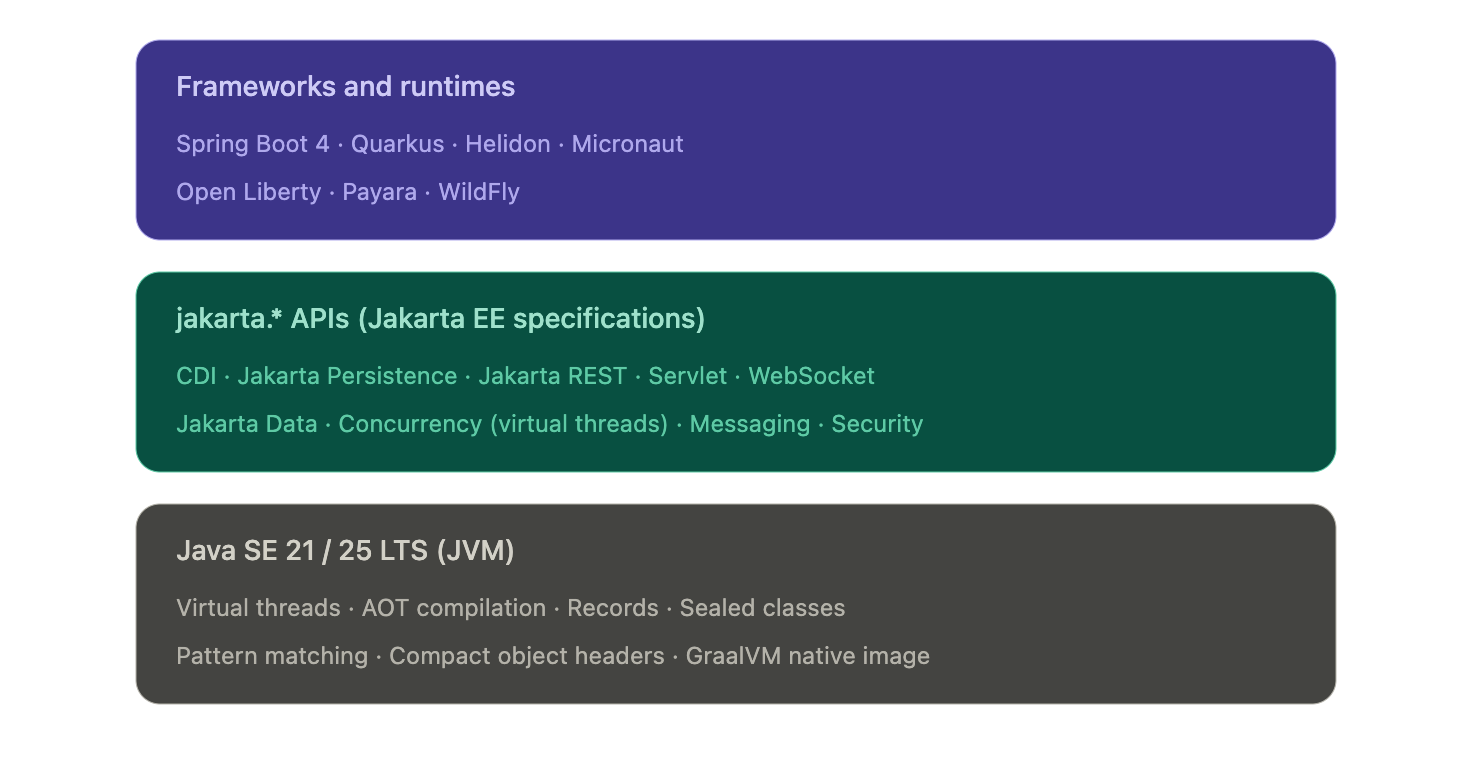
Figure: Modern enterprise Java is a layered stack. Frameworks and runtimes pick their packaging and opinions, but they all sit on the same jakarta.* API surface and the same JVM.
Where the modern Java stacks actually differ
- The honest answer to "Spring Boot vs Jakarta EE" in 2026 is that they differ less than they used to and more than the convergence story implies. The two questions worth separating are: what's actually shared now, and where does the choice still change your life as a platform engineer.
- What's converged (no longer a real differentiator)
- Three things used to be on every Java EE vs Spring comparison and aren't anymore:
- The API surface. Spring Boot 3 and 4 use the same jakarta.* packages Jakarta EE itself defines. A Servlet is a Servlet. A @PersistenceContext is a @PersistenceContext. The annotations and types your business logic touches are the same on both stacks.
- Concurrency model. Virtual threads (Java 21) work identically under any framework. Both Spring Boot and Jakarta EE Concurrency expose virtual-thread executors. The reactive-or-blocking debate that defined the last five years has largely collapsed for typical CRUD services.
- Native compilation. GraalVM native image works for Spring Boot (via Spring AOT), Quarkus, Helidon, Micronaut, and most Jakarta EE runtimes. Cold-start under 100 ms and memory under 100 MB are no longer Quarkus differentiators. They're available on every modern stack with varying degrees of polish.
- If a comparison article tells you the choice between Spring Boot and Jakarta EE comes down to APIs, threading, or native compilation, it's working from a 2020 mental model.
- Where the stacks still diverge
- Four areas actually shape your platform team's day-to-day:
- Packaging and deployment. Spring Boot's fat-JAR plus embedded Tomcat or Netty is the assumed baseline across most of the industry. Quarkus and Helidon SE produce equally simple bootable JARs but lean harder on native images for cold-start-sensitive workloads. Open Liberty, Payara, and WildFly support deployable WAR or EAR archives onto a runtime, which still matters in regulated environments where the runtime is provisioned and audited separately from the application.
- Startup and memory profile. This is where the real numbers diverge. A typical Spring Boot service on the JVM starts in 2 to 5 seconds and runs in 200 to 400 MB. Quarkus on the JVM lands closer to 1 second and 150 MB. Quarkus or Helidon as a native binary starts in 30 to 80 ms and runs in 30 to 80 MB. If you're scaling to zero, running on edge nodes, or paying per-millisecond on a serverless platform, that gap is the entire reason to look beyond Spring Boot.
- Configuration philosophy. Spring Boot leans hard on auto-configuration: pull in a starter, get sane defaults, override what you need. Jakarta EE leans harder on explicit declaration through CDI and standard configuration sources. Neither is objectively better, but they shape how readable a 50-service codebase is to a new hire. Spring Boot wins on initial productivity. Jakarta EE wins on "what is this service actually doing" once the codebase has aged for three years.
- Ecosystem and hiring. Spring Boot has the larger community, the larger Stack Overflow corpus, and the deeper integration library ecosystem. For most enterprise teams, that gravity is the dominant factor. Jakarta EE runtimes and Quarkus, Helidon, and Micronaut all have first-class documentation, but the available talent pool is meaningfully smaller. This is a delivery risk, not a technology risk, and it's worth treating it as one.
- The honest framing for a platform team in 2026: pick the stack whose packaging, runtime profile, and ecosystem maturity match your actual workload. Don't pick based on philosophical preferences for "standards" or "convention over configuration." Those debates were settled in the convergence.
From convergence to choice: what actually drives the decision in 2026
By this point in the article, the framing should be obvious: Spring Boot, Quarkus, Helidon, Micronaut, and vanilla Jakarta EE on Open Liberty or Payara are not five different platforms. They're five different opinions sitting on the same jakarta.* APIs and the same JVM. So how do teams actually decide?
In practice, four signals do most of the work.
Signal 1: What does the rest of your fleet run?
The single biggest predictor of which stack a new service uses is which stack the team's other services already use. This is not laziness. It's a sound platform decision. Two services on the same framework share build tooling, base container images, observability libraries, configuration patterns, deployment templates, and on-call runbooks. A team running 40 Spring Boot services will pay a real operational tax to introduce a Quarkus service, even if Quarkus is technically the better fit for that one workload.
The exception is when the new workload has a specific profile that the existing stack genuinely can't serve well. A Spring Boot shop building one event-driven function that needs to scale to zero on AWS Lambda has a legitimate reason to reach for Quarkus or a native Spring Boot image. A Jakarta EE shop building one async data-processing service has a legitimate reason to reach for Spring Boot's mature integration ecosystem. The decision rule is not "best tool for the job in isolation," it's "best tool given what we already operate."
Signal 2: What's the deployment target?
The deployment target matters more than most architecture discussions admit. Three patterns dominate:
- Long-running services on Kubernetes or VMs. Any framework works. Spring Boot is the path of least resistance because the ecosystem assumes it. Quarkus, Helidon, and Open Liberty's lightweight profiles are competitive on the JVM and pull ahead on memory.
- Serverless and scale-to-zero. Cold start is the dominant cost. Native compilation moves from a nice-to-have to a requirement. Quarkus native and Spring Boot native are the realistic options. Helidon SE native is competitive.
- Traditional application servers. If the deployment target is an existing WebLogic or WebSphere environment, the question isn't which framework to adopt. The question is whether to keep deploying onto that runtime (Open Liberty and Payara are the modernization paths) or to refactor toward a JAR-based deployment model.
Signal 3: What's the team's reactive vs imperative bias?
Five years ago, this was a religious debate. Virtual threads have mostly settled it for new code. But existing services that are already reactive don't get a free migration, and teams that have built fluency with Project Reactor, RxJava, or Mutiny will keep getting value from those investments.
The practical guidance:
- New service, no existing reactive code, typical CRUD or RPC workload: write imperative code on virtual threads. Spring Boot or Jakarta EE either way.
- New service, high-fan-out integration or backpressure-sensitive streaming: reactive still wins. Spring WebFlux or Quarkus with Mutiny.
- Existing reactive codebase: do not migrate to imperative just because virtual threads exist. The migration cost is real. The benefit is marginal for code that already works.
Signal 4: How much governance do you need?
This is the question that quietly distinguishes Jakarta EE from Spring Boot in regulated environments. Jakarta EE is a specification with multiple compatible implementations. A regulated bank or insurer can require "any Jakarta EE 11 compatible runtime" in a procurement document and have meaningful vendor portability. Spring Boot is a single implementation, governed by VMware. That's fine for most teams. It's a real consideration for organizations with compliance requirements around vendor lock-in.
Quarkus, Helidon, and Open Liberty all sit on the Jakarta EE side of this line because they implement Jakarta EE specifications. Spring Boot does not, despite using jakarta.* packages. The distinction matters less than it used to, but it has not gone away.
The takeaway
The convergence at the API layer means most teams can pick any of these stacks and ship perfectly good software. The choice is no longer a technology bet. It's a fit-to-fleet, fit-to-deployment-target, and fit-to-governance-model decision. The teams that get this wrong are the ones still litigating it as a technology choice.
Why your stack choice shapes reliability and AI SRE
Stack choice does not end at deployment. It shapes how your services emit telemetry, how incidents propagate, and how quickly your platform team can pin down the root cause when something breaks at 2 a.m. The convergence story makes parts of this easier (shared APIs mean shared observability standards) and parts of it harder (mixed fleets mean more surface area for incidents to hide in).
Three operational realities worth thinking through.
1. Mixed fleets are the norm, not the exception
The 2026 platform team rarely operates a single-framework fleet. Most enterprise Java estates look like this: a long tail of Spring Boot services, a growing edge of Quarkus or native-compiled services for cold-start-sensitive workloads, and a stable core of older Jakarta EE applications running on Open Liberty, Payara, or WildFly. Sometimes a few WebLogic or WebSphere systems are still in active modernization.
This mix is fine. It reflects real organizational decisions made over time. But it means your reliability strategy cannot assume framework homogeneity. Health endpoint conventions, log formats, metric names, and tracing instrumentation differ across these stacks unless you actively unify them. The teams that struggle most with incident response are the ones who let each service team pick its own conventions.
2. Observability standards have converged. Implementations have not.
OpenTelemetry has become the cross-stack standard for traces, metrics, and logs in enterprise Java. Spring Boot, Quarkus, Helidon, Micronaut, and most Jakarta EE runtimes all ship with OpenTelemetry instrumentation either built-in or one dependency away. This is genuinely good news for platform teams.
The catch: standardization at the protocol layer does not give you standardization at the convention layer. Two services emitting OpenTelemetry traces can still tag spans with completely different attribute names. Two services emitting metrics can still use different naming conventions for the same operation. AI SRE platforms perform best when the signals they ingest are semantically consistent. That consistency is a platform-engineering decision, not a framework decision.
The practical guidance: pick a single OpenTelemetry semantic convention (the OTel HTTP and database conventions are reasonable defaults) and enforce it across stacks through your shared observability libraries. The framework choice does not matter as much as whether you've made the convention choice at all.
3. Cold-start patterns differ enough to change incident behavior
A typical Spring Boot service on the JVM takes 2 to 5 seconds to start, hits steady-state CPU and memory after another 30 to 60 seconds of JIT warmup, and produces meaningful traces and metrics throughout. A Quarkus native binary starts in under 100 milliseconds and reaches steady state immediately. These are different operational profiles. They produce different incident patterns.
Spring Boot deployments tend to fail visibly during startup or warmup. Native deployments tend to fail at build time or never. Spring Boot scaling events are slower and more forgiving. Native scaling events are faster but more brittle when something is wrong with the binary itself. AI SRE platforms detect anomalies based on baselines, and your baselines should reflect the runtime profile of the service being monitored. A 3-second startup that is normal for a JVM service is a critical anomaly for a native service.
Where AI-driven reliability earns its keep
This is where AI SRE platforms like Harness AI SRE become operationally meaningful. In a single-framework fleet, a senior SRE can mostly hold the operational model in their head. In a mixed fleet of 50 to 500 services across Spring Boot, Quarkus, and legacy Jakarta EE, no human can. The questions AI SRE answers well are exactly the questions mixed-fleet teams ask:
- Which of these 12 simultaneous alerts are symptoms of the same root cause?
- Is this latency spike on Service A correlated with the deployment of Service B 40 minutes ago?
- Has this service's startup pattern drifted from its historical baseline in a way that predicts a future outage?
- Across this fleet, which services share the dependency that just got a critical CVE?
These questions are tractable for AI when the underlying telemetry is consistent. They are intractable for humans regardless of telemetry quality. That's the operational case for treating AI SRE as platform infrastructure rather than as a tool individual teams adopt.
The framework choice shapes the data. The platform decision is what you do with it.
See how Harness AI SRE correlates incidents across mixed Java fleets.
Framework decision matrix: which stack fits which workload
The honest answer to "which Java stack should we use" depends on what you're building, what you already operate, and what your deployment target looks like. The matrix below is opinionated and concrete. Use it as a starting point, not a final answer.
Spring Boot
Choose when:
- Your team already runs Spring Boot. The hiring pool, ecosystem, and shared platform tooling pay for themselves several times over.
- You need the broadest integration library coverage. Spring Data, Spring Security, Spring Cloud, and the surrounding ecosystem are deeper than any Jakarta EE alternative.
- You want a single mainstream choice that any senior Java engineer will recognize on day one.
- You need a mature reactive option for backpressure-sensitive or very high fan-out workloads (Spring WebFlux).
Avoid when:
- Cold-start time is your dominant cost and you don't want to take on Spring Boot AOT and native image build complexity.
- Procurement requires multi-vendor specification compatibility. Spring Boot is a single VMware-governed implementation.
Current version baseline: Spring Boot 4.0 (released late 2025), running on Java 21 or 25 LTS. Spring Boot 3.x remains a reasonable choice for teams not ready to upgrade Spring Framework to 7.
Quarkus
Choose when:
- You're deploying to serverless, edge, or scale-to-zero environments where cold start and memory footprint are the dominant operational costs.
- Native image is a first-class concern, not an afterthought. Quarkus was designed around it.
- You want Jakarta EE compatibility with cloud-native packaging and a developer experience optimized for fast feedback loops (live reload, dev services).
- You're greenfield or building a clearly-bounded subset of services where the team can absorb the smaller talent pool.
Avoid when:
- The team has no existing Quarkus expertise and the workload doesn't actually need native compilation. The startup-time gains on the JVM are real but marginal compared to the hiring cost.
- You're deeply invested in Spring-specific libraries (Spring Cloud, Spring Data's full feature set). Quarkus has equivalents for most things, but the migration cost is real.
Helidon
Choose when:
- You're an Oracle-aligned shop or run on Oracle Cloud Infrastructure. Helidon is well-supported there.
- You want a clear choice between a reactive flavor (Helidon SE) and a full Jakarta EE / MicroProfile flavor (Helidon MP) inside the same product family.
- You need native image support backed by an enterprise vendor.
Avoid when:
- You're not in an Oracle-leaning environment. The community and ecosystem around Helidon are smaller than Quarkus or Spring Boot, and the network effects matter.
Micronaut
Choose when:
- You want compile-time dependency injection to avoid reflection overhead and improve startup time on the JVM, without committing to a native image build.
- You're building polyglot teams across Java, Kotlin, and Groovy and want consistent ergonomics.
- You like the architectural opinions: ahead-of-time everything, no runtime classpath scanning, fast cold start without GraalVM as a hard requirement.
Avoid when:
- You need a deep ecosystem of integration libraries on day one. Micronaut's ecosystem is solid but smaller than Spring's.
Vanilla Jakarta EE on Open Liberty, Payara, or WildFly
Choose when:
- You have existing Java EE applications you're modernizing incrementally. These runtimes support the deployable WAR or EAR model and let you upgrade Java versions and Jakarta EE versions without rewriting deployment topology.
- Procurement or compliance requires multi-vendor specification compatibility. "Any Jakarta EE 11 compatible runtime" is a meaningful procurement clause. "Spring Boot 4" is not.
- You want long-term stability over framework innovation. Jakarta EE specifications evolve more slowly and with stronger backwards compatibility guarantees than Spring Boot.
- Your operations team is already proficient with one of these runtimes and the cost of switching outweighs the benefit.
Avoid when:
- You're greenfield with no Jakarta EE legacy. The other options on this list will move faster.
A note on legacy WebSphere and WebLogic
Neither of these is a forward choice in 2026. Both are real products with real production footprints, but new development on them is rare outside very specific enterprise circumstances. If you're running WebSphere full profile or WebLogic, the relevant question is the modernization path: typically Open Liberty (the IBM-supported migration target from WebSphere) or Helidon and WildFly (common WebLogic migration targets).
How to actually decide
If you've read this far and the matrix still feels like five reasonable options, default to one of two answers:
- Greenfield, no strong existing fleet bias: Spring Boot. The ecosystem advantage compounds over time, and any future "we should have picked X for cold start" pain is fixable with Spring Boot AOT or by introducing a second framework for that specific workload.
- Greenfield, cold start matters from day one: Quarkus. The investment in native image tooling and the Quarkus dev experience pays off when scale-to-zero and per-millisecond billing are real costs.
For everything else, the matrix above is a tiebreaker. The decision rule that beats every other rule is: pick the framework your platform team can operate well at 2 a.m.
What this looks like in practice
The article has been pushing toward one conclusion: in 2026, most enterprise Java estates are mixed-framework by design, and the platform team's job is to make that mix operable rather than to force consolidation.
What that looks like concretely:
A Spring Boot core handles the long tail of CRUD services and customer-facing APIs. A handful of Quarkus or native Spring Boot services sit at the edges where cold start matters: serverless functions, event handlers, scale-to-zero workloads. A stable set of Jakarta EE applications on Open Liberty or Payara handles the deeply-integrated systems that have been running reliably for years and would cost more to rewrite than to maintain. Java 21 is the floor across all of it, with a planned migration to Java 25 LTS over the next 12 to 18 months.
This is not an architectural compromise. It is the correct answer for organizations that have grown over time and have services with genuinely different operational profiles. The mistake is treating the mix as a problem to solve rather than an environment to operate.
Four questions worth asking before any new service
When a team proposes adding a new service to the fleet, four questions separate good decisions from defaults:
- What does the rest of our fleet run, and is there a specific reason this service should differ? If yes, name the reason. If no, match the fleet.
- What's the deployment target, and does cold start materially affect cost or user experience? If yes, native compilation is on the table. If no, the JVM is fine.
- What does the service need to integrate with, and which framework's ecosystem makes that easiest? This is usually the strongest signal.
- Who's going to operate this at 2 a.m., and what do they already know? The answer almost always points back to the existing fleet.
These questions matter more than any framework comparison because they're the questions a senior platform engineer asks before writing the first line of code. The frameworks themselves have converged enough that the operational fit dominates the technical fit.
From stack choice to delivery velocity: standardize with AI-powered CD and GitOps
The four questions at the end of the previous section all point at the same operational problem. A platform team running a mixed-framework Java fleet faces the same delivery bottleneck regardless of which frameworks are in the mix: ticket-ops and pipeline sprawl that compound with every new service.
The frameworks have converged. The pipelines have not. Most enterprise Java teams still operate one CI/CD configuration for Spring Boot, a different one for Quarkus, a third for Jakarta EE on Open Liberty or Payara, and a long tail of bespoke automation for whatever legacy systems are still in flight. Every new service adds operational surface area. Every framework upgrade creates a coordination problem.
This is the layer where AI-powered continuous delivery and GitOps practices stop being aspirational and become structural. Pull-based deployments through GitOps eliminate the manual approval steps that previously gated Spring Boot rollouts but not Quarkus ones. Policy as Code guardrails enforce the same release strategies, security requirements, and resource limits across every framework in the fleet. Automated verification catches deployment anomalies against each service's own baseline, whether that baseline is a 3-second JVM startup or a 50-millisecond native cold start. Intelligent rollbacks protect production without requiring on-call engineers to remember which framework needs which recovery playbook.
The platform decision is no longer which Java framework to standardize on. It's how to operate the mix you already have without paying a coordination tax on every change.
Frequently asked questions
What is the difference between Java SE and Jakarta EE in 2026?
Java SE is the language, JVM, and core libraries every Java application runs on. Jakarta EE is a set of standardized APIs (CDI, Jakarta Persistence, Jakarta REST, Servlet, Jakarta Data, and others) that extend Java SE for enterprise applications. In 2026, the choice is rarely between Java SE and Jakarta EE directly. It's between frameworks and runtimes (Spring Boot, Quarkus, Helidon, Micronaut, Open Liberty, Payara, WildFly) that all sit on Java SE and most of which implement or interoperate with the Jakarta EE specifications.
Is Java EE the same as Jakarta EE?
Jakarta EE is the direct successor to Java EE under new governance at the Eclipse Foundation. Oracle transferred Java EE to Eclipse in 2017 and the platform was renamed because Oracle retained the "Java" trademark. Java EE 8 (2017) was the last release under the old name. Jakarta EE 8 (2019) was the same platform under the new name. Jakarta EE 11 (2025) is the current stable version.
What is the javax to jakarta namespace migration?
Starting with Jakarta EE 9 in 2020, every Jakarta EE package was renamed from javax.* to jakarta.*. An import that used to read import javax.persistence.Entity now reads import jakarta.persistence.Entity. Spring Boot 3 (late 2022) and Spring Boot 4 both require the new namespace, which means any Spring Boot 2.x application upgrading to 3.x has to migrate every affected import. Tools like Eclipse Transformer and OpenRewrite automate most of the migration, but it remains the gating event for many platform upgrades happening in 2026.
Should I use Spring Boot or Jakarta EE for a new microservice in 2026?
For most greenfield services, Spring Boot is the path of least resistance because of its ecosystem and hiring advantages. Choose a Jakarta EE runtime like Quarkus when cold start time and memory footprint are your dominant operational costs, when you need native compilation as a first-class concern, or when procurement requires multi-vendor specification compatibility. The technical capabilities have largely converged. The decision is mostly about ecosystem fit, deployment target, and what your platform team already operates well.
What's the performance difference between Spring Boot and Quarkus?
On the JVM, a typical Spring Boot service starts in 2 to 5 seconds and runs in 200 to 400 MB, while a Quarkus service starts closer to 1 second and runs in 150 to 250 MB. As GraalVM native binaries, both Spring Boot (via Spring AOT) and Quarkus start in 30 to 100 milliseconds and run in 30 to 80 MB. The real performance difference shows up in cold-start-sensitive deployments like serverless and scale-to-zero workloads, where native compilation moves from a nice-to-have to a requirement.
Which Java version should I target in 2026?
Java 21 LTS is the production baseline for most enterprise Java fleets, and Java 25 LTS (released September 2025) is what platform teams are migrating to over the next 12 to 18 months. Java 17 should be treated as the floor, not the target. Avoid non-LTS releases (currently Java 26) for production unless you have a specific reason to track preview features, since support windows for non-LTS versions are six months. Both Spring Boot 4 and Jakarta EE 11 support Java 21 with first-class enhancements when running on Java 25.
Can Jakarta EE and Spring Boot services run in the same Kubernetes cluster?
Yes, and most enterprise Java fleets do exactly this. The technical compatibility is straightforward because both stacks produce standard container images and both expose health, metrics, and logs through OpenTelemetry-compatible instrumentation. The harder problem is operational consistency: enforcing the same release strategies, observability conventions, and governance policies across both stacks. Policy-as-code and unified delivery pipelines solve this regardless of which frameworks are in the mix.
Is Java EE dead?
Java EE under that name ended in 2017, but the platform is alive and actively developed under the Jakarta EE name at the Eclipse Foundation. Jakarta EE 11 shipped in 2025 with new specifications including Jakarta Data and first-class virtual thread support. Modern runtimes like Quarkus, Helidon, Open Liberty, Payara, and WildFly implement Jakarta EE specifications in cloud-native form. The "Java EE is dead" narrative was specifically about heavyweight application servers like WebLogic and WebSphere full profile, which are an active migration target rather than a forward choice.
Experience AI-powered continuous delivery and native GitOps with Harness