Harness IDP AI Asset Catalog helps teams discover, govern, and reuse AI assets with automated Git discovery, scorecards, and semantic search.

- AI assets (prompts, skills, agents, plugins, commands) are sprawling unmanaged across repos. Harness IDP's AI Asset Catalog brings them into the same governed catalog as existing software components (APIs, environments, etc.).
- Four core capabilities: Git-driven auto-discovery, semantic/natural-language search, lineage & ownership mapping, and automated scorecards for risk/compliance.
- Benefits differ by role: developers get reusable, verified building blocks; platform teams get a single source of truth; security/governance teams get automated policy enforcement instead of chasing shadow AI.
Here is a story platform engineering teams know by heart: developers find a shiny new tool, start building at a breakneck pace, and before you know it, the organization is drowning in a massive wave of unmanaged components.
Right now, that exact story is playing out with generative AI.
Developers are spinning up prompts, skills, agents, plugins, and custom commands faster than anyone can keep track. They are forking them, tweaking them, and quietly dropping them across dozens of scattered repositories. Sure, some of them work. But many of them carry real operational and compliance risks. And almost none of them can be found by the next engineer who needs the exact same thing. So everyone starts from scratch which leads to redundancy, wasted effort, and unnecessary complexity.
The reality is that we are looking at a classic case of sprawl, just with a fresh coat of AI paint.
That is exactly why we built the AI Asset Catalog in Harness IDP. We have spent the last few months baking these capabilities directly into our internal developer portal catalog, elevating AI Assets to a first-class entity right next to your standard components, APIs, and environments.
Why an AI Catalog belongs in your developer portal
There is an understandable temptation to treat AI components like they are some kind of alien technology that requires a completely bespoke tooling stack. I would argue the exact opposite.
The fundamental reasons a software catalog exists do not change just because a component uses a large language model. You still need to answer three basic questions: What do we have? Who owns it? Is it safe to use? Those core questions apply to an AI skill or an autonomous agent just as cleanly as they do to a traditional microservice.
By placing AI assets inside the same developer portal your teams already use, they automatically inherit your existing software governance model. You do not have to stand up, secure, and maintain a separate control plane. Because the AI Asset Catalog runs natively on the Harness platform, your AI components are instantly scoped by your granular role-based access control, and changes are logged in your immutable audit trails.
This unified control plane becomes incredibly important as autonomous agents start acting on your production systems. Through the Harness MCP Server, external coding assistants can already safely discover ownership and platform standards directly from your catalog. The AI Asset Catalog simply extends that exact same auditable model to the very building blocks those agents are built from.
A closer look at the AI Asset Catalog capabilities
The AI Asset Catalog automatically indexes, maps, and scores your internal AI components to make them instantly discoverable. We focused on four core capabilities to keep things simple and highly scannable:
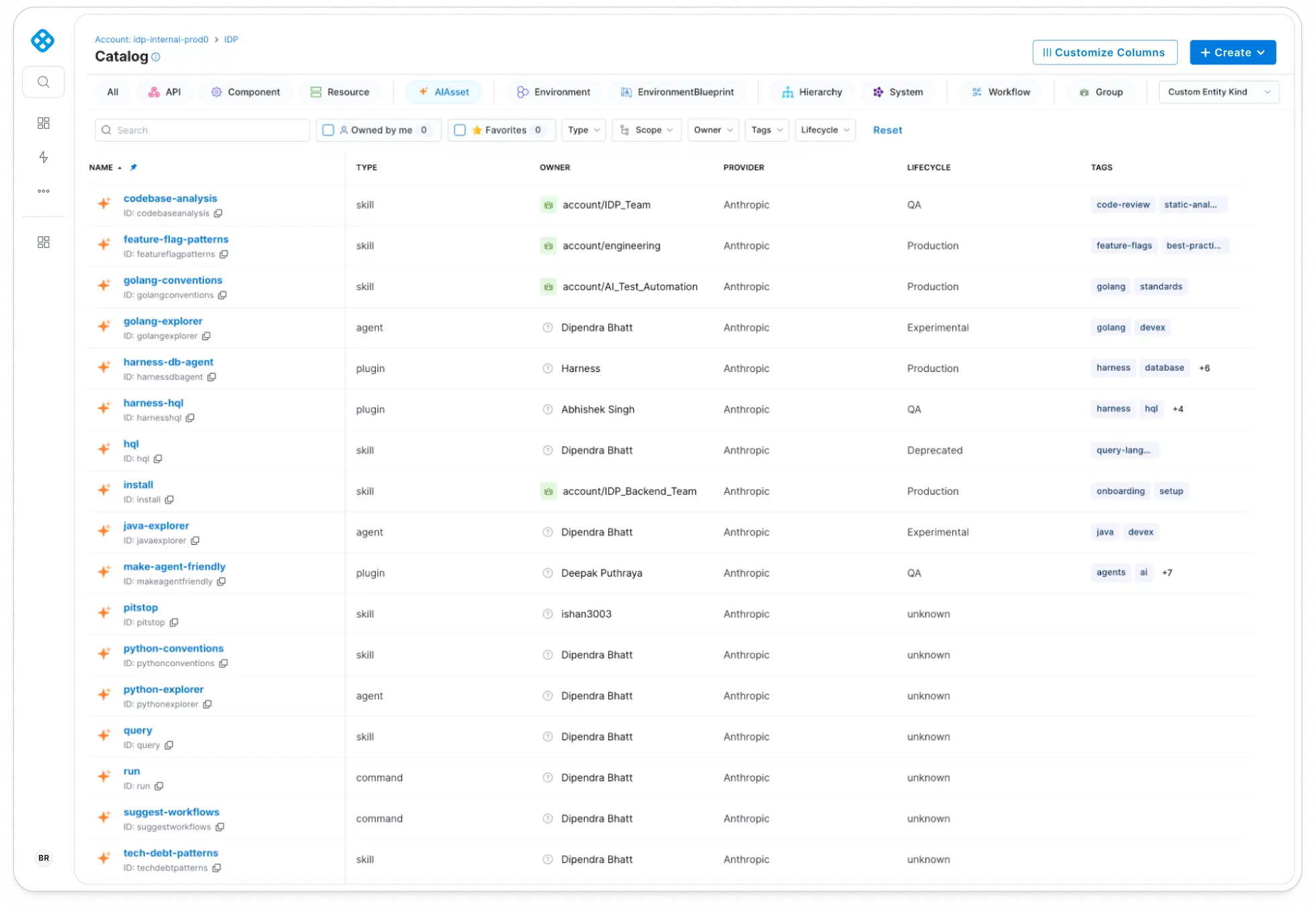
Automated, Git-driven discovery
Manual cataloging is where good ideas go to die because nobody has the spare cycles to keep documentation current. That is why discovery is entirely driven from where your engineers actually live: source control.
With a simple toggle via our GitHub integrations, Harness automatically ingests, de-duplicates, and maps AI assets straight from your repositories. There is no manual upload step and no parallel registry to baby-sit. When an asset changes in Git, the catalog updates in lockstep.
Intelligent content ingestion and semantic search
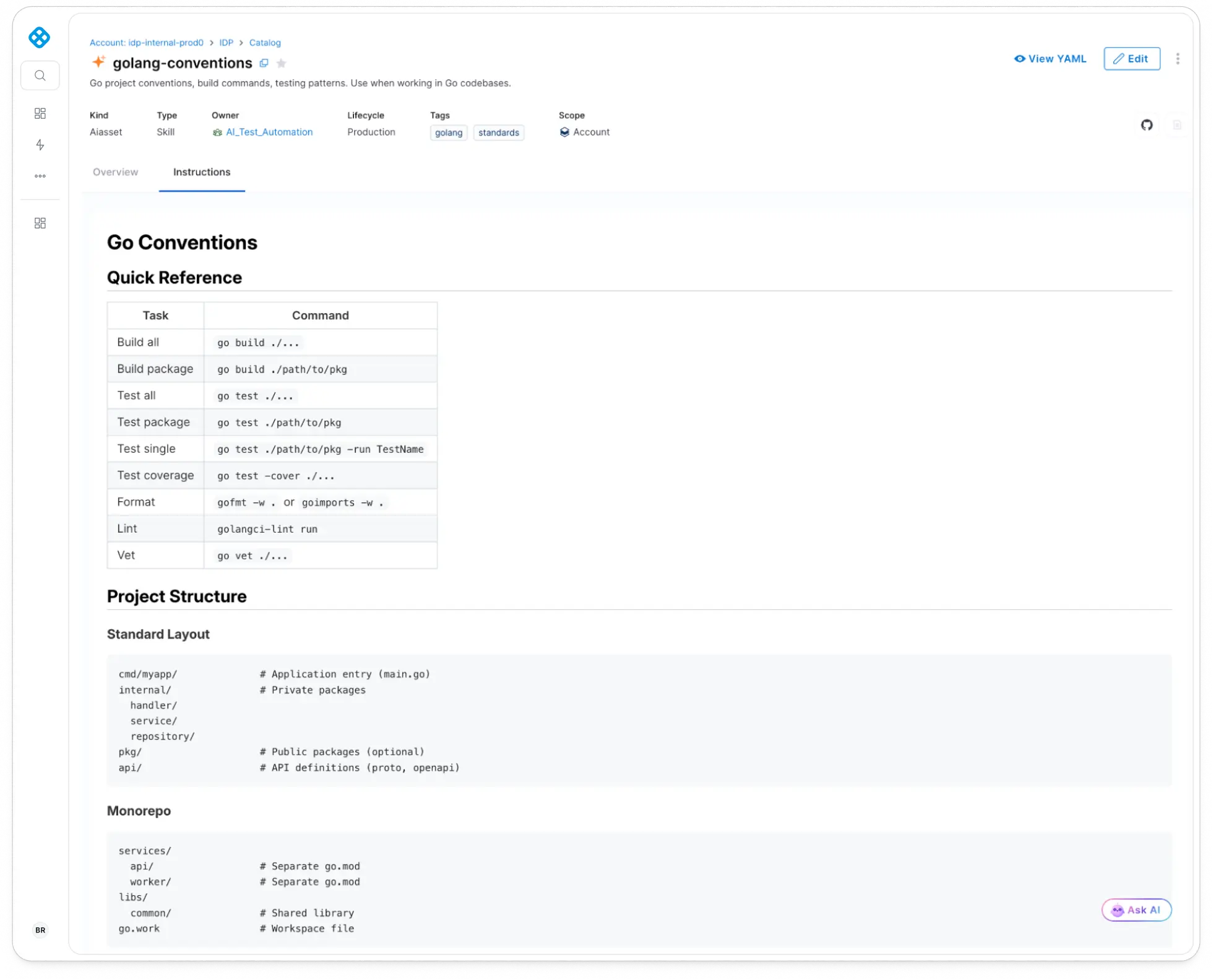
Simply indexing a text file is not the same as actually understanding its purpose. Harness AI reads and parses the artifacts that describe your assets, including instruction files, agent.md profiles, and READMEs, to interpret exactly what a component does.
This deep parsing powers an intuitive natural language search. Instead of playing keyword guessing games, a developer can type a plain question like, "Is there an approved skill to analyze my codebase?" The portal instantly surfaces verified items along with cleanly formatted execution constraints, meaning teams can understand the intent and health of an asset before they ever decide to consume it.
Lineage and team ownership mapping
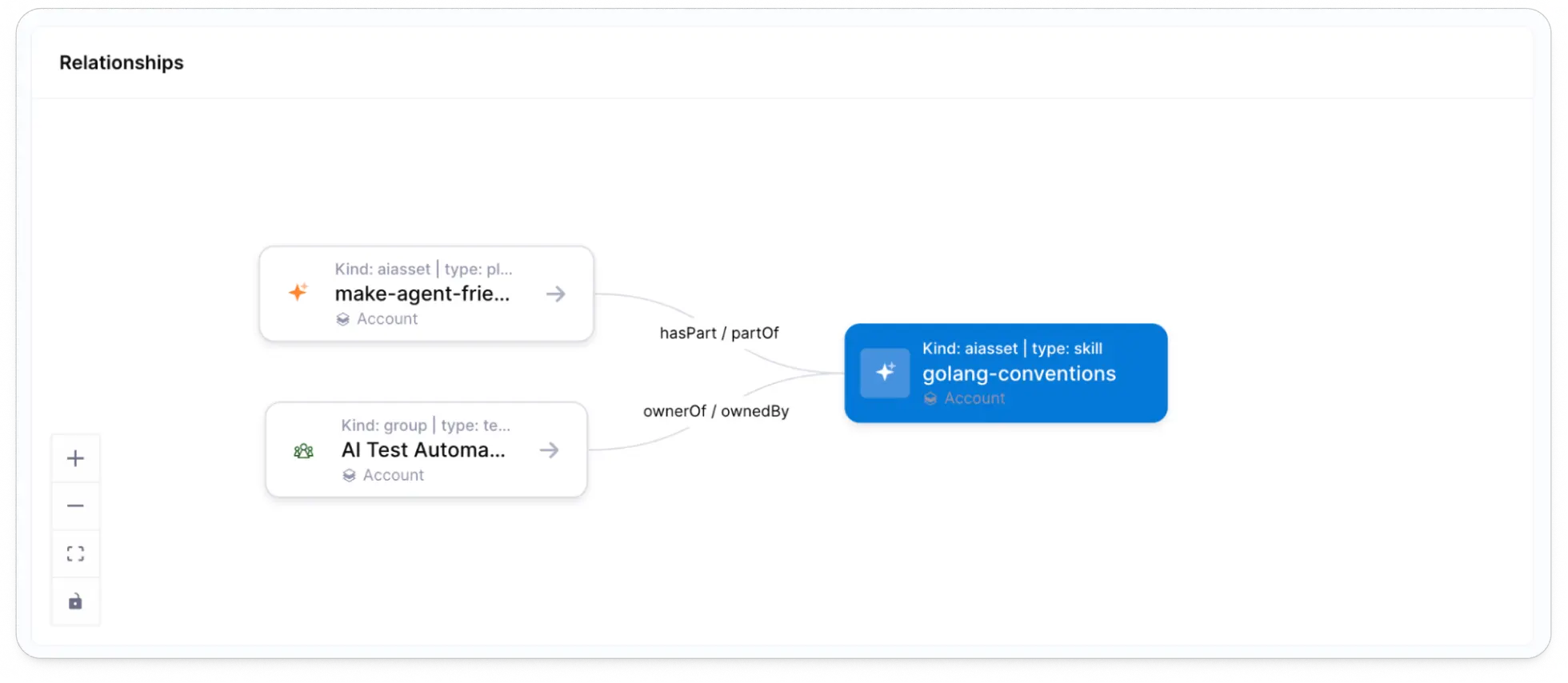
Modern AI architectures are highly compositional. A single plugin bundles multiple skills, an agent triggers specific commands, and a command relies on a highly tuned prompt. When those invisible links break, debugging turns into an absolute nightmare.
The catalog visually charts these parent-child relationships automatically. It maps precisely how prompts and skills roll up into specific plugins, while enforcing explicit team ownership. When an asset misbehaves, you do not waste hours on a wild goose chase; you immediately know the exact blast radius and the exact team to page, slashing triage and support times.
Automated AI asset scorecards
Enabling developer reuse is fantastic, but it is only safe if you can separate reliable, compliant assets from experimental code. Scorecards bring our established software maturity and governance patterns straight to the AI playground.
Our out-of-the-box checks evaluate every single AI asset against essential dimensions: structural integrity, risk maturity, confidence levels, popularity, and data classification compliance. Out-of-policy components are flagged proactively, stopping compliance violations before they escape into production environments. Because these scorecards hook into our broader platform reporting, engineering leaders get a true company-wide view of AI maturity without a separate reporting headache.
Who feels the difference?
The value of a centralized AI catalog looks a bit different depending on your day-to-day role:
- Application Developers: You can stop wasting hours rewriting a prompt or an execution skill that a peer team down the hall already perfected. Natural language search gives you verified, ready-to-use building blocks with clear operational guidelines, making reuse the path of least resistance.
- Platform and DevOps Engineers: You finally get a single pane of glass to track exactly what agents and plugins exist across the enterprise. You can replace chaotic AI sprawl with a clean, searchable source of truth that defines clear ownership and code dependencies.
- Security and Governance Leaders: You can trade your late-night anxiety about shadow AI components and unverified code leaks for automated guardrails. Scorecards proactively flag out-of-policy items and seamlessly enforce your corporate risk matrices.
The big picture
The AI Asset Catalog is not just a shiny standalone tool. It is a foundational part of our goal to make Harness IDP the definitive control plane for both human developers and autonomous AI agents.
Google's DORA research regularly reminds us that while AI code generation tools are making coding faster, actual software delivery throughput remains stubbornly flat because teams get bogged down in downstream execution, testing, and security bottlenecks. Only about 30% of engineering time is spent actually writing code. We want to fix that chokepoint across the entire lifecycle.
Simply put, the catalog handles the question of what assets you have and whether they are safe to use. Our Knowledge Agent assists engineers by executing complex workflows, and our MCP Server grounds external LLMs in your internal architecture and governance standards. Underneath it all sits the exact same secure, auditable platform you already trust to ship code safely every single day.
If you are already running Harness IDP, getting started is incredibly straightforward. You just plug in your existing GitHub or Bitbucket repositories, turn on automated discovery, and watch the catalog map out your AI ecosystem. From there, you can roll out scorecards, assign clear team ownership, and let your developers innovate with total confidence.
FAQs
How does the catalog discover AI assets — do I need to manually upload anything?
No manual step is required. It ingests directly from source control (GitHub/Bitbucket) and stays in sync automatically as Git repos change.
What kinds of AI components does it track?
Prompts, skills, agents, plugins, and custom commands, including their parent-child relationships (e.g., which skills roll up into which plugins).
How does it decide if an asset is safe or compliant to use?
Through automated scorecards that check structural integrity, risk maturity, confidence, popularity, and data classification, flagging out-of-policy assets before they reach production.
Does this require a separate governance or security tool?
No, it inherits the existing Harness platform's RBAC, Open Policy Agent policy layer, and audit trails, so there's no new control plane to stand up.
How is this different from the Harness MCP Server or Knowledge Agent?
They're complementary: the catalog answers "what assets exist and are they safe," the Knowledge Agent executes workflows, and the MCP Server grounds external LLMs/coding assistants in your internal architecture and standards.