Worker Agents are AI agents that run as governed pipeline steps, executing software delivery work under inherited RBAC, OPA policy, and audit controls.
TL;DR
- A worker agent is an AI agent that executes a delegated software delivery task as a step inside a delivery pipeline, rather than answering questions in a chat window.
- Worker agents operate in a loop: they receive a goal, plan an approach, call tools against real systems, verify their own output, and hand off a reviewable result such as a commit or a pull request.
- Because a worker agent runs inside existing pipeline infrastructure, it inherits that pipeline's access controls, policy enforcement, and audit trail instead of requiring a separate governance model.
Introduction
A worker agent is an AI agent that carries out a delegated software delivery task inside a pipeline, such as fixing a failed build, remediating a Kubernetes manifest, closing a coverage gap, and producing an auditable output rather than a suggestion. This article covers what worker agents are, how they execute, how they differ from build agents and conversational AI assistants, the risks they introduce, and the controls that make them safe to run against production systems.
The reason the term is appearing now is a shift in how engineering time is allocated. AI has become genuinely good at generating code. The work between writing code and running it in production — building, testing, scanning, deploying, remediating, operating — has not changed nearly as much, and in most organizations it still consumes the larger share of the day. Worker agents are an attempt to apply reasoning models to that layer.
What is a worker agent?
A worker agent is an AI agent that autonomously executes a delegated task as a step in an automated workflow, using tools to act on real systems and producing a verifiable output. The defining characteristic is action. A worker agent does not return advice for a human to act on; it performs the work and leaves behind an artifact: a commit, a pull request, a patched manifest, a closed ticket.
Three properties separate a worker agent from adjacent things it gets confused with:
- Delegated goal, not a fixed instruction set: A script is told exactly what commands to run. A worker agent is told what outcome to achieve and reasons about how to get there, which means it can handle inputs its author never anticipated.
- Autonomous multi-turn execution: It can call a tool, read the result, revise its approach, and call another tool, repeating until the goal is met or it gives up. A single-shot LLM call cannot do this.
- Verifiable output: The result is something a human or a system can inspect and accept or reject, not a paragraph of prose whose correctness is a matter of opinion.
Worker agents are sometimes described as agentic DevOps, and the underlying idea is straightforward: any step in a delivery pipeline that currently runs a fixed script could instead run a reasoning agent.
How do worker agents work?
A worker agent executes as a loop rather than a linear script. The stages below describe a typical implementation:
- Task intake: The agent receives a goal and its inputs. In pipeline-based implementations, this happens when the pipeline reaches the agent's step and passes its context: the repository, the branch, the failed build's logs, and the scan findings.
- Planning: The agent decomposes the goal into an approach. This is where reasoning models differ most from scripts; the plan is generated per run, against the actual state of the system, rather than encoded in advance.
- Tool and context access: The agent is granted a specific set of capabilities, which repositories it can read, which commands it can run, and which external services it can reach. Well-designed implementations grant this explicitly rather than inheriting whatever ambient credentials happen to be present in the environment.
- Execution: The agent acts — editing files, running builds, querying APIs — observing the result of each action before choosing the next.
- Verification: The agent checks its own work against a defined bar. For a code-modifying agent, this usually means re-running the test suite, the linter, and the build, and treating a failure as a reason to iterate rather than a reason to stop.
- Handoff: The agent produces its output and exits. Depending on how much autonomy it has been granted, that output goes straight to the target system, or into a pull request awaiting human review, or into an approval gate.
The bounded quality of step 4 is what makes the difference between a demo and something runnable against production. An agent with unbounded reasoning steps and unbounded permissions is not a delivery tool; it is an incident waiting for a trigger.
Worker agents vs. build agents, runners, and delegates
"Agent" is heavily overloaded in DevOps, and worker agents are frequently confused with infrastructure components that have carried the name for years. The distinction is decision-making.
| Worker agent | Build agent / runner | Delegate | |
|---|---|---|---|
| What it is | A reasoning process that executes a delegated task | A worker process that executes assigned jobs | A connectivity component that runs tasks inside your network |
| Decides what to do | Yes - plans its own approach per run | No - runs the steps defined in the job | No - runs instructions from the control plane |
| Adapts to unexpected input | Yes | No - fails or passes | No |
| Output | Commit, PR, patch, report | Build artifact, test result | Task result |
| Typical trigger | Pipeline step, schedule, or event | Queued job | Control plane instruction |
A build agent and a worker agent can operate on the same commit in the same pipeline. The build agent compiles it deterministically. The worker agent decides what to do when the compilation fails.
Types of worker agents in software delivery
Worker agents in production today cluster around recurring, well-scoped delivery toil.
Build repair agents
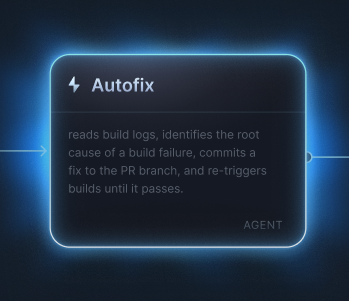
Diagnose the root cause of a failed CI build, apply a fix, and re-trigger until the pipeline passes. This is often the first agent teams deploy, because the failure signal is unambiguous and the success criterion is a green build.
Code review agents
Read a pull request and post targeted feedback on security issues, hardcoded secrets, and code quality. Value depends heavily on the agent knowing which services are production-critical, which is why context beyond the diff matters.
Test and coverage agents
Generate meaningful unit tests to close coverage gaps. The failure mode to design against is tests that raise the coverage number without testing behavior.
Configuration remediation agents
Analyze failed Kubernetes or Helm deployments, or infrastructure drift, and produce a corrected manifest or configuration change.
Security triage agents
Classify scan findings and assess which services a newly disclosed vulnerability actually affects. The bottleneck in vulnerability response is usually triage volume rather than patch availability, which makes this a natural fit — and a high-stakes one.
Cleanup agents
Retire stale feature flags, remove dead code, and handle dependency and framework upgrades, including the code migration that breaking changes require.
Benefits of worker agents
- They absorb work that scales with code volume. Build failures, scan findings, and drift all increase as delivery accelerates. Agent capacity scales with them in a way that headcount does not.
- They compress response time on unambiguous work. A build that fails at 2pm does not need to wait for someone to pick it up.
- They handle the cases scripts cannot. Automation stalls where the correct action depends on context. A reasoning agent can handle that class of decision, which extends automation into work that previously required a person.
- They make delivery knowledge reusable. An agent definition encodes how a team handles a recurring problem, in a file that other teams can read, fork, and improve.
- They shift senior engineering time toward judgment. The work being delegated is largely work that no one was doing by choice.
Risks and limitations
Worker agents introduce failure modes that traditional automation does not have. These are the ones to plan for:
- Non-determinism. The same inputs can produce different outputs across runs, which makes agent behavior harder to test than script behavior and means passing once does not mean evidence of correctness.
- Scope drift. Agents tend to wander beyond their assigned task — inspecting adjacent pipeline stages, touching files outside the intended change. This is common enough in practice to assume it will happen and constrain for it structurally.
- Over-provisioned credentials. The fastest way to get an agent working is to give it broad access. That decision is also the one most likely to turn a bad output into a production incident.
- Cost opacity. Token spend accumulates per run and is easy to discover on an invoice rather than in a dashboard. Model choice matters more than teams expect: the same task can differ by more than an order of magnitude in cost depending on which model runs it, and the most capable model is frequently unnecessary for routine work.
- New attack surface. Prompt injection, credential leakage through reasoning traces, and jailbreaking are agent-specific vulnerability classes with no equivalent in scripted automation.
- Audit ambiguity. If AI-initiated actions land in the audit log under a generic system identity, incident attribution becomes guesswork and compliance reporting becomes manual.
- Review bottlenecks. An agent that opens more pull requests than the team can review has moved the constraint rather than removed it.
- Over-trust. Agents are frequently confidently wrong. Their output is a proposal to be evaluated, not a conclusion.
How to govern worker agents
Governing a worker agent means constraining what it can do structurally, so that a bad output cannot become a bad outcome. The controls that matter:
Give every agent its own identity. An agent should be a distinct principal in your access control system, the way an employee is — not a shared service account and not the credentials of whoever triggered it.
Scope permissions to the task, and make them ephemeral. A code review agent needs pull request access. A deployment agent needs artifact registry credentials. These should not be the same grant. The strongest available pattern mints a short-lived token per run whose scope is the intersection of the agent's declared permissions and the triggering user's own access, so a declared grant can only narrow what the invoker could already do, never widen it. The token is destroyed when the run completes.
Sandbox execution. Run the agent in an isolated container as a non-root user, with a read-only filesystem outside its workspace and network access restricted to an explicit allowlist. An agent that generates a malicious command should have nowhere to send data.
Keep secrets out of the model context. Credentials should be resolved by the execution environment, not passed to the LLM. Prompts and reasoning traces should be stripped of secrets and PII before they are persisted.
Enforce policy at multiple checkpoints, not just at configuration time. Policy evaluation when an agent definition is saved catches misconfiguration. Evaluation when the pipeline starts and again when the agent attempts a governed action catches everything else, including behavior the definition did not predict.
Attribute every action distinctly in the audit trail. AI-initiated actions need their own identity in the log, with a full provenance chain: what triggered the agent, which version of its definition ran, every action it took, and the outcome. This is what makes AI activity filterable and reportable rather than buried.
Cap cost per agent and per pipeline. Set hard spending limits at the point of execution rather than reconciling after the fact.
Gate the blast radius. Approval gates before an agent's change ships, and a rollback path if it ships badly. The same gates that protect human deployments apply.
Best practices for adopting worker agents
- Start with low-risk toil. Documentation generation, test result summarization, report assembly. The goal of the first agent is to learn the operational model, not to solve the hardest problem.
- Move to reviewable work next. Code review and triage, where the agent's output is a recommendation a human accepts or rejects, so mistakes are cheap and visible.
- Add human-in-the-loop approval before anything ships. Let the agent do the work and a person approve the result. Remove the approval only for agents with a track record.
- Right-size the model. Validate the use case with a capable model, then test whether a smaller one produces equivalent results. For routine tasks it usually does, at a fraction of the cost.
- Bound the reasoning. Cap the number of steps an agent may take. Unbounded loops are how cost and scope both escape.
- Version agent definitions in Git. Store the definition in your repository so behavior changes go through code review with the same approval gates as everything else.
- Keep a catalog. Track every agent in the organization with its owner, its permissions, and what it can reach. Agent sprawl is a governance problem before it is a cost problem.
Worker agents and Harness
Harness Autonomous Worker Agents, run as steps inside existing Harness pipelines. Because they execute inside that infrastructure, they inherit its governance rather than requiring a parallel one: the OPA policies that gate deployments also gate agents, the RBAC that controls who can push to production controls who can trigger an agent, and every action lands in the Harness Audit Trail under a distinct Harness AI principal with a full provenance chain.
Each run executes in a container on customer-controlled infrastructure with a scoped ephemeral token, and agents reason over the Harness Software Delivery Knowledge Graph — a connected map of services, pipelines, deployments, incidents, and security findings — so a remediation reflects the actual production blast radius rather than a generic fix. Agents are authored as a single file with YAML frontmatter and natural-language instructions, or generated through Harness AI, and Harness Managed Agents are available in the Harness Agent Marketplace to fork and customize.
Frequently asked questions
What is a worker agent?
A worker agent is an AI agent that autonomously executes a delegated task as a step in an automated workflow, using tools to act on real systems and producing a verifiable output such as a commit or pull request. Unlike a chat assistant, it performs the work rather than describing how to do it.
How do worker agents work?
A worker agent receives a goal, plans an approach, calls tools to act on real systems, checks its own output against a defined bar, and iterates until it succeeds or exits. Each run generates its plan against the current state of the system rather than following pre-written steps.
What is the difference between a worker agent and an AI agent?
"AI agent" is the general category for any system that plans and takes actions toward a goal. "Worker agent" is the narrower case of an agent that executes delegated operational work as a step in an automated workflow, rather than conversing with a user.
Are worker agents the same as build agents?
No. A build agent executes the steps a job defines, deterministically. A worker agent decides what steps to take. Both can run in the same pipeline: the build agent compiles the code, the worker agent decides what to do when compilation fails.
Do worker agents replace developers?
No. Worker agents absorb recurring delivery toil — build failures, scan triage, dependency upgrades — that scales with code volume. Their output is a proposal that a human reviews, and defining what an agent should do remains an engineering judgment.
What is agentic DevOps?
Agentic DevOps is the practice of running reasoning agents in place of fixed scripts at steps in the software delivery lifecycle. Instead of a pipeline stage executing predetermined commands, it delegates a goal to an agent that determines the approach at runtime.
How do you secure a worker agent?
Give the agent its own identity with permissions scoped to its task, issue short-lived credentials per run, sandbox execution in an isolated non-root container with restricted network access, keep secrets out of the model context, enforce policy at runtime, and attribute every action distinctly in the audit trail.
Can worker agents run in a CI/CD pipeline?
Yes, and pipeline-native execution is the most common production pattern. Running the agent as a pipeline step means it inherits the access controls, policy enforcement, approval gates, and audit trail already governing that pipeline instead of needing separate governance infrastructure.
