Legacy SCMs can't handle agent-scale code volume. Learn how Harness Code Repository and built-in AI Code Review handle AI-generated code at scale using risk-based diffs and scoped agent permissions.

Code entering your pipelines today is a collaborative effort. While developers focus on architecture and core logic, AI agents and coding assistants are amplifying code generation, opening PRs, and iterating at unprecedented volume and speed. Underlying repositories still expect every commit to come from a single human. The review process, on top of it, still assumes human speed. Fix the repository without fixing the review process, and you've got a faster way to generate code that no human can verify in time. Fix the review process without fixing the repository, and you're reviewing code faster, but on a repository that can’t handle it. Both must evolve to achieve fast, safe, and governed software delivery at an agent scale.
Today, we're introducing two capabilities built to close that gap: Agent-Ready Harness Code Repository, a source code management (SCM) system designed to handle agent-generated code at scale, and AI Code Review, which reviews that code faster before it merges. These capabilities are now available as part of Harness' Software Delivery Agent, helping organizations deploy code changes to production in a governed way.
The Need for an Agent-Ready Code Repository
All pre-agent SCMs assume a predictable rhythm: a human writes code, opens a PR, and a few colleagues review it over the next few hours or days. That rhythm sets the pace for everything underneath it.
Agents don't keep to that rhythm. They can open dozens of PRs in an hour, each touching hundreds of files, at any time of day. Indexing and search start to lag. Diffs pile up faster than anyone can review them. Permissions built around a fixed set of human teammates don't have a clean answer for a non-human identity that might merge code on its own. None of these issues show up under a normal human workload. They begin to show up as the share of code committed by agents to your repository increases.
Over the last year, our own teams, like many organizations, have accelerated their use of agents for coding and, more recently, for software delivery. With this increased use, it's become obvious that a repository built for human developers and human reviewers doesn’t hold up when agents become the contributors.
Harness Code Repository: An Agent-Ready SCM
Harness Code Repository is what source control looks like when agents are part of the team. It is built to handle agentic workloads without degrading performance and to embrace AI workflows that accelerate human code reviews. Here’s what makes it agent-ready:
Throughput that doesn't assume human pacing
Indexing, diffing, and searching all have to keep up with a much higher volume of branches and PRs than when code was primarily written by humans. Harness Code Repository is scale tested to handle thousands of pull requests and commits per second.
Scoped permissions for non-human identities
With Harness, you can set up RBAC and OPA policies to precisely scope what an agent identity can access, merge, or deploy, similar to how team members operate.
Agents inherit permissions from the developers who trigger them. Developers can further define what an agent may access or merge, just as they would scope a new engineer, down to a specific repository, branch, or environment.
Discoverable and efficient for agents, seamless for humans
For developers who live in a terminal, Harness CLI enables agent-ready tooling for Harness Code Repository and AI Code Review. Harness CLI supports structured commands such as creating repositories, searching for PRs by author email, or pulling all open PRs into a single cross-repository inbox. Built-in commands for AI Code Review help prioritize diffs by risk levels, so that teams can move faster and with more confidence.
Harness CLI returns only the fields that the operation needs, rather than the full page or object graph a browser-driven flow or a generic API call would return. This keeps the token cost down per call. And because the commands are discoverable and self-describing, an agent can find the right operation and drive it on its own, without a human mapping out the workflow first.
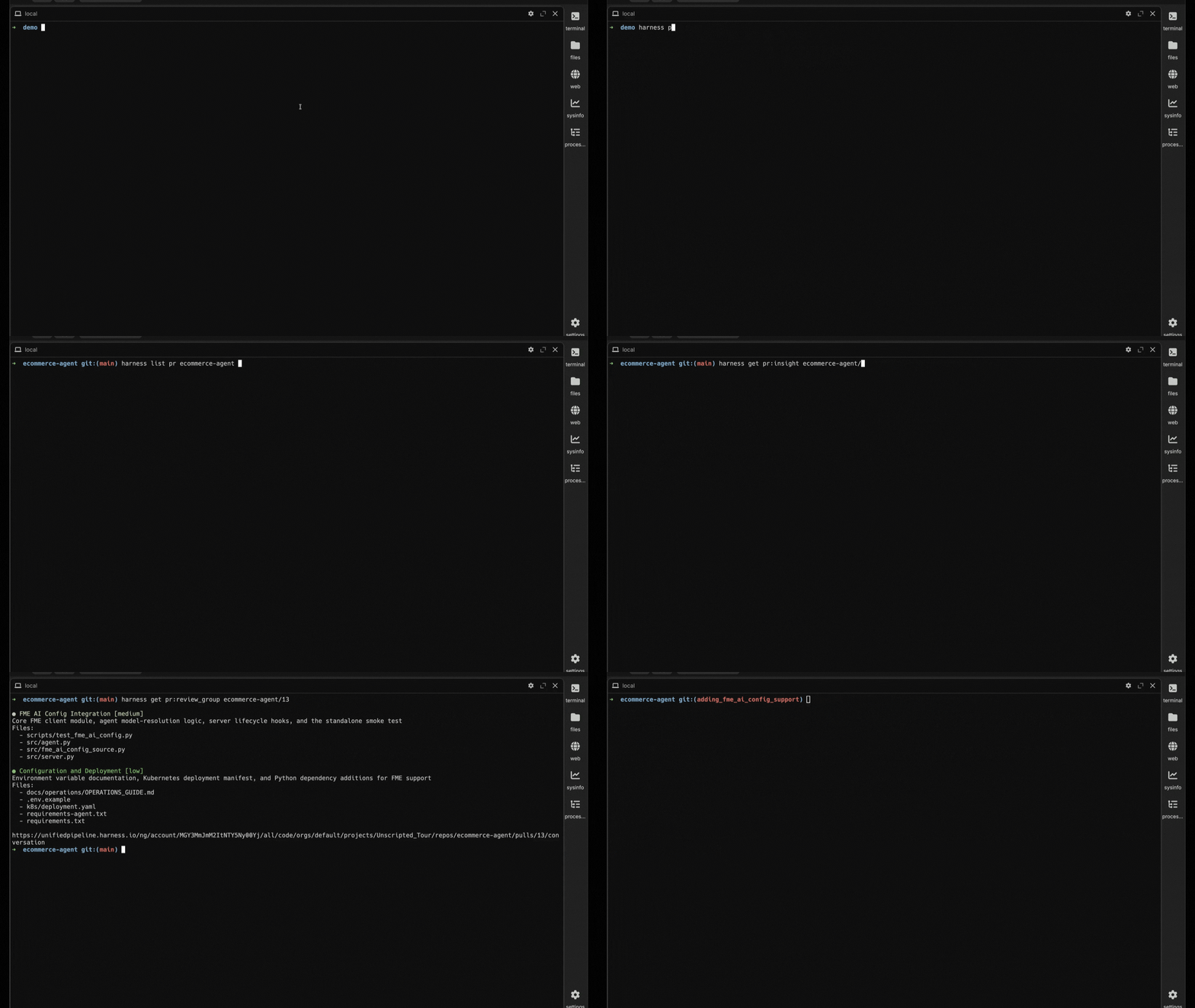
Built-In AI Code Review
Once a pull request is opened, it must be reviewed. The standard line-by-line diff provides a limited signal once agents generate most of the PRs. AI Code Review looks at a pull request the way a tech lead would. It runs customizable AI checks against the change, groups the diff logically rather than by file, and writes feedback grounded in the risk associated with the introduced changes. That's what helps identify the pattern that took down production last quarter, aside from a simple single-line change.
Harness generates reviewer and label suggestions. You define what's important to your team, and the AI Code Review will ensure all new code meets your standards. All these round out the review experience so a PR shows up for review, not cold but already triaged.
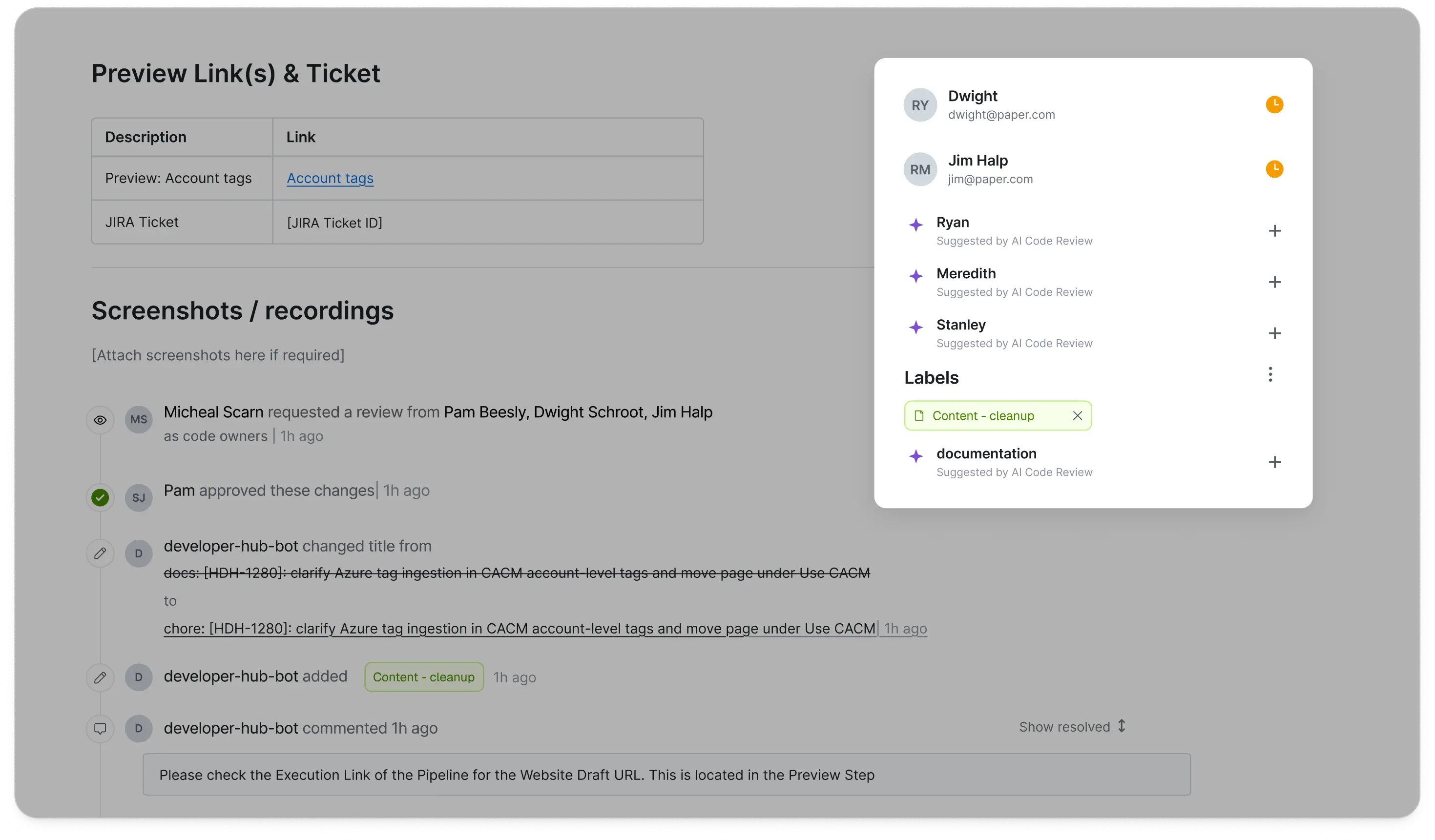
Verification as a mandatory stage
Agent output quality varies PR to PR, so build, test, and secure can't depend on a human kicking them off. In Harness, storing, reviewing, building, testing, securing, and deploying the code follow a single sequence. AI Checks sit within that sequence as a gate that the code must pass before it can be merged. For example, each AI Check can be customized to team-specific conventions and required linting rules. AI Checks can be configured at the Account, Organization, and Project levels and have an inheritance model, allowing teams to configure certain checks at a broader level and ensure compliance at the lowest level. Checks that are required and fail can't be squashed and merged.
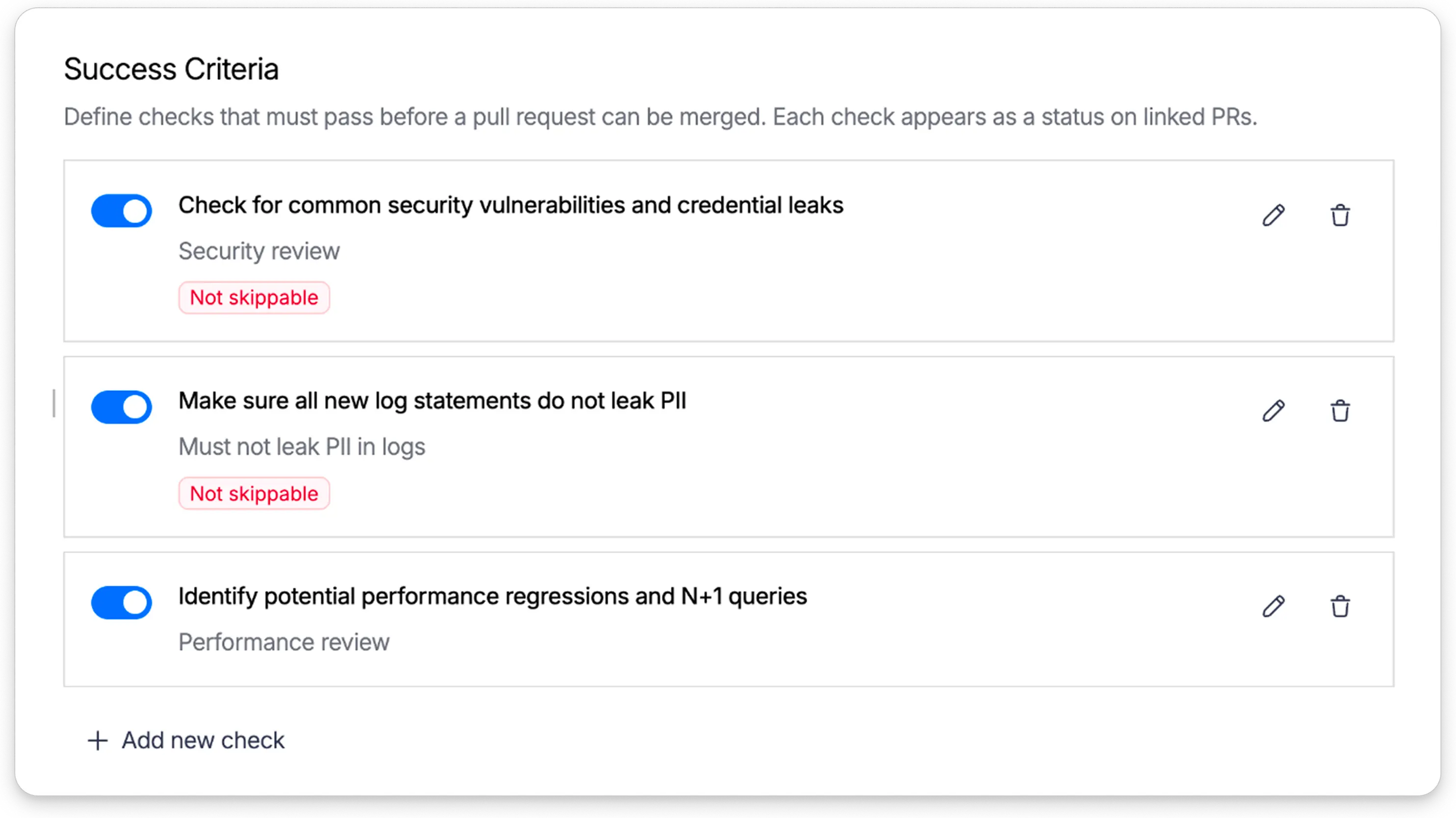
Groupings that prioritize what to review
Agents produce a lot of mechanical change: mass renames, dependency bumps, and generated boilerplate. None of this is risky on its own, but it buries the handful of files that actually changed behavior if the repository can't distinguish between the two. With the volume of code increasing, humans need to do more code reviews now, and it's important to give them the superpowers to succeed. With Diff Grouping by Risks, developers can see the riskiest changes first, allowing them to prioritize higher-risk reviews.
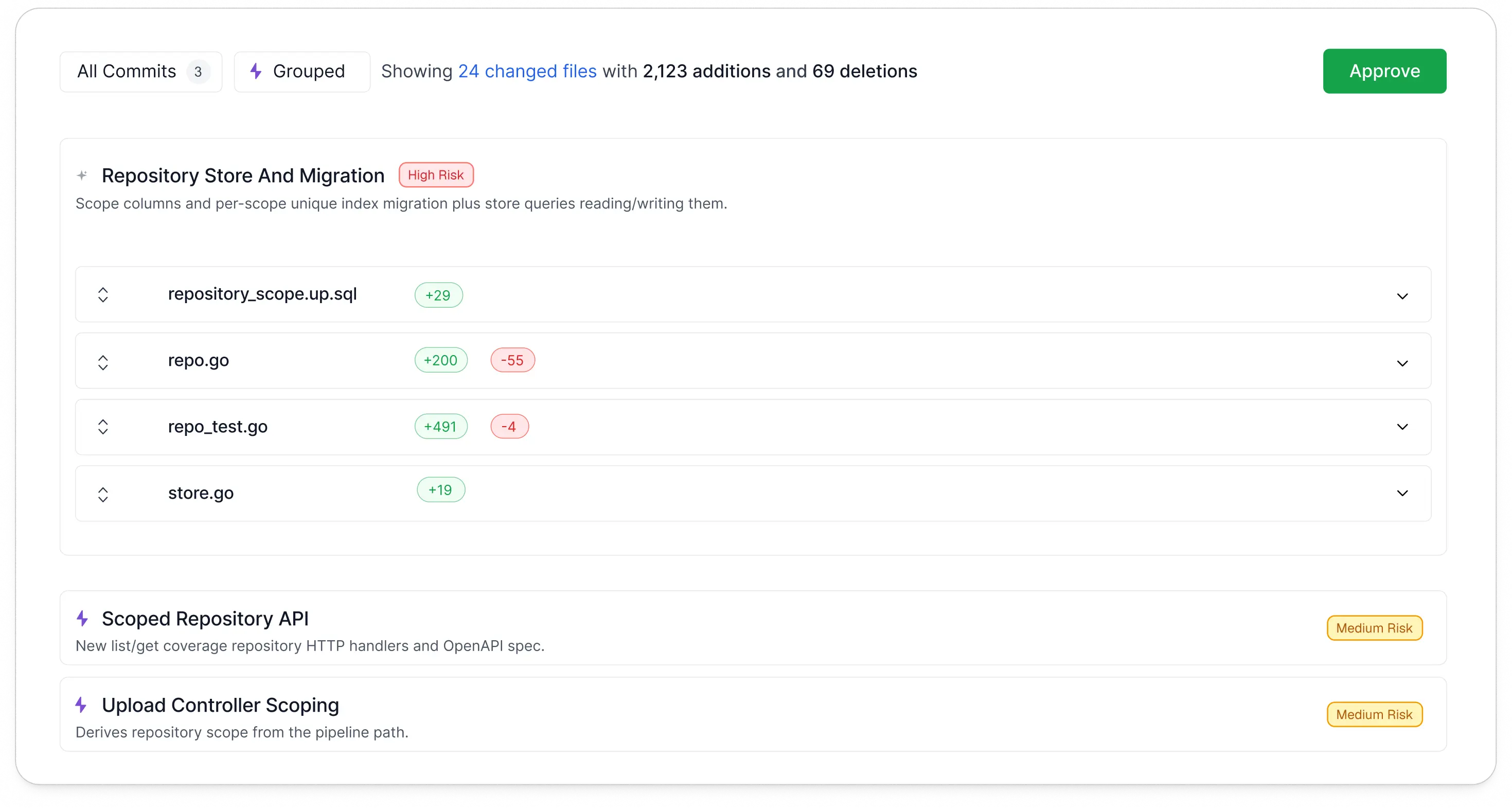
AI Code Review also works on GitHub repositories today. Here’s an example of how it works:
.png)
Our AI Code Review feature was built from our own lived experiences. Like many other organizations, we’ve embraced LLMs to generate large volumes of code and have encountered the same challenges many of you have: too many PRs, too much noise, and not enough context to tell what actually matters. The risk-based diff grouping and the context-grounded feedback in AI Code Review came out of fixing that for our own team first. It was built to make our own review process workable again, and we’re now opening it up to anyone using Harness Code Repository or GitHub.
Reviews Grounded in Your Delivery Context
Most code review tools stop at the diff. Harness AI Code Review will evaluate changes against your organization’s SDLC Knowledge Graph, including historical incidents, to surface risks the code alone can’t reveal.
When a PR modifies something that's caused problems before, AI Code Review flags it with the necessary information: the specific incident, what triggered it, how long it lasted, and the fix the RCA recommended. In the example below, AI Code Review caught a new index migration and flagged it as high-risk, surfacing a prior incident where an unindexed CREATE INDEX statement had locked a production table for 14 minutes, and reminding the author that the RCA called for CREATE INDEX CONCURRENTLY going forward. AI Code Review didn't just say "this could be risky" but it highlighted why, with the right context. This is only possible when the solution you use to review code has your organization’s software delivery context.
.png)
Built as one system
These features are both required in today’s software delivery environment. A repository that can absorb agent-scale volume without a review layer that can keep up just moves the bottleneck downstream. A review layer without the right context is, at best, guessing. Store, review, build, test, secure, and deploy remain a single continuous sequence in Harness, which is what makes both of these possible at the same time.
Most AI code review tools only see the diff in front of them, or at best, the repository they live in. In addition to the repository, Harness AI Code Review uses the context most reviewers never see, i.e., security and runtime policies, build and deployment architecture, and past production incidents specific to your organization. All of this is correlated inside the SDLC Knowledge Graph. That's the difference between a tool that tells you that the code is good with limited context, and a platform that tells you it's good for how your organization actually builds and deploys.
Code Repository and AI Code Review have become a part of the outer loop sequence that Harness Software Delivery Agent runs end-to-end, from commit to production, all under the same policy engine. Organizations like Gentera use Harness Code Repository to standardize DevOps across a regulated banking environment, reducing permission changes from weeks to minutes and improving delivery speed by 4x while halving the cognitive load of switching tools. The same governance that made that possible, fine-grained permissions and validation are moved earlier into the pipeline, and now extend to agent identities: scoped access before merge, verification gates that can't be skipped, and review grounded in the same system already running build, test, secure, and deploy.
See it in action
The clearest way to understand this is to watch a PR go through it. In the demo, you'll see the review land with reviewer and label suggestions already attached, the diff pre-grouped into logical changes, and a report summarizing what was checked and why. You'll also see what that PR looks like sitting in Harness Code Repository itself, scoped permissions, verification gates, and all.
Migration & getting started is easy
If you're moving to Harness Code Repository, getting your Git data in takes a few clicks. Import a single repository or an entire GitHub org, GitLab group, Bitbucket workspace, or Azure DevOps project directly from the UI. If you want your pull requests, labels, webhooks, and branch rules to come with you too, the Harness CLI migration commands handle the full migration, and they can run from your laptop, your self-hosted SCM server, or as a step in your CI/CD pipeline.
Harness Code includes generous storage out of the box: 50 GB per account on the Free tier, and 500 GB per account on paid plans (covering both Git and LFS storage), so teams can get started without worrying about hitting limits.
Built for what's coming
A repository and a review process built for one PR an hour looks different from one built for dozens. At Harness, we’ve reimagined both to hold up as that volume climbs, so teams do not need to rethink their workflows as the pace continues to change.
Our engineering team has been using Code Repository and AI Code Review on our own pipelines. With hundreds of developers contributing code, we’ve seen over 10,000 hours of savings over the last month by using AI Code Reviews. We’re excited to provide this benefit to other developers.
If you want in now, signup for a demo or talk to your account team.