Explore Harness' latest compliance milestones: SOC 1, FedRAMP 20x Class A, PCI DSS, and HIPAA assessments across its platform and runtime security.
TL;DR
Harness announced four compliance milestones: its first SOC 1 audit, FedRAMP 20x Class A certification, and first PCI DSS and HIPAA Security Rule assessments.
SOC 1 and FedRAMP 20x Class A apply to the Harness Autonomous SDLC Platform. PCI DSS and HIPAA apply to the Runtime Protection Agent.
SOC 1 gives independent validation of Harness controls relevant to customers' financial reporting, which can reduce SOX audit effort and vendor risk.
FedRAMP 20x Class A covers the Platform, CI, CD, STO, SCS, IaCM, DBD, Harness Code, and Resilience Testing. Federal agencies, contractors, and integrators can begin assessing Harness through the FedRAMP Marketplace.
Runtime Protection Agent was assessed against PCI DSS v4.0.1 and the HIPAA Security Rule. It can process and redact cardholder data at the edge and can sign a Business Associate Agreement with eligible customers.
In modern enterprise engineering, security cannot be an afterthought, and compliance cannot be a bottleneck. As software release cycles accelerate and API footprints explode, organizations face a daunting challenge: how to innovate at scale while satisfying strict regulatory and governance requirements.
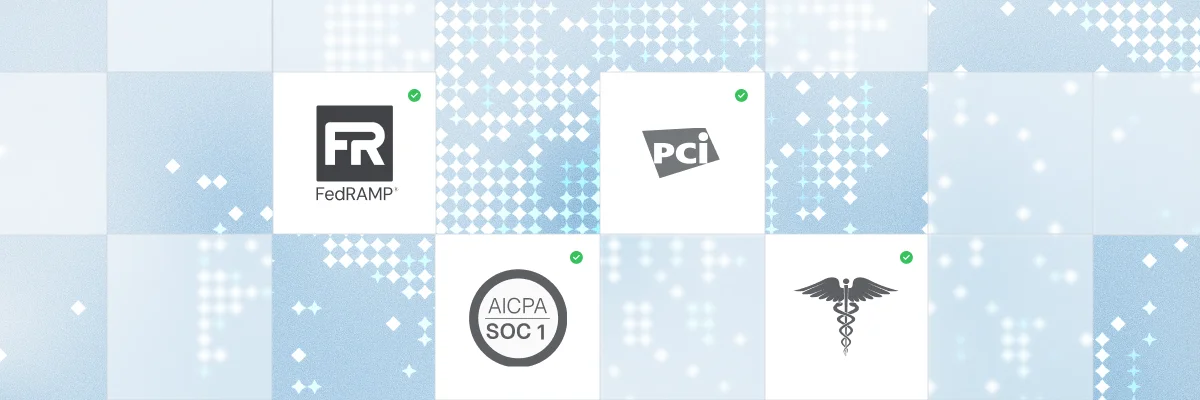
Today marks a major milestone in our mission to deliver friction-free software delivery and application security. We are thrilled to announce four major compliance achievements:
- The Harness Autonomous SDLC Platform has completed its first SOC 1 audit.
- The Harness Autonomous SDLC Platform has achieved FedRAMP 20x Class A certification.
- Harness Runtime Protection Agent completed its first PCI DSS assessment (Attestation of Compliance) and an independent third-party HIPAA Security Rule assessment.
Here is a detailed look at what each of these achievements represents, how they strengthen our platform ecosystem, and why this is a game-changer for our customers.
First SOC 1 audit completed
What does Harness's first SOC 1 audit validate?
While SOC 2 may evaluate overall security, availability, and confidentiality, a SOC 1 audit focuses specifically on an organization's Internal Controls over Financial Reporting (ICFR). Completing our first SOC 1 audit provides independent, third-party validation of the controls at Harness that are relevant to our customers’ internal control over financial reporting.
What it means:
Teams can now use Harness to deploy changes to tools that run finance and billing software with confidence. These changes can directly touch billing systems, transactional databases, and revenue-generating infrastructure. Our SOC 1 report reflects that Harness maintains strict operational guardrails, including immutable audit trails, rigid role-based access controls (RBAC), enforced separation of duties, and fully audited release workflows.
Why SOC 1 is a win for customers:
- Simplified SOX compliance: For publicly traded enterprises subject to Sarbanes-Oxley (SOX), leveraging a SOC 1 audited software delivery platform can help reduce third-party vendor risk.
- Auditable release pipelines: Governance and finance teams can rest assured that code deployments touching financial engines are designed to be captured in an auditable trail.
- Reduced audit drag: Engineering teams can save significant time during annual audit cycles by utilizing pre-validated, compliant delivery controls instead of manually gathering release evidence.
FedRAMP 20x Class A Certification
Which Harness capabilities are covered by FedRAMP 20x Class A?
The federal government’s cloud security landscape has evolved with FedRAMP 20x, the modernized authorization framework designed to replace slow, document-heavy audits with automated, continuous evidence and machine-readable data validation. Achieving FedRAMP 20x Class A certification validates Harness’s capabilities; the Platform, CI, CD, STO, SCS, IaCM, DBD, Harness Code, and Resilience Testing against the Class A ruleset and Key Security Indicators.
What it means:
FedRAMP 20x Class A validation confirms that Harness addresses the Class A ruleset, continuous monitoring expectations, and Key Security Indicators (KSIs). It reflects that workloads managed through Harness are supported by automated vulnerability detection, zero-trust identity controls, and strict incident reporting workflows.
Why FedRAMP 20x is a win for customers:
- Public sector adoption: Federal agencies, contractors, and systems integrators can now begin assessing Harness through the FedRAMP Marketplace.
- Continuous, automated governance: Federal security teams benefit from real-time monitoring and structured evidence generation, designed to support continuous monitoring, not just annual reviews.
- Accelerated Time-to-Mission: Government agencies can replace legacy, manual deployment methods with automated CI/CD and progressive delivery, bringing modern digital services to citizens faster and more securely.
Runtime Protection Agent: First-time PCI DSS and HIPAA assessments
How does Runtime Protection Agent protect payment and health data?
APIs are the backbone of modern applications and the primary target for modern cyber threats. Runtime Protection Agent has been third-party audited and assessed to meet the security and data protection requirements of the PCI DSS v4.0.1 and HIPAA Security Rule compliance frameworks.
PCI DSS compliance
- What it means: Runtime Protection Agent’s edge deployment architecture inspects API traffic and analyzes threats directly within the secure edge environment. Cardholder Data (CHD) can be processed and sanitized at the edge. Sensitive payment data is designed to be redacted before any activity is logged in the platform or processed further, while the agent provides full, real-time threat protection for payment APIs.
- Why customers win: Financial institutions, e-commerce platforms, and payment processors can utilize Runtime Protection Agent’s edge deployment to automatically discover shadow APIs, block payment-gateway attacks (such as SQLi, XSS, and credential stuffing), and redact sensitive data from analytics logs.
HIPAA compliance
- What it means: Runtime Protection Agent has implemented technical, administrative, and physical safeguard requirements designed to protect Protected Health Information (PHI) when inspecting PHI-bearing traffic, and can enter into a Business Associate Agreement with eligible customers.
- Why customers win: Healthcare providers, health-tech startups, and health insurance platforms can inspect runtime API traffic to detect anomalous access behavior, stop unauthorized exfiltration of medical records, and maintain detailed forensic audit logs for regulatory inspections.
Why automated compliance matters now
Harness's 2026 State of DevOps Modernization found that 86% of engineering leaders and practitioners say security and compliance checks need greater automation to meet delivery timelines. It also found that 50% of the heaviest AI coding users experienced more vulnerabilities and security incidents after adopting AI. As AI speeds up code delivery, independently validated controls help teams keep governance in step with release speed.
Enterprise governance: from deployment to runtime
The compliance milestones achieved across the Harness Autonomous SDLC Platform and Runtime Protection Agent establish third-party validated guardrails that mitigate financial, federal, and runtime data risk. Harness remains committed to proactively expanding our security controls and regulatory coverage, helping reduce the operational burden of compliance so our customers can execute on strategic initiatives with confidence.
Harness lets you govern delivery from one place: OPA policy as code on every pipeline, role-based access control, centrally managed secrets, and a full audit trail. Then you decide how much autonomy each workflow gets, from approved steps only to human in the loop to fully autonomous within policy.
What's next for Harness compliance
Harness continues to expand its security and regulatory coverage. Current and planned certifications and attestations:
- 2026 SOC 2 Type II: Harness, Traceable, and Qwiet.ai
- 2026 ISO 27001, ISO 27017, and ISO 27018 Updated Certificate
In Progress:
- FedRAMP 20x Class C and FedRAMP High
See the Harness Trust Center for current reports and status.
Want to see how Harness can streamline your enterprise compliance posture? Request a Personalized Demo today.