Stop the maintenance nightmare of static thresholds. Learn how Harness AI Verification and Rollback provides context-aware safety for Argo CD.

If you've been in the Kubernetes and GitOps space for any length of time, you've heard the pitch for Argo Rollouts' Analysis Templates. They offer a way to gate your progressive delivery (canary or blue-green) by querying metrics sources like Prometheus and validating results against defined thresholds.
On the surface, it sounds like the perfect solution for GitOps automation. But when we sat down with enterprise teams scaling Argo Rollouts in production, the feedback was consistent: Analysis Templates weren't delivering the reliability they expected. Our customers told us that while the concept was sound, the execution fell short because:
- Static thresholds were a maintenance nightmare: Manually defining and updating "good" numbers for hundreds of microservices created massive operational toil.
- System noise triggered false failures: Legitimate, predictable spikes (like batch jobs) caused unnecessary rollbacks, burning out on-call engineers.
- Metrics-only gating left them blind: Purely numeric checks missed critical errors and exceptions hiding in the logs.
That feedback motivated us to bring our field-proven intelligence to the Argo ecosystem. What resulted is Harness AI Verification and Rollback for Argo - a context-aware safety net that understands your unique service health trajectory without the manual overhead.
We’ve been applying AI to software delivery problems 2017. AI Verification and Rollback isn't just a bolt-on feature; it's core to the safety “Harness” that is our identity.
Let’s look at how our approach is different.
Fix #1: AI vs. Static Thesholds
While Argo Rollouts supports automated rollback, it is fundamentally rule-based. It relies on the Analysis Template to return success or failure based on the thresholds you’ve manually defined. If your threshold is too tight, you get a false rollback; if it’s too loose, you miss a regression.
Harness AI Verification and Rollback moves beyond these binary rules:
- Statistical Significance, Not Just Numbers: Harness doesn't just look at a number; it uses unsupervised machine learning to determine if a deviation is statistically meaningful. It understands the "health trajectory" of a service.
- Context-Aware Verification: Because Harness is integrated into the full platform, it knows what changed and how it usually behaves. It can distinguish between a deployment-related regression and a pre-existing infrastructure issue.
- Autonomous Remediation: While both tools can trigger a rollback, Harness provides a Full Audit Trail out of the box—immediately clustering the specific metrics or logs that caused the anomaly so your team knows exactly what to fix.
"Ship faster. Roll back smarter. With Harness AI, your worst-case scenario is a self-healing deployment that actually knows the difference between a bug and a batch job."
Fix #2: Pre vs. Post Comparison — AI Intelligence vs. Static YAML
Argo's Analysis Templates operate on a fundamentally simple, and often flawed, principle: they compare a returned value against a static threshold.
Consider the "10 AM Spike": Your database runs a scheduled batch job every morning, causing a temporary latency spike. If you perform an Argo canary at 10 AM, your deployment will fail, even if the new version is perfectly healthy.
Harness AI Verification and Rollback solves this by asking a better question: "Is this deployment behaving differently from what was normal before I changed anything?"
- Real-World Baselines: Harness captures the actual pre-deployment baseline, the real-world behavior of your service at the exact time the deployment begins.
- Time-Window Comparison: It compares your canary's behavior against the same time-window from your stable deployment.
- Noise Filtering: Harness uses machine learning to determine whether deviations are statistically meaningful or just system noise (like that 10 AM batch job).
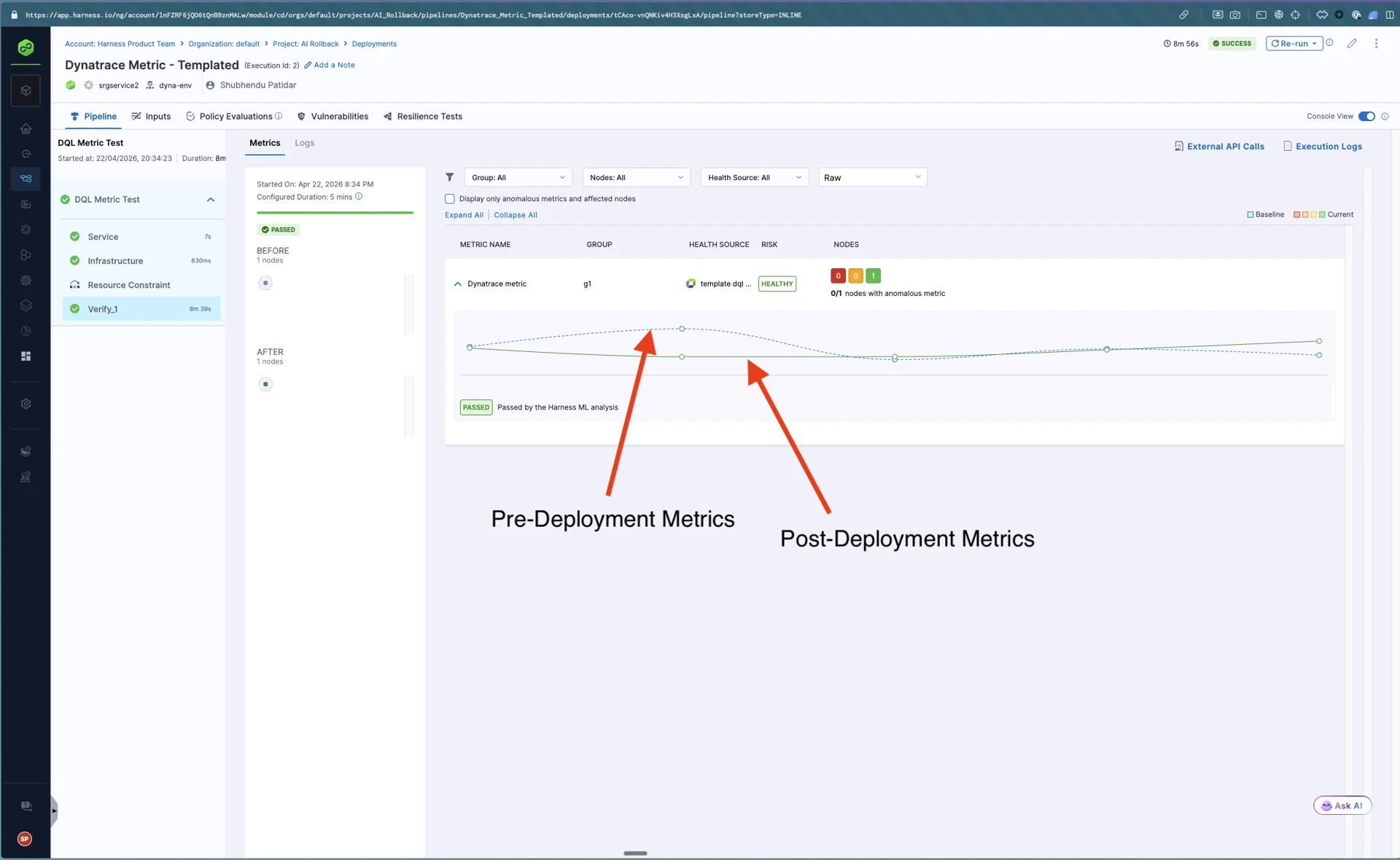
This eliminates the "false positive" noise that leads to developers ignoring deployment alerts.
Fix #3: Log-Based Verification — Catching the "Quiet" Killers
Argo's Analysis Templates are fundamentally a metrics-first framework. They are great for numbers, but logs are a second-class citizen.
However, some of the most critical regressions never show up in as a metric in an observability tool like Prometheus.
A new NullPointerException class, a database timeout log you've never seen before, or a third-party API error pattern. These are deployment health signals that purely metric-based verification will miss. These are in your logs.
It’s critical to watch your logs alongside your metrics to determine if the new release is healthy.
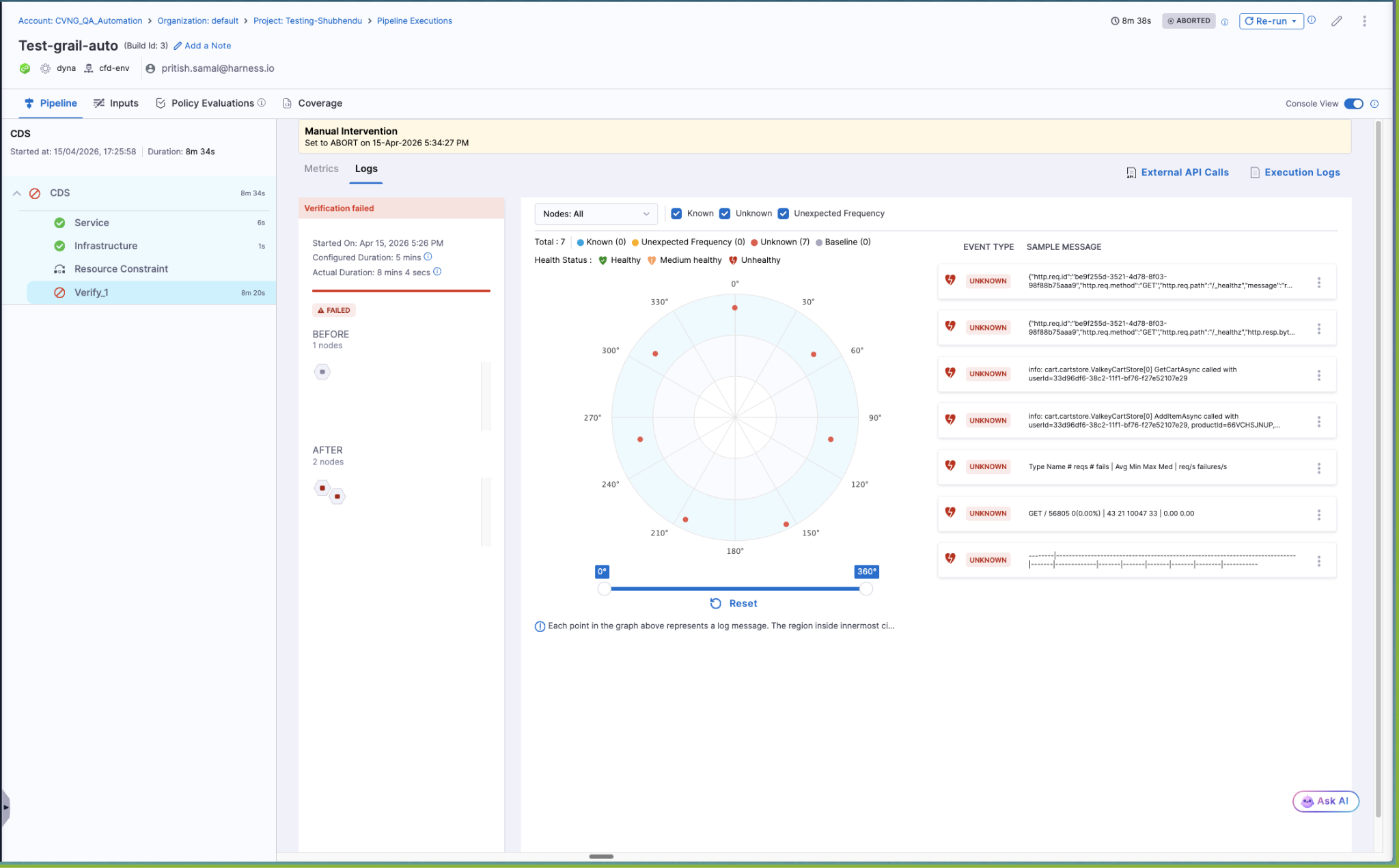
Harness Verification - Intelligent Log Analysis with Unknown Cluster Detection Harness detected 7 unknown log patterns introduced after deployment that had no baseline equivalent, causing the verification to fail and the pipeline to abort.
Harness AI Verification and Rollback treats logs as a peer to metrics:
- Log Clustering: Harness analyzes error log patterns introduced by a new deployment and flags anomalous clusters that didn't exist in the stable version.
- Platform-Native: This works across your entire ecosystem, including Splunk, ELK, Sumo Logic, and Datadog Logs.
- Contextual Triage: Harness doesn't just say there's an error; it clusters the logs so you can see exactly which line of code is failing.
A Tale of Two Deployments: Argo vs. Harness AI
| Scenario | Just Argo (Analysis Templates) | Argo with Harness (AI Verification & Rollback) |
|---|---|---|
| Metric spike at deployment time (e.g., a good deploy during peak traffic) | Static threshold triggers false failure; deployment halted unnecessarily. | AI baseline identifies spike as pre-existing noise; deployment continues safely. |
| New error log pattern | Not detected—metrics look fine while users suffer. | AI clustering detects new exception; deployment automatically rolled back. |
| Unhealthy Deployment detected | Rule-based rollback based on manual thresholds. | AI-driven rollback based on ML-detected anomalies and health trajectory. |
| Configuration Effort | Hours spent writing/maintaining brittle "Analysis" YAML. | AI-assisted setup that learns your service health automatically. |
Expanding the "Argo" Horizon
While Argo alone is often limited to orchestrating Kubernetes "bits," Harness looks at the entire release. Argo specializes in keeping your cluster in sync with Git, but a production-ready release often requires more than just a Kubernetes sync.
Harness extends the GitOps pattern to the rest of your stack. Need to migrate your database schema in lock-step with your service? Our Database DevOps capabilities have you covered. Want to roll out features progressively to users after the bits are deployed? Our Feature Management allows you to decouple deployments from releases.
When you use Harness to coordinate these moving parts across multiple teams and services, leveraging ApplicationSets and our global orchestration, you aren't just syncing a cluster; you're managing a release lifecycle. Or, you can choose to just "fly" within your Argo services, but with a significantly better safety net.
The Bottom Line
Argo CD and its Analysis Templates provide a useful starting point for GitOps. We often see it work for the first couple of teams that adopt GitOps in an organization.
But as your organization scales from dozens to hundreds of services and thousands of deployments, the toil of maintaining static thresholds becomes a bottleneck to innovation.
Harness AI Verification and Rollback is built for this scale. It provides the intelligence to differentiate between noise and failure, and the autonomy to protect your production environment when things go wrong.
Ready to see AI-powered safety in action? Explore the documentation or request a demo.