Discover how Harness Web Application and API Protection (WAAP) unifies web app and API security, testing, and runtime protection. Protect your apps, start today!

- Traditional web application firewalls (WAF) are no longer sufficient for protecting modern, API-first applications. WAAP provides unified, comprehensive runtime security for applications & APIs.
- A WAAP platform should automate policy creation, reduce alert fatigue, and integrate seamlessly into CI/CD pipelines, eliminating ticket-ops bottlenecks and reducing developer and security toil.
- Best practices such as continuous API discovery, API testing, and application-layer threat detection & response enable platform teams to operationalize security at scale without sacrificing delivery speed or developer autonomy.
When APIs now handle the majority of web traffic, protecting only HTML requests creates a blind spot that puts your organization at risk. Traditional WAFs weren't built for this reality and miss API-specific vulnerabilities that define modern attack vectors. Your security platform needs complete visibility into every API endpoint, authentication flow, and data exchange.
A web application and API protection (WAAP) platform should unify API discovery, API testing, API protection, bot & abuse protection, and cloud-scale WAF capabilities into a single platform. Instead of bolting security on after deployment, WAAP should provide standard runtime security control that’s also integrated into your software delivery lifecycle. Harness Web Application & API Protection delivers this unified approach without reintroducing the ticket-ops bottlenecks that slow your teams down.
What Is WAAP?
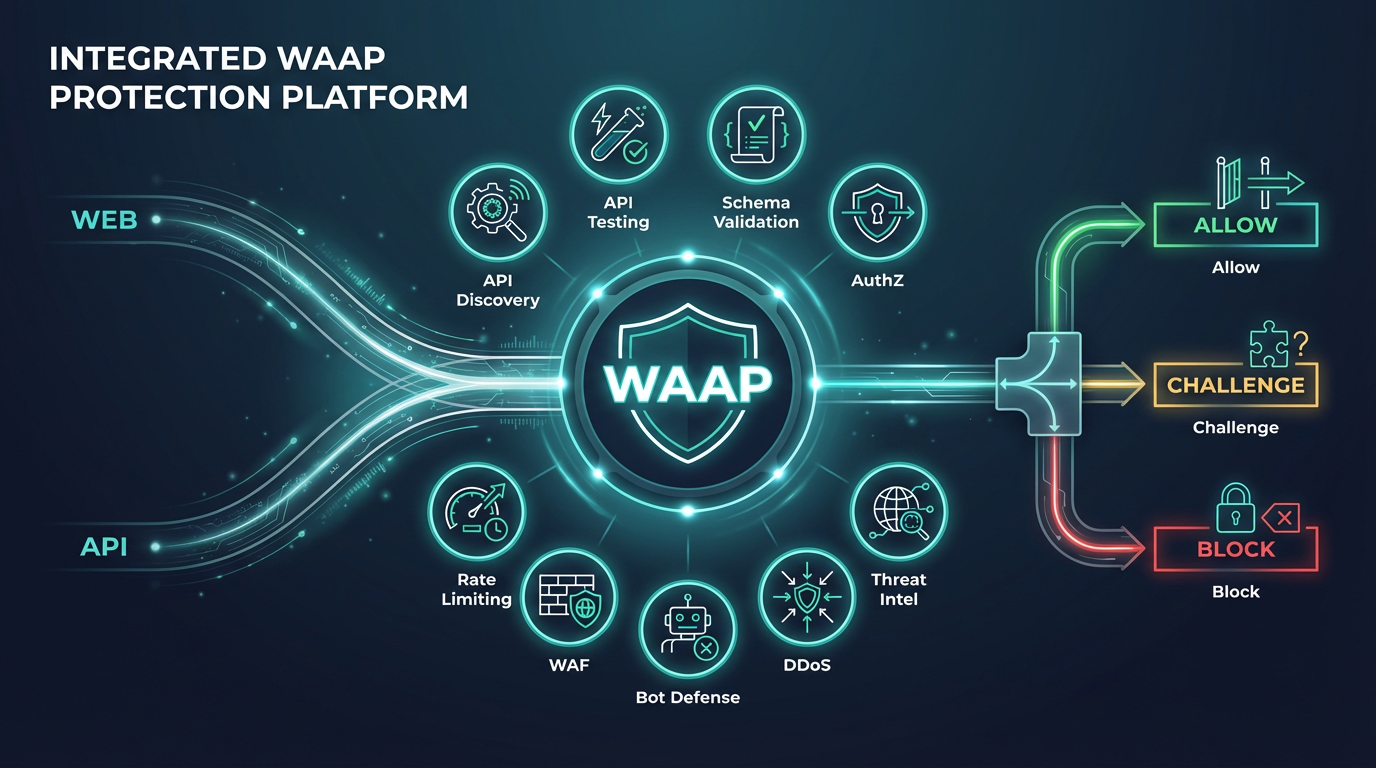
Web Application and API Protection (WAAP) is a modern cybersecurity approach designed to protect web applications and APIs from a wide range of threats.
Instead of relying on a single layer of defense like a network firewall, WAAP combines multiple security technologies into a unified solution to safeguard modern cloud- and AI-native designs.
At its core, WAAP protects against:
- Application-layer attacks (like SQL injection and cross-site scripting)
- API-specific exploitation and data exposures
- Bots, abuse, and automated threats
- Distributed Denial-of-Service (DDoS) attacks
In simple terms:
WAAP ensures that the apps and APIs powering your business stay secure, available, and trustworthy.
Why WAAP Matters More Than Ever
The need for WAAP isn’t just theoretical. It’s driven by real shifts in how applications are built and operated today.
1. The Explosion of APIs
APIs are now the backbone of digital ecosystems. They allow different systems to communicate, power mobile apps, and enable integrations between platforms.
However, APIs are often:
- Poorly documented
- Exposed to the public internet
- Lacking strong authentication
This makes them a prime target for attackers.
2. Cloud and Microservices Architecture
Modern applications are no longer monolithic. They’re built using microservices distributed across cloud environments.
While this improves scalability and flexibility, it also:
- Increases the number of endpoints
- Makes security visibility more difficult
- Expands the attack surface significantly
3. Sophisticated Cyber Threats
Attackers today use automation, AI, and large-scale bot networks to exploit vulnerabilities faster than ever.
They’re not just targeting infrastructure. They’re targeting:
- Login forms
- Payment systems
- Data flows
- User sessions
4. Limitations of Traditional Security
Older security tools, such as network firewalls and basic WAFs, were designed for simpler environments. They often:
- Rely on static rules and attack signatures
- Lack context about user behavior
- Struggle to detect modern attack patterns
WAAP fills this gap by offering adaptive, intelligent, and application-aware protection.
The Core Components of WAAP
WAAP isn’t a single tool. It’s a collection of advanced security capabilities working together. Let’s explore each one in more detail.
1. Web Application Firewall (WAF)
A Web Application Firewall (WAF) is one of the foundational layers of WAAP.
It inspects incoming HTTP and HTTPS traffic and filters out malicious requests before they reach your application. But modern WAAP goes far beyond simple rule matching.
They now incorporate:
- Behavioral analysis
- Machine learning-powered detections
- Context-aware filtering
This allows them to detect not only known threats but also suspicious patterns that may indicate new or evolving attacks.
For example, if a user suddenly submits hundreds of unusual requests in a short time, a modern WAAP can flag and block that behavior, even if it doesn’t match a known attack signature.
2. API Security
APIs are one of the most critical and vulnerable parts of modern systems.
WAAP provides dedicated API security that goes beyond traditional protections by focusing on how APIs operate.
Key capabilities include:
- API Discovery
Identifies all APIs in your environment, including undocumented or “shadow” APIs that developers may have deployed without formal tracking as well as “zombie” APIs” that were abandoned. - API Schema Validation
Ensures that incoming requests follow the expected structure, preventing attackers from sending malformed or malicious data. - Authentication and Authorization Enforcement
Verifies that only authorized users and systems can access specific API endpoints. - API Attack Prevention
Prevents requests that exploit API functionality or extract sensitive data, including risks defined in the OWASP API Security Top 10.
This WAAP layer is crucial to application security because many breaches today occur as a result of poorly secured APIs.
3. Bot & Abuse Protection
Bots and automation account for a significant portion of internet traffic, and not all of them are friendly.
WAAP includes advanced bot & abuse protectionthat can distinguish between:
- Acceptable bot behavior (search engines, monitoring tools)
- Undesirable bot behavior (scrapers, account-targeting, transaction fraud)
Instead of blocking all automated traffic, WAAP uses techniques like:
- Behavioral analysis
- Device fingerprinting
- Interaction patterns
This allows it to:
- Block malicious bot behavior
- Challenge suspicious activity (e.g., insert CAPTCHA dynamically into an application flow)
- Allow legitimate automation
4. DDoS Protection
Distributed Denial-of-Service (DDoS) attacks aim to flood your system with traffic until it crashes or becomes unavailable.
WAAP provides robust DDoS protection by:
- Detecting abnormal traffic spikes
- Filtering malicious requests
- Distributing traffic across infrastructure
- Automatically scaling defenses
This ensures that your application remains accessible, even under heavy attack conditions.
5. Application Threat Intelligence and Analytics
One of WAAP’s most powerful features is its ability to provide deep visibility into application threats.
Instead of simply blocking attacks, WAAP helps you understand:
- Where attacks are coming from
- What methods are being used
- Which API endpoints are being targeted
- How frequently attacks occur
This data enables teams to:
- Improve application runtime security
- Identify complex attack chains
- Respond faster to security incidents
How WAAP Works in Practice
Let’s walk through a simplified example of how WAAP operates behind the scenes.
- A user (or bot) sends a request to your application
- WAAP intercepts the request before it reaches your servers
- The request is analyzed using multiple layers:
- Signature-based detection
- Behavioral analysis
- Machine learning models
- WAAP assigns a risk score to the request
- Based on that score:
- Safe requests are allowed
- Suspicious requests are challenged
- Malicious requests are blocked
All of this happens in real time, often within milliseconds, ensuring both security and performance.
WAAP vs. Traditional Security Tools
Understanding the difference between WAAP and older tools helps clarify its value.
Traditional Security Tools
- Focus on protecting networks rather than applications
- Use static, rule-based detection
- Provide limited visibility into API traffic
- Struggle with modern cloud environments and AI systems
WAAP
- Focuses on application-layer security
- Protects applications, APIs, and AI
- Uses adaptive, intelligent detection methods
- Designed for distributed cloud- and AI-native systems
In essence:
WAAP is built for modern application architectures, while other security tools were built for traditional infrastructure.
Common Threats WAAP Protects Against
WAAP is designed to defend against a wide range of modern threats, including:
- Injection Attacks - Attackers insert malicious code into inputs to manipulate databases or systems.
- Cross-Site Scripting (XSS) - Malicious scripts are injected into web pages to steal user data or hijack sessions.
- API Exploitation - Attackers misuse APIs to extract sensitive data or bypass security controls.
- Credential Stuffing & Account Takeovers (ATO) - Automated bots use stolen credentials or target account logins to compromise identities and gain unauthorized access.
- DDoS Attacks - Flooding systems with traffic to disrupt availability.
- Zero-Day Attacks - Previously unknown vulnerabilities that haven’t yet been patched.
WAAP’s behavioral and AI-driven detection helps identify these even before signatures exist.
Benefits of Implementing WAAP
Adopting WAAP provides several key advantages:
- Comprehensive Protection - A unified solution that covers multiple attack vectors.
- Enhanced Visibility - Clear insights into traffic, usage patterns, and threats.
- Reduced Complexity - Eliminates the need for multiple disconnected tools and point solutions.
- Improved User Experience - Minimizes false positives, ensuring legitimate users aren’t blocked and availability is maintained.
- Scalability - Designed to grow with your applications and handle global traffic.
Who Needs WAAP?
WAAP is essential for any organization that relies on web applications or APIs, especially:
- SaaS companies
- E-commerce platforms
- Financial institutions
- Healthcare providers
- Enterprises with digital services
If your business operates online, WAAP is no longer optional and is a critical defense layer.
Best Practices for Implementing WAAP
Platform teams can't protect what they can't see, and the scale of the problem is often shocking. Most organizations discover they have three times as many APIs as they thought once they enable continuous discovery.
These enterprise API protection best practices turn visibility gaps and manual processes into automated guardrails that scale with your delivery velocity.
- Inventory everything first - Deploy continuous API discovery across all clusters and regions to eliminate shadow endpoints.
- Map sensitive data flows early - Identify which APIs handle PII, authentication, and critical business functionality before attackers do.
- Fail builds on high-severity issues: Integrate API testing into CI pipelines with contextual remediation guidance for developers.
- Enforce policies as code - Embed org-wide security rules in templates and gateway configurations, not manual reviews.
- Start with controlled rollouts - Operationalize protection for 7-10 critical services first to prove low friction before expanding.
Smart platform teams treat API protection like any other infrastructure component. Start small, automate the repetitive work, and let unified WAAP capabilities handle the scale while developers focus on shipping features.
Operationalize WAAP With Harness
Platform teams can't afford to treat API security as an afterthought when most incidents start with compromised endpoints. Harness Web Application & API Protection transforms security from a bottleneck into an automated control that fits your delivery pipelines. AI-powered detection cuts through alert noise while continuous API discovery eliminates shadow endpoints across your entire infrastructure.
The right WAAP solution integrates with your existing CI/CD workflows without creating new ticket-ops friction. Teams get runtime protection that adapts to application changes and shift-left testing that catches vulnerabilities before production.
Ready to gain full API visibility and protect applications at the speed of modern delivery? Try Harness Web Application & API Protection and see how unified API discovery, API testing, API protection, bot & abuse protection, and WAF can eliminate security toil for your application security program.
WAAP In Practice: CI/CD Integration And Governance FAQ
Platform teams need concrete answers about WAAP integration that avoid new approval workflows and maintain engineering’s ability to deliver quickly. These WAAP FAQ responses address deployment scenarios andstrengthening security posture.
How does WAAP integrate with CI/CD without slowing builds?
WAAP runs API testing as part of your existing pipeline stages, not as a separate gate, to detect issues such as those defined in the OWASP API Security Top 10. Tests run against live traffic patterns and API schemas. Builds fail only on high-severity issues like broken authentication or data exposure, following NIST guidance for automated security enforcement without review delays.
What reduces false positives compared to traditional WAF solutions?
WAAP correlates full user journeys and API call chains (the sequence of service-to-service requests) to understand user intent rather than inspecting isolated requests. Machine learning models tune to your actual application configurations and data flows, not generic signature databases. This contextual approach reduces alert noise significantly compared to rule-based WAFs and catches threats that bypass traditional detection methods.
Which deployment options work for hybrid multi-cloud environments?
Any WAAP should support agentless edge routing, in-line integration with API gateways and load balancers, and out-of-band collection via traffic mirroring or eBPF. Teams should be able to combine deployment methods for different services to support their given application architecture. Kubernetes and container environments may also require native ingress controller and sidecar support for east-west microservices traffic protection. Harness WAAP provides 30+ integrations to support modern designs.
How do you enforce governance without creating ticket-ops?
Policy-as-code templates can be used to embed WAAP deployment directly into service deployment pipelines. Teams inherit org-wide protections automatically when using approved templates, providingguardrails that scale without approval bottlenecks.
What operational overhead should platform teams expect?
AI-assisted policy generation eliminates the need for signature writing and weekly change windows. Runtime protection automatically adapts to application changes. Platform teams generally see a 60-70% reduction in security-related tickets compared to traditional WAF management. Most operational tasks shift to self-service developer workflows.
How do you measure WAAP ROI and security improvements?
WAAP provides metrics on API discovery coverage, vulnerability remediation time, and blocked attacks. Platform teams track developer velocity through build time impact and ticket reduction. Security posture improves through measurable reductions in exposed APIs, faster incident response, and more efficient compliance audits.