Harness shipped 58 features in August 2026: an agent-scale code repository, AI Code Review, AI Risks scanning, and the Blast Radius Agent.

TL;DR
- Harness shipped 58 features over 31 days in August.
- The biggest release: Harness Code Repository and AI Code Review now handle agent-scale pull requests and commit volume, with reviews grounded in your organization's own software delivery history.
- AI agents now make more calls through the Harness CLI than humans do: 500,000 agent actions against 300,000 human ones in its first few weeks live.
- A new AI Risks scanner catches prompt injection and tool poisoning hiding inside AI agent skills, the same skill directories that tools like Claude Code read from.
- Terraform and OpenTofu changes now get a risk score from 1 to 10 and a dependency graph before you hit apply.
Software used to be limited by how fast it could be written. That constraint is gone. Code generation moves at AI speed now: agents draft it, test it, and open the pull request before you or I finish our coffee!
What's not moving at AI speed yet is everything after it. Build, test, secure, deploy, optimize, each one still runs closer to human pace. That is where this month's 58 features landed. Here's everything that shipped.
This Month's Biggest Ships
- The biggest release this month: a code repository and reviewer built for agent-scale volume: Harness Code Repository now scales to thousands of pull requests and commits per second, and AI Code Review groups diffs by risk and grounds every review in your organization's own software delivery history rather than just the diff. Internally, it has already saved Harness's own engineering team more than 10,000 hours every month.
- Agents are now the primary users of Harness's own CLI: In its first few weeks live, the Harness CLI logged 500,000 actions from AI agents against 300,000 from humans. Built for coding agents as much as for developers, it now includes AI code review, single sign-on, native Windows support, and more.
- Security scanning catches up to the agent skills problem: A new AI Risks scanner reads the instructions, permissions, and dependencies inside AI agent skills and flags prompt injection, tool poisoning, and data exfiltration before any of it ships, closing a gap that traditional application security scans miss entirely.
- Infrastructure changes now come with a risk score before you apply them: The new Blast Radius Agent reads a Terraform or OpenTofu plan, scores the change from 1 to 10, and draws the dependency graph of what it could break, all before anyone types apply.
Software Delivery Agent
Move changes safely to production.
The Code Repository and Reviewer Built for Agent-Scale Volume
Two capabilities shipped together this month, because they only work if they ship together: a repository that can't absorb agent-scale commit volume just moves the bottleneck into review, and a faster review layer bolted onto a repository that chokes under the load doesn't get you anywhere.
Harness Code Repository is now built for agent-scale traffic: It's scale-tested to handle thousands of pull requests and commits per second, treats agent identities as first-class citizens, and lets teams scope exactly what an agent can access, merge, or deploy down to a specific repository, branch, or environment, the same way you'd scope a new hire. Migrating in takes a few clicks: import an entire GitHub org, GitLab group, Bitbucket workspace, or Azure DevOps project directly from the UI, or run CLI commands that bring pull requests, labels, webhooks, and branch rules along with you. Free accounts get 50 GB of storage; paid accounts get 500 GB, covering both Git and LFS.
AI Code Review reads a pull request the way a tech lead would, not line by line: It groups a diff by what actually changed logically rather than by file, ranks changes by risk so the riskiest ones surface first, and automatically writes reviewer and label suggestions. Required checks run as a mandatory gate before merge, configurable at the account, org, or project level, and can't be skipped or squashed through. It also runs against GitHub repositories directly, not just Harness Code.
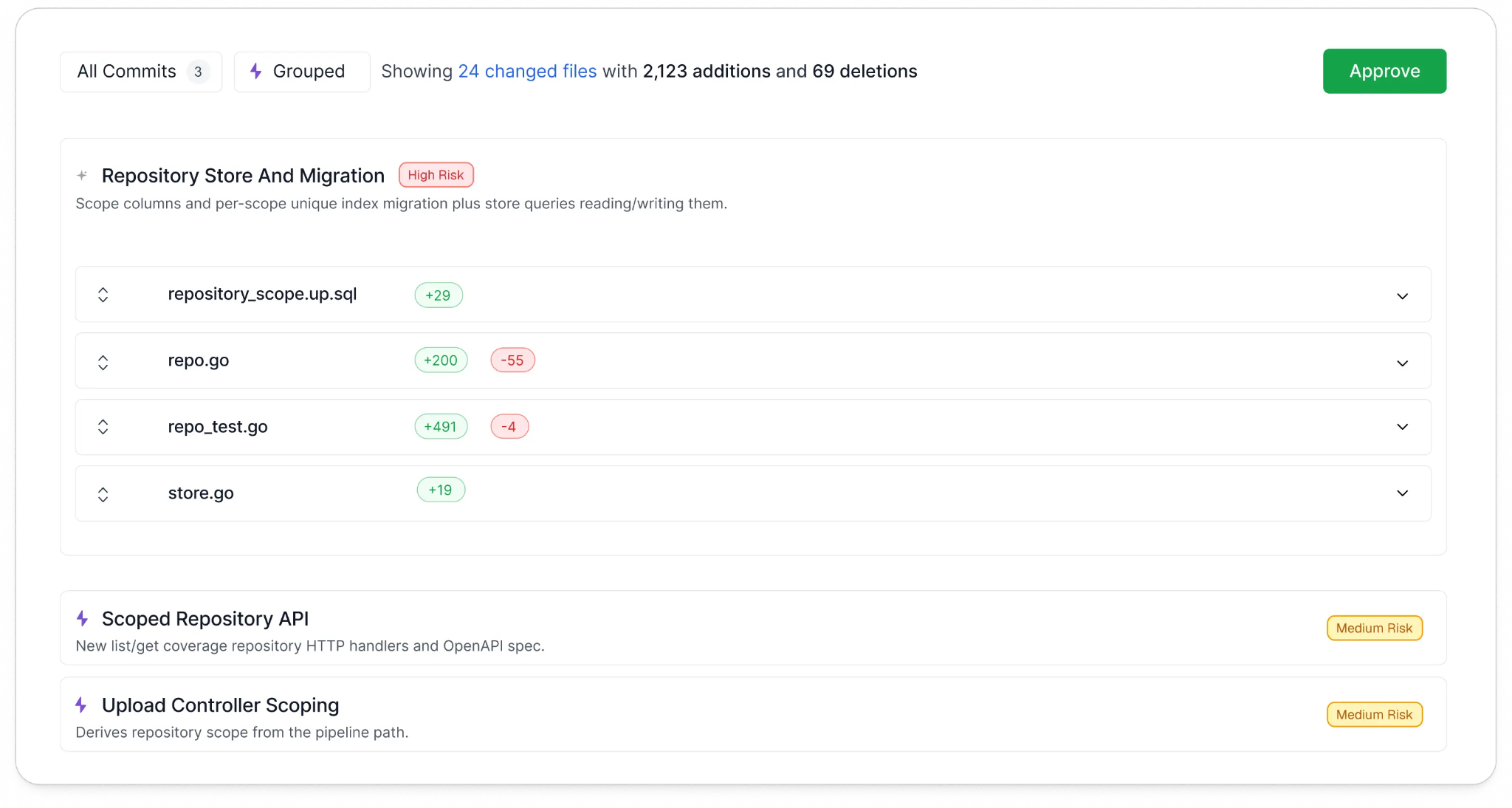
The part that's harder to copy: reviews are grounded in Harness's own record of your software delivery history, not just the diff in front of them. Harness ran this on its own pipelines first. With hundreds of developers contributing code, AI Code Review saved the engineering team more than 10,000 hours over a single month. Learn more about Agent-Ready Code Repository and AI Code Review.
Infrastructure Changes That Show Their Blast Radius Before You Apply Them
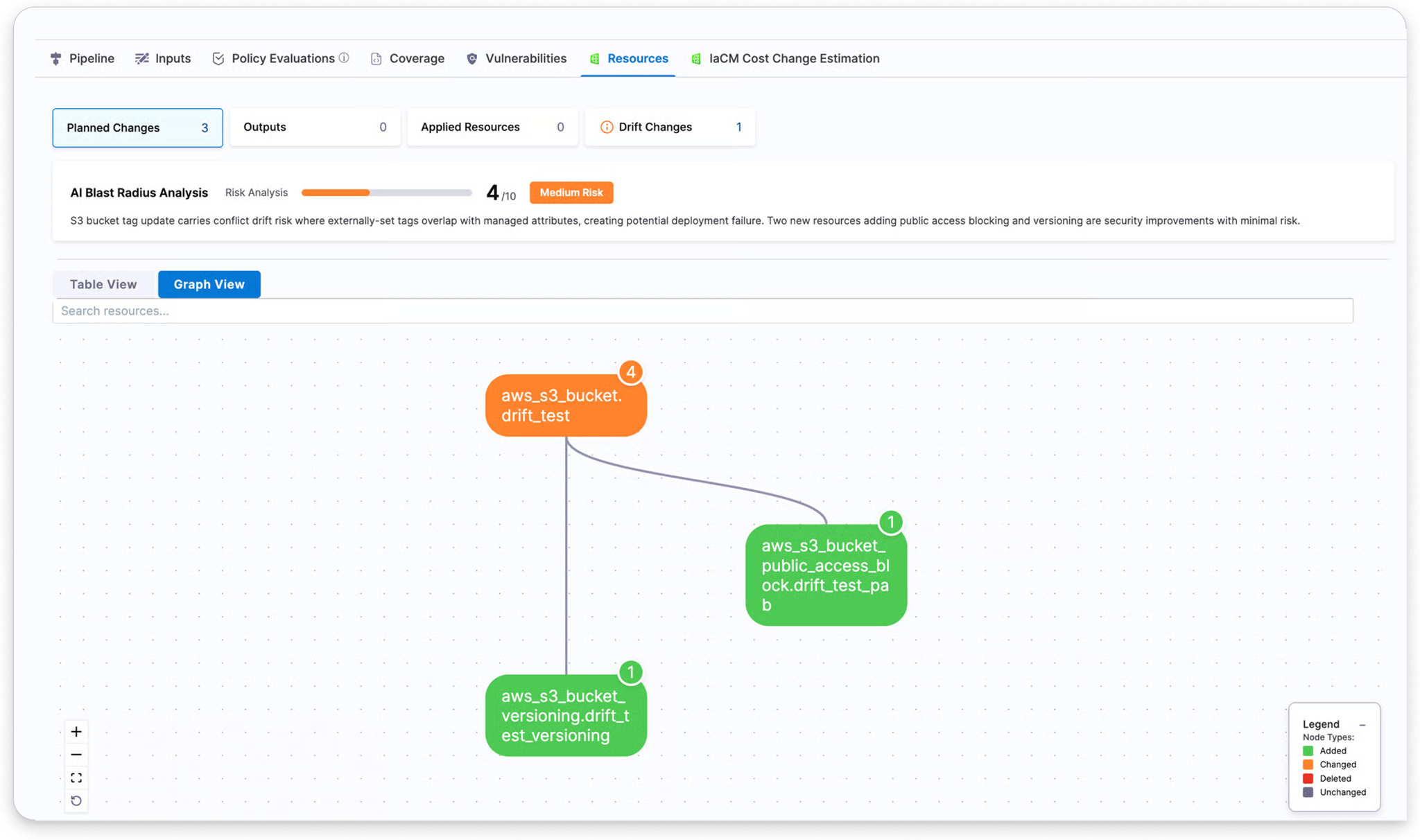
AI Blast Radius Agent runs immediately after a Terraform or OpenTofu plan and scores the risk of the change from 1 to 10, combining resource dependency analysis with AI reasoning to flag the main risk drivers. An interactive dependency graph shows exactly how the change propagates before anyone applies it. Learn more about the Blast Radius Agent.
IaC Remediation Agent reads a drift finding, where live infrastructure has diverged from your Terraform or OpenTofu configuration, and opens a pull request with the exact changes needed to bring it back in line. Nothing in your infrastructure changes until that PR is reviewed and merged. Learn more about the Remediation Agent.
Insights tab puts drift findings and, when Cloud Cost Management is connected, cost optimization opportunities in one place for each workspace, with an "Apply with agent" button on every open insight that kicks off the remediation above. Learn more about the Insights tab.
Workspace Overview was redesigned to surface resource counts, live cloud costs, optimization opportunities, provisioner details, and recent activity at a glance, with a toggle to pull real cost data in from Cloud Cost Management. Learn more about Workspace Overview.
Ephemeral Workspaces reached limited general availability. Infrastructure for expired workspaces tears itself down automatically, and the workspace record can delete itself after a configurable delay. Learn more about Ephemeral Workspaces.
Database Changes Get Reviewed Like Code
AI Impact Analysis puts a worker agent in front of every SQL change to check for the patterns that most commonly cause production downtime, then either clears it automatically or routes it to a human reviewer. Learn more about AI Impact Analysis.
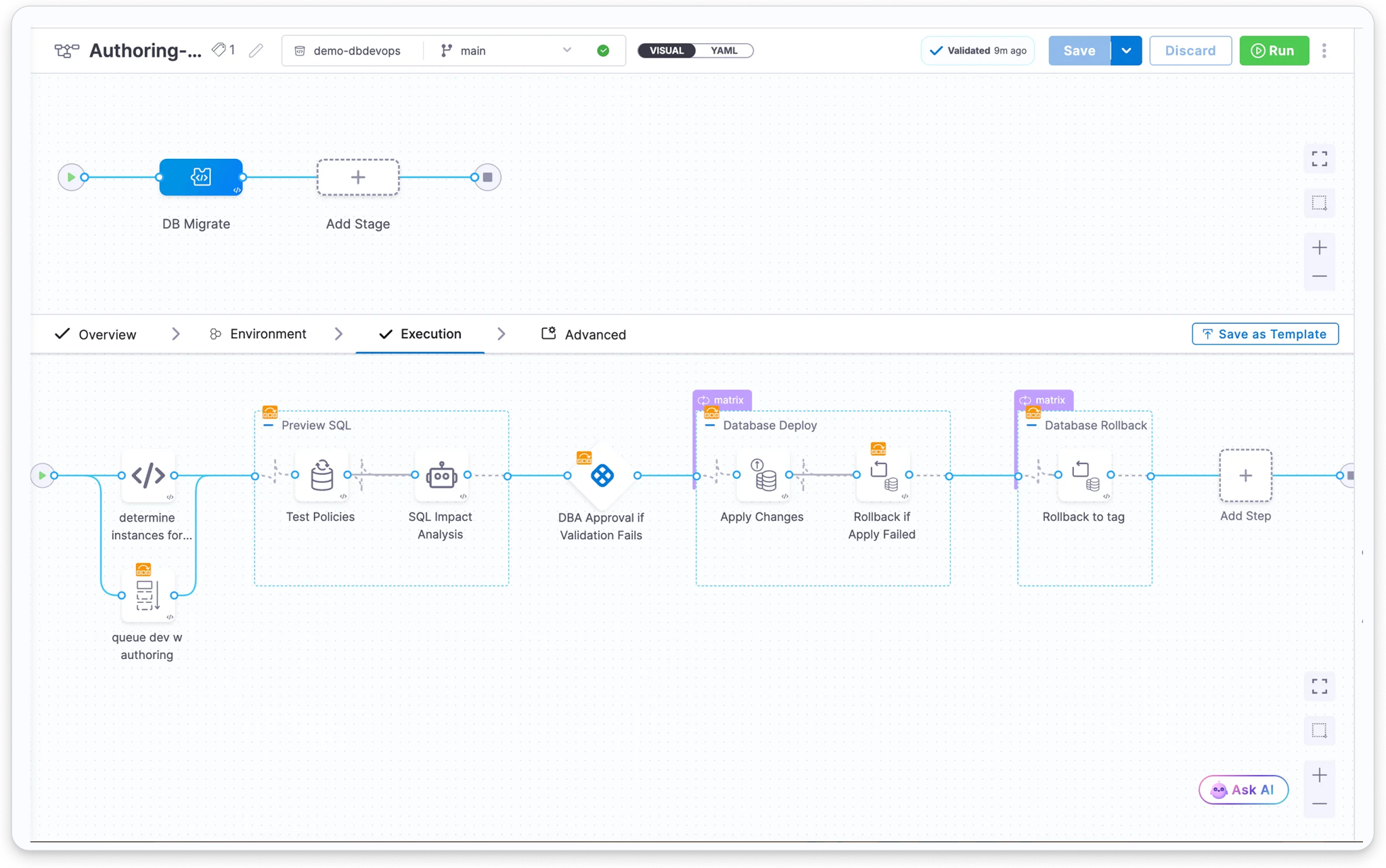
Native executors for Oracle and MSSQL run changes through the database vendor's own CLI tools, so vendor-specific syntax, GO in SQL Server, apex commands in Oracle, work without rewriting scripts to route around it.
Smaller database updates: Author DB Change now runs on the current Harness AI platform for better stability with rules and external MCP servers, and drone images can now be pinned from the project settings UI instead of the API only.
Deploys and Builds With Fewer Surprises
Helm's newest major version is now supported for Harness CD deployments, picking up Server-Side Apply, wait strategies based on kstatus, and an improved plugin system. Existing service configurations don't need manual updates: deprecated flags translate automatically. Learn more about Continuous Delivery updates.
onSave policy checks now run the moment someone commits a service, environment, infrastructure definition, or override straight to Git, not only when it changes inside Harness, and can block a pipeline at the step level, the instant the entity fails the check.
Workload Identity for CI Run steps authenticates to AWS, GCP, Azure, and Vault over OIDC with no connector required. Define an identities block in your Run step, and Harness handles minting and federating the token. Learn more about Continuous Integration updates.
Harness Cloud pricing drops across most resource classes: macOS support moves to Apple M4 hardware, and gets about 40% cheaper. Windows pricing drops roughly 33%. Most Linux tiers drop by as much as 20%, and new 2-core and 4-core Linux tiers cover lighter workloads at a lower cost. The one increase: the Linux 8-core tier moves from $0.010 to $0.020 per minute, bringing it in line with per-core pricing on the rest of the Linux fleet. Customers on active Cloud Credits, DOE, or Flex contracts keep their current 8-core pricing and existing discounts. Learn more about Harness Cloud pricing.
Smaller build and pipeline updates: resource overrides for build and cache intelligence plus Azure Blob Storage caching in existing pipeline configurations, refreshed default cloud build images (macOS moved to Sequoia, Linux to Ubuntu 24.04, with the older macOS image now deprecated), internal CA certificate support for Windows build pods, and two rounds of egress proxy fixes covering build and push steps and secret resolution.
More Package Types, One Registry
Artifact Registry now supports six more package types: Conan (beta), RubyGems, R (CRAN), Terraform modules and providers, and Alpine and Wolfi Linux packages, each with full UI support, upstream proxy integration, and CLI setup instructions. Learn more about Artifact Registry package support.
Security Testing Agent
Catching the Risks AI Agents Introduce Before They Ship
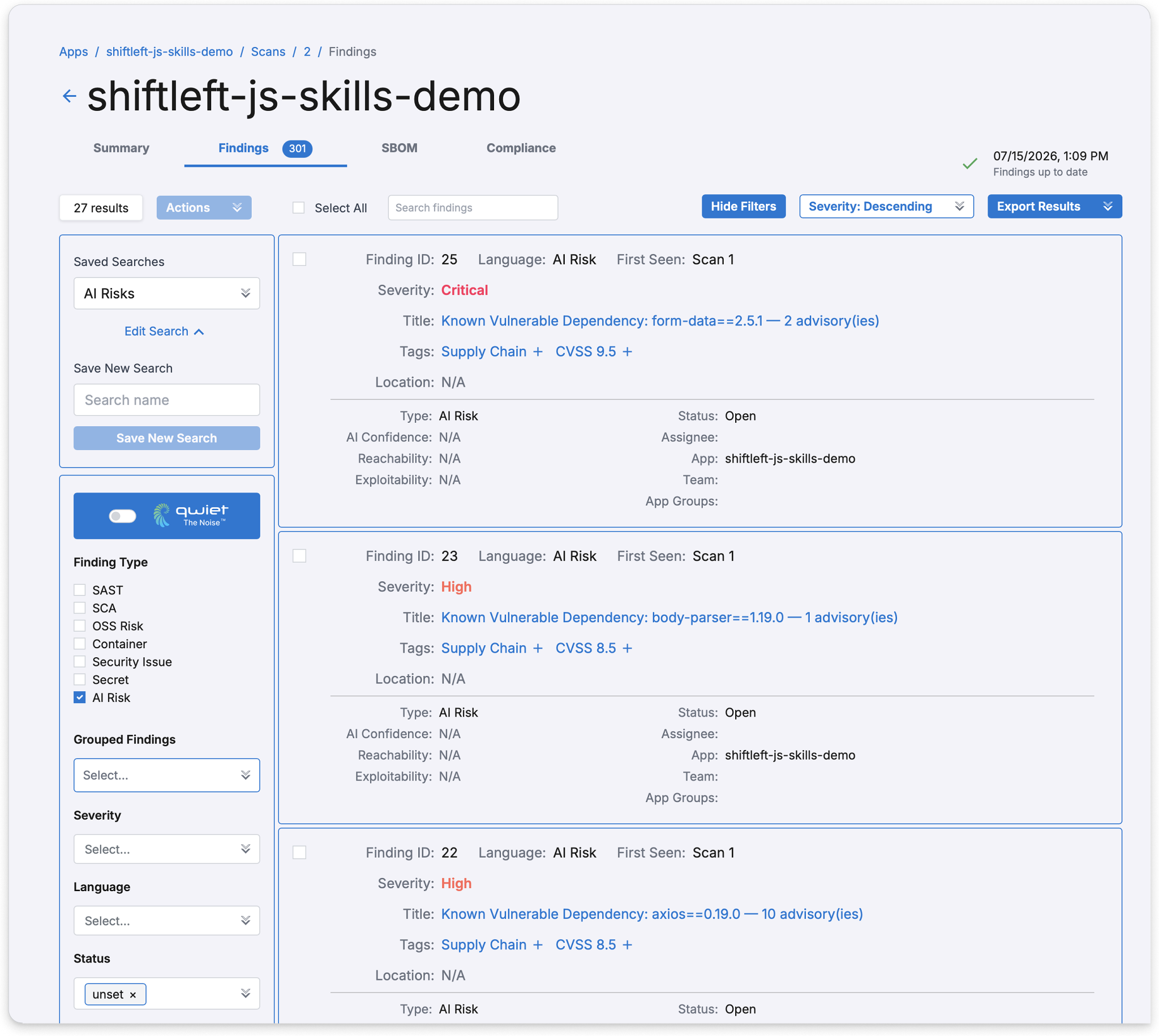
AI Risks analyzes agent skill directories directly inside application repositories and flags prompt injection, data exfiltration, excessive agency, tool misuse, supply chain vulnerabilities, and MCP tool poisoning, the same skill directories that tools like Claude Code read from, with evidence and remediation guidance attached to every finding. Configurable at the org or application level. Learn more about AI Risks scanning.
Closing the Loop From Vulnerability to Fix
GitLab and Bitbucket now get automated vulnerability remediation pull requests, the same capability GitHub users have had through tools like Dependabot for years. AI generates the fix and opens the PR directly in the repository. Learn more about AI-based remediation.
Contextual Severity and Severity Override factor in how a vulnerability is actually used inside your specific application, not just its theoretical CVSS score, so a critical CVE sitting in dead code no longer ranks the same as one on a live execution path. Built off a direct request from The Home Depot. Teams can still manually override the score when their own risk judgment disagrees. Learn more about Contextual Severity.
Enhanced Static Reachability now shows the actual call path from your application's entry point to a vulnerable function, and whether attacker-controlled data can reach it, instead of just confirming the vulnerable dependency is technically present. Learn more about Enhanced Static Reachability.
Package Age Policy Enforcement lets teams write policy rules that block newly published packages from entering the software supply chain before they've had time to prove they aren't malicious. Learn more about Package Age Policy Enforcement.
Runtime Protection Agent
Find and fix risk before production.
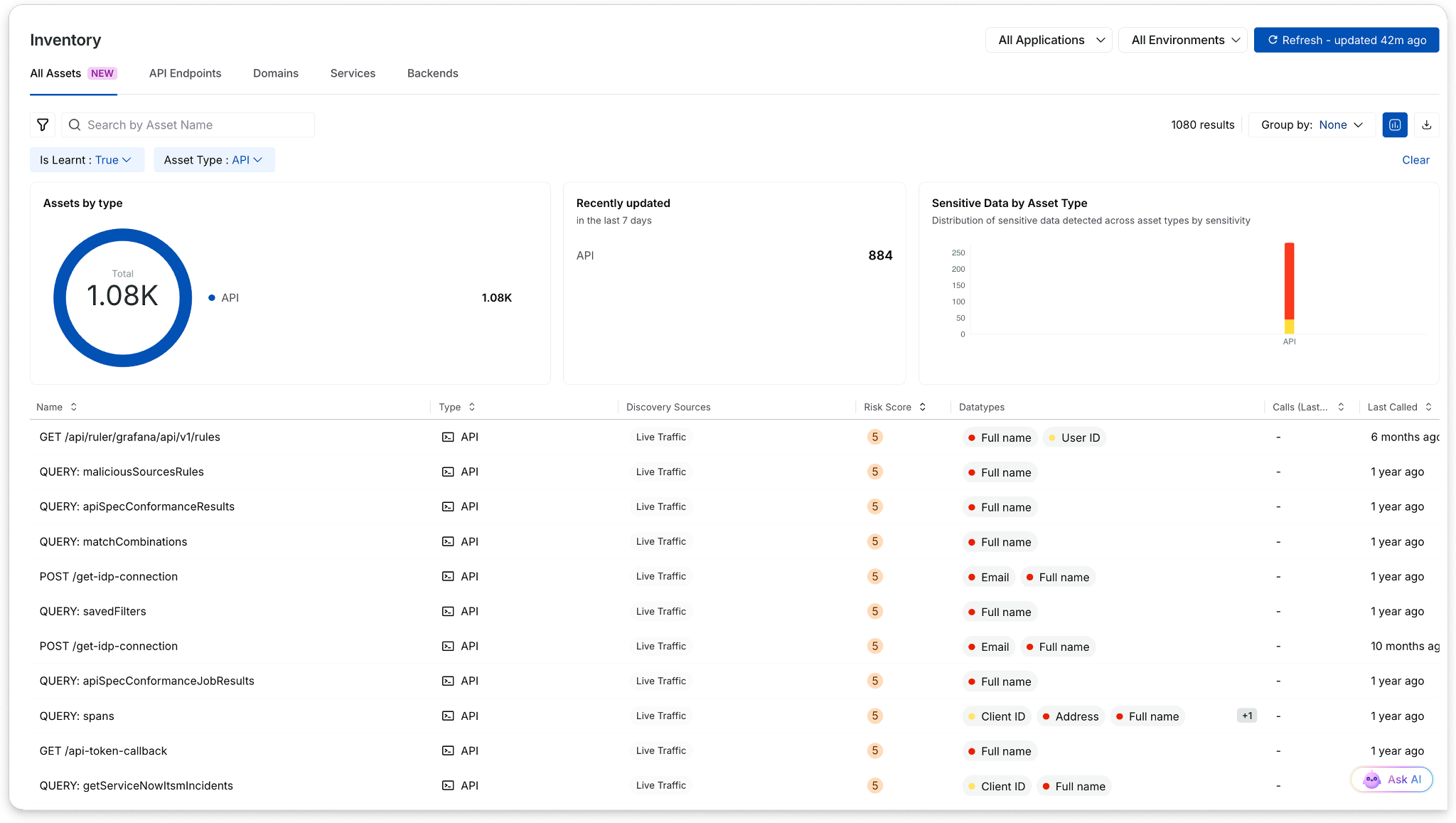
Unified API Inventory combines discoveries from runtime traffic, code repositories, and API documentation into one correlated view of your API attack surface, instead of three separate ones. Learn more about Unified API Inventory.
Virtual Patching connects API security testing directly to your web application firewall. When a scan turns up a vulnerability that can't be fixed right away, generate a targeted WAF rule from that finding and block exploitation in real time until the actual code fix ships.
Scan Recommendation now flags common scan configuration problems automatically and tells you how to fix them, lifting scan completion rates and coverage without a human combing through logs. Learn more about Scan Recommendation.
MCP Discovery and Shadow MCP Detection are now generally available. Security teams can see every MCP server, tool, resource, and prompt running in live traffic, compare it against what's actually documented, and catch anything undocumented before it turns into sprawl. Learn more about MCP Discovery.
Platform Updates
The Command Line Built for Agents as Much as Humans
The Harness CLI got its biggest update since launch.
- AI code review and code migration now run directly against Harness Code repositories from the terminal. Learn more about the Harness CLI.
- Single sign-on through Harness ID means developers and agents authenticate the same way they log into everything else.
- Native Windows support shipped, with Homebrew installation for macOS following shortly after.
- Coverage extended to two more product areas: GitOps and Resilience Testing.
- The number worth sitting with: 500,000 agent actions against 300,000 human ones in the CLI's first few weeks live. Agents are already the heavier users of Harness's own command line. Command line reference.
Harness AI Chat Reaches Further
Harness AI Chat now runs inside the IDE, in VS Code, Cursor, and Devin, pulling context from whichever pipeline you're viewing and calling your own MCP connectors instead of only Harness's defaults.
Harness AI Chat can now reach outside Harness entirely. A new MCP Gateway lets a single chat conversation call connected third-party apps like GitHub, Jira, and Confluence directly: sync a YAML file, open a pull request, update a ticket, all without leaving the conversation. It runs on the RBAC, secrets, and connectors already configured in Harness, so a user only ever sees the apps they already have access to, and admins can mark each tool call as allowed, needing approval, or blocked. Learn more about the MCP Gateway.
The open-source Harness MCP Server shipped several rounds of updates this month, expanding coverage across infrastructure-as-code workspaces, variable sets, and module registries; Chaos Engineering service management with full Locust, K6, and JMeter load-test authoring; remediation diffs for security testing; account- and org-scoped policies; and feature-flag scope migration. New MCP tools also let agents pull AI-SRE alert context directly, alongside fixes to URL resolution, user lookups, and tool-scope error messages. Learn more on GitHub.
Seeing Where Adoption Actually Stands
Usage Analytics is a new centralized dashboard that shows how deeply each team has adopted every Harness capability, so leaders can validate actual usage rather than guessing.
Dashboards were rebuilt from the ground up, AI-native. Describe what you want, and AI builds or updates the dashboard and its widgets, or build visually, or write your own queries for advanced cases. Ask the Knowledge Graph a question in natural language and turn the answer into a dashboard you track over time. Filters now work across data sources, with one-time exports and scheduled sends, and access control works at the data level, not just the dashboard level. Out-of-the-box dashboards ship for CI, CD, pipelines, and application security testing, with more added as additional modules migrate over. Learn more about the new dashboards.
Other Product Updates
A Developer Portal That Mirrors How Your Org Actually Works
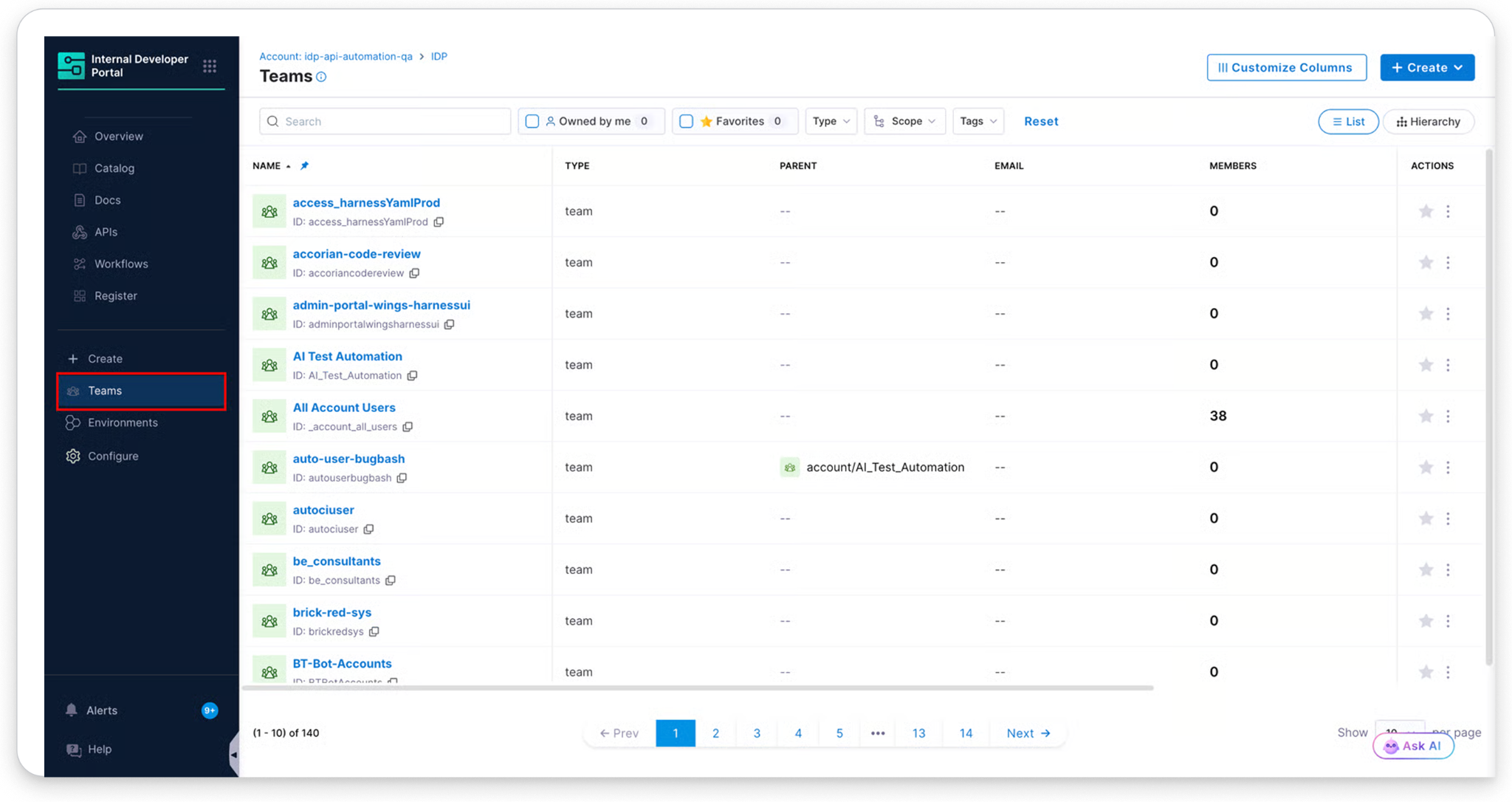
Teams brings your actual org structure, crews, squads, platform teams, and cross-functional units into the software catalog as first-class entities, so ownership and access map to how the company is really organized instead of an idealized chart. Learn more about Teams.
Custom Integrations push operational data from any external tool into the catalog and display it against the right service, without touching that service's own metadata. Learn more about Custom Integrations.
Custom Metrics push your own time-series data in and render it as charts directly on the catalog entity page, using the same correlation model as Custom Integrations. Learn more about Custom Metrics.
Kubernetes service pages now show autoscaling and routing. HPA replica counts and scaling metrics, plus Ingress rules and Istio VirtualServices and Gateways, once the updated discovery agent is installed. Learn more about Kubernetes catalog discovery.
Resilience Testing That Starts Before You Ask For It
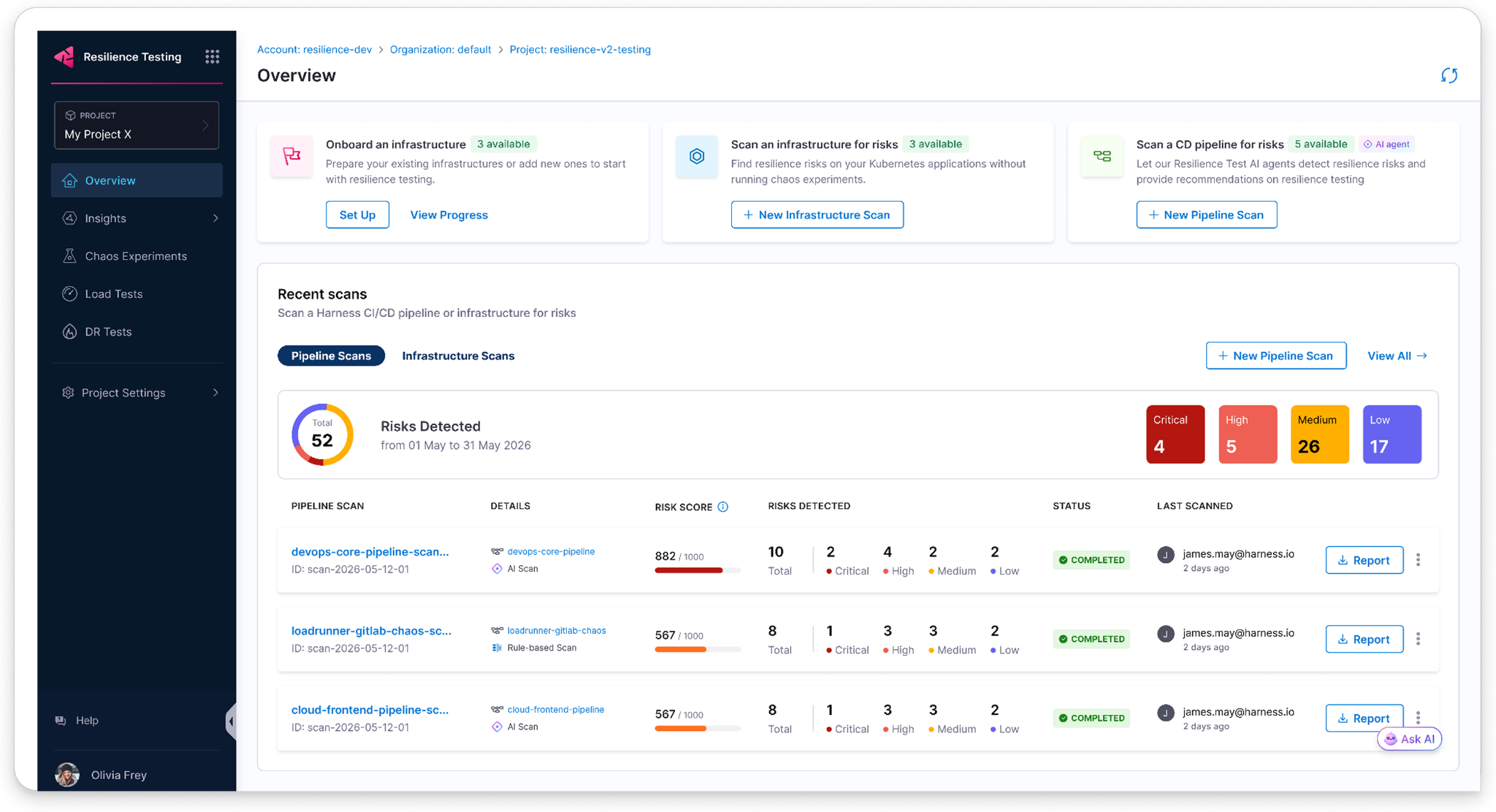
AI agents for Resilience Testing are now available to every Harness CD customer. They passively scan CD pipelines and Kubernetes workloads with no instrumentation or fault injection required, flag risks the moment a cluster connects, track a Resilience Score per service over time, and can write load tests in Java, JavaScript, or Python. A free tier shipped alongside it, with the full fault library, hosting, and RBAC included, undercutting what teams typically pay for chaos engineering tooling from vendors like Gremlin. Learn more about automated resilience risk detection.
Feature Flags Get a Metric-Based Guardrail
Feature flag rollouts can now gate on a Metric Check pipeline step, a guardrail pattern similar to what LaunchDarkly popularized with guarded rollouts: evaluate a flag's real performance metrics mid-pipeline and stop the rollout automatically if they slip. Learn more about the Metric Check step.
Feature flag changes can now be scheduled for a future timestamp via the API, rather than executing immediately upon approval. Learn more about scheduled change requests.
Closing
The Blast Radius Agent scores infrastructure risk before anyone hits the apply button. AI Risks catches prompt injection hiding inside agent skills before it ships. The Remediation Agent opens a pull request rather than modifying production directly. AI Code Review grounds every flag in your organization's incident history rather than guessing from the diff. All of it scoped, all of it audited, all of it still running at the speed the rest of the pipeline is trying to catch up to.
That's the actual bet this month: features that don't make you choose between speed and safety. Look out for more such features next month!