Run enterprise Builds on Harness Cloud Runners with Private Connectivity for internal systems and Outbound Egress Controls to restrict external destinations.

Cloud builds eliminate much of the work involved in provisioning, maintaining, and scaling CI infrastructure. But for many enterprises, moving builds to the cloud isn't simply a question of compute capacity. Build pipelines often depend on private repositories, internal artifact registries, databases, and services that aren't accessible from the public internet. Security teams may also require strict controls over which external systems build machines can communicate with. These requirements have kept many organizations running CI workloads on self-managed virtual machines and Kubernetes clusters, Meanwhile, demand for Cloud Runners infrastructure continues to grow.
As developers and coding agents generate more changes, every additional pull request creates more work for build and test systems. Anthropic recently reported a 25x increase in CI jobs over six months, demonstrating how quickly infrastructure demands can change when coding agents become part of software development. For platform teams, this creates a growing operational burden: more machines to provision, more capacity to manage, and more infrastructure to maintain. The opportunity is to scale build execution without scaling the infrastructure teams responsible for running it, while preserving the security controls enterprises require.
What's new in Harness Cloud Runners
Harness Cloud Runners gives enterprise teams fully managed build infrastructure, so they can run CI workloads without provisioning or maintaining their own machines.Cloud Runners extend that model to enterprises with stricter network requirements, running builds on Harness-managed infrastructure while fitting into the way those organizations already control access.
Now, Cloud Runners support private connectivity and outbound egress control. Builds can securely reach private repositories, artifact registries, databases, and other internal services without exposing any of them to the public internet. Security and platform teams can also define which external HTTP and HTTPS destinations those builds are allowed to reach.
With these additions, enterprises can run more builds on fully managed infrastructure and scale build execution without operating their own build fleet, while staying compliant with essential organizational network security policies.
Securely access private infrastructure from cloud-hosted builds
Harness Cloud Private Connectivity allows builds running on Harness-managed infrastructure to securely communicate with privately addressed systems through an encrypted network, without requiring those systems to have public endpoints. For example, consider a pipeline that needs to retrieve source code from a private Git repository, download dependencies from an internal artifact registry, and run integration tests against a database inside a corporate network.
Previously, organizations might have kept these builds on self-managed infrastructure or relied on custom VPN connections, networking scripts, cloud-specific connectivity solutions, and manually maintained IP allow lists. With Harness Cloud Private Connectivity, the build can run on Harness Cloud while accessing the required private resources through a Tailscale-powered encrypted overlay network.
The connection works through three components:
- Harness Cloud build VM: Runs the build or test workload in Harness-managed infrastructure.
- Encrypted private network: Establishes a secure connection using Tailscale without exposing internal resources through public inbound endpoints.
- Customer-managed connectivity appliance: Provides access to approved private networks or applications, using configured routes, domains, and existing security controls.
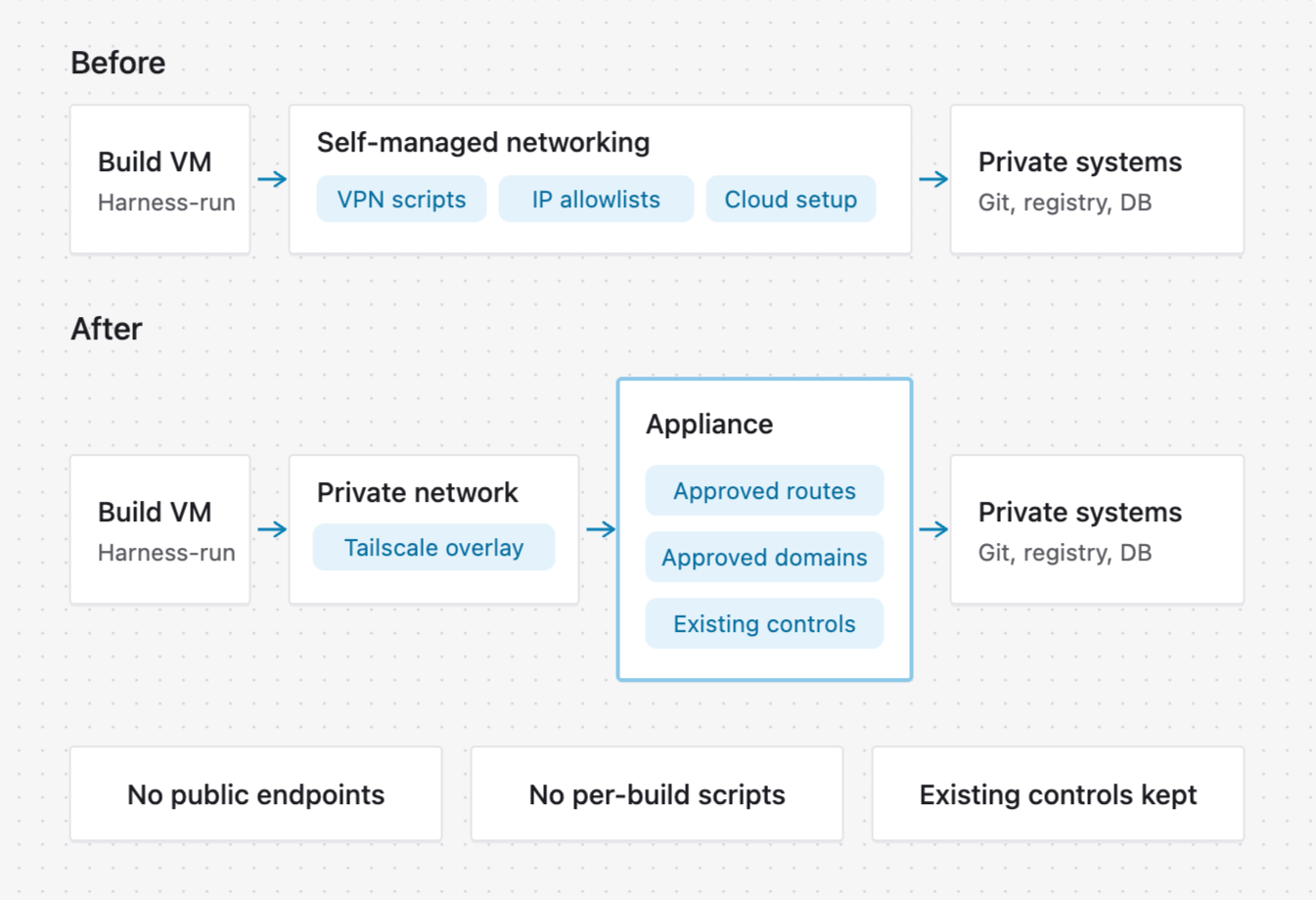
This can reduce reliance on per-build VPN scripts, public IP allowlisting, customer-managed VPN connections, and complex cloud-specific private networking configurations.
Control where cloud-hosted builds can connect
Harness Cloud Outbound Egress Controls allow security and platform teams to restrict outbound HTTP and HTTPS traffic from supported build machines to approved external destinations. Build pipelines routinely download packages, retrieve container images, communicate with external APIs, and execute scripts that make network requests.
Without outbound network policies, those requests may reach destinations that haven't been approved by the organization's security team. Outbound Egress Controls give enterprises a way to apply consistent restrictions across supported Harness Cloud builds.
Using Harness API Advanced Protection, security teams can protect any external-facing cloud-hosted builds they can access. They can also create policies to allow trusted interactions and block unauthorized requests, with precise controls down to individual URLs and paths.
Security teams can:
- Allow approved destinations: Permit access to trusted package repositories, artifact registries, and external APIs.
- Block unauthorized destinations: Prevent HTTP/HTTPS requests from reaching external resources that aren't approved.
- Apply granular restrictions: Define rules using domains, URLs, or specific URL paths, including individual repository paths.
- Centrally manage policies: Configure account-wide rules that apply consistently across supported Harness Cloud build machines.
- Review outbound traffic: Identify destinations accessed during builds to help refine policies and investigate unexpected requests.
Example: Restrict builds to approved package sources
A security team may want builds to download dependencies only from an approved package registry.
An illustrative policy could look like this:
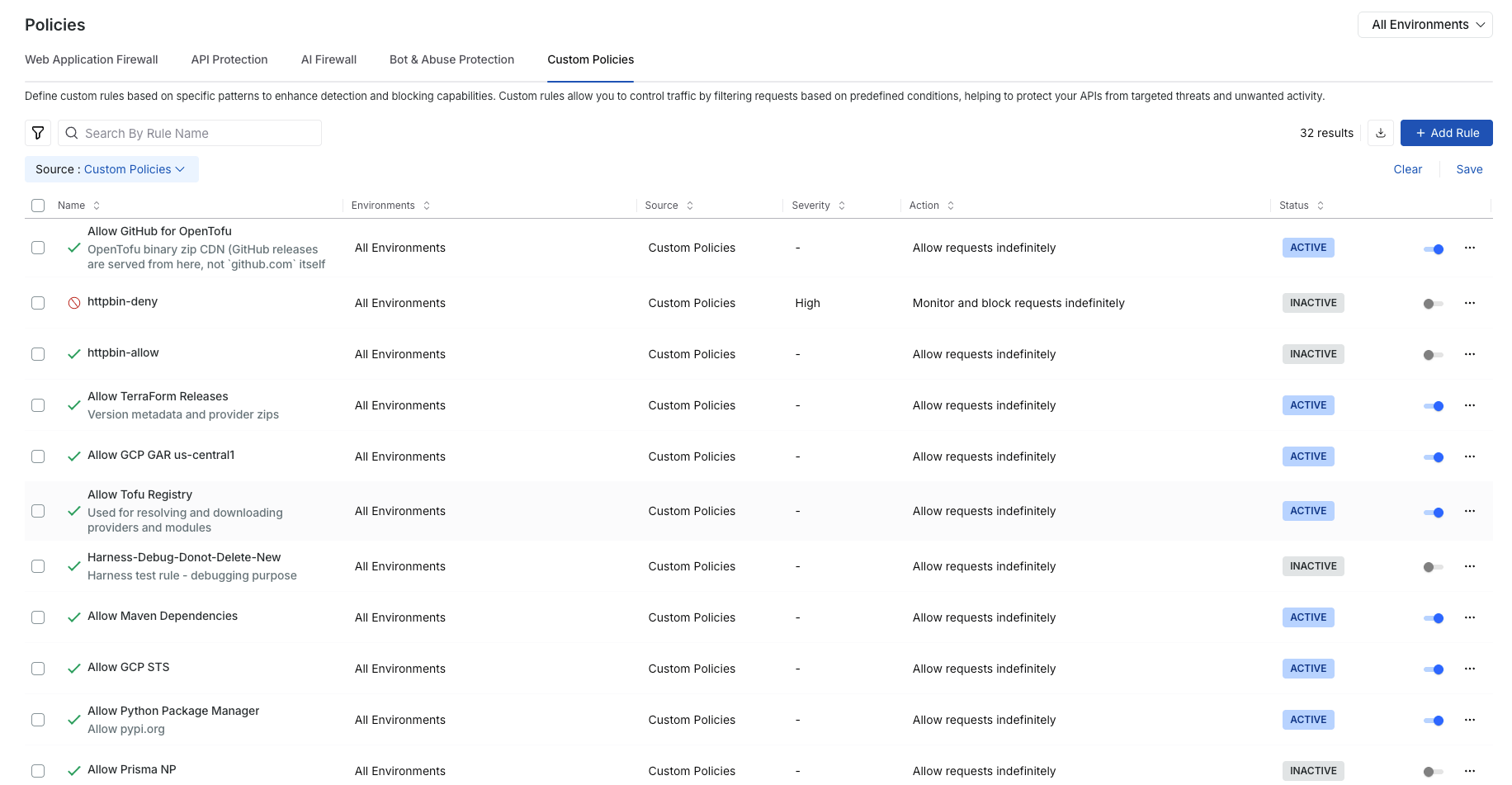
Administrators configure the actual allow and block rules through the Harness console. Allow rules take precedence over block rules, enabling an allowlist with a default-deny policy. Before introducing a default-deny policy, teams can review existing traffic and identify required dependencies to avoid disrupting legitimate builds.
Policies apply at the account level across supported Linux and Windows hosted build machines, without requiring modifications to individual pipelines. This gives security teams centralized control over outbound HTTP/HTTPS communication while allowing developers to continue using managed build infrastructure.
Scale build execution as developers and agents generate more code
AI-powered software factories can only move as fast as the systems that build, test, and validate their code. More code shouldn't mean more infrastructure to manage, longer build queues, or compromises in security. Harness Cloud Runners helps enterprises scale build execution with secure access to private systems, controlled outbound traffic, and fully managed infrastructure. Harness Builds provides the quality feedback, while Software Delivery Agent can act on that feedback to drive fixes and keep delivery moving. The result: less time managing infrastructure, faster feedback on every change, and a software factory that can scale without sacrificing security or quality. Ready to scale your software factory without compromising security? Explore Harness Cloud Runners, or talk to your Harness account team to review availability and requirements.