RT Agents detect resilience risk in your CD pipelines and Kubernetes workloads, then generate and run chaos experiments or load tests to confirm it.

Resilience Testing (RT) Agents scan your CD pipelines and Kubernetes workloads for resilience risk before it reaches production, then generate and run the chaos experiments or load tests needed to confirm it.
What We're Announcing
We're announcing a major update to our Resilience Testing called RT Agents. Instead of handing you a testing tool and a blank page, our agents now do the first part of the work, often the hardest part, for you. They continuously analyze your deployment pipelines and infrastructure to predict where resilience risks are hiding, tell you exactly what kind of testing is needed to prove it, and recommend next steps. From there, you decide where to take action. When you do, the agents help you get there: generating the chaos experiments and load tests, running them, and reading the results, so you don't have to start from scratch.
Resilience Testing no longer has to start from zero. Harness finds the risk and helps you act on it, directly in your existing pipeline.
Key Features
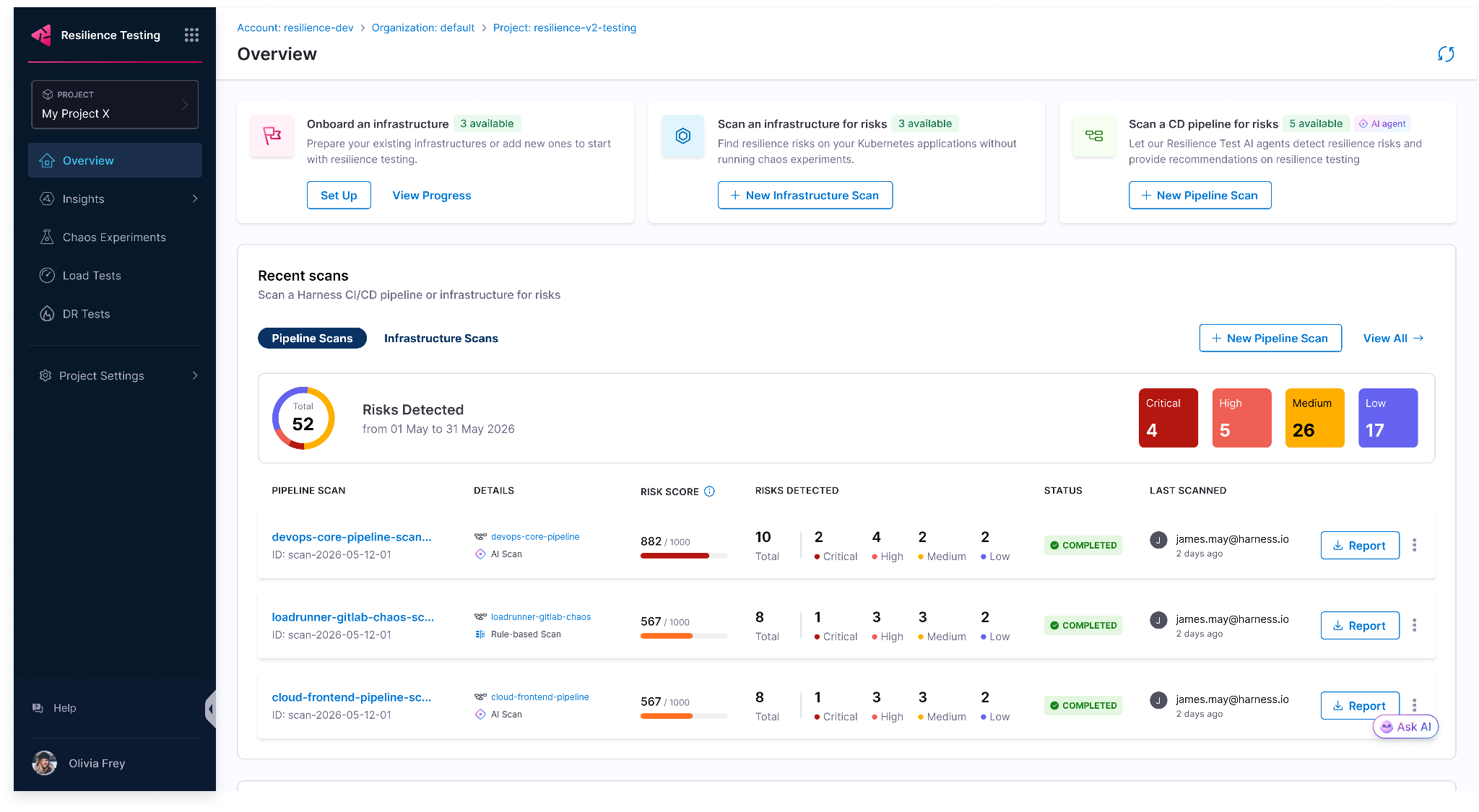
Passive risk detection in your Harness Continuous Delivery (CD) pipelines
If you're a Harness CD user, this shows up as Agentic Resilience inside the pipeline you already run. RT Agents continuously read your deployment configuration, manifests, and pipeline history to flag resilience risk as it's introduced, before it reaches production. There's nothing to instrument and nothing to run. Detection happens automatically as part of your existing CD workflow, so risk gets caught at the moment it's created instead of months later during an incident.
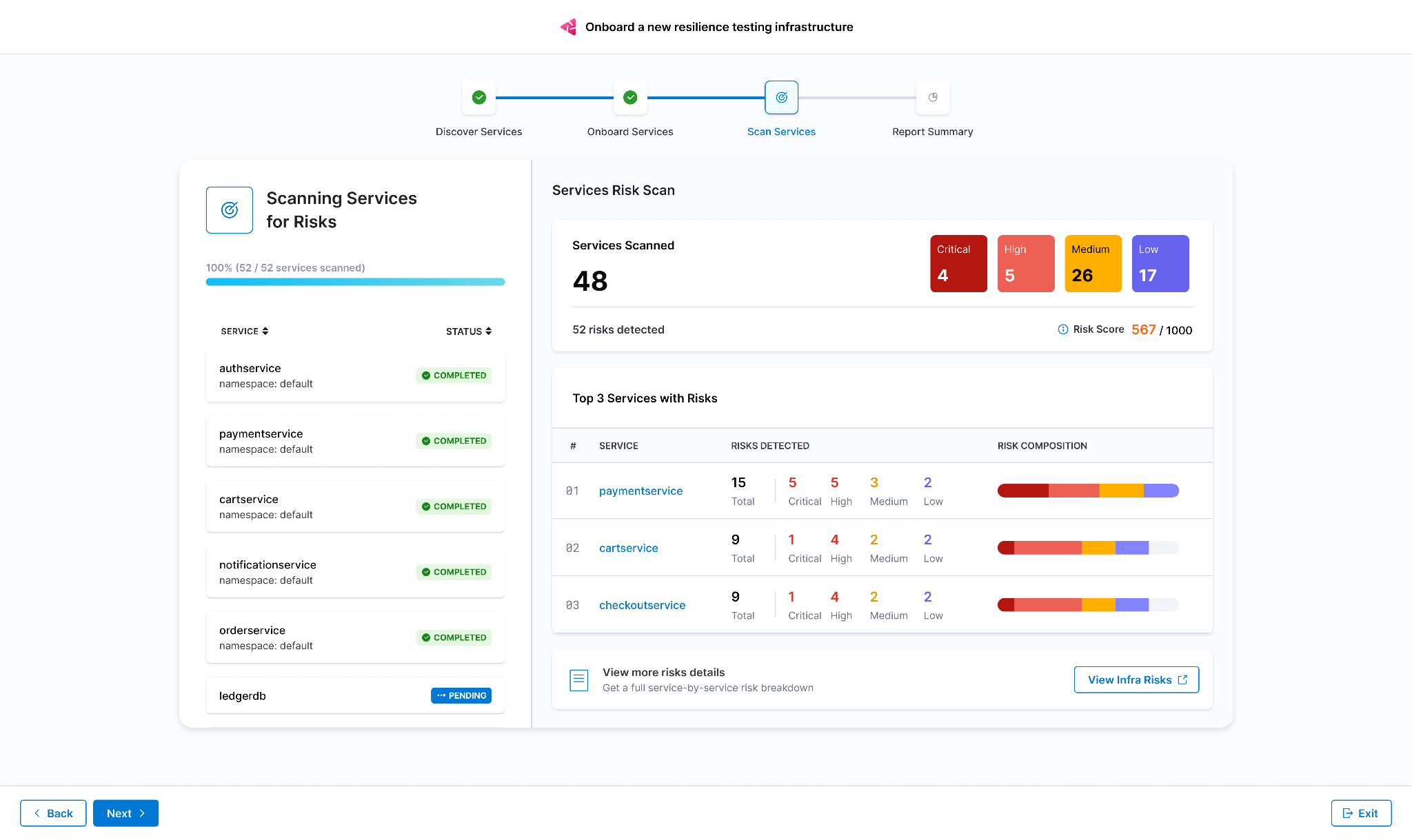
Simplified onboarding for Kubernetes apps
Getting resilience insight into your Kubernetes workloads no longer requires a lengthy chaos experiment or load test setup process. Onboard your applications through a streamlined flow that connects to your existing cluster and infrastructure metadata, and the agents start surfacing the resilience risks specific to your environment right away. No faults injected, nothing touched in production.
In-product dashboards for Resilience Insights
Every risk the agents detect rolls up into dashboards built for tracking resilience posture over time, not just point-in-time results. You get a consolidated view of risk across services and pipelines, so teams and leadership can see whether resilience is trending in the right direction.
Resilience Scores for your Load Tests
Load testing results now come with a Resilience Score: a single, trackable number that reflects how your services hold up under load, beyond raw throughput and latency numbers. It's built to make load test outcomes easier to compare over time and easier to explain to stakeholders who don't work with performance data day to day.
Java, JavaScript, and Python support for Load Test scripting
You can now write Load Test scripts in the language your team already uses. That removes a common barrier to adoption: teams don't need to learn a new scripting language just to write a load test, so load testing fits more naturally into how your engineers already work.
Free Plan: Try It Out
You don't need to take our word for it. Harness offers a free plan for resilience testing, so you can put it to work in your own environment before committing to anything. It includes a hosted experience with the core capabilities you'd expect: an extensive fault library, a centralized control plane, native integration with Harness pipelines, and enterprise features like RBAC and hosted logging, all at no cost. It's a way to validate the resilience of your own services without the limits of a typical trial account.
If you're new to Resilience Testing, this is the easiest way to see what RT Agents find in your own pipelines. Sign up, connect your infrastructure, and let the agents show you where your risk actually is.
FAQ
Does RT AI Agents touch production or inject faults during detection?
No. Detection is passive: the agents read your existing deployment configuration, manifests, and pipeline history. Nothing is instrumented and nothing runs against your services until you choose to generate and run a chaos experiment or load test.
Do I need to set up a chaos experiment or load test before RT Agents can find risk?
No. The agents analyze your CD pipelines and Kubernetes workloads on their own and tell you what kind of test would confirm the risk. You only run a test once you decide to act on what they find.
What's included in the free plan for Resilience Testing?
A hosted experience with the full fault library, a centralized control plane, native Harness pipeline integration, and enterprise features like RBAC and hosted logging, all at no cost.
Which languages can I use to write load test scripts?
Java, JavaScript, and Python, alongside Harness's existing load testing options. Use whichever your team already works in instead of learning a new scripting language.
What is a Resilience Score?
A single, trackable number attached to each load test that reflects how a service holds up under load, beyond raw throughput and latency numbers, so teams can compare results over time and report them to stakeholders.